Logarithm - JEE Advanced Previous Year Questions with Solutions
Logarithm is a high-importance JEE Advanced Mathematics chapter focused on logarithmic identities, inequalities, domain conditions, and multi-concept problem solving, with 1–2 questions appearing consistently every year.
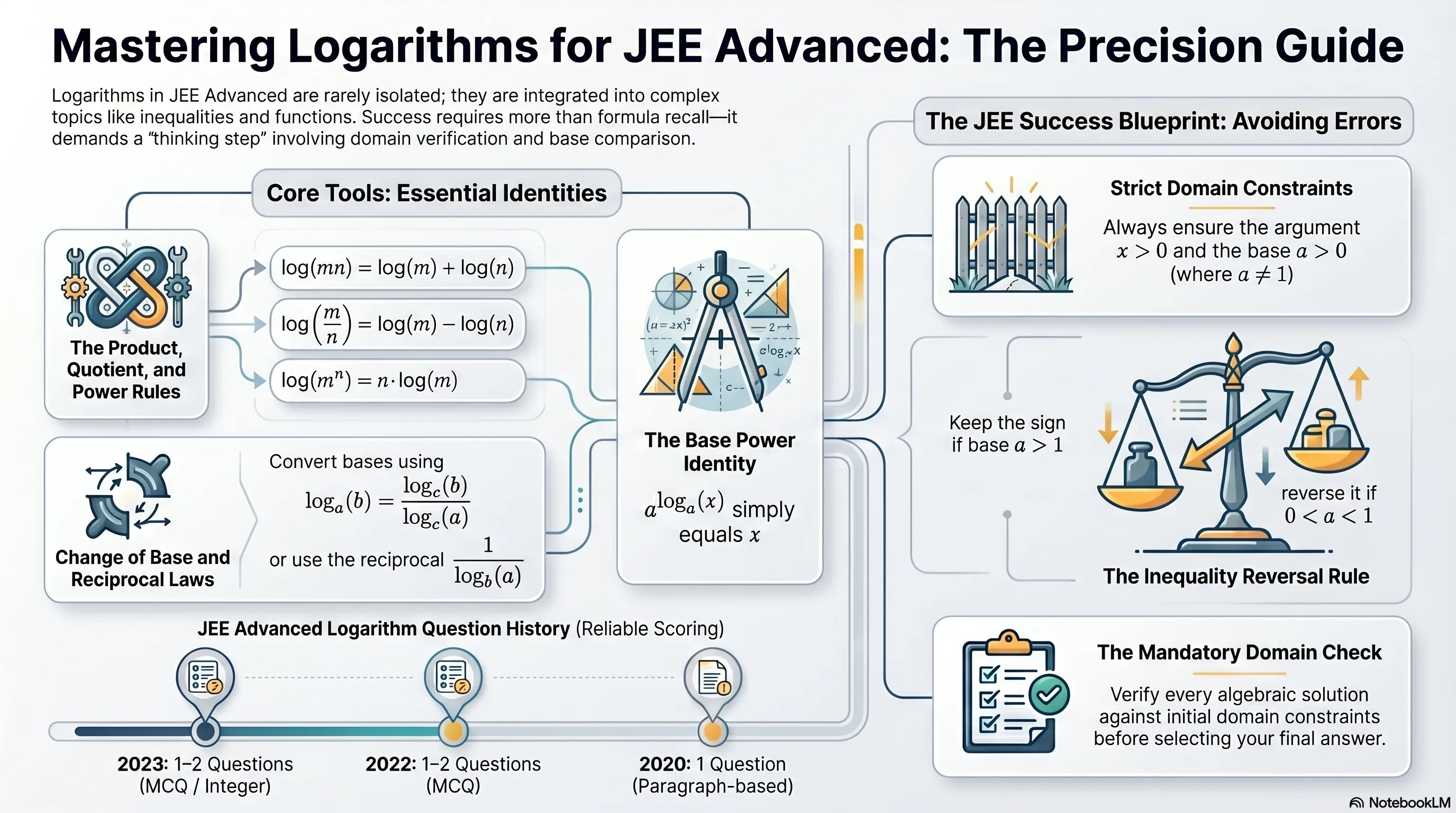
Table of Contents

eSaral › JEE › JEE Main ›Logarithm - JEE Advanced Previous Year Questions with Solutions

Why Logarithm Matters in JEE Advanced
Logarithm is one of the foundational chapters in JEE Advanced Mathematics. It is not an isolated topic — logarithmic manipulation appears directly inside problems from inequalities, functions, sequences, and even complex numbers.
JEE Advanced regularly tests at a level well above what students typically prepare in Class 11. A question may combine log inequalities with domain restrictions, or require simplification across multiple bases simultaneously. Students who treat logarithms as a formula-recall topic — rather than a reasoning topic — consistently lose marks here.
How Often Does a Logarithm Appear in JEE Advanced?
| Year | Questions on Logarithm (direct or combined) | Type |
|---|---|---|
| JEE Advanced 2023 | 1–2 | MCQ / Integer |
| JEE Advanced 2022 | 1–2 | MCQ |
| JEE Advanced 2020 | 1 | Paragraph-based |
| JEE Advanced 2019 | 1–2 | MCQ |
| JEE Advanced 2018 | 1 | Integer type |
Source: JEE Advanced official question papers. The topic appears consistently across years, making it a reliable scoring opportunity.
💡 Expert Tip by Saransh Gupta, IIT Bombay AIR-41: "Logarithm in JEE Advanced is never purely computational. Every log question has a thinking step — either a domain check, a base comparison, or a substitution trick. Students who skip that step lose the question even when their algebra is correct."
Beyond Logarithm - JEE Advanced PYQs (Maths), students can practise complete JEE Advanced papers through the JEE Advanced exam paper collection.
JEE Advanced Previous Year Questions — Logarithm


Key Logarithm Properties You Must Know
Before attempting any JEE Advanced PYQ on logarithms, these properties must be second nature — not just memorised, but understood well enough to apply in reverse or in combination.
The 7 Core Logarithm Identities for JEE Advanced
| # | Property | Formula |
|---|---|---|
| 1 | Product Rule | log_a(mn) = log_a(m) + log_a(n) |
| 2 | Quotient Rule | log_a(m/n) = log_a(m) − log_a(n) |
| 3 | Power Rule | log_a(m^n) = n · log_a(m) |
| 4 | Change of Base | log_a(b) = log_c(b) / log_c(a) |
| 5 | Reciprocal | log_a(b) = 1 / log_b(a) |
| 6 | Identity | log_a(a) = 1 ; log_a(1) = 0 |
| 7 | Base Power | a^(log_a(x)) = x |
Domain Conditions — The #1 Source of Errors
For log_a(x) to be defined:
- x > 0 (argument must be strictly positive)
- a > 0 and a ≠ 1 (base must be positive and not equal to 1)
In JEE Advanced, forgetting to apply domain conditions after solving a log equation is the most common reason for a correct algebraic answer being marked wrong. Always verify your solution satisfies the domain before writing the final answer.
Logarithm Inequalities — Critical Rule
When solving log_a(f(x)) > log_a(g(x)):
- If a > 1: the inequality direction is preserved → f(x) > g(x)
- If 0 < a < 1: the inequality direction is reversed → f(x) < g(x)
This rule reversal is the single most tested concept in JEE Advanced log inequality problems.
Common Mistakes Students Make in Log Questions
Understanding where marks are lost is as valuable as knowing how to solve correctly.
Mistake 1 — Skipping Domain Verification
After solving a log equation and finding x = −3 or x = 0, students often write this as the final answer without checking if it satisfies the domain condition (argument > 0, base ≠ 1). In JEE Advanced, this costs the full mark for the question.
Fix: Always write "Domain check:" as a mandatory final step before boxing your answer.
Mistake 2 — Forgetting Base Comparison in Inequalities
When solving log_a(f) > log_a(g), students drop the inequality direction without checking whether a > 1 or 0 < a < 1. This produces the exact wrong answer — opposite to the correct one.
Fix: Write the base value explicitly before solving any log inequality. Confirm: "a = 0.5, so a < 1, direction reverses."
Mistake 3 — Treating log_a(b) and log_b(a) as Equal
These are reciprocals, not equal values. log₂(8) = 3 but log₈(2) = 1/3.
Fix: Practise change of base until the reciprocal relationship is reflexive, not recalled.
Mistake 4 — Errors in Change of Base During Nested Expressions
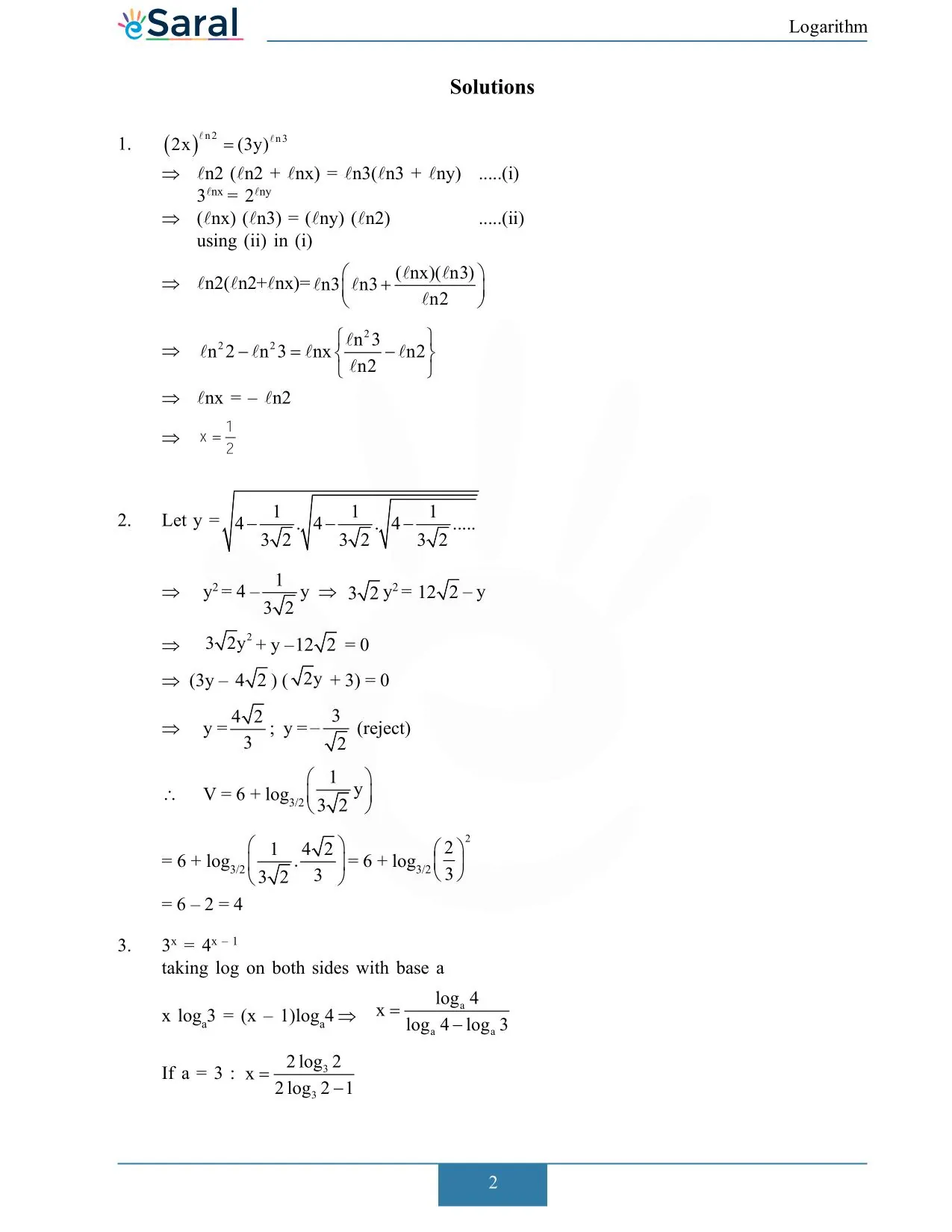
In problems like Question 2 above, students convert bases incorrectly when the expression is nested. Using a consistent target base (always convert to ln or log₂) prevents arithmetic errors.
| Common Error | Correct Approach |
|---|---|
| log_a(b) = log_b(a) | log_a(b) = 1/log_b(a) |
| Solving without domain check | Always verify argument > 0 after solving |
| Keeping inequality direction when base < 1 | Reverse direction when 0 < base < 1 |
| Random base changes mid-solution | Pick one target base and convert everything |
How to Approach Logarithm Questions in JEE Advanced
Step-by-Step Method for Any Log Problem
- Identify the question type — Is it an equation, inequality, simplification, or nested expression?
- State domain conditions upfront — Write constraints before solving, not after.
- Choose a consistent base — Convert all logs to a single base (usually ln or log base 2) to avoid errors.
- Apply the relevant identity — From the 7 properties listed above, pick the one that simplifies the expression.
- Solve algebraically — Use substitution (let log_a(x) = t) for cleaner working.
- Verify against domain — Cross-check every solution against the domain constraints from Step 2.
How Much Time to Spend on a Log Question in JEE Advanced?
| Difficulty Level | Expected Time | Strategy |
|---|---|---|
| Single-step simplification | 1–2 minutes | Direct property application |
| Multi-step equation | 3–4 minutes | Substitution + change of base |
| Nested radical + log | 5–7 minutes | Name the nested part, form equation |
| Log inequality | 3–5 minutes | Domain + direction rule carefully |
If a log question is taking longer than 7 minutes in the exam, mark it and move on. Return to it after completing other questions — do not let one question consume time from the rest of the paper.
What Level of Difficulty Does JEE Advanced Set for Logarithm?
Logarithm in JEE Advanced is typically at the moderate-to-hard level. Questions rarely test only one property. A typical Advanced log question combines:
- Change of base with an inequality
- A domain restriction that eliminates one solution
- Or a substitution that converts a log equation into a quadratic
Practising only JEE Main-level log questions is insufficient preparation. You need JEE Advanced PYQs and module-level problems where the answer is not immediately obvious.
For structured practice with Advanced-difficulty logarithm exercises and faculty-guided solutions, eSaral's JEE course modules include topic-wise question banks specifically built to this standard.
Frequently Asked Questions
Find answers to common questions.
How many logarithm questions appear in JEE Advanced each year?
JEE Advanced typically includes 1 to 2 questions directly or indirectly involving logarithm each year. The topic also appears embedded in inequalities, functions, and sequences problems. Across a 5-year window, logarithm contributes consistently to the Maths paper, making it a reliable scoring chapter if prepared at depth.
Which logarithm properties are most tested in JEE Advanced?
The change of base rule, log inequality direction (especially when base is between 0 and 1), and domain conditions are the most tested concepts. Questions combining a nested expression with a log equation also appear regularly. These three areas should receive the most focused practice.
What is the most common mistake in JEE Advanced logarithm questions?
Skipping domain verification after solving. Students find a value of x that satisfies the algebraic equation but fail to check whether that x satisfies the original domain condition (argument > 0, base ≠ 1). In JEE Advanced, this is an automatic wrong answer even when all algebra is correct.
How to solve logarithm questions quickly in JEE Advanced?
The fastest approach is to first convert all logs to a single consistent base, apply substitution (let log_a(x) = t) to reduce the expression to a standard equation form, solve for t, then back-substitute for x. Always budget 30 seconds at the end to verify domain. This process handles 90% of JEE Advanced log questions reliably.
Is logarithm important for JEE Advanced or only for JEE Main?
Logarithm is important for both, but the level of difficulty differs significantly. JEE Main tests direct application of properties. JEE Advanced tests combinations — log inequalities with domain conditions, nested expressions, multi-base equations. Students preparing only for JEE Main level will find JEE Advanced log questions substantially harder without dedicated Advanced-level practice.