Mind Maps of Current Electricity Revision - Class 12, JEE, NEET
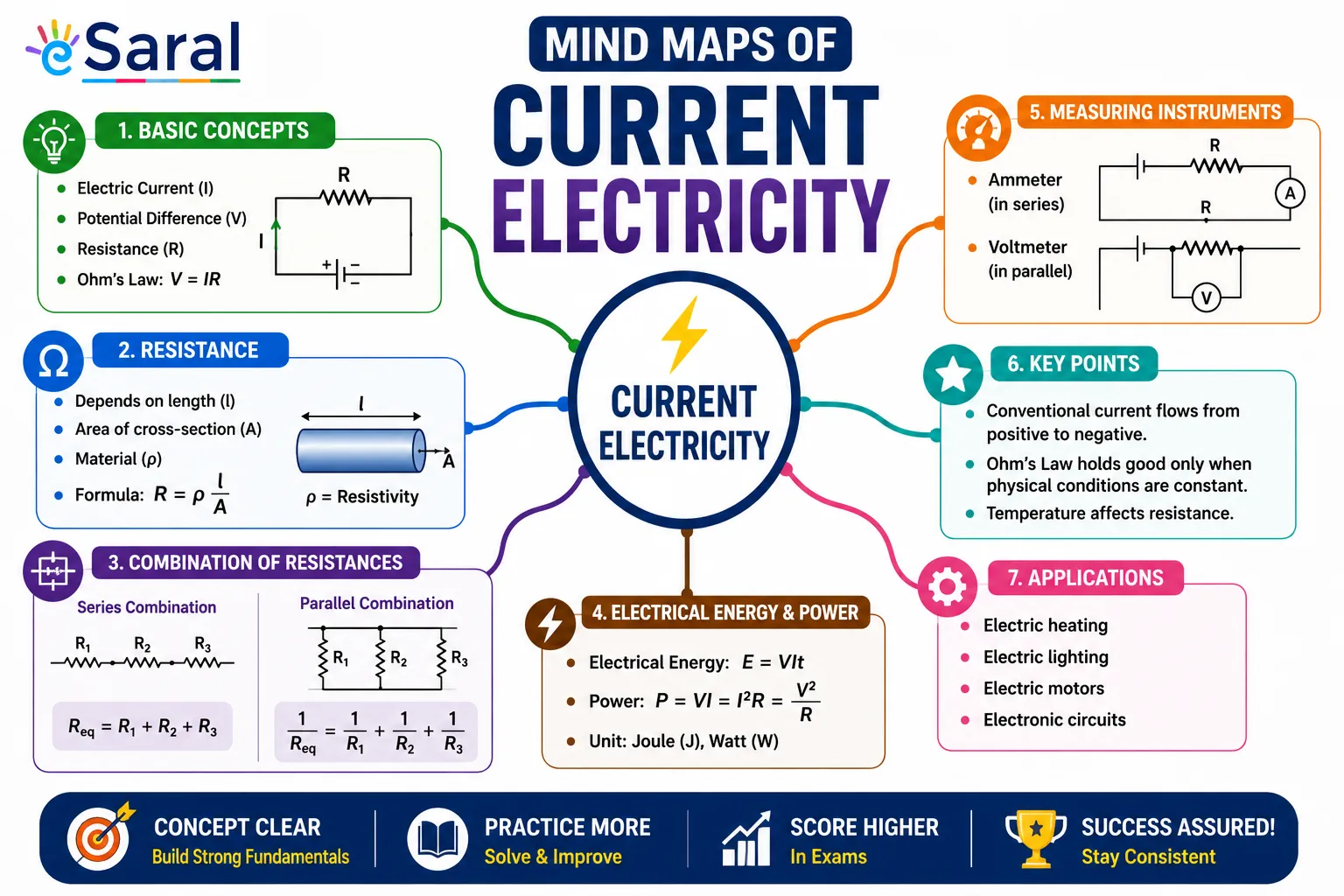
Table of Contents
- Current Electricity Mind Map for JEE Main, NEET & CBSE Class 12
- What Does the Current Electricity Mind Map Cover?
- Key Formulas– Quick Reference Table
- How to Use This Mind Map for Last-Minute Revision
- Topic-Wise Weightage: JEE Main vs NEET
- Common Mistakes Students Make in Current Electricity
- Download the Current Electricity Mind Map PDF

eSaral > Class 12 Physics > Current Electricity

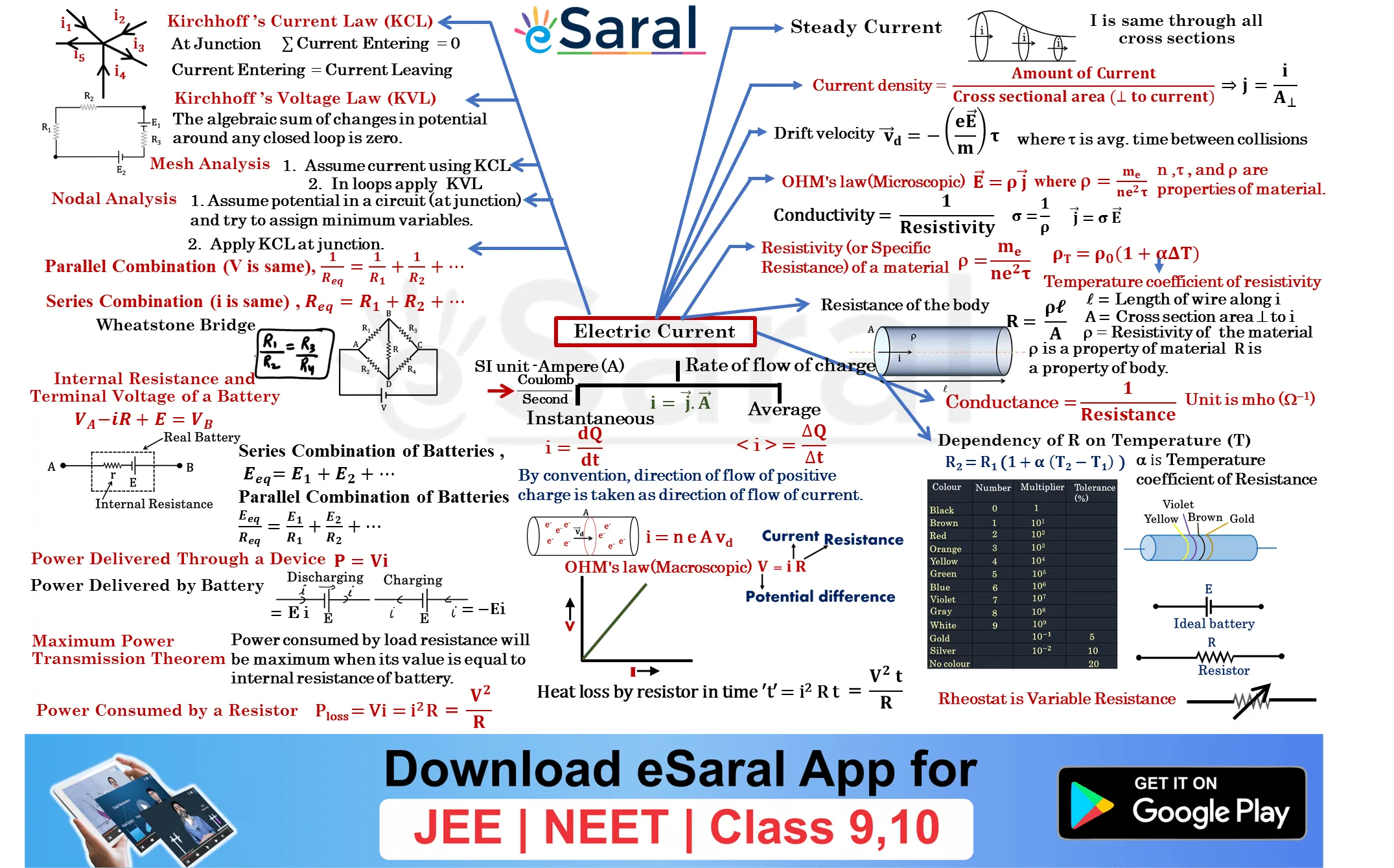
Current Electricity comprises a variety of cases with important formulae and key points. So here is the mind map to help you remember all the formulae and important key concepts at your fingertips.
India's Best Exam Preparation for Class 12th - Download Now
India's Best Exam Preparation for Class 12th - Download Now
Current Electricity Mind Map for JEE Main, NEET & CBSE Class 12
Current Electricity consistently appears in every JEE Main paper released by NTA and in every NEET Physics section. According to NTA's official question paper archives, this chapter contributes 2–3 questions in JEE Main and 2 questions in NEET almost every year — making it one of the highest return-on-time-investment chapters in Class 12 Physics.
The chapter also has direct overlaps with the Class 12 CBSE board exam, meaning students who master it once benefit across three high-stakes assessments simultaneously.
The challenge most students face is not understanding the concepts in isolation — it is keeping all formulas, conditions, and exceptions connected in memory under exam pressure. That is exactly the gap a well-structured mind map solves.
Students who joined eSaral's JEE Dropper batch have reported that visual revision tools like these mind maps helped them consolidate an entire chapter in under 20 minutes before mock tests — a strategy taught directly by our IIT Bombay faculty.
For deeper conceptual grounding, pair these mind maps with the NCERT Solutions for Class 12 Physics, which walk through every derivation step by step.
What Does the Current Electricity Mind Map Cover?
Core Concepts Mapped Visually
The Current Electricity mind map covers every sub-topic prescribed in the Class 12 Physics syllabus (CBSE + NTA JEE + NEET):
- Electric current and drift velocity — definition, formula, and the link between microscopic motion and macroscopic current
- Ohm's Law — V = IR, its validity and limitations
- Resistance and Resistivity — R = ρL/A, temperature dependence (R = R₀(1 + αΔT))
- Colour code for resistors — the mnemonic and band reading rules
- Combinations of resistors — series, parallel, and mixed networks
- Kirchhoff's Laws — KCL (junction rule) and KVL (loop rule) with sign conventions
- EMF, terminal voltage, and internal resistance — V = E − Ir
- Cells in series and parallel — equivalent EMF and internal resistance
- Wheatstone bridge — balance condition P/Q = R/S
- Meter bridge — working principle and formula
- Potentiometer — comparison of EMFs, measurement of internal resistance
- Electrical energy and power — P = VI = I²R = V²/R
Why Visual Mapping Works
Research in cognitive science confirms that the spatial organisation of information (as in mind maps) reduces cognitive load and improves recall speed. For formula-heavy chapters like Current Electricity, seeing the logical tree — from Ohm's Law branching to resistivity, then to temperature dependence — creates memory anchors that a linear list cannot replicate.
When using a mind map for revision, do not just read it — cover each branch and try to recall the formula from the central node outward. This active recall technique is the same method top JEE rankers use before their final exam day.
Key Formulas– Quick Reference Table
| Concept | Formula | Quantity | SI Unit |
|---|---|---|---|
| Electric Current | I = Q/t | Charge per unit time | Ampere (A) |
| Drift Velocity | vd = I / (nAe) | Avg. electron speed | m/s |
| Ohm's Law | V = IR | Voltage–current relation | — |
| Resistance | R = ρL/A | Geometric resistance | Ohm (Ω) |
| Temp. Dependence | R = R₀(1 + αΔT) | Resistance at temp. T | Ω |
| Series Combination | Req = R₁ + R₂ + … | Equivalent resistance | Ω |
| Parallel Combination | 1/Req = 1/R₁ + 1/R₂ + … | Equivalent resistance | Ω |
| Terminal Voltage | V = E − Ir | EMF minus voltage drop | Volt (V) |
| Wheatstone Balance | P/Q = R/S | No current through the galvanometer | — |
| Electric Power | P = VI = I²R = V²/R | Rate of energy dissipation | Watt (W) |
| Potentiometer EMF | E₁/E₂ = l₁/l₂ | EMF ratio by length | — |
How to Use This Mind Map for Last-Minute Revision
The 20-Minute Revision Protocol
Last-minute revision is most effective when it is structured, not random. Here is the exact protocol recommended by eSaral's Kota-trained faculty:
- Minutes 0–5: Scan the full mind map once without stopping. Let your brain build a skeleton.
- Minutes 5–12: Go branch by branch. For each formula, write it on a rough sheet from memory, then verify.
- Minutes 12–17: Focus only on the branches you got wrong. Re-read, rewrite once.
- Minutes 17–20: Close the map. Write the 5 most important formulas from memory. If you can do this, you are revision-ready.
Combining Mind Maps with NCERT
Mind maps are revision tools, not learning tools. Before using them, ensure you have worked through the NCERT textbook thoroughly. You can access fully solved NCERT Solutions for Class 12 Physics to build the conceptual base first, then use the mind map to lock in formulas before your exam.
Topic-Wise Weightage: JEE Main vs NEET
What is the weightage of Current Electricity in JEE and NEET?
Current Electricity carries approximately 8–12% of the Physics section in JEE Main across recent years, and around 6–8% in NEET Physics. Below is a topic-level breakdown to help you prioritise.
| Sub-Topic | JEE Main Importance | NEET Importance |
|---|---|---|
| Ohm's Law & Resistivity | High | High |
| Kirchhoff's Laws (KCL, KVL) | Very High | Medium |
| Cells, EMF, Internal Resistance | High | High |
| Wheatstone Bridge | Very High | High |
| Meter Bridge | Medium | Medium |
| Potentiometer | High | Medium |
| Power & Energy | Medium | High |
| Colour Code (Resistors) | Low | Medium |
In JEE Main, Kirchhoff's Laws combined with Wheatstone bridge problems account for nearly half the Current Electricity questions. Solve at least 30 circuit problems of mixed types before your exam. Speed and accuracy on these problems is what separates 99-percentile scorers from 95-percentile scorers.
Common Mistakes Students Make in Current Electricity
Sign Convention Errors in KVL
The most frequent error in Kirchhoff's Voltage Law problems is an inconsistent sign convention. Always define your loop direction before starting, and stick to it throughout. A voltage rise is positive; a voltage drop is negative, regardless of which direction current flows inside a battery.
Confusing Terminal Voltage with EMF
EMF (E) is the energy supplied per unit charge by the source. Terminal voltage (V) is always less than EMF when current flows through the cell because of internal resistance: V = E − Ir. Many students use E and V interchangeably in calculations, which leads to systematic errors in potentiometer and cell problems.
Misapplying the Parallel Resistance Formula
For exactly two resistors in parallel, Req = (R₁ × R₂) / (R₁ + R₂). For three or more, you must use the reciprocal formula. Applying the two-resistor shortcut to three resistors is one of the most common calculation errors in board and entrance exams.
For a structured approach to solving these types of problems, refer to the NCERT Books for Class 12 — the NCERT exercises on Current Electricity are directly aligned with both JEE Main and NEET question patterns.
Download the Current Electricity Mind Map PDF
The mind map PDF below covers all sub-topics listed in Section 2. It is formatted for A4 printing and mobile screen reading.
[⬇ Download Current Electricity Mind Map PDF]
The mind map is part of eSaral's full Physics Mind Map Series — created by IIT Bombay faculty with verified All India Ranks. Each map in the series has been used by thousands of students in eSaral's JEE and NEET batches, including students who went on to crack JEE Advanced with ranks inside the top 500.
You may also find it useful to download the NCERT Class 12 Physics Book to keep the standard textbook reference alongside your mind map revision.
Frequently Asked Questions
Find answers to common questions.
Is Current Electricity important for NEET Physics?
Yes, Current Electricity is important for NEET. It typically contributes 1 to 2 questions in the NEET Physics section each year. NEET tends to focus more on conceptual applications — such as comparing EMFs using a potentiometer or finding equivalent resistance — rather than multi-loop circuit analysis. Both formula recall and conceptual understanding are tested
How many questions come from Current Electricity in JEE Main?
JEE Main typically includes 2 to 3 questions from Current Electricity per paper, based on NTA's question papers from 2019 to 2024. The most frequently tested areas are Kirchhoff's Laws, Wheatstone bridge circuits, and potentiometer-based problems. Consistent practice on these three areas alone gives a strong probability of scoring full marks on this chapter.
What topics are covered in the Current Electricity mind map for Class 12?
The mind map covers all major topics: electric current, drift velocity, Ohm's Law, resistance and resistivity, temperature dependence of resistance, colour coding, series and parallel combinations, Kirchhoff's Laws, EMF and internal resistance, cells in series/parallel, Wheatstone bridge, meter bridge, potentiometer, and electrical power. Every formula prescribed in the CBSE Class 12 and NTA JEE syllabus is included.
Where can I find NCERT solutions for Current Electricity Class 12?
You can access fully solved NCERT solutions for Current Electricity and all other Class 12 Physics chapters on eSaral's NCERT Solutions page. The solutions include step-by-step derivations aligned with both CBSE board and NTA JEE marking schemes. Visit NCERT Solutions for Class 12 Physics to access them for free
What is the difference between EMF and terminal voltage?
EMF (electromotive force, E) is the total energy supplied per coulomb of charge by a cell, measured in an open circuit. Terminal voltage (V) is the potential difference across the cell's terminals when current flows, and it equals E − Ir, where r is internal resistance and I is current. Terminal voltage is always lower than EMF during discharge.
Can I revise the entire Current Electricity chapter in one day using a mind map?
A mind map is a revision tool, not a first-time learning tool. If you have already studied the chapter, one focused session of 2 to 3 hours using the mind map alongside NCERT solutions is sufficient for a strong revision. Use the 20-minute active recall protocol in Section 4 of this article for the most efficient approach.