Mind Maps for Kinematics 1D Revision - Class XI, JEE, NEET
Revise Class 11 Kinematics 1D quickly with concise mind maps covering essential formulas, motion concepts, and key points for efficient exam preparation.
.webp)

eSaral › Class 11› Mind Maps for Kinematics 1D Revision

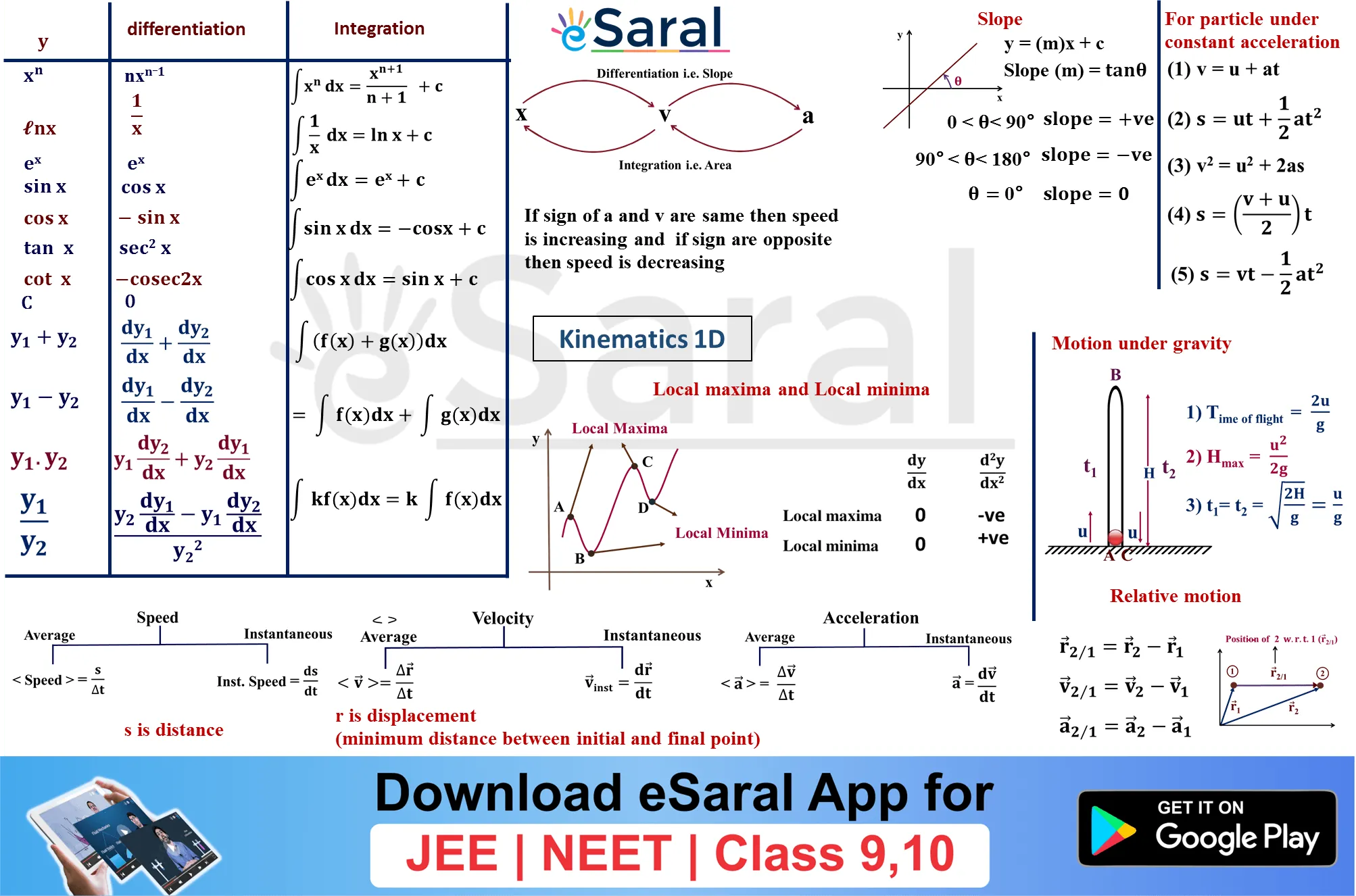
Kinematics 1D Chapter in Class 11 comprises variety of cases with important formulae and key points. So here are the mind maps to help you in remembering all the formulas and important key concepts on finger tips.
India's Best Exam Preparation for Class 11th - Download Now
India's Best Exam Preparation for Class 11th - Download Now
Frequently Asked Questions
Find answers to common questions.
What is Kinematics 1D in Class 11 Physics?
Kinematics 1D, officially called "Motion in a Straight Line," is Chapter 3 of the Class 11 NCERT Physics syllabus. It studies how objects move along a single axis — covering displacement, velocity, acceleration, equations of motion, and graphical analysis. It is a foundational chapter for both JEE Main and NEET, as per the NTA syllabus.
How many formulas are there in Kinematics 1D?
There are approximately 12–15 core formulas in Kinematics 1D. The three equations of motion are the most important. Additional formulas cover distance in the nth second, relative velocity, maximum height in free fall, time of flight, and relations between average velocity and instantaneous velocity. The mind map on this page organises all of them by sub-topic.
Can I revise Kinematics 1D in one day using a mind map?
Yes, one day is enough for revision — not for first learning — if you already have basic familiarity with the chapter. Use the mind map for a 30-minute active recall session: read, hide, reproduce from memory, then solve 8–10 targeted questions. This method is practised in eSaral's Kota-quality online batches and is effective one day before a JEE mock test.
Which graphs are most important in Kinematics 1D for JEE and NEET?
The three most important graphs are: (1) displacement-time (s-t) graph — slope gives velocity; (2) velocity-time (v-t) graph — slope gives acceleration, area gives displacement; (3) acceleration-time (a-t) graph — area gives change in velocity. JEE Main regularly asks students to interpret unusual or piecewise graph shapes. These are covered in the dedicated graphical analysis section of the mind map.