Mind Maps for SHM (Simple Harmonic Motion) Revision - Class 11, JEE, NEET
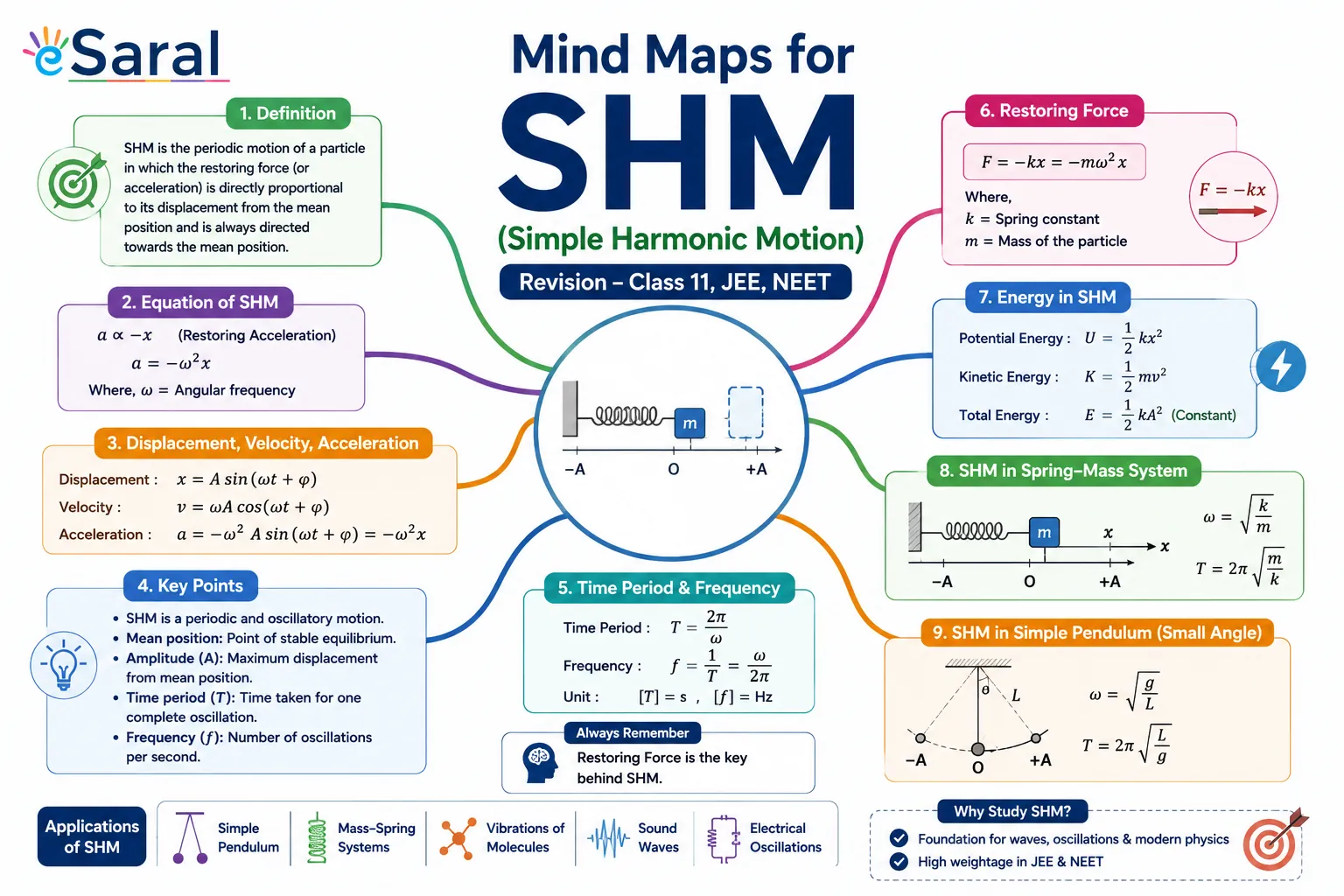
Table of Contents

Home >Mind Maps> SHM Mind Map for Class 11, JEE & NEET

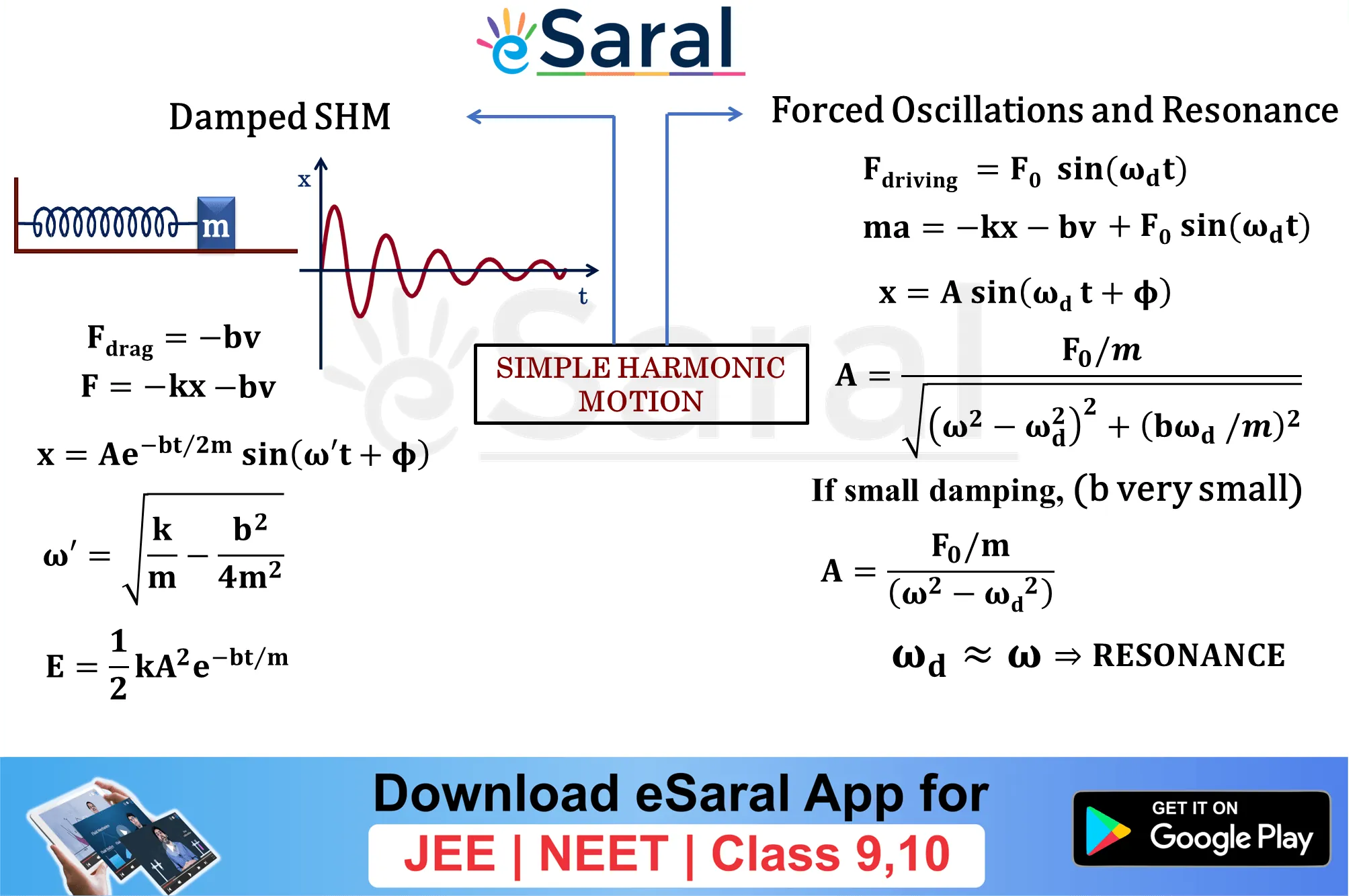
Simple Harmonic motion in Class 11th comprises variety of cases with important formulae and key points. So here is the mind map to help you in remembering all the formulae and important key concepts on finger tips.
India's Best Exam Preparation for Class 11th - Download Now
MIND MAP 1
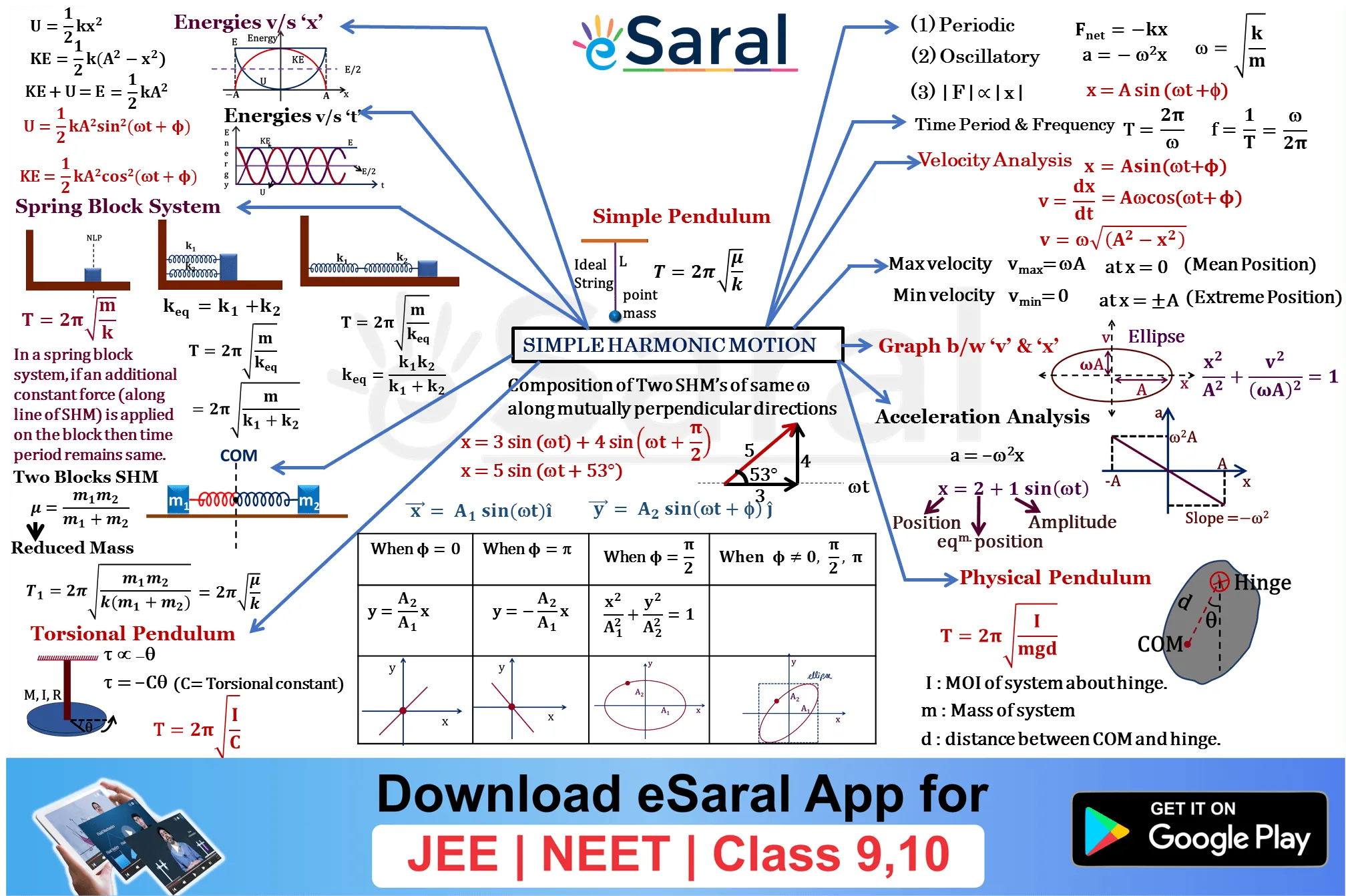
MIND MAP 2
Frequently Asked Questions
Find answers to common questions.
What is the difference between SHM and oscillatory motion?
All SHM is oscillatory, but not all oscillatory motion is SHM. Oscillatory motion simply means back-and-forth movement. SHM is a special case where the restoring force is strictly proportional to displacement (F = −kx). A swinging pendulum at small angles approximates SHM; at large angles it does not.
How many formulas are there in SHM for Class 11?
There are roughly 15–20 core formulas in SHM for Class 11, covering displacement, velocity, acceleration, time period (spring and pendulum), kinetic energy, potential energy, total energy, and spring combinations. The two mind maps on this page organise all of them into two visual sheets so nothing is missed during revision.
Is SHM important for JEE Main 2025?
Yes, SHM is consistently important for JEE Main. NTA typically includes 1–2 questions on Oscillations in every JEE Main session, often testing time period of spring-mass systems, energy graphs, or pendulum in non-inertial frames. Based on past papers, this chapter alone can contribute 8–16 marks across both sessions in a year.
Where can I find solved SHM problems for JEE practice?
Solved SHM problems are available in the NCERT textbook (Chapter 14 – Oscillations) and its solutions. You can access fully worked-out NCERT Solutions for Class 11 Physics on eSaral, which cover every exercise question with step-by-step explanations written by IIT-faculty. For additional practice, eSaral's question bank includes topic-wise SHM sets graded by difficulty.
What is the time period formula for a spring-mass system?
The time period for a spring-mass system is T = 2π√(m/k), where m is the mass attached to the spring (in kg) and k is the spring constant (in N/m). This formula holds for both horizontal and vertical orientations because the effect of gravity cancels out in the vertical case when measured from the new equilibrium position.
Can I use these SHM mind maps for NEET revision?
Yes. The SHM formulas and concepts covered in these mind maps are identical for NEET Physics. The NEET syllabus follows NCERT Class 11 Chapter 14 (Oscillations) directly. Focus on spring-mass systems, simple pendulum, and energy graphs — these are the highest-frequency NEET SHM question types