Mind Maps for Rotational Motion Revision - Class XI, JEE, NEET
Download concise Rotational Motion mind maps for Class 11 covering Moment of Inertia, Torque, Angular Momentum, and CRTM to quickly revise formulas, concepts, and problem-solving techniques.

eSaral › Class 11› Mind Maps for Rotational Motion Revision

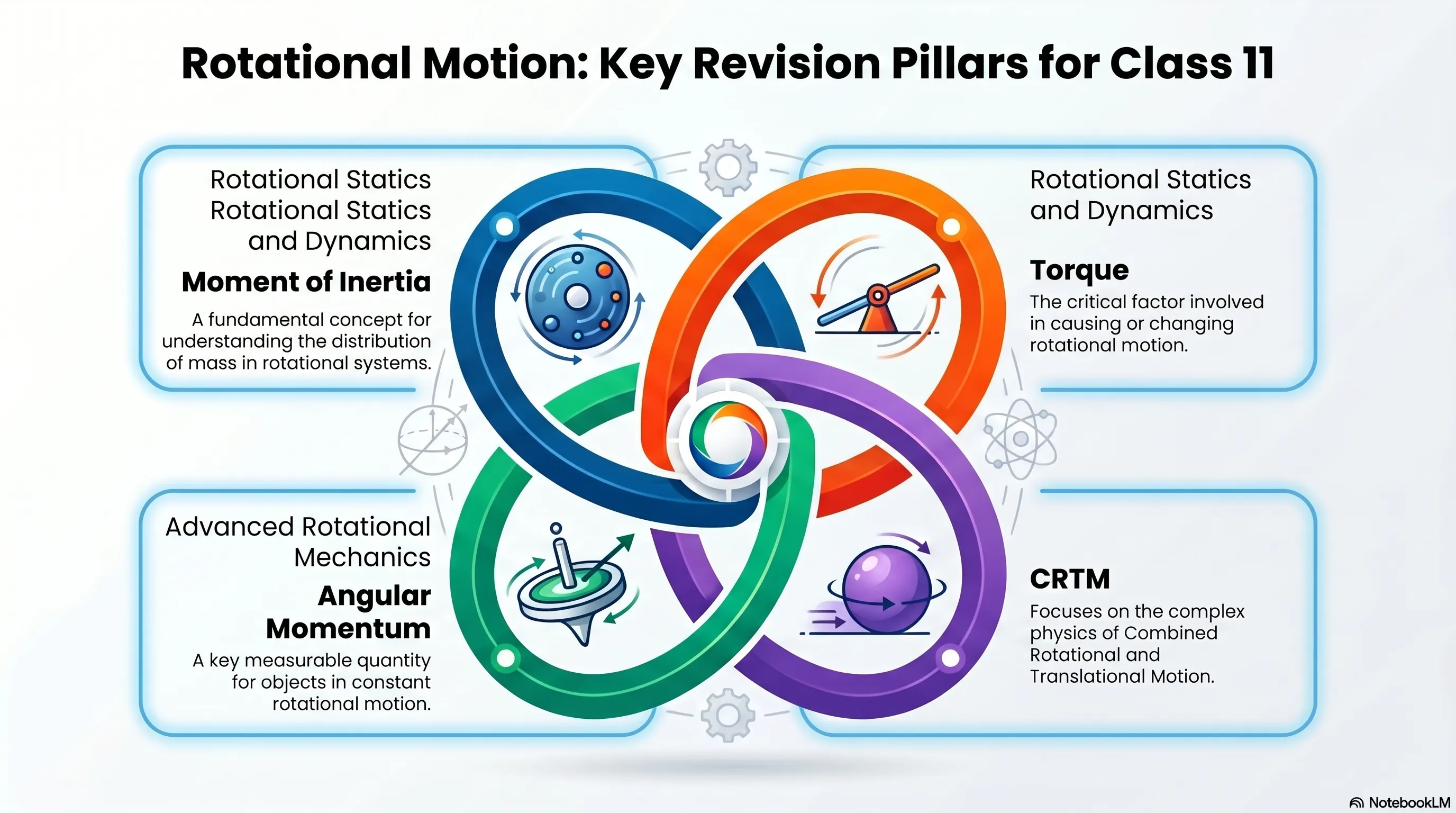
Rotational Motion Class 11 comprises variety of cases with important formulae and key points. So here is the mind maps to help you in remembering all the key formulae and important concepts on finger tips.
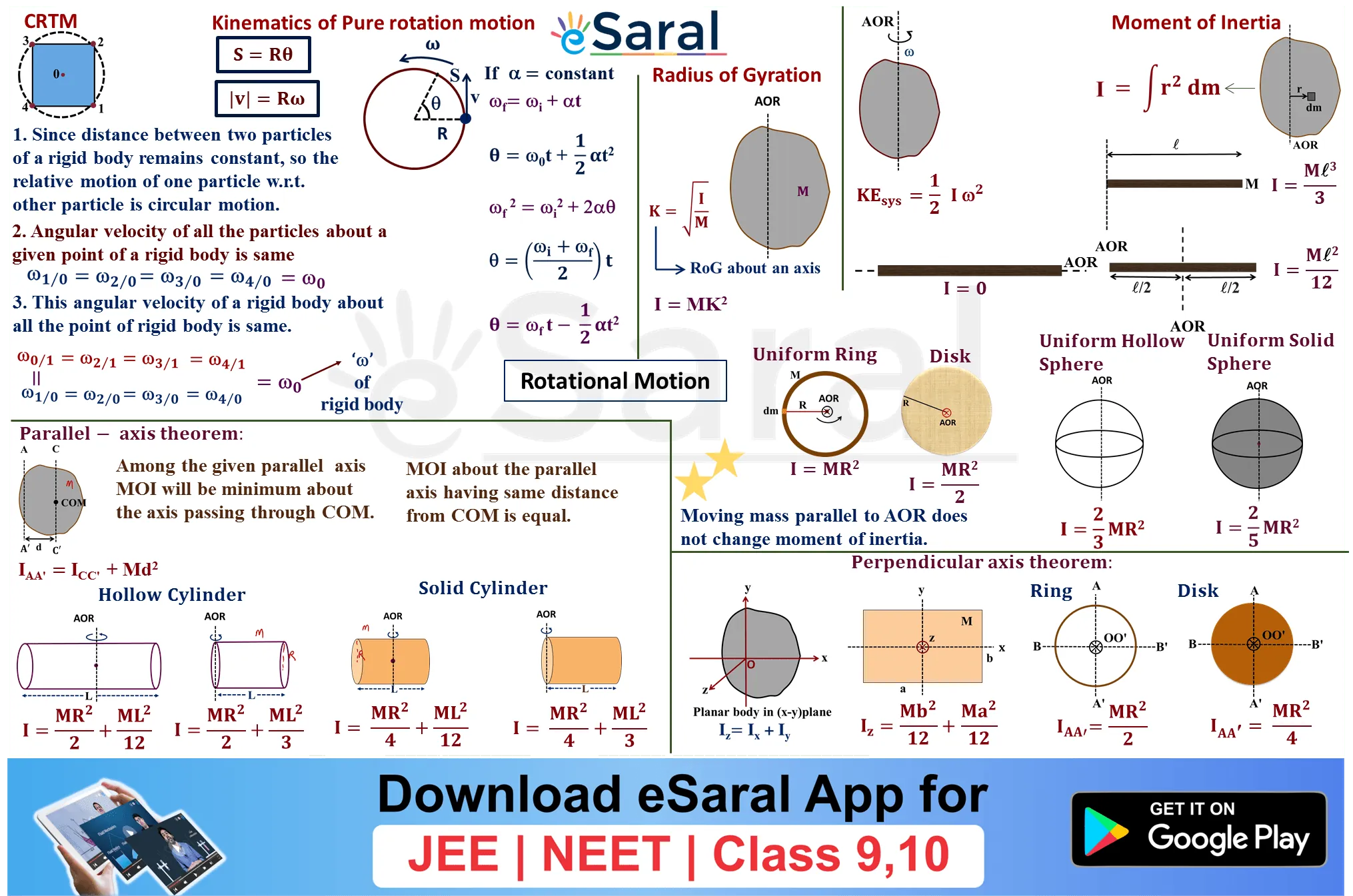
- Rotational Motion: Moment of Inertia
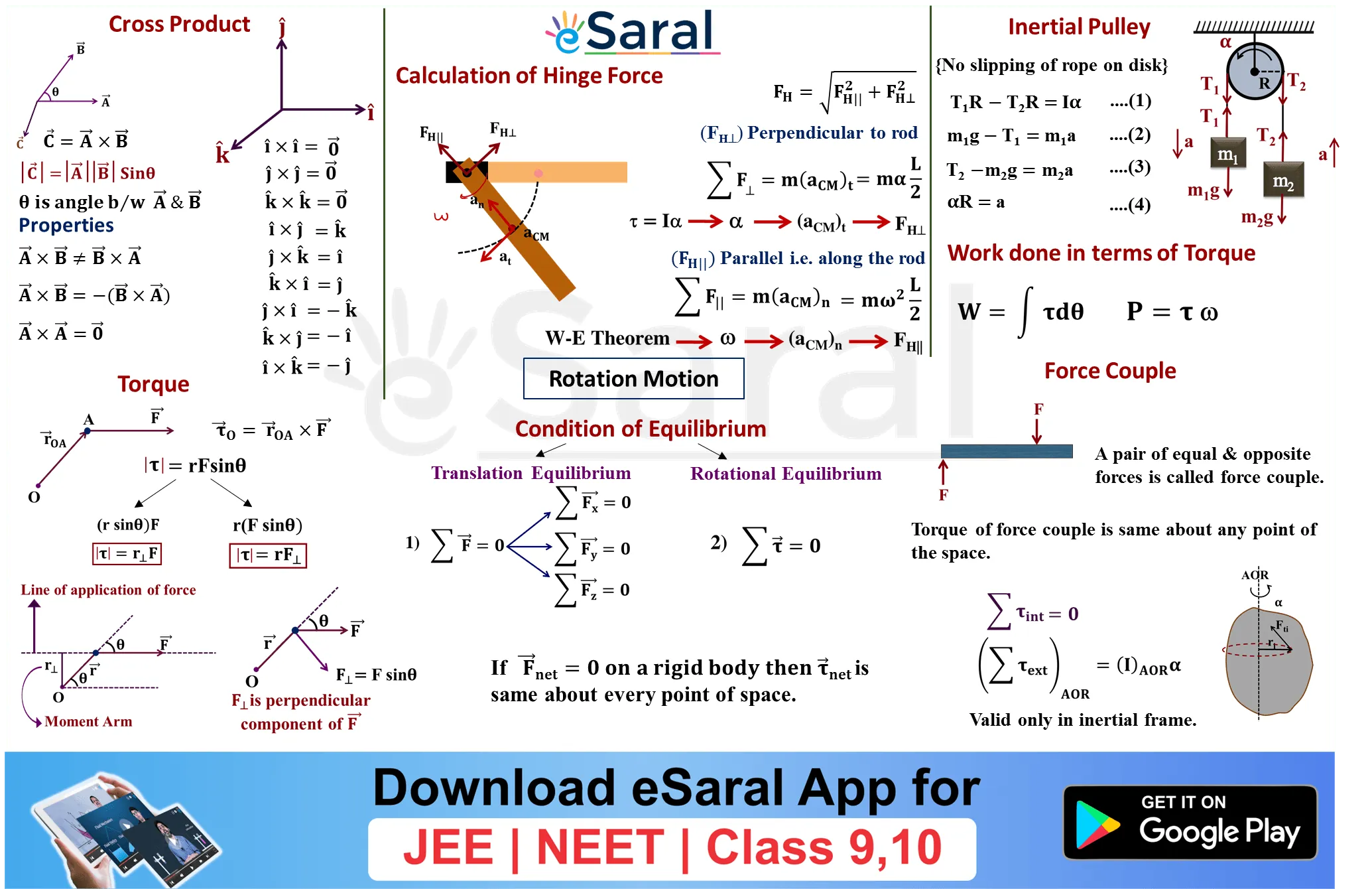
- Rotational Motion: Torque
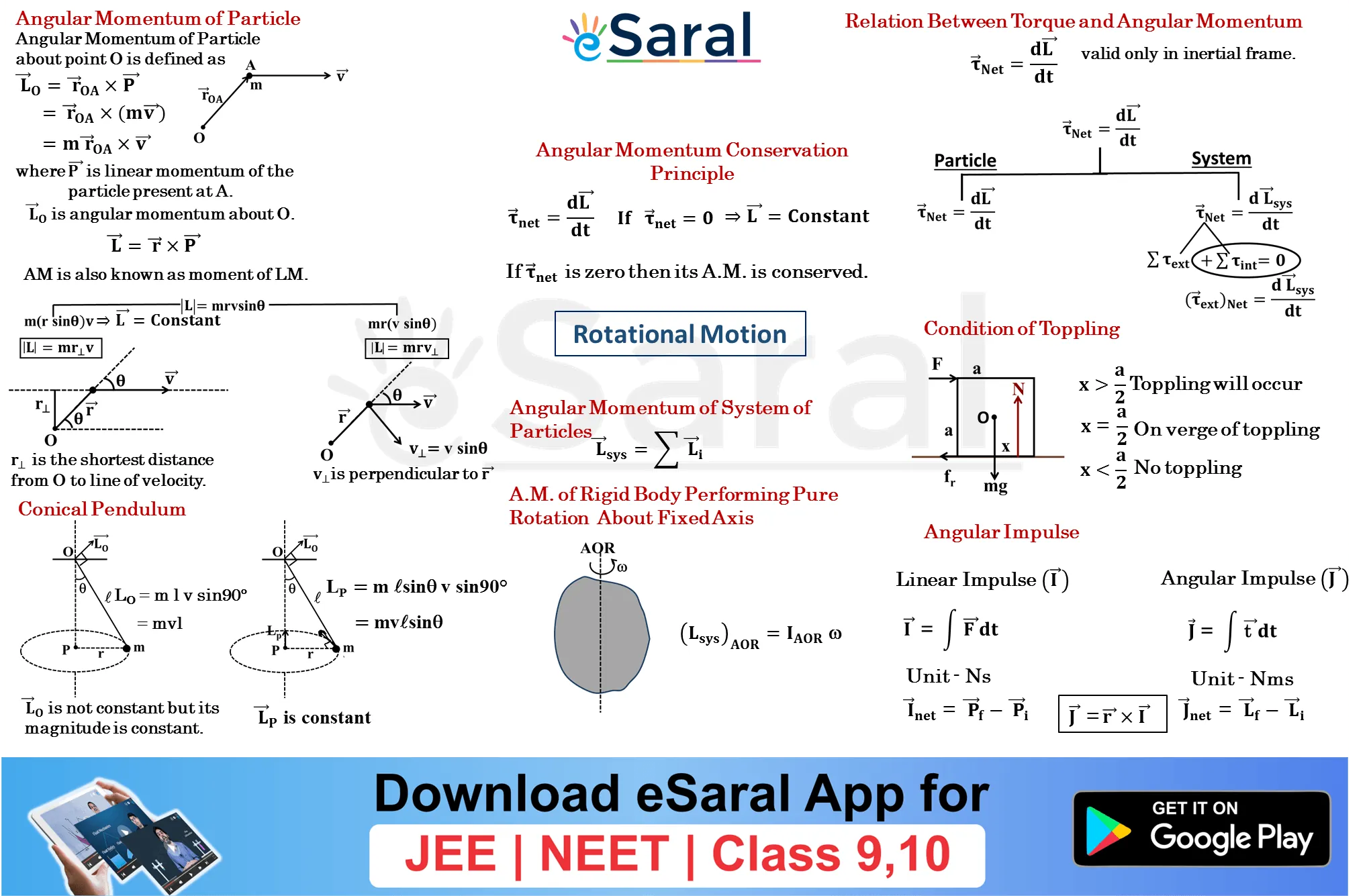
- Rotational Motion: Angular Momentum
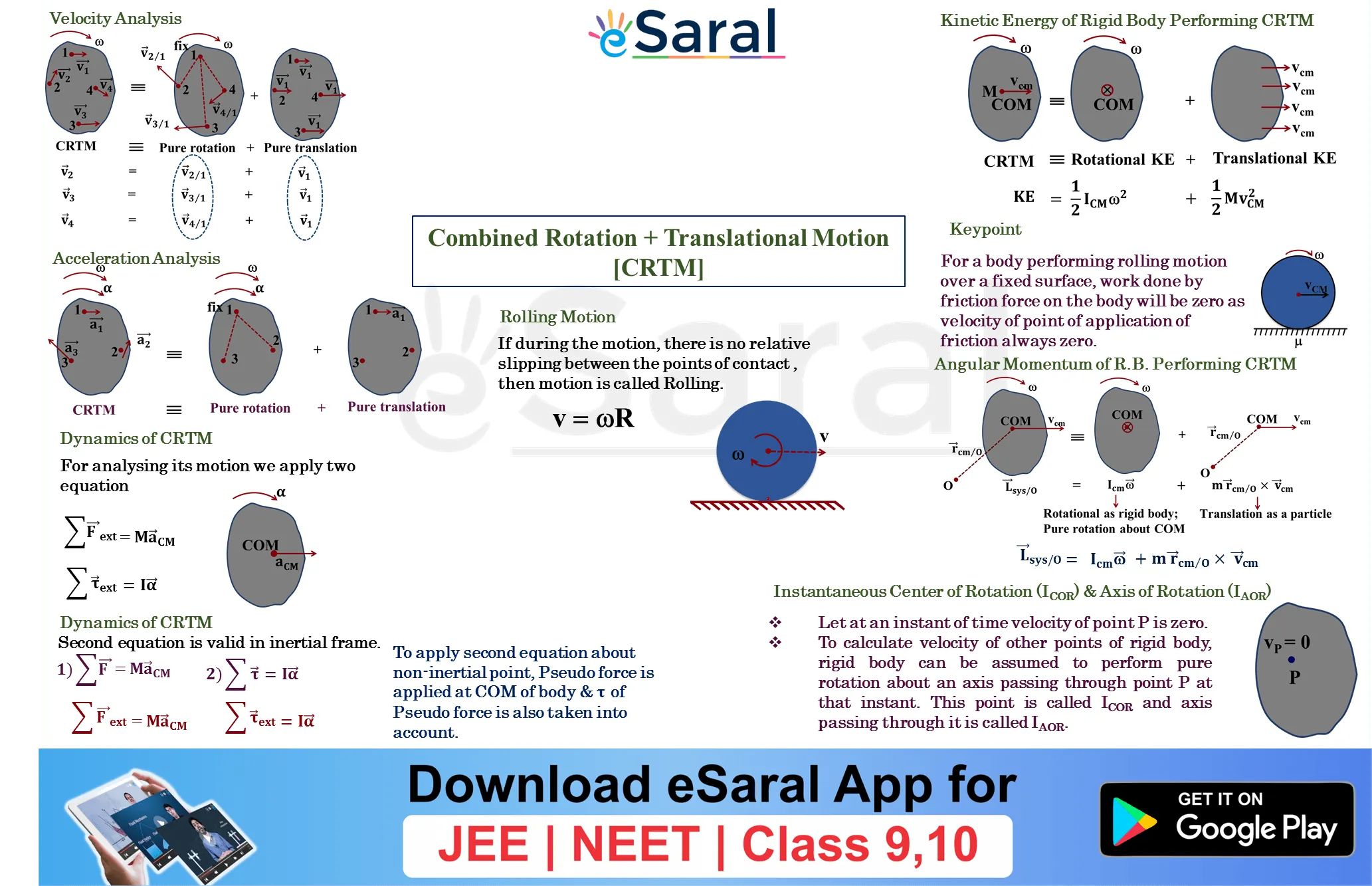
- Rotational Motion: CRTM
Mind Map for Moment of Inertia
Mind Map for Torque
Mind Maps for Angular Momentum
Mind Map for Rotational Motion CRTM
Frequently Asked Questions
Find answers to common questions.
What topics are covered in the Rotational Motion mind maps?
The four mind maps cover Moment of Inertia (standard bodies and axis theorems), Torque (scalar, vector, and equilibrium), Angular Momentum (L = Iω, L = mvr, and conservation), and CRTM (rolling without slipping, kinetic energy, and incline problems). Together they cover every sub-topic tested in JEE Main, JEE Advanced, and NEET from this chapter.
How many questions come from Rotational Motion in JEE Main?
JEE Main consistently includes 2 to 3 questions from Systems of Particles and Rotational Motion per session, as confirmed by NTA's official paper archives. This makes it one of the highest-return chapters in Physics for marks per hour of revision time.
Is CRTM important for NEET or only for JEE?
CRTM (rolling motion) appears occasionally in NEET but carries low direct weightage. NEET students should focus primarily on Torque, Equilibrium, and Angular Momentum Conservation. JEE students — especially those targeting JEE Advanced — must master CRTM fully, as multi-step rolling problems are a regular feature.
Can I use these mind maps as my only revision tool?
Mind maps work best as a retrieval aid, not a learning tool. Use them after you have studied the chapter through video lectures, NCERT solutions, and solved examples. Attempting to learn from the mind maps without prior study leads to surface-level memorisation that breaks down on multi-step JEE problems
What is the difference between the Parallel Axis Theorem and the Perpendicular Axis Theorem?
The Parallel Axis Theorem (I = I_cm + Md²) applies to any 3D or 2D body and shifts the axis parallel to the centre-of-mass axis. The Perpendicular Axis Theorem (I_z = I_x + I_y) applies only to planar (2D) bodies where the z-axis is perpendicular to the plane of the body. Confusing their scope is one of the most frequent errors in JEE.