Permutation & Combination - JEE Advanced Previous Year Questions with Solutions
Permutation and Combination questions in JEE Advanced test counting principles, derangements, distributions, and combinatorial identities. From 2009 to 2018, JEE Advanced has included 1–2 PnC questions per paper, mostly 3–4 marks each. Practising these previous year questions with solutions is the fastest way to identify recurring patterns and plug weak areas before the exam.
JEE Advanced Previous Year Questions of Math with Solutions are available at eSaral. Practicing JEE Advanced Previous Year Papers Questions of mathematics will help the JEE aspirants in realizing the question pattern as well as help in analyzing weak & strong areas.eSaral helps the students in clearing and understanding each topic in a better way. eSaral also provides complete chapter-wise notes of Class 11th and 12th both for all subjects.Besides this, eSaral also offers NCERT Solutions, Previous year questions for JEE Main and Advance, Practice questions, Test Series for JEE Main, JEE Advanced and NEET, Important questions of Physics, Chemistry, Math, and Biology and many more.Download eSaral app for free study material and video tutorials.
Q. The number of seven digit integers, with sum of the digits equal to 10 and formed by using the digits 1, 2 and 3 only, is (A) 55 (B) 66 (C) 77 (D) 88[JEE 2009, 3]
Ans. (C) For sum to be 10Case-I $\quad 1,2,3,1,1,1,1,=\frac{7 !}{5 !}$Case-II $\quad 2,2,2,1,1,1,1,=\frac{7 !}{3 ! 4 !}$So total number $=77$
Q. Let S = {1,2,3,4}. The total number of unordered pairs of disjoint subsets of S is equal to – (A) 25 (B) 34 (C) 42 (D) 41[JEE 10, 5M, –2M]
Ans. (D) Case- $\mathrm{I}:$ The number of elements in the pairs $(\mathrm{A}, \mathrm{B})$ can be $(1,1) ;(1,2) ;(1,3) ;(2,2)$$=^{4} \mathrm{C}_{2}+^{4} \mathrm{C}_{1} \times^{3} \mathrm{C}_{2}+^{4} \mathrm{C}_{1} \times^{3} \mathrm{C}_{3}+\frac{^{4} \mathrm{C}_{2} \cdot^{2} \mathrm{C}_{2}}{2}=25$Case- $\mathrm{II}:$ Number of pairs with $\phi$ as one of subsets $=2^{4}=16$$\therefore$ Total pairs $=25+16=41$
Q. The total number of ways in which 5 balls of different colours can be distributed among 3 persons so that each person gets at least one ball is – (A) 75 (B) 150 (C) 210 (D) 243[JEE 2012, 3M, –1M]
Ans. (B) Balls can be distributed as $1,1,3$ or $1,2,2$ to each person.When $1,1,3$ balls are distributed to each person, then total number of ways:$=\frac{5 !}{1 ! 1 ! 3 !} \cdot \frac{1}{2 !} 3 !=60$When $1,2,2$ balls are distributed to each person, then total number of ways :$=\frac{5 !}{1 ! 2 ! 2 !} \cdot \frac{1}{2 !} 3 !=90$$\therefore$ total $=60+90=150$
Let $\mathrm{a}_{\mathrm{n}}$ denotes the number of all n-digit positive integers formed by the digits 0, 1 or both such that no consecutive digits in them are 0. Let $b_{n}$ = the number of such n-digit integers ending with digit 1 and $\mathrm{C}_{\mathrm{n}}$ = the number of such n-digit integers ending with digit 0.
Q. The value of $\mathrm{b}_{6}$ is (A) 7 (B) 8 (C) 9 (D) 11[JEE 2012, 3M, –1M]
Ans. (B) $\mathrm{a}_{1}=1, \mathrm{a}_{2}=2$So $a_{3}=3, \quad a_{4}=5 a_{5}=8$$\Rightarrow b_{6}=a_{5}=8$
Q. Which of the following is correct ? (A) $a_{17}=a_{16}+a_{15}$(B) $\mathrm{c}_{17} \neq \mathrm{c}_{16}+\mathrm{c}_{15}$(C) $\mathrm{b}_{17} \neq \mathrm{b}_{16}+\mathrm{c}_{16}$(D) $a_{17}=c_{17}+b_{16}$[JEE 2012, 3M, –1M]
Ans. (A) $a_{n}=a_{n-1}+a_{n-2}$put $n=17$$a_{17}=a_{16}+a_{15} \quad($ A) is correct$c_{n}=c_{n-1}+c_{n-2}$$\mathrm{c}_{\mathrm{n}}=\mathrm{c}_{\mathrm{n}-1}+\mathrm{c}_{\mathrm{n}-2}$$\mathrm{So}$ put $\mathrm{n}=17$$\mathrm{c}_{17}=\mathrm{c}_{16}+\mathrm{c}_{15} \quad(\mathrm{B})$ is incorrect$\mathrm{b}_{\mathrm{n}}=\mathrm{b}_{\mathrm{n}-1}+\mathrm{b}_{\mathrm{n}-2}$put $\mathrm{n}=17$$\mathrm{b}_{17}=\mathrm{b}_{16}+\mathrm{b}_{15} \quad(\mathrm{C})$ is incorrect$\mathrm{a}_{17}=\mathrm{a}_{16}+\mathrm{a}_{15}$while $(\mathrm{D})$ says $\mathrm{a}_{17}=\mathrm{a}_{15}+\mathrm{a}_{15} \quad$ (D) is incorrect
Q. Let $n_{1}[JEE(Advanced)-2014, 3]
Ans. 5 as $n_{1} \geq 1, n_{2} \geq 2, n_{3} \geq 3, n_{4} \geq 4, n_{5} \geq 5$Let $n_{1}-1=x_{1} \geq 0, n_{2}-2=x_{2} \geq 0 \ldots \ldots \ldots \ldots n_{5}-5=x_{5} \geq 0$$\Rightarrow$ New equation will be$\quad x_{1}+1+x_{2}+2+\ldots \ldots x_{5}+5=20$$\Rightarrow x_{1}+x_{2}+x_{3}+x_{4}+x_{5}=20-15=5$Now $x_{1} \leq x_{2} \leq x_{3} \leq x_{4} \leq x_{5}$ANDNumbr of red line segments $=^{\mathrm{n}} \mathrm{C}_{2}-\mathrm{n}$Number of blue line segments $=\mathrm{n}$$\therefore^{\mathrm{n}} \mathrm{C}_{2}-\mathrm{n}=\mathrm{n}$$\frac{\mathrm{n}(\mathrm{n}-1)}{2}=2 \mathrm{n} \Rightarrow \mathrm{n}=5$ Ans.
Q. Let n $\geq$ 2 b an integer. Take n distinct points on a circle and join each pair of points by a line segment. Colour the line segment joining every pair of adjacent points by blue and the rest by red. If the number of red and blue line segments are equal, then the value of n is [JEE(Advanced)-2014, 3]
Ans. 7
Q. Six cards and six envelopes are numbered 1, 2, 3, 4, 5, 6 and cards are to be placed in envelopes so that each envelope contains exactly one card and no card is placed in the envelope bearing the same number and moreover the card numbered 1 in always placed in envelope numbered 2. Then the number of ways it can be done is – (A) 264 (B) 265 (C) 53 (D) 67[JEE(Advanced)-2014, 3(–1)]
Ans. (C) Total number of dearrangement6! $\left[\frac{1}{2 !}-\frac{1}{3 !}+\frac{1}{4 !}-\frac{1}{5 !}+\frac{1}{6 !}\right]$$=360-120+30-6+1$$=240+25=265$There are equal chances that card 1 goes into any envelope from 2 to $6 \quad \therefore \quad \frac{1}{5}(265)=53$
Q. Let n be the number of ways in which 5 boys and 5 girls can stand in a queue in such a way that all the girls stand consecutively in the queue. Let m be the number of ways in which 5 boys and 5 girls can stand in a queue in such a way that exactly four girls stand consecutively in the queue. Then the value of $\frac{\mathrm{m}}{\mathrm{n}}$ is [JEE (Advanced) 2015, 4M, –0M]
Q. A debate club consists of 6 girls and 4 body. A team of 4 members is to be selected from this club including the selection of a captain (from among these 4 member) for the team. If the team has to include at most one boy, then the number of ways of selecting the team is (A) 380 (B) 320 (C) 260 (D) 95[JEE (Advanced) 2016]
Ans. (A)
Q. Words of length 10 are formed using the letters A, B, C, D, E, F, G, H, I, J. Let x be the number of such words where no letter is repeated; and let y be the number of such words where exactly one letter is repeated twice and no other letter is repeated. Then, $\frac{\mathrm{y}}{9 \mathrm{x}}$ = [JEE (Advanced) 2017]
Ans. 5 $\mathrm{x}=10 !$$\mathrm{y}=^{10} \mathrm{C}_{1}^{9} \mathrm{C}_{8} \frac{10 !}{2 !}$
Q. Let $S=\{1,2,3, \ldots \ldots, 9\} .$ For $\mathrm{k}=1,2, \ldots . ., 5,$ let $\mathrm{N}_{\mathrm{k}}$ be the number of subsets of $\mathrm{S},$ each containing five elements out of which exactly $\mathrm{k}$ are odd. Then $\mathrm{N}_{1}+\mathrm{N}_{2}+\mathrm{N}_{3}+\mathrm{N}_{4}+\mathrm{N}_{5}=$b(A) 125 (B) 252 (C) 210 (D) 126[JEE (Advanced) 2017]
Ans. (D) $\mathrm{N}_{1}+\mathrm{N}_{2}+\mathrm{N}_{3}+\mathrm{N}_{4}+\mathrm{N}_{5}=$ Total ways $-\{\text { when no odd }\}$Total ways $=^{9} \mathrm{C}_{5}$Number of ways when no odd, is zero $\quad(\because \text { only available even are } 2,4,6,8)$$\therefore$ Ans $:^{9} \mathrm{C}_{5}-$ zero $=126$
Q. The number of 5 digit numbers which are divisible by 4, with digits from the set {1, 2, 3, 4, 5} and the repetition of digits is allowed, is —— [JEE (Advanced) 2018,3(0)]
Ans. 625 Option for last two digits are $(12),(24),(32),(44)$ are $(52) .$$\therefore \quad$ Total No. of digits$=5 \times 5 \times 5 \times 5=625$
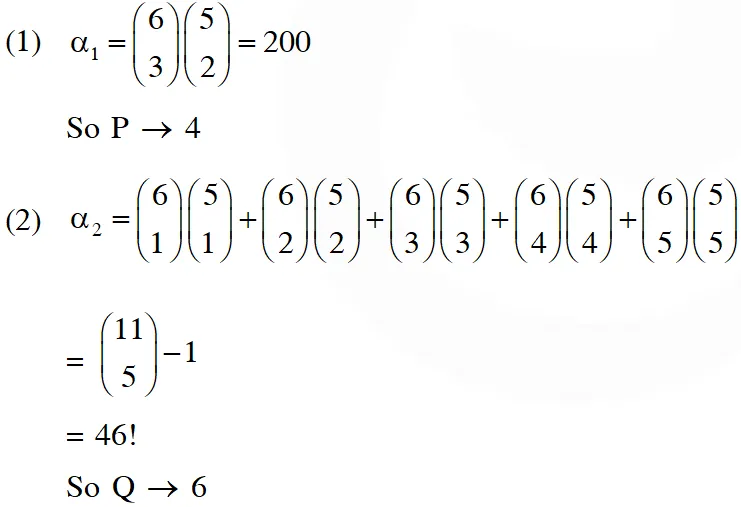
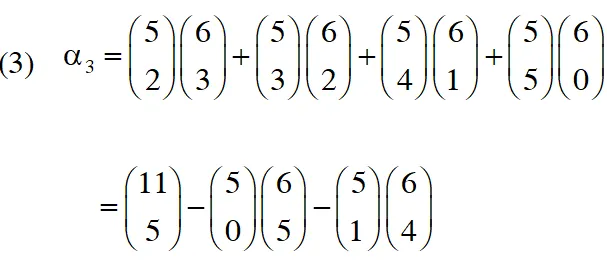
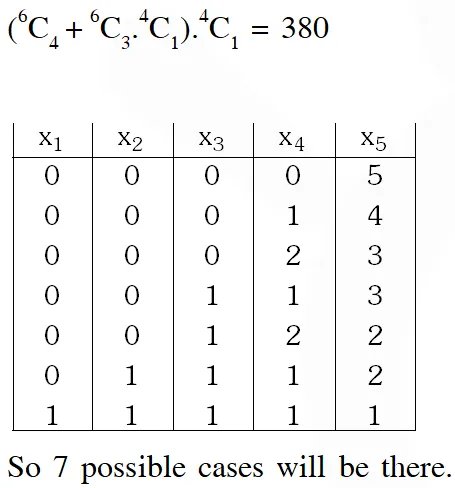
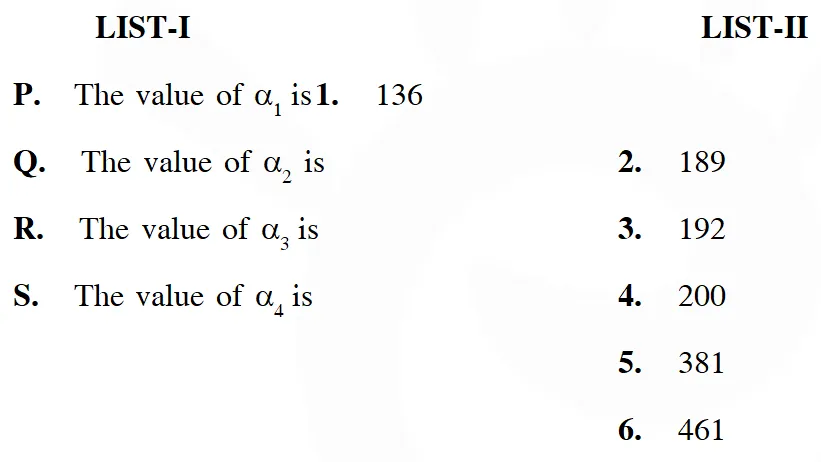
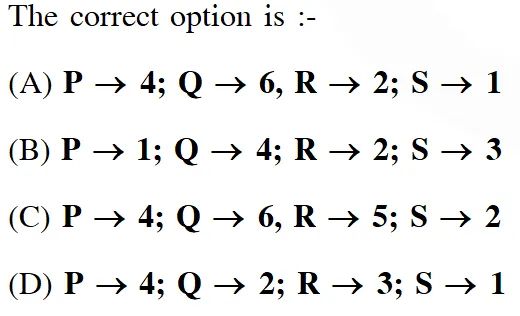
Q. In a high school, a committee has to be formed from a group of 6 boys $\mathrm{M}_{1}, \mathrm{M}_{2}, \mathrm{M}_{3}, \mathrm{M}_{4}, \mathrm{M}_{5},$ $\mathrm{M}_{6}$ and 5 girls $\mathrm{G}_{1}, \mathrm{G}_{2}, \mathrm{G}_{3}, \mathrm{G}_{4}, \mathrm{G}_{5}$ (i) Let $\alpha_{1}$ be the total number of ways in which the committee can be formed such that the committee has 5 members, having exactly 3 body and 2 girls.(ii) Let $\alpha_{2}$ be the total number of ways in which the committe can be formed such that the committee has at least 2 members, and having an equal number of boys and girls.(iii) Let $\alpha_{3}$ be the total number of ways in which the committe can be formed such that the committee has 5 members, at least 2 of them being girls.(iv) Let $\alpha_{4}$ be the total number of ways in which the committee can be formed such that the commitee has 4 members, having at least 2 girls and such that both $\mathrm{M}_{1}$ and $\mathrm{G}_{1}$ are NOT in the committee together.[JEE (Advanced) 2018,3(–1)]
Ans. (C)
For year-wise practice after Permutation & Combination - JEE Advanced PYQs (Maths), refer to the JEE Advanced PYQ archive.
Share Blog
Share via...
Or copy link
Frequently Asked Questions
Find answers to common questions.
What is the best strategy to solve derangement problems in JEE Advanced?
Memorise derangement values: D₄ = 9, D₅ = 44, D₆ = 265. When a constraint like "item X must go to position Y" is added, compute the full derangement first, then use the symmetry argument — divide by the number of equally likely valid positions for the restricted item, as shown in the 2014 card-envelope problem.
Is PnC asked every year in JEE Advanced?
Yes, PnC has appeared in every JEE Advanced paper from 2009 through 2018 covered in this article, and the trend has continued in subsequent years. It is a reliable high-weightage topic that rewards students who practise case-based thinking.
How many questions from Permutation and Combination appear in JEE Advanced each year?
JEE Advanced typically includes 1–2 questions from Permutation and Combination per paper, contributing 3–6 marks. Some years feature a paragraph-based set with 2–3 sub-questions on the same PnC scenario. The topic also connects to Probability, so conceptual clarity here pays double dividends
Can I score full marks in PnC without studying Probability first?
Yes — PnC is a standalone topic in the syllabus. However, studying them together is more efficient because PnC techniques (combinations, complement counting) are directly applied in Probability. eSaral's faculty recommend completing PnC fully before starting the Probability chapter in your JEE preparation schedule.
Which is harder — PnC in JEE Main or JEE Advanced?
JEE Advanced PnC is significantly harder. JEE Main questions are largely formula-based, while JEE Advanced questions require multi-case enumeration, recurrence thinking, derangements, and constraint-based counting — often wrapped in paragraph sets with no options to fall back on.
How do I avoid over-counting in distribution problems?
Always divide by the factorial of the number of identical groups. For example, if two groups receive the same number of items (like the 1,2,2 pattern in the 2012 ball-distribution question), divide by 2! to account for the groups being interchangeable. Writing out the partition table first makes this automatic.
Comments
Problems in Physical Chemistry/Bi N Awasthi
Oct. 3, 2025, 6:35 a.m.
Welcome to Gboard clipboard, any text that you copy will be saved here.Tap on a clip to paste it in the text box.Use the edit icon to pin, add or delete clips.Touch and hold a clip to pin it. Unpinned
Harshit
Nov. 13, 2023, 6:35 a.m.
Sir I wanted to ask one doubt in 4th question (b6 value one) how ans is 8 because when I am writing all possible no. My ans is greater then 8
100001
100011
100111
101111
111111
111101
111001
110001
110011
101011 ans so on
Subha Dhar
Jan. 20, 2024, 6:35 a.m.
thats because you have not paid attention to the condition given which says that there cant be any two consecutive zeroes..
Vaibhav Samdani
Sept. 25, 2022, 9:44 a.m.
Last Question me JEE Advanced 2018 ka solution pura nahi h!
john
Aug. 19, 2022, 12:32 p.m.
good
.
Aug. 19, 2022, 12:32 p.m.
.
Just trying to help
Aug. 19, 2022, 12:31 p.m.
Five persons A,B,C,D and E are seated in a circular arrangement .If each of them is given a hat of one of the three colours red, blue and green ,then the numbers of ways of distributing the hats such that the person seated in adjacent seats get different coloured hats is___
[JEE ADVANCED 2019]
ss
Sept. 18, 2026, 10:52 p.m.
30
Just Helping
Aug. 19, 2022, 12:29 p.m.
Five persons A,B,C,D and E are seated in a circular arrangement .If each of them is given a hat of one of the three colours red, blue and green ,then the numbers of ways of distributing the hats such that the person seated in adjacent seats get different coloured hats is___
[JEE ADVANCED 2019]
Ananya
Aug. 19, 2022, 12:16 p.m.
Very helpful as i found all ques here for practice but the answers of some ques are wrong.. Still did good for me.
MUSKAAN MEHROTRA
Jan. 14, 2021, 1:47 p.m.
I THINK ANSWER TO QUESTION 3 FROM THE TOP IS WRONG... IT SHOULD BE 243-3=240 BECAUSE BALLS ARE DISTINCT SO IT SHOULD BE( 3^(5))-3
thor
Dec. 31, 2020, 9:05 a.m.
which ans is wrong?
HARSHAD MEHTHA
Dec. 19, 2020, 8:27 p.m.
literally stupid
aa
Dec. 18, 2020, 7:34 p.m.
crap
Anonymous
Oct. 15, 2020, 11:21 p.m.
Many of the answers are wrong and few questions are incomplete.



 [JEE (Advanced) 2018,3(–1)]