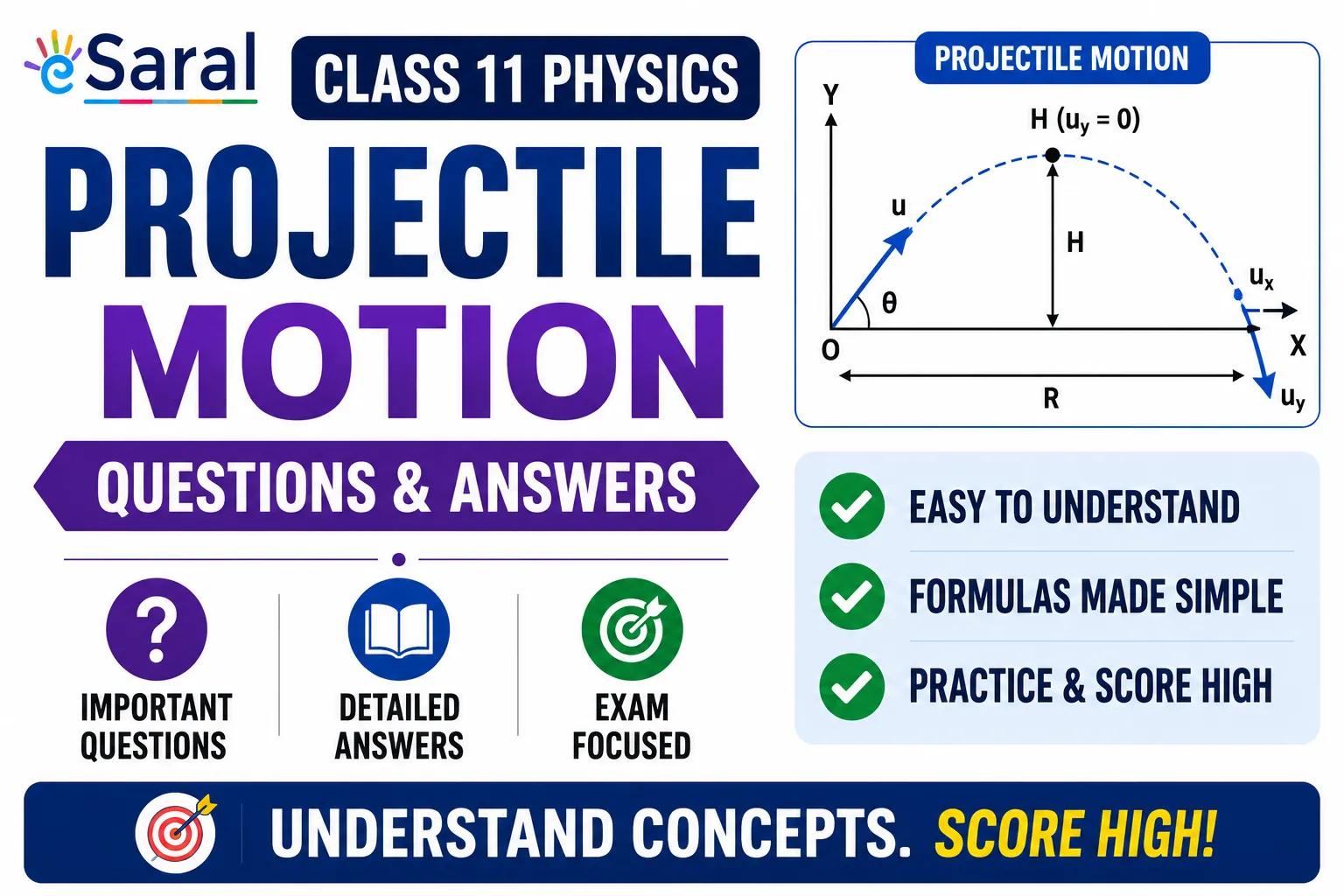
Projectile Motion Questions and Answers: Important for Class 11 Physics

eSaral > Class 11 Physics > Projectile Motion Questions and Answers

Get Projectile Motion important questions and answers. View 11th Physics important questions for exam point of view. These important questions will play a significant role in clearing concepts of Projectile Motion. This question bank is designed by expert faculties keeping the NCERT in mind, and the questions are updated with respect to the upcoming Board exams. You will get here all the important questions with the solutions of Projectile motion. Also, eSaral provides you this question bank for other subjects and chapters too.
Click Here for Detailed Notes of Projectile Motion along with other chapters and Subjects. 

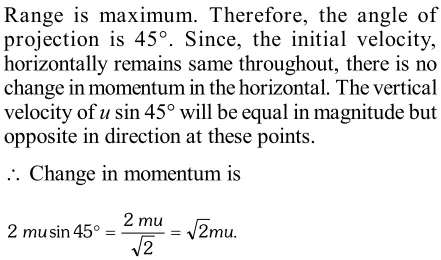
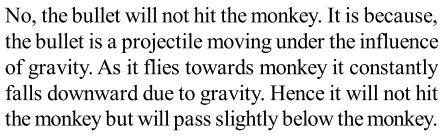




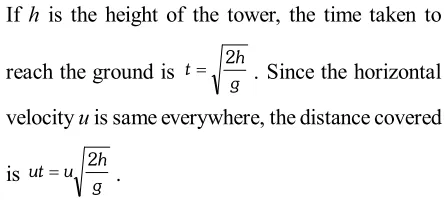
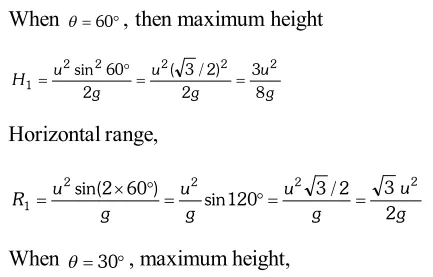
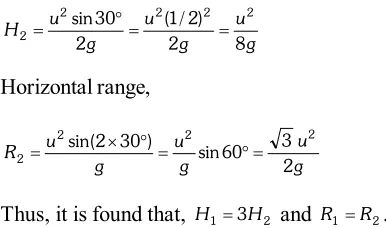

Before solving projectile numericals, it helps to refresh vector resolution and motion in two dimensions, especially how the initial velocity is split into horizontal and vertical components.
Frequently Asked Questions
Find answers to common questions.
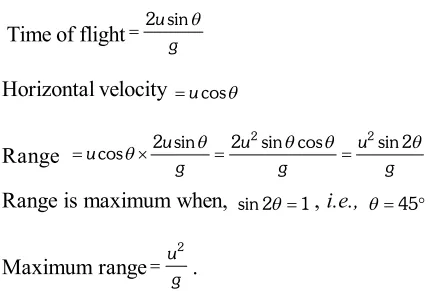
At what angle of projection is the range of a projectile maximum?
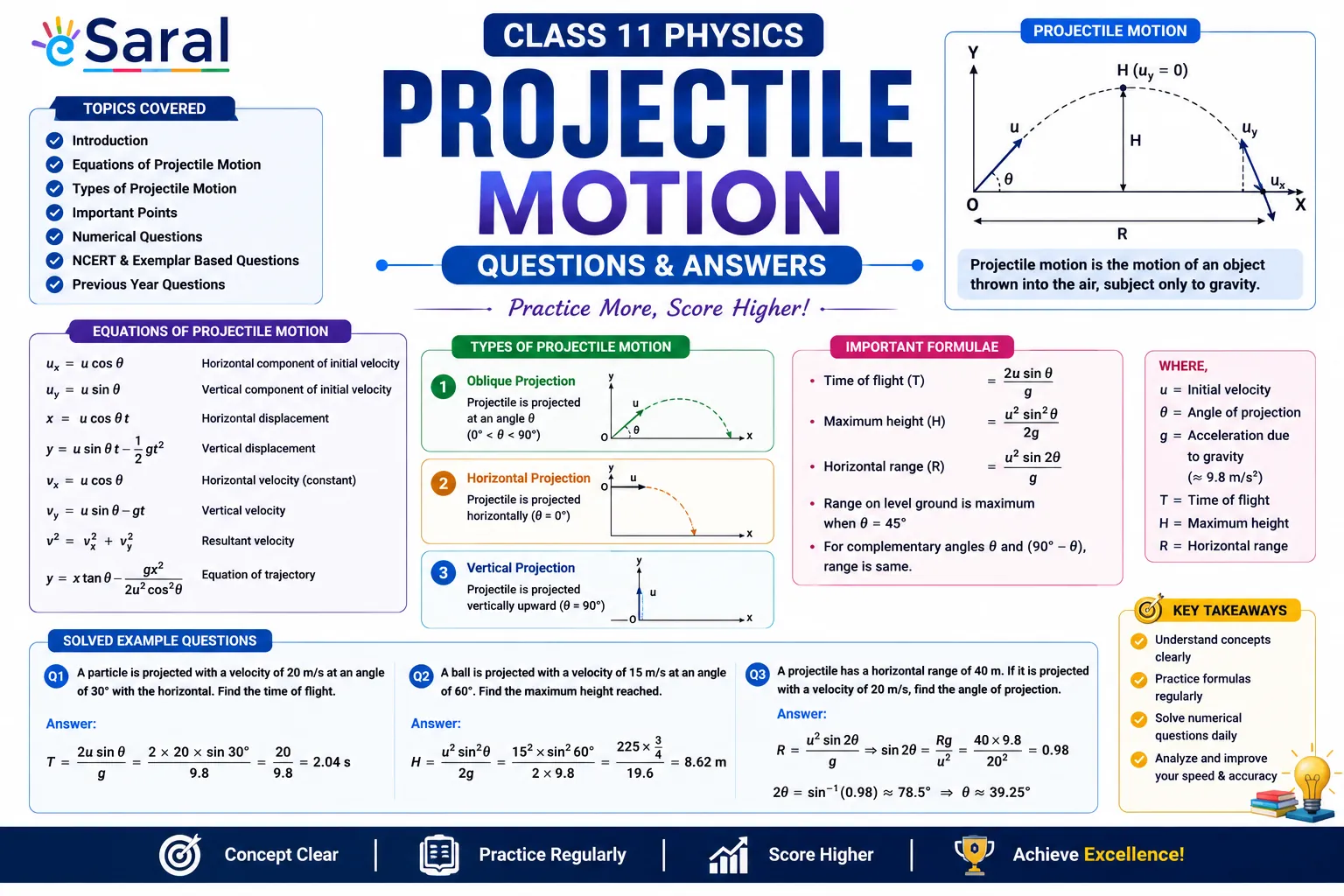
Range is maximum when sin 2θ = 1, i.e., when 2θ = 90°, so θ = 45°. At 45°, the range equals u²/g (where u is initial speed and g is gravitational acceleration). This result is directly derivable from R = u² sin 2θ / g and is frequently tested in JEE Main.
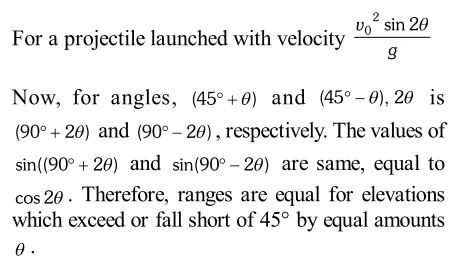
Why is the range the same for complementary angles of projection?
Range is given by R = u² sin 2θ / g. For complementary angles θ and (90° − θ), sin 2θ = sin(180° − 2θ) = sin 2(90° − θ). Since the sine values are equal, both angles produce the same range with the same initial speed. For example, 30° and 60° give identical range.
What is the minimum speed of a projectile during its flight?
The minimum speed occurs at the highest point of the trajectory. At that point, the vertical velocity is zero, so the speed equals only the horizontal component: u cos θ. For a horizontally projected object (θ = 0°), the initial speed is the minimum speed since vertical velocity only adds to total speed after launch
Which physical quantities remain constant during projectile motion?
Only the horizontal component of velocity (u cos θ) remains constant throughout the flight (since no horizontal force acts). All other quantities — total speed, vertical velocity component, kinetic energy, potential energy, and momentum — change continuously. This is a frequently asked 1-mark question in CBSE board exams.
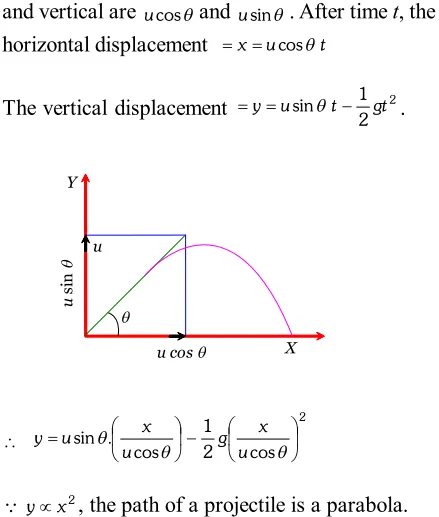
How does a projectile's path differ when launched horizontally vs. at an angle?
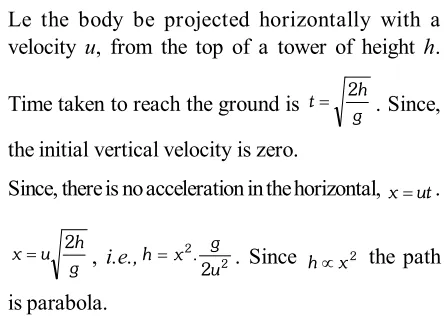
Both follow parabolic paths, but their equations differ. For horizontal projection: y = (g/2v²)x², a symmetric parabola from the launch point. For angular projection at θ: y = x tan θ − [g/(2u²cos²θ)]x², an asymmetric parabola with a peak. In both cases, horizontal velocity stays constant and vertical velocity changes uniformly under gravity.
What is the change in momentum of a projectile at the highest point compared to at launch?
At launch, momentum has both horizontal (mu cos θ) and vertical (mu sin θ) components. At the highest point, vertical momentum = 0. The change in momentum = mu sin θ, directed vertically downward. This change is caused by the impulse of gravity acting over the time of ascent (t = u sin θ / g)