Boiling point of water at 750 mm Hg is 99.63°C.
Calculate boiling point elevation using molality to determine that approximately 121.67 g of sucrose must be added to 500 g of water to raise its boiling point from 99.63°C to 100°C.
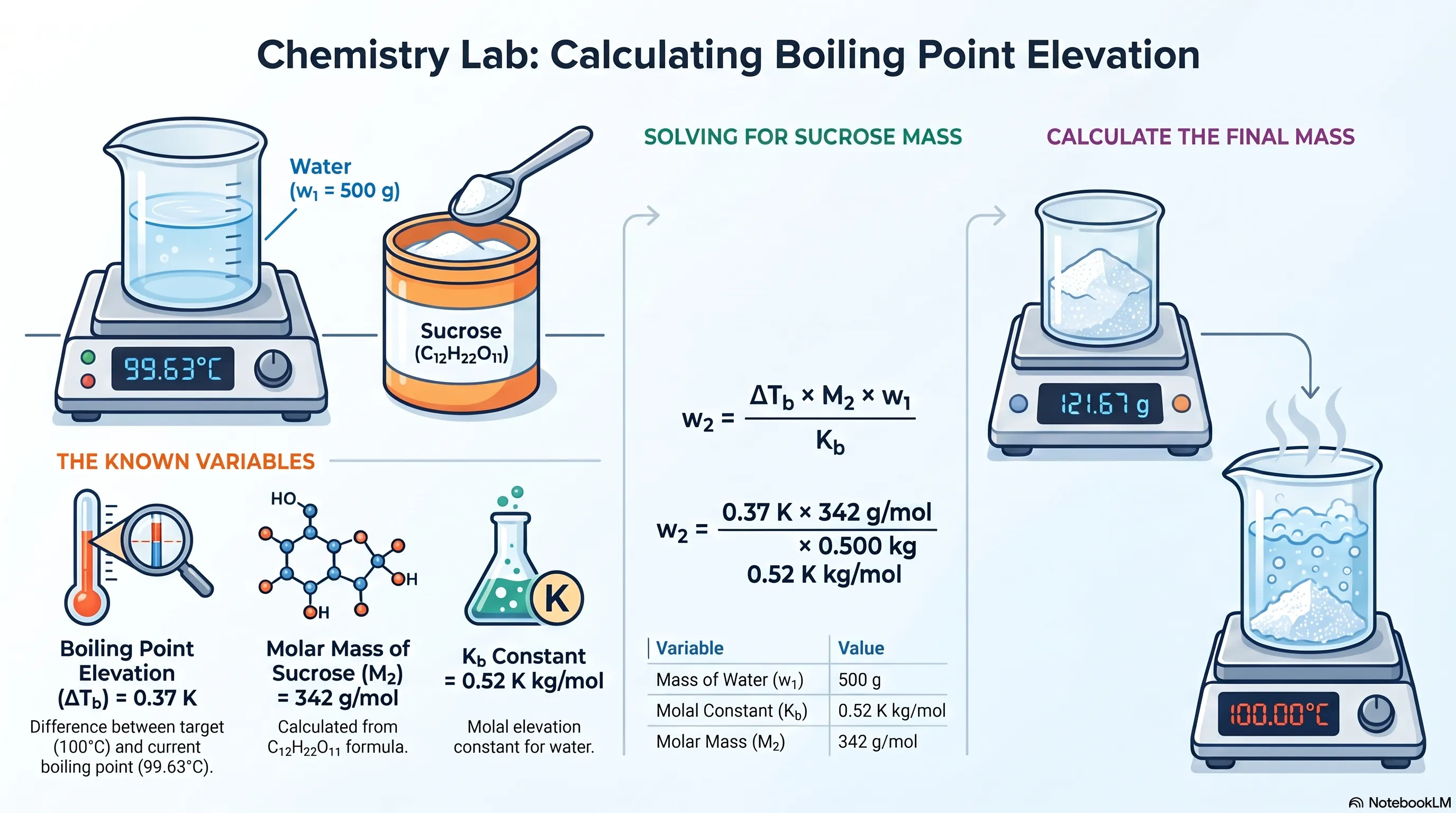


Boiling point of water at 750 mm Hg is 99.63°C. How much sucrose is to be added to 500 g of water such that it boils at 100°C. Molal elevation constant for water is 0.52 K kg mol−1.
Here, elevation of boiling point ΔTb = (100 + 273) − (99.63 + 273)
= 0.37 K
Mass of water, wl = 500 g
Molar mass of sucrose (C12H22O11), M2 = 11 × 12 + 22 × 1 + 11 × 16
= 342 g mol−1
Molal elevation constant, Kb = 0.52 K kg mol−1
We know that:
$\Delta T_{b}=\frac{K_{b} \times 1000 \times w_{2}}{M_{2} \times w_{1}}$
$\Rightarrow w_{2}=\frac{\Delta T_{b} \times M_{2} \times w_{1}}{K_{b} \times 1000}$
$=\frac{0.37 \times 342 \times 500}{0.52 \times 1000}$
= 121.67 g (approximately)
Hence, 121.67 g of sucrose is to be added.
Note: There is a slight variation in this answer and the one given in the NCERT textbook.
Frequently Asked Questions
Find answers to common questions.
What is the boiling point of water at 750 mm Hg?
The boiling point of water at 750 mm Hg is 99.63°C. At reduced atmospheric pressure, water's vapour pressure reaches the external pressure threshold at a temperature slightly below 100°C. This is a direct application of the pressure–temperature relationship for phase transitions. At standard 760 mm Hg pressure, water boils at exactly 100°C.
How much sucrose must be added to 500 g of water to make it boil at 100°C when the initial boiling point is 99.63°C?
Approximately 121.67 g of sucrose must be added. Using ΔTb = 0.37 K, Kb = 0.52 K kg mol⁻¹, M₂ = 342 g mol⁻¹, and w₁ = 500 g in the formula w₂ = (ΔTb × M₂ × w₁)/(Kb × 1000) gives w₂ = (0.37 × 342 × 500)/(0.52 × 1000) = 121.67 g.
What is the formula for the elevation of the boiling point?
The formula is ΔTb = (Kb × 1000 × w₂)/(M₂ × w₁). Here, ΔTb is the boiling point elevation in Kelvin, Kb is the molal elevation constant in K kg mol⁻¹, w₂ is the solute mass in grams, M₂ is the molar mass of the solute in g mol⁻¹, and w₁ is the solvent mass in grams. Rearranged to find w₂: w₂ = (ΔTb × M₂ × w₁)/(Kb × 1000).
What is the value of Kb for water?
The molal elevation constant (ebullioscopic constant) for water is Kb = 0.52 K kg mol⁻¹. This means dissolving 1 mole of any non-volatile, non-electrolyte solute in 1 kg of water raises the boiling point by 0.52 K. This value is a fixed physical constant for water and is provided in NCERT Class 12 Chemistry, Chapter 2.
What is the molar mass of sucrose and how is it calculated?
The molar mass of sucrose (C₁₂H₂₂O₁₁) is 342 g mol⁻¹. It is calculated as: (12 × 12) + (22 × 1) + (11 × 16) = 144 + 22 + 176 = 342 g mol⁻¹. Sucrose is a non-volatile, non-electrolyte solute, which means it does not dissociate in water — making it ideal for demonstrating pure colligative behaviour.