If the standard deviation of the numbers 2, 3, 2x, 11 is 3.5,

If the standard deviation of the numbers 2, 3, 2x, 11 is 3.5, calculate the possible values of x.
Given: Standard Deviation, $\sigma=3.5$
and Numbers are 2, 3, 2x, 11
We know that,
Mean $(\overline{\mathrm{x}})=\frac{\text { Sum of observations }}{\text { Total number of observations }}$
$=\frac{2+3+2 x+11}{4}$
$=\frac{16+2 x}{4}$
$\overline{\mathrm{x}}=\frac{8+\mathrm{x}}{2}$
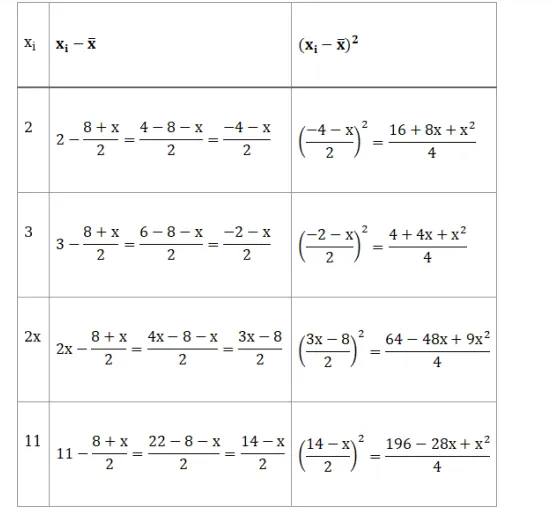
Variance, $\sigma^{2}=\frac{1}{\mathrm{n}} \sum\left(\mathrm{x}_{\mathrm{i}}-\overline{\mathrm{x}}\right)^{2}$
$(3.5)^{2}=\frac{1}{4}\left[\frac{16+8 x+x^{2}}{4}+\frac{4+4 x+x^{2}}{4}+\frac{64-48 x+9 x^{2}}{4}+\frac{9-6 x+x^{2}}{4}\right]$
$\begin{aligned} \Rightarrow 12.25=& \frac{1}{16}\left[16+8 x+x^{2}+4+4 x+x^{2}+64-48 x+9 x^{2}+196-28 x\right.\\ &\left.+x^{2}\right] \end{aligned}$
$\Rightarrow 12.25 \times 16=280-64 x+12 x^{2}$
$\Rightarrow 196=280-64 x+12 x^{2}$
$\Rightarrow 12 x^{2}-64 x+280-196=0$
$\Rightarrow 12 x^{2}-64 x+84=0$
$\Rightarrow 3 x^{2}-16 x+21=0$
$\Rightarrow 3 x^{2}-9 x-7 x+21=0$
$\Rightarrow 3 x(x-3)-7(x-3)=0$
$\Rightarrow(3 x-7)(x-3)=0$
Putting both the factors equal to 0, we get
$3 x-7=0$ and $x-3=0$
$\Rightarrow 3 x=7$ and $x=3$
$\Rightarrow x=\frac{7}{3}$
Hence, the possible values of $x$ are $\frac{7}{3} \& 3$