In the given figure, a circle is inscribed in a quadrilateral ABCD in which

In the given figure, a circle is inscribed in a quadrilateral ABCD in which ∠B = 90°. It AD = 23 cm, AB = 29 cm and DS = 5 cm, find the radius r of the circle.
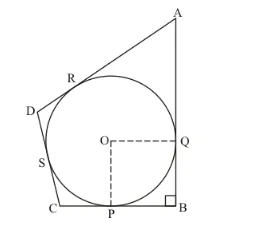
Let us first consider the quadrilateral OPBQ.
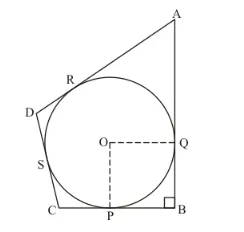
It is given that  .
.
Also from the property of tangents we know that the radius of the circle will always be perpendicular to the tangent at the point of contact. Therefore we have,

We know that sum of all angles of a quadrilateral will always be equal to  . Therefore,
$\angle B+\angle O P B+\angle O Q B+\angle P O Q=360^{\circ}$
$90^{\circ}+90^{\circ}+90^{\circ}+\angle P O Q=360^{\circ}$
$270^{\circ}+\angle P O Q=360^{\circ}$
$\angle P O Q=90^{\circ}$
Also, in the quadrilateral,
OQ = OP (both are the radii of the same circle)
PB = BQ (from the property of tangents which says that the length of two tangents drawn to a circle from the same external point will be equal)
Since the adjacent sides of the quadrilateral are equal and also since all angles of the quadrilateral are equal to 90°, we can conclude that the quadrilateral OPBQ is a square.
It is given that DS = 5 cm.
From the property of tangents we know that the length of two tangents drawn from the same external point will be equal. Therefore,
DS = DR
DR = 5
It is given that,
AD = 23
DR + RA = 23
5 + RA = 23
RA = 18
Again from the same property of tangents we have,
RA = AQ
We have found out RA = 18. Therefore,
AQ = 18
It is given that AB = 29. That is,
AQ + QB = 29
18 + QB = 29
QB = 11
We have initially proved that OPBQ is a square. QB is one of the sides of the square. Since all sides of the square will be of equal length, we have,
OP = 11
OP is nothing but the radius of the circle.
Thus the radius of the circle is equal to 11 cm.