In the given figure, AB || CD. Prove that p + q − r = 180.
This geometry problem uses properties of parallel lines and transversals to prove that the angles satisfy the relation p + q − r = 180°, demonstrating the application of supplementary and alternate interior angles.


What Does This Problem Actually Ask?
Understanding the FigureIn the standard version of this problem:
- AB and CD are two parallel lines (AB ∥ CD).
- A point E lies on line AB, forming angle p (i.e., ∠AEF = p°).
- A point G lies on line CD, and angle r = ∠FGD is formed at G.
- Point F lies between the two parallel lines, and angle q = ∠EFG is formed at F.
- The line segment EFG acts as a transversal connecting both parallel lines through the interior point F.
In the given figure, AB || CD. Prove that p + q − r = 180.
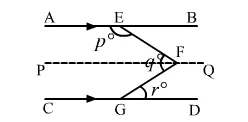 Draw $P F Q\|A B\| C D$.
Now, $P F Q \| A B$ and EF is the transversal.
Then,
$\angle A E F+\angle E F P=180^{\circ} \ldots \ldots(1)$
[Angles on the same side of a transversal line are supplementary]
Also, $P F Q \| C D$.
$\angle P F G=\angle F G D=r^{\circ}[$ Alternate Angles $]$
and $\angle E F P=\angle E F G-\angle P F G=q^{\circ}-r^{\circ}$
putting the value of $\angle E F P$ in eqn. (i)
we get,
$p^{\circ}+q^{\circ}-r^{\circ}=180^{\circ}$
$\Rightarrow p+q-r=180$
Frequently Asked Questions
Find answers to common questions.
When AB ∥ CD, why does p + q − r = 180° and not p + q + r = 180°?
The minus sign on r arises because angle r (∠FGD) and the auxiliary angle ∠PFG are alternate interior angles — they are equal, not supplementary. When you decompose ∠EFG = ∠EFP + ∠PFG, you get ∠EFP = q − r. Substituting into the co-interior angle equation p + ∠EFP = 180° gives p + q − r = 180°, not p + q + r.
What is the construction step in this proof and why is it necessary?
The construction is: draw line PFQ through point F such that PFQ ∥ AB ∥ CD. It is necessary because without this auxiliary line, the three angles p, q, and r exist at three different points (E, F, G) with no direct angular link. The auxiliary parallel line creates two separate transversal relationships at point F, connecting all three angles algebraically.
Which angle theorem is used in Step 1 of this proof?
Step 1 uses the co-interior angles theorem (also called same-side interior angles or allied angles). When two parallel lines are cut by a transversal, co-interior angles — which lie on the same side of the transversal between the parallel lines — are supplementary, meaning they add up to 180°. Here, ∠AEF (= p) and ∠EFP are co-interior angles between AB and PFQ.
Which angle theorem is used in Step 2 of this proof?
Step 2 uses the alternate interior angles theorem. When two parallel lines are cut by a transversal, alternate interior angles — which lie on opposite sides of the transversal between the parallel lines — are equal. Here, ∠PFG and ∠FGD (= r) are alternate interior angles between PFQ and CD, so ∠PFG = r.
Is this question from NCERT or another textbook?
This problem is a standard type from the Lines and Angles chapter (Chapter 6, Class 9 NCERT Mathematics) and also appears in RS Aggarwal Class 9, RD Sharma Class 9, and various state board textbooks. The construction technique used here is explicitly taught in the NCERT Class 9 syllabus under parallel line properties.