Surface Area & Volumes - Class 9 Maths Chapter 11 Short Notes (Mind Maps)
This page provides concise mind maps for Class 9 Maths Chapter 11 (Surface Area & Volumes), helping students quickly revise important formulas and key concepts for effective exam preparation.

eSaral ›Foundation courses ›Surface Area & Volumes - Class 9 Maths Chapter 11 Short Notes (Mind Maps)

Get to learn all the formulae and important points of Surface Area & Volumes through this Mind Map. Download and share with your friends also.
Download 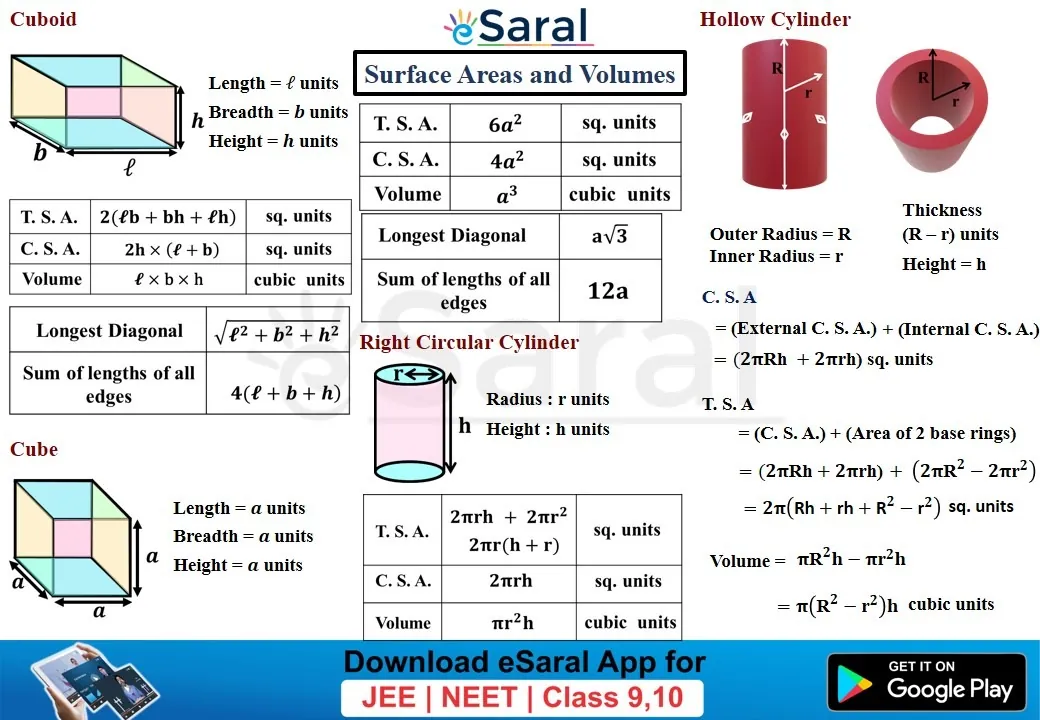
Download 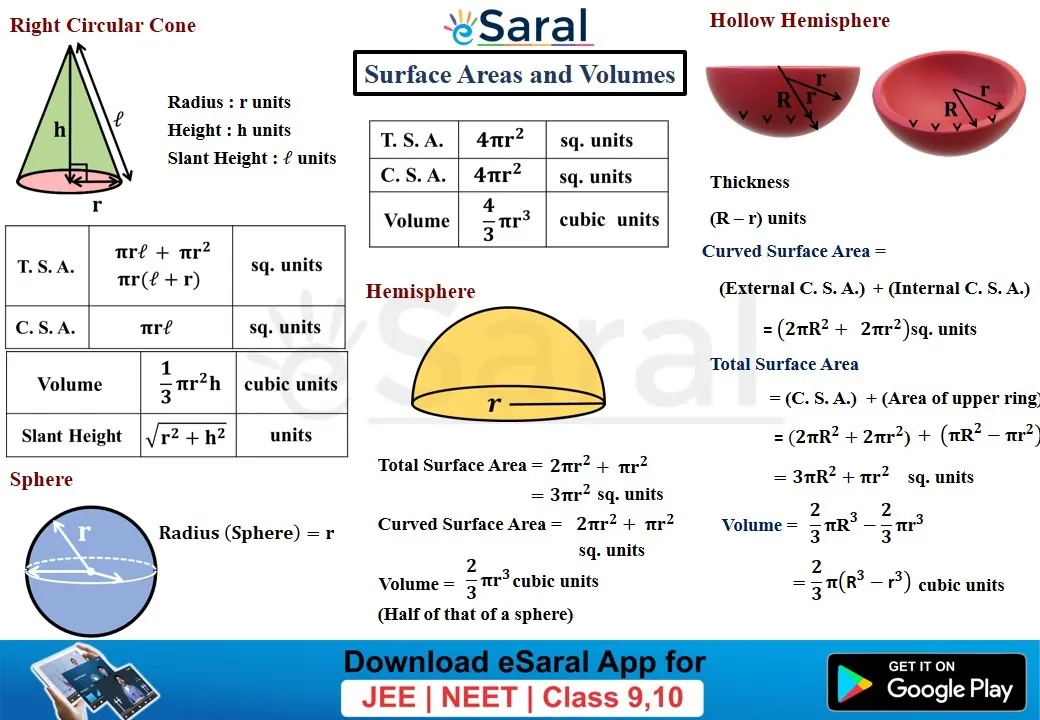
Revise Complete Mathematics for Class 9.
Frequently Asked Questions
Find answers to common questions.
What is the difference between lateral surface area and total surface area?
Lateral Surface Area (LSA) includes only the side or curved surfaces of a shape — not the base(s). Total Surface Area (TSA) adds the area of all bases to the LSA. For example, a cylinder's LSA = 2πrh, but its TSA = 2πrh + 2πr² (adding two circular bases). Always read the question carefully to know which one is required.
Is Chapter 11 Surface Area and Volumes important for JEE?
Yes. The concepts in Class 9 Chapter 11 form the base for mensuration in JEE Main and JEE Advanced. Questions in JEE often involve combinations of solids — for example, a cone placed on a cylinder, or a sphere melted into cones. Students who learn these formulas with understanding (not just memorisation) find 3D geometry in JEE significantly easier. eSaral's IIT Bombay faculty integrate this foundation from Class 9 onwards
What value of π should be used in Class 9 surface area problems?
Use π = 22/7 when the radius is a multiple of 7 (e.g., r = 7, 14, 21). Use π = 3.14 when the radius involves decimals or the question explicitly states it. CBSE problems always specify which value to use. If no instruction is given, either value is acceptable — but 22/7 is preferred in most NCERT exercises.
How many shapes are covered in Class 9 Chapter 11?
Class 9 Chapter 11 covers exactly six 3D shapes: cuboid, cube, right circular cylinder, right circular cone, sphere, and hemisphere. For each shape, students need to know the lateral/curved surface area, the total surface area, and the volume. The CBSE exam can test any combination of these six shapes and their three measurements.