What are physical quantities? and What are the Types of physical quantities?
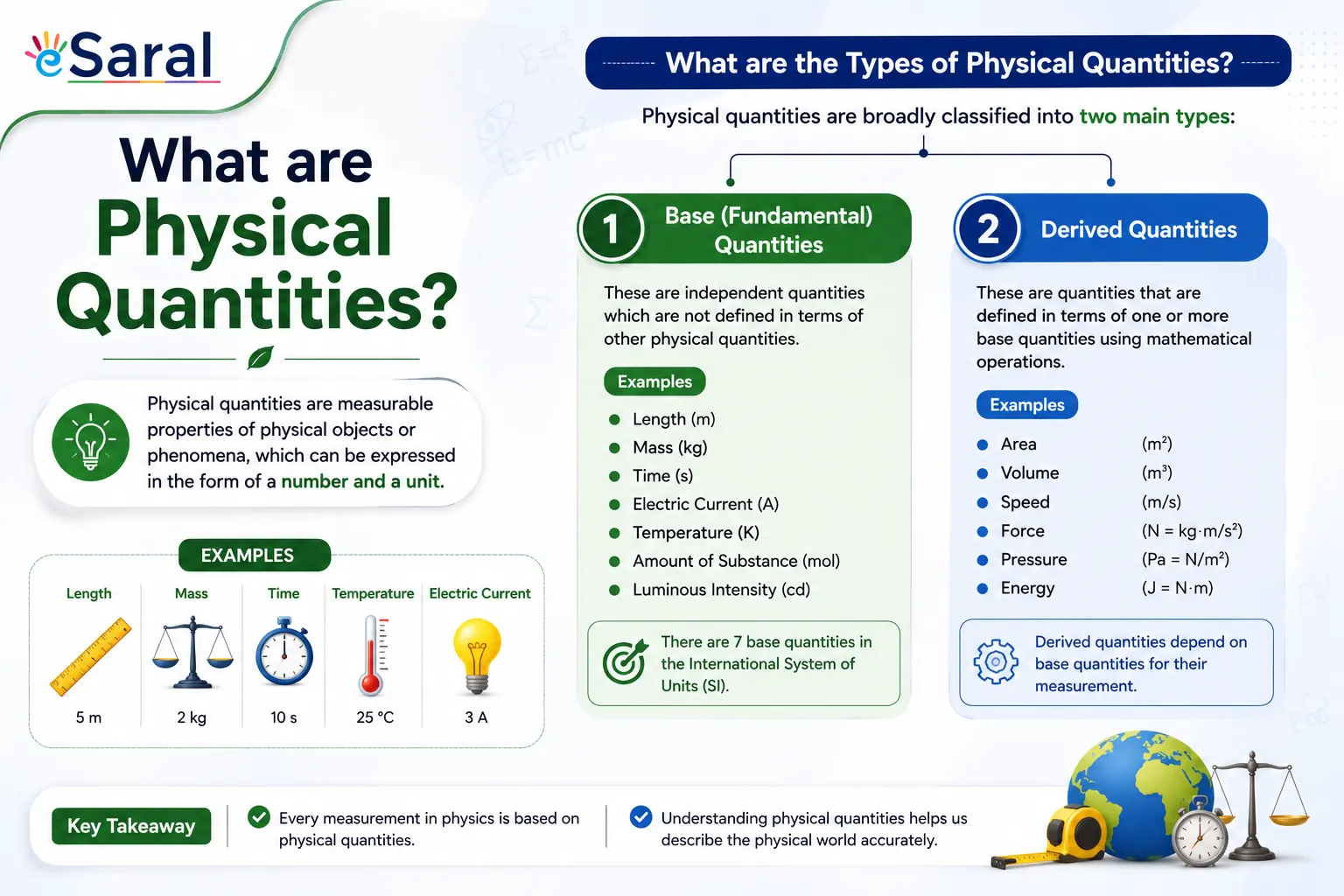
Table of Contents

Home > Physics Notes > Class 11 Physical Quantities

What are Physical Quantities
Those quantities that can describe the laws of physics and are possible to measure are called physical quantities. A physical quantity is that which can be measured.
Note:
(1) Some physical quantities are not completely specified even by magnitude, unit, and Direction. These physical quantities are called tensors. eg, moment of Inertia.
(2) Physical quantity = Numerical value $\mathrm{x}$ unit
Types of physical quantities
The physical quantities that do not depend upon other quantities are called fundamental quantities. In the M.K.S. system, the fundamental quantities are mass, length, and time.
In a standard International (S.I.) system, the Fundamental quantities are mass, length, time, temperature, illuminating power (or luminous intensity), current, and amount of substance. 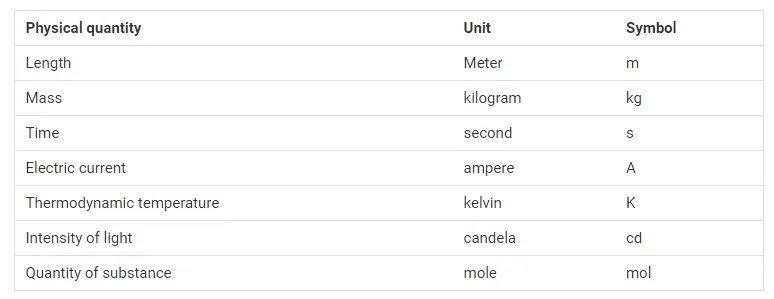
Also Read
JEE Physics Notes
To watch Free Learning Videos on JEE by Kota’s top IITian Faculties, install the eSaral App
What Are Physical Quantities?
A physical quantity is any property of matter or energy that can be measured and expressed as a number along with a unit. The laws of physics are written entirely in terms of physical quantities, which is why a clear understanding of this concept is the first step in your Class 11 Physics journey and a direct scoring area in JEE Main and NEET.
Key Rule to Remember
Physical Quantity = Numerical Value × Unit
For example, if the length of a rod is 5 metres, then:
- Numerical value = 5
- Unit = metre (m)
- Physical quantity = length
Not every quantity in nature is a physical quantity. Feelings, colours perceived subjectively, or emotions cannot be measured — and therefore are not physical quantities. If something can be quantified with an instrument and expressed in a standard unit, it qualifies.
For a deeper look at how these concepts appear in problems, refer to the NCERT Solutions for Class 11 Physics — fully solved by eSaral's IIT Bombay faculty.
Types of Physical Quantities
Physical quantities are classified on two main bases:
- Whether they depend on other quantities → Fundamental vs. Derived
- Whether they have direction → Scalar vs. Vector
Fundamental vs. Derived Quantities
What Are Fundamental Quantities?
Fundamental quantities (also called base quantities) do not depend on any other physical quantity. They are independently defined. In the older CGS and MKS systems, only three fundamental quantities existed — mass, length, and time.
The modern International System of Units (SI), adopted by the General Conference on Weights and Measures (CGPM) and used as the global standard by bodies including India's National Physical Laboratory, recognises 7 fundamental quantities.
What Are Derived Quantities?
Derived quantities are expressed mathematically using two or more fundamental quantities. They are derived from base quantities through multiplication or division.
| Derived Quantity | Derivation | SI Unit |
|---|---|---|
| Velocity | Length ÷ Time | m/s |
| Acceleration | Length ÷ Time² | m/s² |
| Force | Mass × Acceleration | Newton (N) |
| Work / Energy | Force × Length | Joule (J) |
| Pressure | Force ÷ Area | Pascal (Pa) |
| Density | Mass ÷ Volume | kg/m³ |
| Electric Charge | Current × Time | Coulomb (C) |
In JEE Main, dimensional analysis questions almost always test whether you can correctly identify which quantities in an expression are fundamental and which are derived. Memorise the 7 SI base quantities along with their dimensions on Day 1 of your Units and Measurements chapter — it saves time across multiple topics.
Scalar vs. Vector Quantities
What Is the Difference Between Scalar and Vector Quantities?
The second major classification depends on whether a physical quantity needs a direction to be fully described.
Scalar Quantities are completely described by magnitude and unit alone. Direction is irrelevant.
Examples: Mass, temperature, speed, time, energy, distance, density, and electric charge.
Vector Quantities require both magnitude and unit, and a direction for a complete description.
Examples: Displacement, velocity, acceleration, force, momentum, electric field, magnetic field.
| Feature | Scalar | Vector |
|---|---|---|
| Direction needed? | No | Yes |
| Follows ordinary algebra? | Yes | No (follows vector algebra) |
| Can it be negative? | Only for relative scalars | Yes (opposite direction) |
| Example | Mass = 5 kg | Force = 10 N, eastward |
A common JEE trap: speed is scalar, velocity is vector. Similarly, distance is scalar, displacement is vector. Students who confuse these lose easy marks in kinematics problems. When in doubt, ask yourself: "Does the direction change the physical meaning?" If yes, it is a vector.
What Are Tensors?
Some physical quantities cannot be fully described even by a magnitude and a direction. These are called tensors. A tensor carries information about how a quantity transforms under changes of coordinates.
Examples of tensor quantities:
- Moment of Inertia
- Stress and Strain
- Refractive Index (in anisotropic media)
For Class 11 and JEE purposes, you need to know that tensors exist and recognise moment of inertia as the most commonly cited example. Tensor mathematics is studied in detail at the undergraduate level.
Frequently Asked Questions
Find answers to common questions.
How many fundamental quantities are there in the SI system?
There are 7 fundamental (base) quantities in the SI system: length, mass, time, electric current, thermodynamic temperature, amount of substance, and luminous intensity. Each has a defined SI unit — metre, kilogram, second, ampere, kelvin, mole, and candela respectively
What are the types of physical quantities?
Physical quantities are classified in two ways. First, by independence: fundamental quantities (mass, length, time, etc.) do not depend on others, while derived quantities (force, energy, pressure) are derived from fundamental ones. Second, by directionality: scalar quantities have magnitude only, while vector quantities have both magnitude and direction.
What are physical quantities? Give two examples.
Physical quantities are measurable properties used to describe physical phenomena, expressed as a numerical value multiplied by a unit. Examples: (1) Mass — the amount of matter in an object, measured in kilograms. (2) Velocity — the rate of change of displacement, measured in metres per second. Both are used in Newton's Second Law: F = ma.
What is the formula for a physical quantity?
Every physical quantity follows the formula: Physical Quantity = Numerical Value × Unit. For example, a force of 50 newtons is written as F = 50 × N. When you change the unit, the numerical value changes inversely so that the physical quantity itself stays the same — this is the basis of unit conversion in dimensional analysis.
Is moment of inertia a scalar, vector, or tensor?
Moment of inertia is a tensor quantity. It cannot be completely described by a single magnitude or even a direction — its value depends on the axis chosen. This makes it different from both scalars and vectors. At Class 11–12 level, you need to recognise it as a tensor; detailed tensor mathematics is part of higher education.
What is the difference between a scalar and a vector quantity?
A scalar quantity is fully described by its magnitude and unit alone — for example, temperature or mass. A vector quantity requires magnitude, unit, and direction — for example, force or displacement. Scalars follow ordinary arithmetic; vectors follow vector algebra, including operations like dot product and cross product.