CBSE Class 9 Syllabus 2026-27: PDF Download
The CBSE Class 9 Syllabus 2026-27 covers Mathematics, Science, Social Science, English, and Hindi through five brand-new NCERT textbooks — Ganita Manjari, Exploration, Understanding Society: India and Beyond, Kaveri, and Ganga — replacing every core textbook used before this session. Class 9 exams remain school-conducted, not a CBSE board exam.
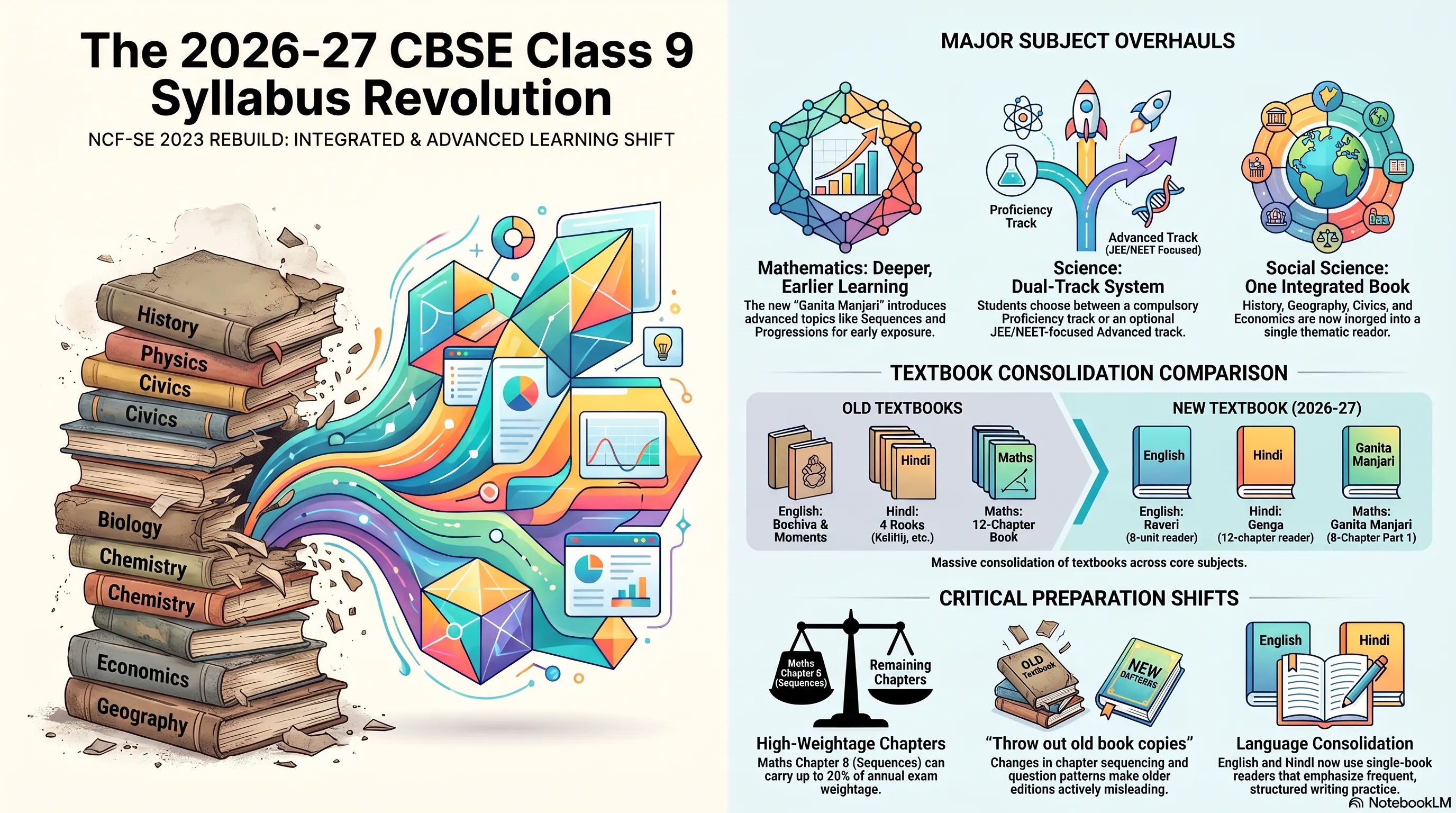
Table of Contents
- CBSE Class 9 Syllabus 2026-27 PDF
- CBSE Class 9 Syllabus Subject-Wise
- CBSE Syllabus for Class 9 Mathematics
- CBSE Syllabus for Class 9 Science
- CBSE Syllabus for Class 9 Social Science
- CBSE Syllabus for Class 9 English
- CBSE Syllabus for Class 9 Hindi
- Why Class 9 2026-27 Is the Biggest Curriculum Change in Two Decades
- Benefits of Completing the CBSE Class 9 Syllabus Early

eSaral ›Foundation courses ›CBSE Class 9 Syllabus 2026-27: PDF Download

CBSE Class 9 Syllabus 2026-27 PDF
| Subject | PDF Download |
|---|---|
| CBSE Syllabus for Class 9 Mathematics (Ganita Manjari) | PDF Download |
| CBSE Syllabus for Class 9 Science (Exploration) | PDF Download |
| CBSE Syllabus for Class 9 Social Science (Understanding Society) | PDF Download |
| CBSE Syllabus for Class 9 English (Kaveri) | PDF Download |
| CBSE Syllabus for Class 9 Hindi (Ganga) | PDF Download |
💡 Expert Tip by eSaral Academic Team: Throw out any hand-me-down Beehive, Kshitij, or old Science book copies. This year's chapters, question patterns, and even which topics fall in Class 9 versus Class 10 have genuinely changed — studying from the old book will actively mislead you on what to prepare.
CBSE Class 9 Syllabus Subject-Wise
The scale of change in the CBSE Class 9 Syllabus 2026-27 is unusual even by NCERT's recent standards. Mathematics has been redesigned around fewer, deeper chapters, with select topics moved down from the Class 10-12 syllabus for earlier exposure. Science now offers two levels — a compulsory Proficiency track for every student and an optional Advanced track aimed at future JEE, NEET, and Olympiad aspirants. Social Science merges History, Geography, Civics, and Economics into a single integrated book. English retires Beehive and Moments in favour of one 8-unit reader, Kaveri, and Hindi consolidates Kshitij, Kritika, Sparsh, and Sanchayan into a single book, Ganga.
Since Class 9 has no CBSE board exam, each school still sets its own internal weightage across periodic tests and the annual exam — but because CBSE affiliation requires following the NCERT sequence, virtually every school's paper design will track these new chapters closely.
CBSE Syllabus for Class 9 Mathematics
The new Maths textbook, Ganita Manjari, currently has only Part 1 published for the 2026-27 session, containing 8 redesigned chapters. It replaces the earlier 12-chapter book entirely.
| Chapter | Title |
|---|---|
| 1 | Orienting Yourself: The Use of Coordinates |
| 2 | Introduction to Linear Polynomials |
| 3 | The World of Numbers |
| 4 | Exploring Algebraic Identities |
| 5 | I'm Up and Down, and Round and Round |
| 6 | Measuring Space: Perimeter and Area |
| 7 | The Mathematics of Maybe: Introduction to Probability |
| 8 | Predicting What Comes Next: Exploring Sequences and Progressions |
What Changed in the Class 9 Maths Syllabus 2026-27?
Ganita Manjari asks students to reason and explain rather than simply calculate — several exercises present a question before teaching the formal method, and topics like sequences and progressions, previously taught only in Class 10 or 11, now appear here for early exposure.
Chapter 8: Predicting What Comes Next typically carries the highest weightage in schools that have adopted the new book — often 15-20% of the annual exam — making it disproportionately important despite being one of the more demanding chapters.
💡 Expert Tip by eSaral Academic Team: Don't treat Chapter 1 (coordinates) as a warm-up chapter to skim. It sets up the coordinate thinking used throughout Chapter 5 and forms the base students will need for coordinate geometry in Class 10 and beyond.
CBSE Syllabus for Class 9 Science
The new Science textbook, Exploration, has 13 chapters and introduces a two-level system: the Proficiency level is compulsory for every student, while the Advanced level is an optional add-on aimed at students targeting JEE, NEET, or Olympiads later on.
| Chapter | Title |
|---|---|
| 1 | Exploration: Entering the World of Secondary Science |
| 2 | Cell: The Building Block of Life |
| 3 | Tissues in Action |
| 4 | Describing Motion Around Us |
| 5 | Exploring Mixtures and Their Separation |
| 6 | How Forces Affect Motion |
| 7 | Work, Energy and Simple Machines |
| 8 | Journey Inside the Atom |
| 9 | Atomic Foundations of Matter |
| 10 | Sound Waves: Characteristics and Applications |
| 11 | Reproduction: How Life Continues |
| 12 | Patterns in Life: Diversity and Classification |
| 13 | Earth as a System: Energy, Matter and Life |
What Is the Science Advanced Level in Class 9?
The Advanced Level is an optional deeper stream within the new Science syllabus, built for students aiming at JEE, NEET, or Olympiads, covering the same chapter themes with more rigorous concepts than the compulsory Proficiency track that every Class 9 student takes.
Compared to the earlier syllabus, the new book removes Gravitation and Improvement in Food Resources, and introduces Reproduction, Diversity and Classification, and Earth as a System as revised or entirely new chapters — a meaningful shift in what counts as "core" Class 9 Science.
💡 Expert Tip by eSaral Academic Team: If your child is aiming for JEE or NEET around 2029-30, the Advanced Level track is worth opting into now — it's genuinely early exposure to higher-class concepts, but only pays off if the Proficiency-level basics are solid first.
CBSE Syllabus for Class 9 Social Science
The new Social Science textbook, Understanding Society: India and Beyond, Part 1, merges History, Geography, Civics, and Economics into a single integrated book of 9 thematic chapters, replacing the earlier four separate books (India and the Contemporary World, Contemporary India, Democratic Politics, and Economics).
This integrated structure follows the same design NCERT used for Class 8's Exploring Society: India and Beyond — geography, history, governance, and economic concepts are threaded together by theme rather than taught as four unrelated subjects with their own chapter sequences.
How Is the New Social Science Syllabus Different From the Old One?
The earlier syllabus split Class 9 Social Science into four standalone books — History, Geography, Civics, and Economics — each with 5-6 chapters covering topics like the French Revolution, India's physical features, and village Palampur; the new Understanding Society: India and Beyond threads comparable concepts into 9 unified thematic chapters instead.
Because this is a genuinely new book, schools are still finalising how internal exam weightage splits across the old subject boundaries within it — worth confirming directly with your school's Social Science teacher this term.
💡 Expert Tip by eSaral Academic Team: Since the new book threads History, Geography, and Civics together by theme, don't study each old "subject" in isolation. Read chapters in the order they're printed — the sequencing is deliberate and each chapter often builds on the geography or history just covered before it.
CBSE Syllabus for Class 9 English
The new English textbook, Kaveri, replaces both Beehive and Moments with a single 8-unit reader. Each unit pairs one prose piece with one poem, linked by a common theme.
Kaveri covers a wide genre range across its 8 units — short stories, a play, an interview, a documentary-style article, a letter, and an extract — and builds functional writing (letters, notices, advertisements, scripts) alongside literary writing (stories, poems, dialogues) and persuasive essays.
Is Beehive Still Part of the Class 9 English Syllabus?
No — for the 2026-27 session, NCERT has replaced Beehive and Moments with the single new textbook Kaveri, though schools still finishing their transition may run the older books for part of the year, so it's worth confirming with your school.
Each Kaveri unit includes multiple structured writing tasks, so students are expected to write far more frequently through the year than the older textbook required, rather than concentrating writing practice only before exams.
CBSE Syllabus for Class 9 Hindi
The new Hindi textbook, Ganga (गंगा), replaces four older books — Kshitij, Kritika (Course A) and Sparsh, Sanchayan (Course B) — with a single 12-chapter textbook: 7 chapters in the प्रोज़ section (गद्य खंड) and 5 in the poetry section (काव्य खंड), plus a multilingual Bhasha Sangam section connecting Hindi with other Indian languages.
गद्य खंड (Prose) includes: दो बैलों की कथा, रीढ़ की हड्डी, क्या लिखूं?, में और मेरा देश, and an interview-style chapter with Lata Mangeshkar, among others.
काव्य खंड (Poetry) includes: पद, राम-लक्ष्मण-परशुराम संवाद, भारती जय विजय करो!, झाँसी की रानी, and घर की याद.
What Happened to Kshitij and Sparsh in Class 9 Hindi?
For the 2026-27 session, NCERT has replaced Kshitij, Kritika, Sparsh, and Sanchayan with the single new textbook Ganga, though many schools mid-transition continue referencing the older books for additional practice.
Why Class 9 2026-27 Is the Biggest Curriculum Change in Two Decades
Every core Class 9 subject changed textbook, chapter structure, or both this session. Maths moved topics down from Classes 10-12 for earlier exposure. Science added an entire optional Advanced track. Social Science abandoned four separate subject books for one integrated text. This isn't incremental revision — it's a full NCF-SE 2023 rebuild, and it means Class 9 now carries meaningfully more conceptual weight than it did even two years ago. Students and parents underestimating this shift, assuming Class 9 is "the same as always," risk being caught off guard by both the depth of new topics and the unfamiliar chapter sequencing.
Benefits of Completing the CBSE Class 9 Syllabus Early
- Confirm which textbook edition your school has adopted, subject by subject. Some schools may still be finishing the transition for one or two subjects — get this sorted in week one, not before a unit test.
- Treat Chapter 8 of Maths and the Advanced Level of Science as genuine priorities, not optional extras. Both carry outsized weightage or long-term value for students planning JEE, NEET, or Olympiad prep.
- Read Social Science chapters in printed order. The new integrated book's theme-based sequencing means skipping around loses the connections between geography, history, and governance chapters that the syllabus is built around.
- Practice writing every week in English, not just before exams. Kaveri's structured writing tasks are spread across the year, and consistent practice beats last-minute essay cramming.
- Solve every NCERT in-text and exercise question as you go. Since the new chapter sequencing is unfamiliar even to many teachers this year, working through NCERT's own questions is the most reliable way to know what "complete" preparation looks like.
- Get structured guidance for topics moved down from higher classes. Concepts like sequences and progressions in Maths or the Science Advanced Level track are genuinely harder than what Class 9 covered before — this is exactly where eSaral's Foundation courses for Classes 8-10 help bridge the gap early.
If you want structured Class 9 preparation that also builds strong JEE and NEET foundations through the new Science Advanced Level and Maths syllabus, eSaral's Foundation Course for Class 9 is worth exploring alongside your school's curriculum. Bookmark this page and check back through the year — Part 2 of Ganita Manjari and further syllabus updates are expected as NCERT completes the rollout.
Frequently Asked Questions
Find answers to common questions.
What is the CBSE Class 9 syllabus for 2026-27?
The CBSE Class 9 Syllabus 2026-27 covers Mathematics, Science, Social Science, English, and Hindi through five brand-new NCERT textbooks — Ganita Manjari, Exploration, Understanding Society: India and Beyond, Kaveri, and Ganga — introduced under the NCF-SE 2023 framework.
What are the new NCERT textbooks for Class 9?
The new textbooks are Ganita Manjari (Maths, Part 1 with 8 chapters), Exploration (Science, 13 chapters with Proficiency and Advanced levels), Understanding Society: India and Beyond (Social Science, 9 integrated chapters), Kaveri (English, 8 units), and Ganga (Hindi, 12 chapters).
What is the Science Advanced Level in Class 9?
It's an optional, deeper stream within the new Science syllabus aimed at students preparing for JEE, NEET, or Olympiads, running alongside the compulsory Proficiency level that all Class 9 students take.
Does Class 9 have a CBSE board exam?
No. Class 9 exams are conducted and evaluated entirely by individual schools, not by CBSE. However, CBSE-affiliated schools are required to follow the official NCERT syllabus and chapter sequence.
Are Beehive, Kshitij, and the old Science textbook still valid for Class 9?
For the 2026-27 session, NCERT has officially replaced these with Kaveri, Ganga, and Exploration. Some schools may still be transitioning, so confirm with your school which edition each subject teacher is using.
Why does the Class 9 syllabus matter for JEE and NEET preparation?
Several Class 9 topics — including sequences and progressions in Maths and the optional Science Advanced Level — have been deliberately moved down or added to give early exposure to concepts that build directly toward JEE and NEET preparation in later years.