Essay On Tree Plantation
Tree plantation is the practice of planting trees to restore green cover, reduce pollution, combat climate change, prevent soil erosion, support biodiversity, and maintain ecological balance, making it one of the most effective ways to protect the environment and ensure a sustainable future.
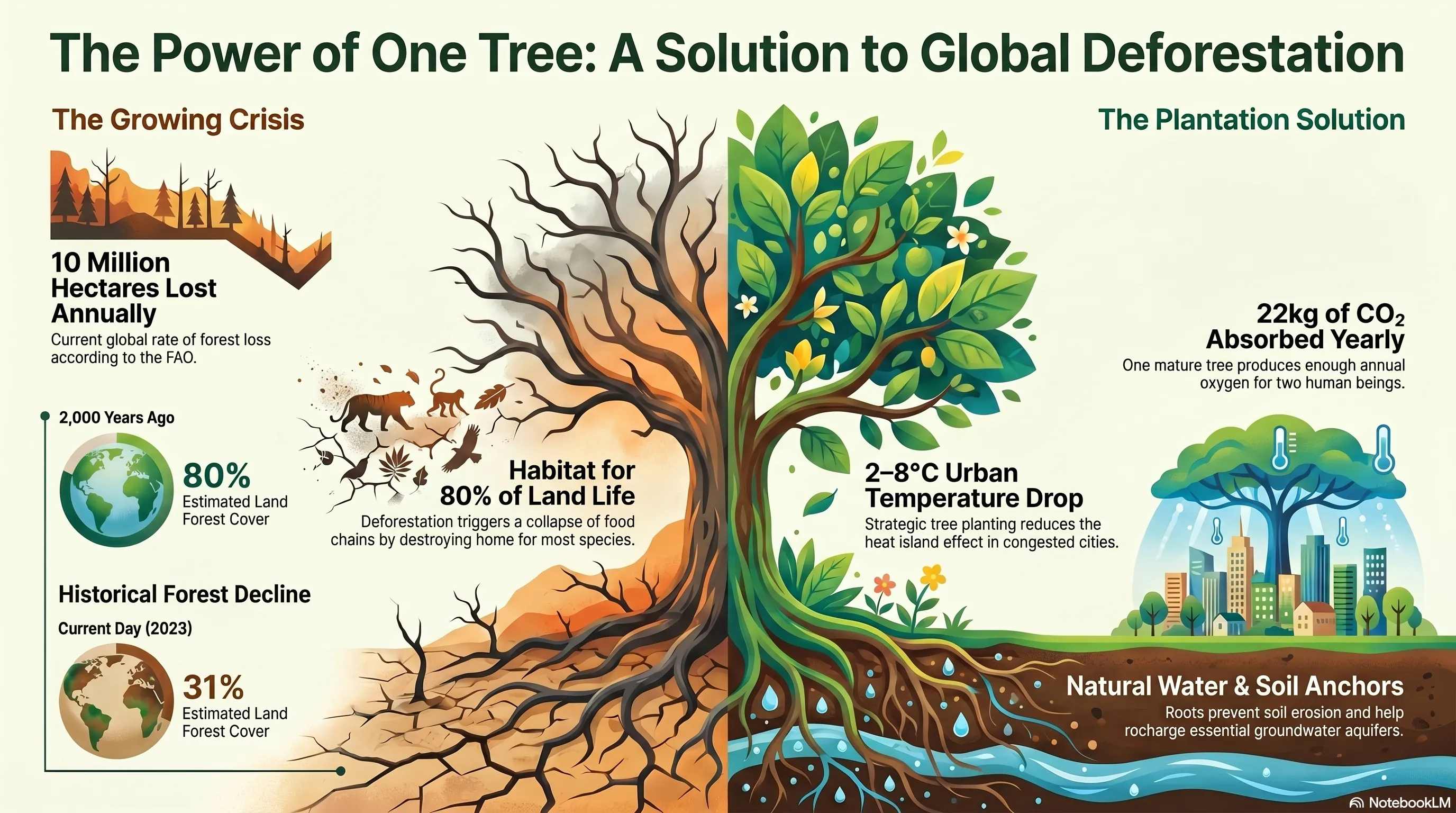
Table of Contents
- Key Points on Tree Plantation — Quick Reference
- 10 Lines on Tree Plantation for Kids (Class 1–3)
- Essay on Tree Plantation — 100 Words (Class 3 & 4)
- Essay on Tree Plantation — 150 Words (Class 5)
- Essay on Tree Plantation — 200 Words (Class 6)
- Essay on Tree Plantation — 300 Words (Class 7 & 8)
- Essay on Tree Plantation — 400 Words (Class 9)
- Essay on Tree Plantation — 500 Words (Class 10–12)
- Advantages and Disadvantages of Tree Plantation
- Slogans on Tree Plantation
- How to Write a Tree Plantation Essay — Tips

eSaral ›Foundation courses ›Essay On Tree Plantation

Key Points on Tree Plantation — Quick Reference
Use these points as the foundation of any essay or answer on tree plantation, regardless of word count.
| Point | Detail |
|---|---|
| Definition | Planting trees in areas with reduced or no green cover to restore the environment |
| Main purpose | Combat deforestation, reduce pollution, restore biodiversity |
| National initiative | Van Mahotsav — celebrated every July since 1950 in India |
| Trees absorb | Carbon dioxide (CO₂), sulphur dioxide (SO₂), carbon monoxide |
| Trees release | Oxygen — essential for all life |
| Role in soil | Tree roots prevent soil erosion and maintain soil fertility |
| Role in water | Trees support the water cycle and help recharge groundwater |
| Habitat role | Forests house 80% of the world's terrestrial biodiversity |
| Forest cover (global) | About 31% of Earth's land surface (World Bank, 2023) |
| Deforestation rate | Approximately 10 million hectares of forest lost per year (FAO) |
| Key Indian NGOs | Green Yatra, Grow Trees, Sankalp Taru, Say Trees, Save Green |
| Economic value | Trees provide wood, rubber, fruits, medicines, and raw materials |
10 Lines on Tree Plantation for Kids (Class 1–3)
- Tree plantation means planting trees in empty or barren places.
- Trees give us oxygen, which we need to breathe and stay alive.
- They absorb carbon dioxide and help keep the air clean and fresh.
- Trees provide shade, fruits, and shelter for birds and animals.
- Planting trees helps reduce pollution and global warming.
- Tree roots hold the soil together and stop it from washing away.
- In India, Van Mahotsav is a festival celebrated every July to plant trees.
- Deforestation — cutting down trees — harms nature and all living beings.
- Every person can help by planting at least one tree every year.
- Trees are our best friends — let us protect them and plant more.
Essay on Tree Plantation — 100 Words (Class 3 & 4)
Tree plantation means planting trees in areas where green cover has reduced. Trees are essential for life — they absorb carbon dioxide and release oxygen through photosynthesis. They provide shade, fruits, wood, and a safe home for birds and animals. Tree roots hold the soil together and prevent erosion. When forests are cut down, animals lose their homes and air becomes more polluted.
Planting trees is the best solution to fight deforestation and climate change. Even planting one tree makes a difference. Schools, communities, and governments all over India organise tree plantation drives. Let us all plant more trees and protect our environment for the future.
Essay on Tree Plantation — 150 Words (Class 5)
Tree plantation is the act of planting trees to restore forests and green cover that have been lost due to deforestation and urbanisation. Trees are among the most important living things on Earth. Through photosynthesis, they absorb the carbon dioxide we breathe out and release the oxygen we need to survive. They also filter harmful gases like sulphur dioxide and carbon monoxide from the air, acting as natural purifiers.
Beyond clean air, trees play a vital role in maintaining ecological balance. Their roots bind the soil, preventing erosion during heavy rains. They support biodiversity by providing food and shelter for countless species of birds, insects, and animals.
India celebrates Van Mahotsav every year in July, during which millions of trees are planted across the country. Every student, family, and community can participate in tree plantation drives. Planting one tree is a simple act with a lasting impact on our planet's health and future.
Essay on Tree Plantation — 200 Words (Class 6)
Tree plantation is one of the most meaningful contributions a person can make to the environment. As deforestation continues at an alarming rate — with approximately 10 million hectares of forest lost globally every year according to the Food and Agriculture Organization (FAO) — the need to actively plant more trees has never been greater.
Why Trees Are Essential
Trees perform several critical functions for the Earth and its inhabitants:
- Air purification: Trees absorb CO₂, SO₂, and other harmful gases while releasing oxygen. A single mature tree can absorb approximately 22 kilograms of CO₂ per year.
- Climate regulation: Forests absorb heat and release moisture, helping to moderate local temperatures and rainfall patterns.
- Soil conservation: Tree roots anchor the soil, preventing erosion caused by wind and rain.
- Water cycle: Trees release water vapour through transpiration, contributing to cloud formation and rainfall.
- Biodiversity: Forests are home to over 80% of all terrestrial plant and animal species on Earth.
How Tree Plantation Helps
Tree plantation directly reverses the damage caused by deforestation. When communities, schools, and NGOs plant trees on barren or degraded land, they restore habitats, improve air quality, and reduce the urban heat island effect. Every sapling planted today becomes a source of oxygen, shade, and life for decades to come.
Tree plantation is not a one-time event. It requires consistent care — watering, protecting from pests, and ensuring adequate space. The true success of tree plantation lies in the survival and growth of the trees planted, not just the number of saplings put in the ground.
Essay on Tree Plantation — 300 Words (Class 7 & 8)
Tree plantation is the deliberate process of planting trees to restore forest cover, improve environmental conditions, and support sustainable development. In an era of rapid urbanisation and industrialisation, tree plantation has emerged as one of the most accessible and impactful ways for individuals and communities to address environmental degradation.
The Consequences of Deforestation
Deforestation — the large-scale removal of forests — is one of the most serious environmental challenges of our time. Historically, forests covered approximately 80% of Earth's land surface. Today, only about 31% remains (World Bank, 2023). Forests are cleared for agriculture, construction, mining, and fuel. The consequences are severe:
- Rising levels of CO₂ in the atmosphere, accelerating global warming
- Loss of habitat for millions of plant and animal species
- Increased frequency and severity of floods and droughts
- Soil degradation and loss of agricultural productivity
- Disruption of the water cycle, leading to erratic rainfall
What Tree Plantation Achieves
Tree plantation directly counters each of these consequences. Newly planted trees begin absorbing CO₂ within their first year of growth. As they mature, they provide increasing ecosystem services — cleaner air, cooler temperatures, reduced flood risk, and restored habitat. Urban tree plantation in cities reduces the heat island effect, lowers air conditioning energy demands, and improves mental well-being among residents.
India's Tree Plantation Initiatives
India has a long tradition of organised tree plantation. Van Mahotsav, launched in 1950, is a week-long festival held every July during which millions of saplings are planted across the country. The National Afforestation Programme supports state forest departments in planting on degraded land. Several NGOs — including Green Yatra, Grow Trees, and Sankalp Taru — have planted millions of trees through community and school partnerships.
Individual Responsibility
Tree plantation is not only the government's responsibility. Every student can participate in school plantation drives. Every family can plant in their garden, balcony, or neighbourhood. Every act of planting — however small — contributes to a collective effort that has the power to reverse decades of environmental damage.
The best time to plant a tree was twenty years ago. The second-best time is now.
Essay on Tree Plantation — 400 Words (Class 9)
Tree plantation is the organised practice of growing trees to restore the ecological balance disrupted by decades of deforestation, urbanisation, and industrial expansion. It is one of the most powerful tools available to humanity in the fight against climate change, biodiversity loss, and environmental degradation. Yet despite its proven benefits, the rate of tree plantation worldwide still lags far behind the rate of deforestation.
Economic Benefits of Tree Plantation
The value of trees extends well beyond the environment. Trees are a significant source of economic resources — providing timber, rubber, fruits, resins, medicines, and fibres used across industries. In rural India, trees planted on agricultural land (agroforestry) supplement farming income and reduce dependence on a single crop. According to the World Agroforestry Centre, agroforestry systems can increase farm income by 10–30% in many parts of South Asia.
Urban trees also generate measurable economic value. Studies show that properties located near mature trees command higher market values. Cities with significant green cover attract tourism, reduce municipal energy costs through natural cooling, and experience lower rates of stormwater damage due to better water absorption.
Tree Plantation and Biodiversity
Forests are the most biodiverse ecosystems on Earth. They house approximately 80% of all terrestrial plant species, 75% of all bird species, and 68% of all mammal species. When forests are cleared, entire food chains collapse. Species that cannot adapt quickly enough face extinction — and extinction is permanent.
Tree plantation — particularly when it involves native species — directly restores these habitats. Native trees attract the specific insects, birds, and animals that evolved alongside them, creating functional ecosystems rather than just green cover. This is why conservationists emphasise planting native species rather than fast-growing monocultures that provide little biodiversity value.
The Role of NGOs and Schools
In India, NGOs have emerged as vital partners in tree plantation. Organisations like Say Trees in Bangalore, Grow Trees, and Green Life have collectively planted millions of trees by partnering with schools, corporations, and local communities. School-level plantation programmes are particularly impactful — children who plant and care for a tree develop a lifelong connection to the environment.
A Collective Call to Action
Tree plantation succeeds only when it is a collective, sustained effort. Planting saplings without follow-up care results in low survival rates. Communities must commit to watering, protecting, and monitoring trees after planting. Governments must enforce anti-deforestation laws while simultaneously funding large-scale afforestation. Individuals must plant, protect, and spread awareness.
The relationship between humans and trees is ancient and inseparable. Trees sustained us through food and shelter for millennia. It is now our responsibility to sustain them.
Essay on Tree Plantation — 500 Words (Class 10–12)
Introduction
Tree plantation — the deliberate planting of trees on barren, degraded, or deforested land — is among the most urgent and accessible environmental actions of our time. With global forest cover declining by approximately 10 million hectares annually and atmospheric CO₂ levels reaching record highs, tree plantation represents both a practical and symbolic commitment to restoring the planet's ecological health. It is a solution that is simultaneously local and global, individual and collective, immediate and generational.
The Scale of the Crisis
The numbers surrounding deforestation are stark. Two thousand years ago, forests covered roughly 80% of the Earth's habitable land surface. Today, that figure stands at approximately 31%, with the loss continuing at an accelerating pace driven by agriculture, logging, urban expansion, and mining. The Amazon rainforest — often called the "lungs of the Earth" — has lost over 17% of its area in the last 50 years. In India, despite significant afforestation efforts, net forest cover remains under pressure in biodiversity-rich states like the Northeast.
The consequences of this loss are compounding. Rising CO₂ levels accelerate global warming, which in turn triggers more extreme weather events — floods, droughts, and unseasonal rainfall. Soil erosion reduces agricultural productivity. Species extinction eliminates potential medicines and disrupts food chains in ways that are difficult to fully predict or reverse.
What Tree Plantation Achieves — The Science
A single mature tree absorbs approximately 22 kilograms of CO₂ per year and produces enough oxygen for two human beings. Forests as a whole absorb about 2.6 billion tonnes of CO₂ annually — roughly one-third of all CO₂ released by fossil fuel combustion. Beyond carbon, trees regulate local climate by shading surfaces and releasing water vapour, reducing ambient temperatures in urban areas by 2–8°C compared to treeless zones.
Tree roots perform essential hydrological work — slowing runoff, preventing soil erosion, and recharging groundwater aquifers. In regions prone to flooding, a well-forested watershed can reduce peak flood flows by up to 25%, protecting downstream communities and farmland.
Tree Plantation in India — Initiatives and Progress
India has one of the world's most active national afforestation programmes. Van Mahotsav, initiated in 1950 by K. M. Munshi (India's first Agriculture Minister), has grown into an annual week-long celebration of tree planting held every July. The National Afforestation Programme funds plantation on degraded forest land across all states. Under the Green India Mission — one of the eight missions of India's National Action Plan on Climate Change — the government aims to increase forest cover to 33% of the country's geographical area.
At the grassroots level, NGOs have proven to be powerful drivers of change. Organisations like Green Yatra (Mumbai), Sankalp Taru, and Say Trees (Bangalore) have collectively planted millions of trees through school partnerships, corporate CSR collaborations, and community drives. Their success demonstrates that large-scale tree plantation is achievable when communities take ownership.
The Responsibility of Individuals
Governments and NGOs cannot act alone. Every individual has a role. Planting one tree per year — tended, watered, and monitored — is a concrete, measurable contribution. Choosing wood products from certified sustainable sources reduces the commercial incentive for illegal logging. Educating peers and family members about the value of forests creates a culture of environmental stewardship that is far more durable than any single policy.
Conclusion
Tree plantation is not merely an environmental activity — it is an act of civilisational responsibility. The choices this generation makes about forests will determine the climate, water supply, and biodiversity available to the next. Planting a tree is an investment in a future we may not fully live to see, but one that the children of today will inherit entirely. Every sapling planted is a declaration that we choose life — for the planet and for each other.
Advantages and Disadvantages of Tree Plantation
For balanced essays and debate-style exam questions:
Advantages
| Benefit | Explanation |
|---|---|
| Reduces air pollution | Trees absorb CO₂, SO₂, and particulate matter |
| Combats climate change | Forests absorb ~2.6 billion tonnes of CO₂ annually |
| Prevents soil erosion | Roots anchor soil against wind and rain |
| Supports biodiversity | Native trees restore habitats for wildlife |
| Regulates water cycle | Trees contribute to rainfall through transpiration |
| Economic value | Timber, fruits, rubber, medicines — all forest products |
| Reduces urban heat | Urban trees lower city temperatures by 2–8°C |
| Improves mental health | Green spaces reduce stress and improve well-being |
Disadvantages / Challenges
| Challenge | Explanation |
|---|---|
| Low survival rates | Many planted saplings die without follow-up care |
| Monoculture risk | Planting single species creates ecologically fragile forests |
| Invasive species risk | Non-native trees can displace local biodiversity |
| Land conflicts | Plantation on degraded land may conflict with local land use |
| Time to maturity | Trees take decades to reach full environmental benefit |
💡 Writing Tip: In a balanced essay, acknowledge the challenges in a single paragraph and immediately follow with how they can be addressed (e.g., "While low survival rates are a concern, structured care programmes and community involvement can significantly improve outcomes"). This shows critical thinking without undermining your main argument.
Slogans on Tree Plantation
Use these in posters, speeches, or essay conclusions:
- Plant a tree, plant a life.
- Trees are the lungs of the Earth — let them breathe.
- Save trees, save lives.
- One person, one tree, one planet.
- Don't cut trees — they cut pollution for you.
- A world without trees is a world without future.
- Plant today for a greener tomorrow.
- Trees give life — give back to them.
- Forests are not just wood — they are home.
- Go green. Plant trees. Save the Earth.
How to Write a Tree Plantation Essay — Tips
Choose Your Angle Based on the Question
Tree plantation essays can be approached from multiple angles. Match your angle to the exam instruction:
| Question Phrasing | Best Angle |
|---|---|
| "Write an essay on tree plantation" | Benefits + importance + call to action |
| "Discuss the importance of tree plantation" | Environmental + economic + social benefits |
| "Describe the effects of deforestation and role of tree plantation" | Problem + solution format |
| "Write a paragraph on tree plantation" | 5–6 sentences, most important facts only |
Structure for Each Word Count
- 100 words: Definition + 2 benefits + one sentence call to action
- 150 words: Add habitat and soil conservation; 1 India-specific fact
- 200 words: Add data (FAO, CO₂ absorption) + specific benefits in bullet or short para form
- 300 words: Full problem (deforestation) + solution (tree plantation) + India initiatives + individual role
- 400–500 words: Add economic angle + biodiversity + NGO examples + strong conclusion with quote or data
Opening Lines That Score Well
Avoid: "In this essay, I will write about tree plantation."
Try instead:
- "Every minute, an area of forest the size of 27 football fields is lost to deforestation."
- "Trees have sustained human civilisation for thousands of years — it is now our turn to sustain them."
- "The best time to plant a tree was twenty years ago. The second-best time is now."
Frequently Asked Questions
Find answers to common questions.
What are the main benefits of tree plantation?
Tree plantation provides environmental, economic, and social benefits. Environmentally, trees absorb CO₂, release oxygen, prevent soil erosion, regulate the water cycle, and restore biodiversity. Economically, they supply timber, fruits, rubber, and medicines. Socially, trees improve air quality, reduce urban heat, provide shade, and enhance community well-being. A single mature tree absorbs approximately 22 kilograms of CO₂ per year and produces enough oxygen for two people.
How do you write a tree plantation essay for Class 5?
For Class 5, write a 150-word essay with three parts: an introduction defining tree plantation, a body covering two or three benefits (clean air, habitat for animals, soil conservation), and a conclusion with a call to action. Use simple sentences, include one India-specific fact (such as Van Mahotsav), and avoid complex vocabulary. End with an encouraging sentence about how students can participate in planting drives.
What are 10 lines on tree plantation for kids?
Tree plantation means planting trees in empty or barren areas. Trees give us oxygen and absorb carbon dioxide. They provide shade, fruits, and homes for birds and animals. Planting trees reduces pollution and helps fight climate change. Tree roots hold soil together and prevent erosion. India celebrates Van Mahotsav every July to plant trees across the country. Deforestation harms nature and all living beings. NGOs and schools organise tree plantation drives. Everyone can help by planting at least one tree. Trees are our best friends — let us plant and protect them.
What is Van Mahotsav and why is it important for a tree plantation essay?
Van Mahotsav is India's annual tree plantation festival, launched in 1950 by Agriculture Minister K. M. Munshi. It is celebrated every year during the first week of July, during which millions of trees are planted across the country by schools, government bodies, and NGOs. Mentioning Van Mahotsav in your essay demonstrates India-specific knowledge, which earns additional marks in CBSE and state board exams. It also shows that tree plantation is a national priority, not just an individual choice.
What is the difference between tree plantation and afforestation?
Tree plantation refers broadly to the act of planting trees — in gardens, schools, roadsides, or degraded areas. Afforestation is a more specific term referring to the establishment of a forest or stand of trees in an area where there was no recent tree cover. All afforestation is tree plantation, but not all tree plantation is afforestation. For school essays, both terms are often used interchangeably, but understanding the distinction is useful for Class 9–12 exams.