JEE 2026 April Attempt Strategy: How to Get 99 Percentile & IIT After a Bad January Result
Recover from a poor JEE January attempt with a structured 40-day strategy featuring focused revision, advanced practice, mock test analysis, mentorship, and disciplined preparation to maximize your April attempt and target a 99+ percentile.
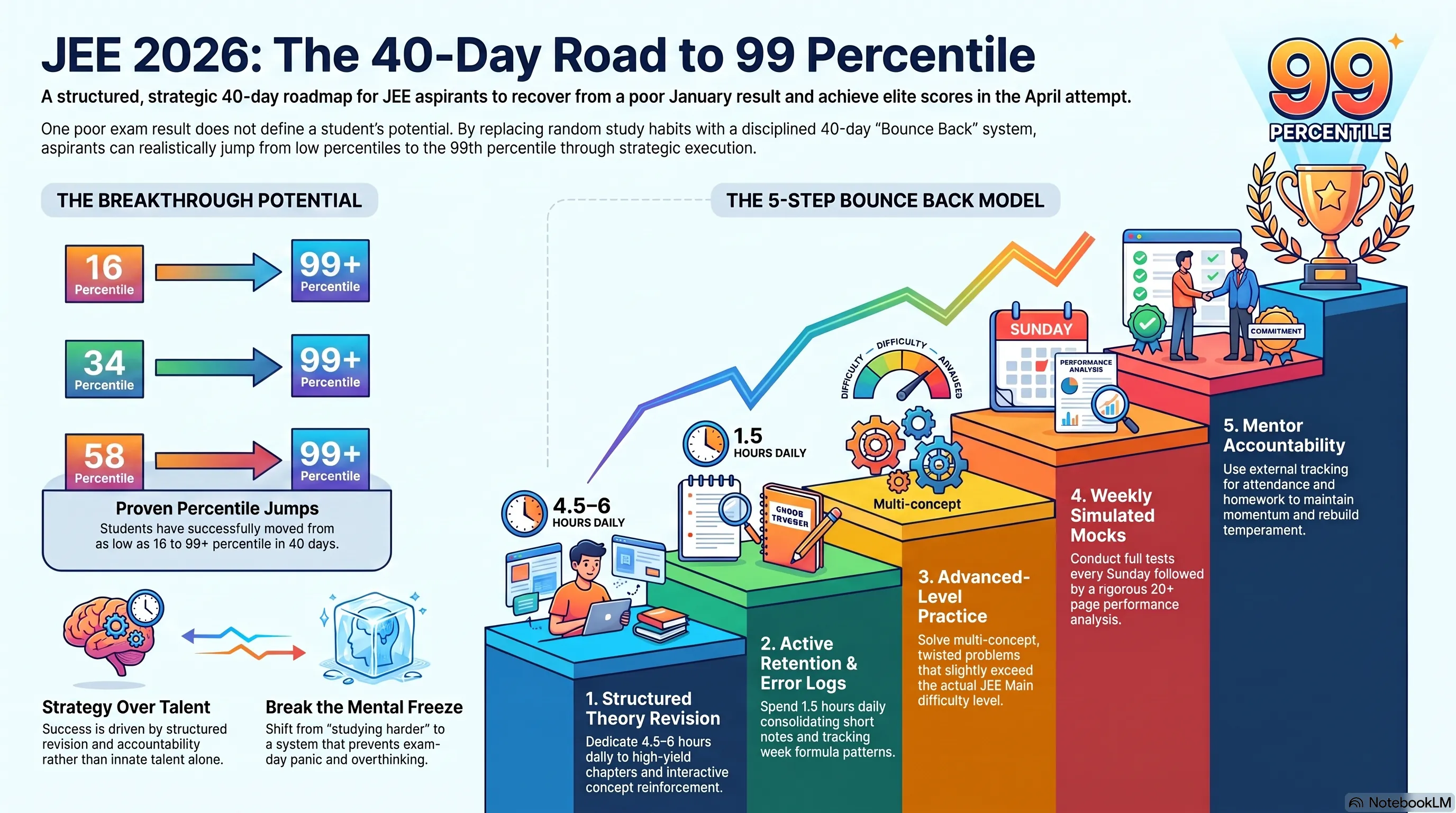
Table of Contents
- Can You Really Jump to 99 Percentile in April?
- The Real Problem After a Bad Attempt
- The 40-Day Bounce Back Model for JEE 2026
- Subject-Wise April Strategy
- What If Your Mock Scores Were High but Actual Paper Went Bad?
- Is It Too Late Now?
- About the JEE 2026 Eisham Bounce Back 2.0 Crash Course
- Final Thought

eSaral › JEE › JEE Main ›JEE 2026 April Attempt Strategy: How to Get 99 Percentile & IIT After a Bad January Result

🚀 Checkout eSaral Courses
Many serious JEE aspirants are stuck in the same mental loop:
-
“January attempt went badly.”
-
“Mocks were good, but I panicked in the real exam.”
-
“What if April also goes wrong?”
-
“Can I still get 99 percentile?”
-
“Is IIT still possible?”
If your percentile is 47, 37, 16, 70, or even 80 — this article is for you.
Because one paper does not define your preparation level.
And more importantly — 40 focused days can completely change your rank trajectory.
Can You Really Jump to 99 Percentile in April?
Yes — but only under one condition:
You stop overthinking and start structured execution.
Every year, students move:
-
58 → 99 percentile
-
34 → 99 percentile
-
16 → 99 percentile
-
70 → 99+ percentile
The difference is not “talent.”
The difference is:
-
Structured revision
-
Daily high-level practice
-
Mentorship + accountability
-
Real mock test analysis
This is exactly where most students fail.
They try to “study harder.”
Instead, they need to “study strategically.”
The Real Problem After a Bad Attempt
From thousands of student conversations, common issues are:
-
Panic in exam hall
-
Chemistry level not matching actual paper
-
Physics unexpectedly tough
-
Mock score ≠ actual performance
-
Backlogs overwhelming
-
No daily structure
-
Sleep cycle disturbed
-
Constant comparison and negative comments
This creates a mental freeze.
You want to study — but you can’t move.
To break this loop, you need a system, not motivation.
The 40-Day Bounce Back Model for JEE 2026
To realistically aim for 99 percentile in April, your next 40 days must follow a disciplined structure:
Step 1: 4.5–6 Hours Daily Structured Theory Revision
Not random YouTube hopping.
Not scattered PDFs.
Focused concept reinforcement with:
-
High-yield chapters
-
Application-oriented examples
-
PYQ-aligned explanations
In structured programs like eSaral’s Eisham Bounce Back 2.0 Crash Course (Main + Advanced), this is done through daily live interactive classes covering Physics, Chemistry, and Mathematics from fundamentals to exam-relevant level.
Step 2: 1.5 Hours Guided Notes Consolidation
After theory:
-
Revise short notes
-
Highlight weak formulas
-
Create error log
-
Strengthen frequently asked concepts
This converts passive learning into active retention.
Step 3: Advanced-Level Practice (Not Basic Sheets)
Many students plateau because they solve easy questions repeatedly.
The April attempt usually demands:
-
Twisted conceptual application
-
Multi-concept blending
-
Slightly elevated chemistry level
-
Analytical physics problems
eSaral’s Special 26 Question Bank and selected module problems are designed to:
-
Match JEE Main level
-
Slightly exceed it
-
Prepare students for Advanced crossover
This prevents shock during the actual exam.
Step 4: Weekly Full-Length Mock Tests
Every serious aspirant should:
-
Give one full test every Sunday
-
Simulate real exam environment
-
Avoid pause/restart
But the most important part is:
20+ Page Detailed Test Analysis
Not just score checking.
You must identify:
-
Time lost areas
-
Silly mistake patterns
-
Weak chapter clusters
-
Over-attempt mistakes
Structured mentorship systems like eSaral provide detailed performance analytics and mentor guidance to convert analysis into improvement.
Step 5: Daily Mentor Accountability
Most students fail not because of low IQ — but because of lack of accountability.
When no one tracks:
-
Whether you attended class
-
Whether you completed homework
-
Whether you attempted tests
Momentum collapses.
In the Bounce Back 2.0 model, students are assigned mentors who:
-
Track class attendance
-
Check homework consistency
-
Guide post-test correction
-
Push students during low motivation phases
This external structure helps rebuild exam temperament.
Subject-Wise April Strategy
Physics
-
Focus on modern physics, current electricity, mechanics core, and electrostatics
-
Solve PYQs in timed mode
-
Strengthen formula application speed
Chemistry
Chemistry can swing percentile dramatically.
Divide into:
-
IOC: Memory + NCERT precision
-
OC: Mechanism clarity
-
PC: Numerical speed + conceptual clarity
High-quality question banks like Special 26 help students adjust to elevated chemistry levels seen in recent papers.
Mathematics
-
Prioritize high-weight chapters
-
Practice mixed question sets
-
Improve question selection strategy
Many students lose marks due to poor time allocation — not lack of knowledge.
What If Your Mock Scores Were High but Actual Paper Went Bad?
This is common.
Reasons include:
-
Exam anxiety
-
Overconfidence
-
Time mismanagement
-
Unexpected paper pattern
The solution is:
More simulated full-length testing + mentor review.
Structured crash courses combine:
-
Live classes
-
Practice modules
-
Weekly tests
-
Advanced PYQ practice
-
Rank booster material
Which improves both knowledge and exam temperament.
Is It Too Late Now?
No.
If 40 days are left:
Each day equals thousands of rank positions.
If approximately 2 lakh serious students compete:
One focused day = massive rank shift potential.
The question is:
Will you spend the next 40 days in regret —
or in structured execution?
About the JEE 2026 Eisham Bounce Back 2.0 Crash Course
The course includes:
-
Daily live interactive classes (Physics, Chemistry, Mathematics)
-
4.5+ hours structured concept teaching
-
Guided revision plan
-
Special 26 Question Bank
-
Selected eSaral module problems
-
JEE Main + Advanced PYQs
-
Rank Booster material
-
Weekly full-length tests
-
Detailed performance analysis
-
Dual mentorship support
-
Live doubt-solving system
-
Homework tracking
It is designed specifically for students who:
-
Underperformed in January
-
Want 99 percentile in April
-
Aim for IIT through structured comeback
Instead of random preparation, this provides a complete comeback system.
Final Thought
Sympathy does not improve rank.
Structured effort does.
One bad attempt does not define you.
But the next 40 days will.
If you are serious about 99 percentile in JEE 2026 —
focus, structure, accountability, and high-level practice are non-negotiable.
Frequently Asked Questions
Find answers to common questions.
Can I get 99 percentile in JEE 2026 April attempt after a low January score?
Yes, it is entirely achievable. Many students at eSaral have moved from 34 percentile in January to 99 percentile in April by following a structured 40-day plan. The key components are daily concept revision, advanced-level practice beyond standard mock difficulty, weekly full-length test analysis, and mentor accountability. The gap between attempts is enough time to fix specific weaknesses if approached systematically.
How many hours should I study daily in the last 40 days for JEE Main?
Quality-focused students typically study 10–14 hours daily in the final 40 days. A sustainable structure is: 4–6 hours theory revision, 2–3 hours advanced problem solving, 1.5 hours notes and error log consolidation, and 1–2 hours weak topic correction. Raw hours matter less than structured time blocks with defined goals for each session.
What is the most important single factor for improving in the April attempt?
Mock test analysis is the highest-leverage activity. Most students give tests but spend fewer than 20 minutes reviewing mistakes. Detailed analysis — identifying which chapters cost the most time, which errors repeat, and which question types you over-attempt — directly converts into score improvement. Structured mentorship that guides this analysis process accelerates improvement significantly.
How should I improve Chemistry for JEE Main 2026 in 40 days?
Divide Chemistry into three distinct tracks. For Inorganic, read NCERT line by line — every exception and trend is exam material. For Organic, focus on mechanism understanding rather than memorising products. For Physical, time your numerical practice and maintain an error log for formula mistakes. Practising from a curated question bank calibrated to recent NTA paper trends is essential given how much Chemistry difficulty has shifted in recent sessions.
s daily mentorship really necessary for JEE April preparation?
Yes. The research on consistency in high-pressure preparation is clear: external accountability structures produce better outcomes than self-discipline alone, especially after a setback. When a mentor tracks your class attendance, homework, and test performance, you are significantly less likely to lose momentum during low-motivation phases — which every serious aspirant experiences in the final stretch.