JEE Main 2026 Jan 21 Shift 1 Paper Analysis: Difficulty, Weightage & Student Reactions
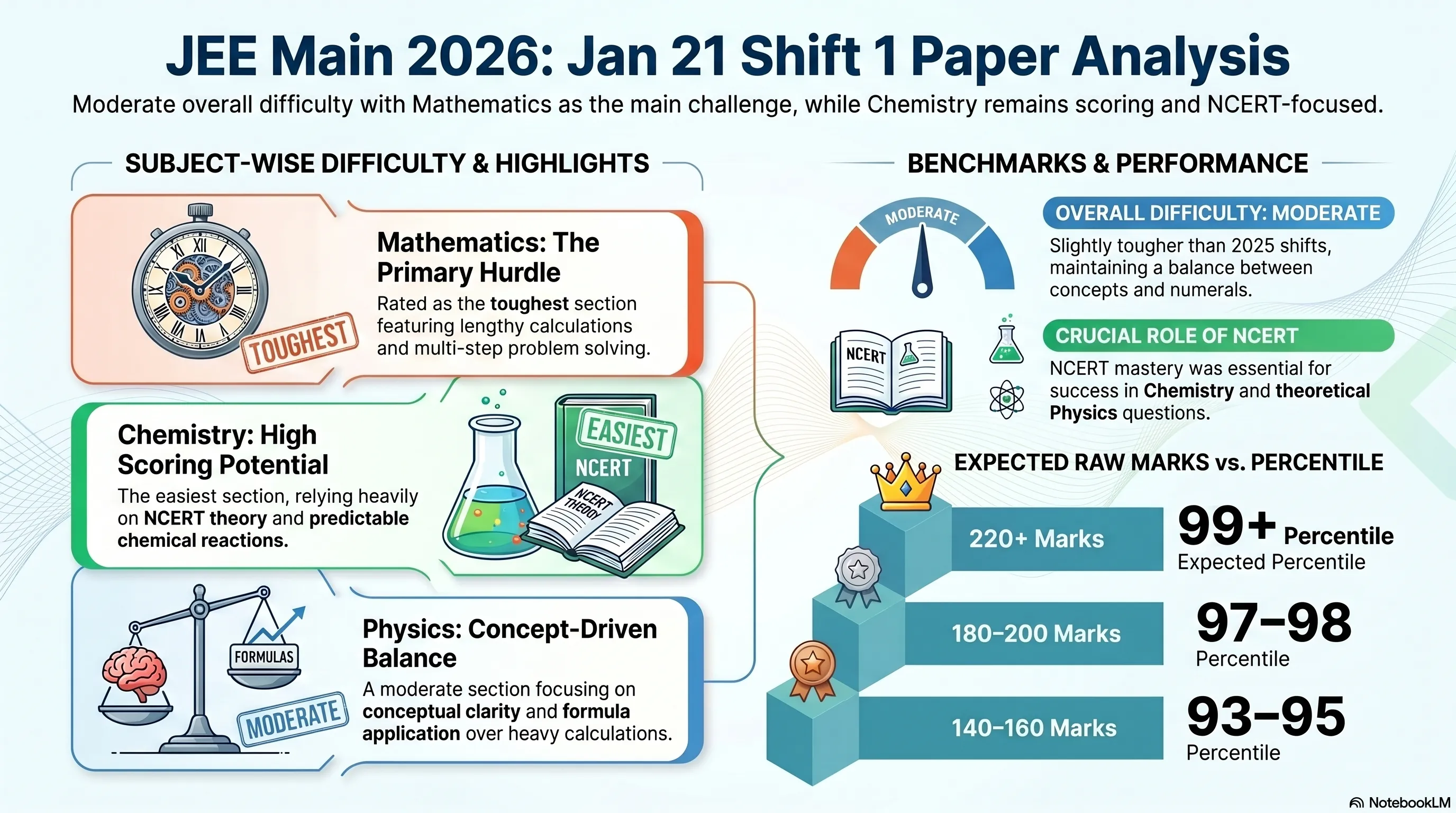
JEE Main 2026 Jan 21 Shift 1 was a moderate, balanced, and concept-driven paper with easy-to-moderate Chemistry, moderate Physics, and lengthy Mathematics, emphasizing NCERT-based concepts, strong problem-solving skills, and effective time management.

eSaral › JEE › JEE Main ›JEE Main 2026 Jan 21 Shift 1 Paper Analysis

🚀 Checkout eSaral Courses
The JEE Main 2026 January 21 Shift 1 paper marked the beginning of this year’s JEE Main session and set the tone for what aspirants can expect in upcoming shifts. As always, students were eager to know about the paper level, toughness, chapter-wise weightage, and overall trend.
In this detailed analysis, we bring you a complete breakdown of the paper based on student feedback and expert review. If you are preparing for upcoming sessions or JEE Advanced, joining a focused JEE Crash Course can help you revise effectively and boost your score in a short time.
Overall Paper Difficulty – Jan 21 Shift 1
The overall difficulty level of JEE Main 2026 Jan 21 Shift 1 can be classified as:
✅ Moderate
The paper maintained a balance between conceptual and numerical questions. It was neither too easy nor excessively tough, making it a fair paper for well-prepared students.
|
Parameter |
Verdict |
|
Overall Difficulty |
Moderate |
|
Time Management |
Slightly Tight |
|
Length of Paper |
Moderate |
|
Conceptual Level |
Moderate to High |
|
Surprise Elements |
Few |
Subject-wise Difficulty Analysis
Physics Analysis – Jan 21 Shift 1
Physics was rated Moderate, with emphasis on conceptual clarity and formula application.
Physics Highlights:
- Questions were more concept-based than calculation-heavy
- NCERT-based theory questions were visible
- Some tricky questions from Modern Physics and Electrodynamics
Physics Difficulty: 🟡 Moderate
Chemistry Analysis – Jan 21 Shift 1
Chemistry emerged as the easiest section among the three.
Chemistry Highlights:
- Inorganic Chemistry was directly NCERT-based
- Organic had predictable reactions
- Physical Chemistry was formula-driven
Chemistry Difficulty: 🟢 Easy to Moderate
Mathematics Analysis – Jan 21 Shift 1
Mathematics was the toughest section in this shift.
Mathematics Highlights:
- Lengthy calculations
- Questions required multi-step problem solving
- Strong hold on Algebra and Calculus was necessary
Mathematics Difficulty: 🔴 Moderate to Tough
Chapter-wise Weightage – Jan 21 Shift 1
Here is the approximate chapter-wise distribution based on memory-based questions:
Physics Weightage
|
Chapter |
Weightage |
|
Current Electricity |
2–3 |
|
Modern Physics |
2–3 |
|
Ray Optics |
2 |
|
Laws of Motion |
1–2 |
|
Electrostatics |
1–2 |
|
Thermodynamics |
1–2 |
Chemistry Weightage
|
Chapter |
Weightage |
|
Chemical Bonding |
2–3 |
|
Coordination Compounds |
2 |
|
Thermodynamics |
1–2 |
|
Electrochemistry |
1–2 |
|
Hydrocarbons |
2 |
|
Periodic Table |
1–2 |
Mathematics Weightage
|
Chapter |
Weightage |
|
Limits & Continuity |
2 |
|
Definite Integration |
2–3 |
|
Matrices & Determinants |
2 |
|
Vector & 3D |
2–3 |
|
Quadratic Equations |
1–2 |
|
Probability |
1–2 |
Toughness Level Compared to Previous Years
Compared to JEE Main 2025 January papers:
|
Parameter |
Jan 2026 Shift 1 |
|
Overall Level |
Slightly Higher |
|
Mathematics |
Tougher |
|
Chemistry |
Easier |
|
Physics |
Similar |
👉 The paper was a little tougher than the average 2025 shift but still within JEE Main standards.
Students’ Reactions – Jan 21 Shift 1
Based on student feedback after the exam:
What Students Liked 👍
- Chemistry was scoring
- Physics was balanced
- No out-of-syllabus questions
- NCERT played a major role
What Troubled Students 👎
- Maths was lengthy
- Time management in Mathematics
- Few tricky Physics questions
Common Student Opinion:
“Paper was fair but Maths consumed a lot of time.”
If you are preparing for upcoming sessions or JEE Advanced, joining a focused JEE Crash Course can help you revise effectively and boost your score in a short time.
Expected Cut-off Trend Based on This Shift
Since the paper was Moderate, the expected percentile vs marks trend may look like:
|
Marks |
Expected Percentile |
|
220+ |
99+ |
|
180–200 |
97–98 |
|
140–160 |
93–95 |
|
100–120 |
88–90 |
(Indicative only, actual may vary)
To understand how your raw score translates into percentile, check the detailed JEE Mains Marks vs Percentile analysis.
What This Means for Upcoming Shifts
If you are appearing in later shifts:
- Focus on speed in Maths
- Revise NCERT thoroughly for Chemistry
- Strengthen Modern Physics & Current Electricity
- Practice mixed conceptual problems
Final Verdict – JEE Main 2026 Jan 21 Shift 1
The paper was balanced, fair, and concept-driven.
Students with:
- Strong NCERT base
- Regular mock practice
- Time management skills
were able to perform well in this shift.
🚀 Checkout eSaral Courses
Frequently Asked Questions
Find answers to common questions.
Was JEE Main 2026 Jan 21 Shift 1 paper tough?
The paper was Moderate overall. Mathematics was relatively tougher due to lengthy multi-step calculations, but Physics and Chemistry were balanced. Students who managed their time well and had a strong NCERT foundation found the paper fair and completable within the given 3 hours.
Which section was the easiest in Jan 21 Shift 1?
Chemistry was the easiest and most scoring section in this shift. Inorganic Chemistry questions were closely based on NCERT text, Organic Chemistry had standard reactions, and Physical Chemistry numericals had clean, manageable numbers. Students strong in Chemistry had a clear scoring advantage.
Which subject was toughest in JEE Main 2026 Jan 21 Shift 1?
Mathematics was the toughest section. Questions required multi-step problem solving with lengthy calculations, particularly in Definite Integration and Vector & 3D Geometry. Students who attempted Maths without a time strategy struggled to complete the section, which hurt their overall scores.
Was the Jan 21 Shift 1 paper based on NCERT?
Yes, significantly so — especially in Chemistry and Physics theory. NCERT formed the backbone of Inorganic Chemistry questions and several Physics conceptual problems. Students who had read NCERT carefully, particularly Class 11 and 12 Chemistry, reported that many questions felt familiar and direct.
Can JEE Main 2026 Jan 21 Shift 1 be considered a high-scoring paper?
Yes, for students strong in Chemistry and Physics it was a good scoring opportunity. Chemistry alone could fetch 60–70+ marks with thorough NCERT preparation. A combined strong performance in Physics and Chemistry could cover for a moderate Mathematics score and still push overall percentile above 95.