JEE Main 2026 Jan 24 Shift 2 Paper Analysis: Difficulty, Weightage & Student Reactions
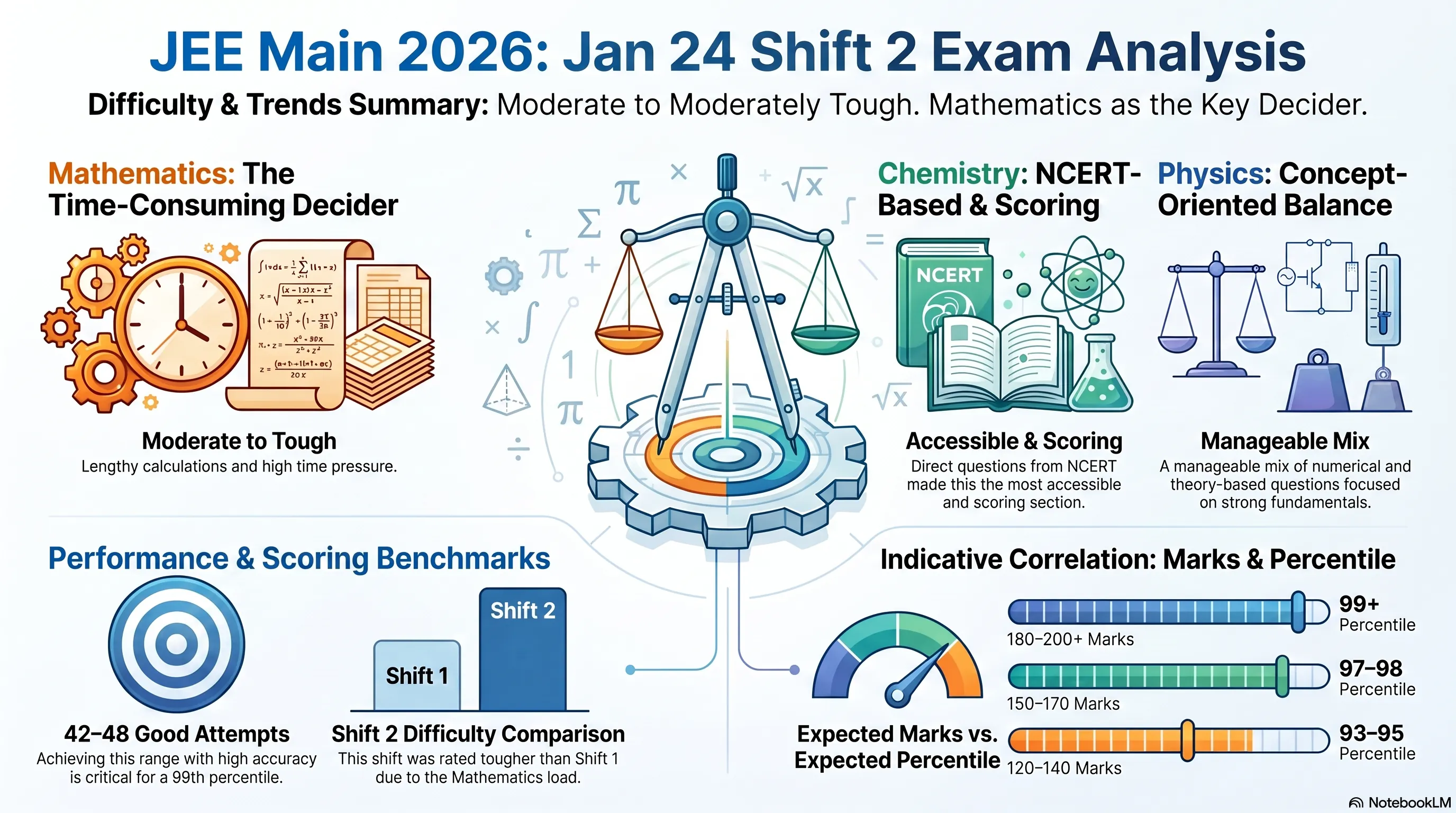
The JEE Main 2026 Jan 24 Shift 2 paper was moderate to moderately tough, featuring balanced Physics, NCERT-based Chemistry, and lengthy Mathematics, making speed, accuracy, and time management crucial for a high score.

eSaral › JEE › JEE Main ›JEE Main 2026 Jan 24 Shift 2 Paper Analysis: Difficulty, Weightage & Student Reactions

🚀 Checkout eSaral Courses
The JEE Main 2026 January 24 Shift 2 exam was conducted by NTA in the afternoon session. Based on student feedback and exam pattern observations, the paper followed the standard JEE Main format with a balanced distribution of conceptual and calculation-based questions.
This detailed analysis includes:
- Overall difficulty level
- Subject-wise paper review
- Chapter-wise weightage trends
- Toughness comparison
- Student reactions
- Performance outlook
Overall Difficulty Level – Jan 24 Shift 2
|
Parameter |
Level |
|
Overall Difficulty |
Moderate to Moderately Tough |
|
Paper Length |
Moderate to Lengthy |
|
Conceptual Level |
Moderate |
|
Calculation Intensity |
High (especially Mathematics) |
|
Time Management |
Challenging |
📌 Many students felt that time management was the key challenge, mainly because of lengthy Mathematics questions.
Subject-wise Paper Analysis – Jan 24 Shift 2
Physics Analysis
Difficulty Level: Moderate
Physics was concept-oriented with a mix of numerical and theory-based questions. Students with strong fundamentals found this section manageable.
Important Topics Asked:
- Electrostatics
- Magnetic Effects of Current
- Ray Optics
- Thermodynamics
- Modern Physics
Student Reaction:
Physics was balanced and not overly tricky.
Chemistry Analysis
Difficulty Level: Easy to Moderate
Chemistry was largely NCERT-based, making it a scoring section for students with good theoretical preparation.
Important Topics Asked:
- Coordination Compounds
- Biomolecules
- Chemical Kinetics
- Thermodynamics
- Organic Reaction Mechanism
Student Reaction:
Chemistry was direct and largely from NCERT.
Mathematics Analysis
Difficulty Level: Moderate to Tough
Mathematics emerged as the most time-consuming section of this shift. Questions were lengthy and calculation-heavy.
Important Topics Asked:
- Vector & 3D Geometry
- Matrices and Determinants
- Integration
- Differential Calculus
- Conic Sections
Student Reaction:
Maths was lengthy and required strong speed and accuracy.
Chapter-wise Weightage Trend (Observed)
Physics
- Electrostatics & Magnetism
- Optics
- Modern Physics
Chemistry
- Inorganic Chemistry (NCERT)
- Physical Chemistry numericals
- Organic Chemistry reactions
Mathematics
- Calculus
- Vector & 3D Geometry
- Algebra
- Coordinate Geometry
Good Attempts & Expected Performance – Jan 24 Shift 2
|
Parameter |
Expected Range |
|
Good Attempts |
42–48 |
|
High Accuracy Attempts |
Critical for 99%ile |
|
Time Pressure Sections |
Mathematics |
Expected Marks vs Percentile (Indicative)
|
Marks |
Expected Percentile |
|
180–200+ |
99+ |
|
150–170 |
97–98 |
|
120–140 |
93–95 |
|
100–120 |
90–92 |
👉 Students can estimate their percentile using a detailed JEE Mains Marks vs Percentile analysis.
Student Reactions – Jan 24 Shift 2
What Students Liked 👍
- Predictable paper pattern
- Physics and Chemistry were manageable
- No out-of-syllabus questions
What Students Found Difficult 👎
- Lengthy Mathematics
- High calculation load
- Time pressure
Overall Student Opinion:
“The paper was balanced, but Mathematics decided the final rank outcome.”
Comparison with Other Shifts
|
Date & Shift |
Difficulty |
|
Jan 24 Shift 1 |
Moderate |
|
Jan 24 Shift 2 |
Moderate to Moderately Tough |
|
Jan 23 Shift 2 |
Moderate to Moderately Tough |
|
Jan 22 Shift 2 |
Tough |
📌 Jan 24 Shift 2 was considered slightly tougher than Shift 1, mainly due to the length of Mathematics questions.
What Students Should Learn from Jan 24 Shift 2
- Speed and accuracy are crucial in Mathematics
- NCERT remains essential for Chemistry
- Conceptual clarity is key in Physics
- Regular timed mock tests improve performance
For students preparing for upcoming sessions or JEE Advanced, joining a focused JEE Crash Course can help strengthen concepts and improve performance in a short time.
Final Verdict – JEE Main 2026 Jan 24 Shift 2
The JEE Main 2026 January 24 Shift 2 paper followed the standard NTA pattern with:
- Moderate Physics
- NCERT-based and scoring Chemistry
- Lengthy and decisive Mathematics
Students with strong fundamentals and good time management skills were able to perform well.
Frequently Asked Questions
Find answers to common questions.
What was the overall difficulty level of JEE Main January 24 Shift 2?
The paper was rated moderate to moderately tough overall. Physics was manageable, Chemistry was easy to moderate with a strong NCERT focus, and Mathematics was the most challenging due to lengthy, calculation-heavy questions. Students with good time management performed better than those who were technically stronger but slower.
Which section was the toughest in JEE Main Jan 24 Shift 2?
Mathematics was the toughest section in this shift. It was not conceptually out of scope, but the questions were long and required multiple calculation steps. Many students ran short on time in this section specifically, which affected their overall attempt count and accuracy.
Was Chemistry completely NCERT-based in this shift?
Yes, Chemistry was largely NCERT-driven. Inorganic Chemistry questions — particularly from Coordination Compounds and Biomolecules — were almost directly sourced from Class 11 and Class 12 NCERT textbooks. Students who had read NCERT thoroughly, including examples and footnotes, found this section highly scoring.
Was Jan 24 Shift 2 harder than Shift 1 on the same day?
Yes, Jan 24 Shift 2 was considered slightly harder than Shift 1. The primary reason was the length and calculation demand of the Mathematics section in Shift 2. Physics and Chemistry difficulty levels were comparable between the two shifts.
What marks are needed to score 99 percentile in JEE Main 2026 Jan 24 Shift 2?
Based on difficulty normalisation, scoring 180 marks or above is expected to fetch 99+ percentile in this shift. Scores around 150–170 are likely to correspond to the 97–98 percentile range. These are indicative figures subject to NTA's final normalisation process.