JEE Mains Percentile to Rank 2026
NEETWant to know your JEE Main Rank (CRL & Category) & Colleges from your JEE Main Percentile? Try this tool NOW!
Confused about JEE Main rank vs percentile and how they translate to your admission chances?
"Sir, I got 97.5 percentile in JEE Main. What's my rank? Can I get CSE in a good NIT?"
If questions like this are running in your mind right now, you've come to the right place.
The JEE Main rank vs percentile system is what decides your engineering college fate — not your raw marks, not your board percentage, but your percentile and the rank it converts to. To truly understand how marks translate into performance, students must analyze JEE Main marks vs percentile trends rather than assuming fixed cutoffs. JEE Main happens across multiple sessions in January and April, with different shifts each day. Each shift gets different question papers, making direct mark comparison impossible.
Here's what most students don't realize: your JEE Main result shows only percentile and rank — never your actual marks. Your percentile is not the percentage of marks you scored. It's something completely different and far more important.
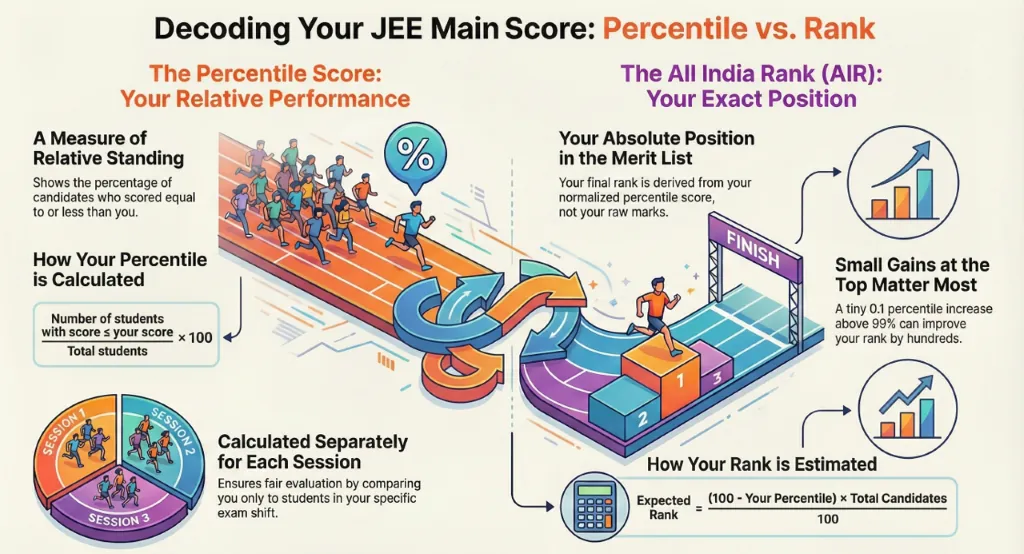
Your percentile = percentage of students who scored equal to or below you.
So if you got 95 percentile, you performed better than 95% of all students in your session. Sounds simple, right? But here's where it gets interesting.
NTA calculates these percentiles to 7 decimal places — that's 99.9876543 level precision — to avoid ties between students.
Why?
Because at the top end, even a 0.01 percentile difference can mean hundreds of rank positions.
Your percentile is not your marks. It's a normalized score that accounts for paper difficulty differences across sessions. Student A scoring 180 in a tough paper might get 99.2 percentile, while Student B scoring 200 in an easier paper gets 99.1 percentile.
Bottom line: Your final JEE Main rank comes from this percentile, and this rank decides which colleges you can target.
This blog breaks down exactly how percentile converts to rank, what marks you need for specific percentiles, and why this system exists in the first place. Every table, every number, every insight here is based on actual JEE Main data.
Let's decode this system once and for all.
The Real Truth About JEE Main Percentile and Rank
Most students think they understand percentile and rank. They don't.
Here's what actually happens when you get your JEE Main result: You see two numbers that will decide your engineering future. One is your percentile. The other is your rank. Both are connected, but the connection isn't what most people think.
Let me break this down in a way that actually makes sense.
JEE Main Percentile: What It Really Means
Your percentile is your relative standing among everyone who wrote the same paper as you. It's not about how many questions you got right. It's about how many people you beat.
Think about it this way:
In your session, 1 lakh students wrote the exam. You scored better than 99,000 of them. Only 1,000 students scored better than you. Your percentile = 99.0.
NTA calculates three separate percentiles for you:
· Physics percentile
· Chemistry percentile
· Mathematics percentile
· Overall percentile (this is the main one)
The student with the highest marks in each session gets 100 percentile. Everyone else gets calculated based on the formula:
Percentile = (Students with equal or lower marks ÷ Total students in session) × 100
Example: Out of 10,000 students in your session, 9,996 scored equal to or below you. Your percentile = 99.96.
Key insight: A higher percentile from an easy session might actually mean lower marks than a lower percentile from a tough session. Your percentile only compares you within your session, not across sessions.
JEE Main Rank: Your True Position
Your rank is your actual position among all JEE Main candidates across every session. This is what matters for college admissions.
Since 2019, NTA stopped using raw marks completely. Everything runs on percentile now, and your final rank comes from comparing percentiles across sessions.
Here's the relationship: Higher percentile = Better rank
But there are different types of ranks:
· CRL (Common Rank List): Your overall rank among all candidates
· Category Rank: Your rank within your specific category (if applicable)
Reality check: At the 99+ percentile level, even 0.01 percentile difference can change your rank by hundreds of positions. The competition is that intense.
Why Raw Marks Don't Matter Anymore
JEE Main happens across multiple days. Each day has different shifts. Each shift gets a completely different question paper.
The problem with raw marks:
· Session 1: Paper difficulty level = 7/10. Topper scores 280.
· Session 2: Paper difficulty level = 4/10. Topper scores 295.
If we used raw marks, Session 2 students would have unfair advantage.
The percentile solution:
· Session 1 topper: 280 marks = 100 percentile
· Session 2 topper: 295 marks = 100 percentile
Both get rank 1 in their respective categories. Fair game.

Why this system works:
1. No session disadvantage: Tough paper? Your marks drop, but so does everyone else's. Your percentile stays competitive.
2. Difficulty adjustment: In harder papers, even 150 marks might fetch 99 percentile. In easier papers, you need 220+ for the same percentile.
3. Fair comparison: Your percentile represents your performance relative to others who faced the same challenges.
4. Equal opportunity: Whether you got morning shift or evening shift, easy paper or tough paper, the percentile system ensures everyone competes on level ground.
Bottom line: Raw marks became meaningless the moment JEE went multi-session. Percentiles ensure that your rank reflects your actual ability, not your luck with paper difficulty.
The system isn't perfect, but it's the fairest method possible when lakhs of students can't all sit for the same paper on the same day.
JEE Main 2025 Marks vs Percentile: The Real Numbers
The 2025 JEE Main data tells a story that every serious aspirant needs to understand. These aren't predictions or estimates — this is exactly what happened when lakhs of students battled for their engineering dreams. These figures align closely with historical JEE Main marks vs percentile data, which students should always review before setting score targets
Let's break down the reality, scoring range by scoring range.

The Elite Zone: 270+ Marks Territory
At the absolute top, the competition is brutal.
290-300 marks = 99.999-100 percentile = Ranks 1-20
280-289 marks = 99.998-99.999 percentile = Ranks 21-100
270-279 marks = 99.996-99.998 percentile = Ranks 101-200
Here's what this means: just 10 marks can separate you by hundreds of ranks. Only 24 students achieved the perfect 100 percentile in JEE Main 2025 Paper 1. These are the students fighting for IIT Bombay CSE, IIT Delhi CSE — the dream seats.
If you're targeting the top 100 ranks, you need almost perfect execution. One silly mistake in Maths can cost you 50+ ranks.
The High Scorer Zone: 150-270 Marks
This is where most serious NIT aspirants land.
200-219 marks → 99.740-99.869 percentile → Ranks 1,501-3,000
180-199 marks → 99.560-99.739 percentile → Ranks 3,001-5,000
150-179 marks → 99.000-99.559 percentile → Ranks 5,001-10,000
The sweet spot? Around 150 marks typically gave 97.08+ percentile. This opens doors to top NITs, IIITs, and GFTIs.
But here's something most students miss: evening shifts generally needed higher marks for the same percentile compared to morning shifts. The toughest paper in 2025? 2 April Evening shift — needed 203 marks just to hit 99 percentile.
The Reality Check Zone: Sub-150 Marks
Even if you scored below expectations, options exist.
90-119 marks = 94.998-97.499 percentile
60-89 marks = 87.512-93.152 percentile
30-59 marks = 58.151-86.907 percentile
For JEE Advanced qualification in 2025:
· General category: 89-91 percentile (around 80-90 marks)
· OBC-NCL: 74-76 percentile
· SC: 44-48 percentile
· ST: 37-42 percentile
The Paper Difficulty Factor
This changes everything:
Easy paper: 95 percentile needed 155.5+ marks Tough paper: Same 95 percentile with just 107+ marks
Historical reference points:
· 50 marks = 75.89 percentile
· 250 marks = 99.99 percentile
The curve is not linear. Small mark improvements at the top end create massive percentile jumps. At lower levels, the same mark improvement barely moves your percentile.
This is why strategy matters more than just "studying hard."
JEE Main Percentile vs Rank 2025: The Brutal Reality Check
Here's what 9 lakh JEE Main 2025 candidates discovered: your percentile directly decides your engineering future.
The connection between percentile and rank isn't just mathematical — it's the difference between getting CSE at IIT Bombay and settling for a lower branch at a tier-3 college. Every 0.1 percentile matters. Every decimal place counts.

The Percentile-to-Rank Formula That Rules Your Fate
Your rank calculation follows this simple but ruthless formula:
Rank = (100 - Percentile) × (Total candidates ÷ 100)
With 8.5 lakh candidates in 2025:
· 99 percentile = roughly 8,500 rank
· 99.5 percentile = roughly 4,250 rank
· 99.9 percentile = roughly 850 rank
The harsh truth? That 0.5 percentile jump from 99 to 99.5 cuts your rank in half.
But here's where it gets scary. At the top end, tiny percentile differences create massive rank gaps. NTA uses 7-decimal precision because a 0.001 percentile difference can mean 100+ rank positions.
Top Percentiles: Where Every Decimal Fights for Survival
The 2025 data reveals how brutal the top end really is:
The Elite Circle:
· 100 percentile: Only 24 students in entire India got this
· 99.99+ percentile: Ranks 1-20
· 99.994-99.997: Ranks 24-80
· 99.990-99.994: Ranks 55-83
· 99.977-99.988: Ranks 85-210
Translation? To break into top 100 ranks, you need minimum 99.994 percentile. For top 1,000, you need at least 99.901 percentile.
The Reality Check: A student with 99.95 percentile gets rank 425. Another with 99.94 percentile gets rank 510. That's 85 ranks lost for 0.01 percentile.
Mid-Range Percentiles: The NIT Battleground
Students should always verify branch availability using official JoSAA opening and closing rank trends instead of relying on assumptions. This is where most serious JEE aspirants fight:
The NIT Zone (99+ Percentiles):
· 99.85-99.89: Ranks 920-1,367
· 99.79-99.84: Ranks 1,375-1,888
· 99.71-99.78: Ranks 1,900-2,664
· 99.59-99.68: Ranks 2,700-3,710
· 99.45-99.57: Ranks 3,800-5,003
The Comfortable Zone:
· 99.02-99.23: Ranks 6,800-8,949
· 98.73-98.99: Ranks 9,000-11,678
Ground Reality:
· 98 percentile = rank 17,490
· 95 percentile = rank 43,724
· 90 percentile = rank 87,448
Category-Wise Qualifying Cutoffs 2025
JEE Advanced Qualifying Percentiles:
· General: 93.10 percentile
· OBC-NCL: 79.43 percentile
· SC: 61.15 percentile
· ST: 47.90 percentile
The Non-Linear Truth Nobody Tells You
Here's what textbooks won't teach you: rank distribution is completely non-linear.
At the top end:
· 99.9 to 99.8 percentile = 1,500 rank difference
· 99.8 to 99.7 percentile = 1,100 rank difference
In the middle:
· 95 to 94 percentile = 9,000 rank difference
· 90 to 89 percentile = 8,500 rank difference
What this means:
Improving from 94 to 95 percentile jumps you 9,000 ranks. But improving from 99.8 to 99.9 percentile jumps you only 1,500 ranks.
The competition gets exponentially tougher as you climb higher.
Target Percentiles for Top Colleges
Actual admissions depend on branch-wise cutoffs, which vary every year based on JoSAA opening and closing ranks
For CSE at top NITs:
· Need 99+ percentile minimum
· Closing ranks typically 4,463-7,644
· Female candidates get slight advantage in closing ranks
For any decent engineering branch:
· 99.5+ percentile = top tier colleges
· 99+ percentile = good colleges with some branch flexibility
· 98+ percentile = decent colleges, limited branch choices
Your percentile is your passport. Your rank is your seat number.
The only question left: where do you want to sit?
JEE Main 2026 Predictions: Your Strategic Roadmap
"What marks do I need for 99+ percentile in JEE 2026?"
The 2026 predictions aren't random guesses. They're based on solid data analysis and can help you plan your target scores intelligently.
How These Predictions Work
These JEE Main 2026 predictions come from scientific analysis, not wishful thinking:
· Historical patterns: Complete analysis of 2022-2025 data shows clear trends
· Normalization formulas: NTA's established percentile calculation methods
follow predictable patterns
· Difficulty assessment: Expected paper difficulty based on pattern analysis
· Candidate numbers: Estimated 12 lakh students appearing this year
The system tracks cutoff movements, difficulty shifts, and performance distributions year after year. Once the first 2026 session happens, these predictions get even more accurate.
Here's what makes these predictions reliable: AI algorithms compare potential scores against databases containing normalized data from 45,000+ students. That's not guesswork — that's pattern recognition at scale.
JEE Main 2026: Expected Marks vs Percentile
Based on multi-year analysis, here are the projected numbers for JEE Main 2026:
JEE Main 2026 Expected Marks vs Percentile (Out of 300)
|
Marks Range |
Expected Percentile |
Estimated Rank Range |
|
300-290 |
100 - 99.999 |
1 - 15 |
|
289-280 |
99.999 - 99.997 |
16 - 36 |
|
279-270 |
99.994 - 99.993 |
37 - 100 |
|
269-260 |
99.990 - 99.988 |
101 - 160 |
|
259-250 |
99.977 - 99.969 |
161 - 428 |
|
249-240 |
99.950 - 99.946 |
429 - 755 |
|
239-230 |
99.915 - 99.934 |
756 - 1,189 |
|
229-220 |
99.866 - 99.901 |
1,190 - 1,893 |
|
219-210 |
99.807 - 99.851 |
1,894 - 2,720 |
|
209-200 |
99.731 - 99.795 |
2,721 - 3,803 |
|
150-180 |
98.778 - 99.456 |
13,164 - 17,290 |
|
100-140 |
95.643 - 98.407 |
47,980 - 61,651 |
Key insight: Just one extra mark from 249 to 250 can jump your percentile from 99.950 to 99.969 — that's a 300+ rank improvement.
Paper difficulty matters hugely. In tough papers, 160-180 marks can get you 99 percentile. In easier papers, you might need 220-250 for the same percentile.
Expected Percentile to Rank Conversion 2026
Here's how percentiles will likely convert to ranks:
JEE Main 2026 Expected Percentile vs Rank Conversion
|
Percentile Range |
Approximate All India Rank |
|
99.99+ |
Top 100 ranks |
|
99.95 - 99.98 |
250 - 600 |
|
99.90 - 99.94 |
601 - 800 |
|
99.80 - 99.89 |
801 - 1,500 |
|
99.70 - 99.79 |
1,501 - 2,700 |
|
99.50 - 99.69 |
2,701 - 5,000 |
|
99.00 - 99.49 |
5,001 - 10,000 |
|
98.00 - 98.99 |
15,001 - 22,000 |
|
95.00 - 97.99 |
22,001 - 55,000 |
|
90.00 - 94.99 |
55,001 - 110,000 |
Simple formula for your rank: Rank = (100 - Percentile) / 100 × Total Candidates. With 12 lakh candidates expected, 99.5 percentile = roughly rank 6,000.
What These Numbers Mean for Your Target
If you're aiming for specific colleges, here are the marks you'll likely need:
· Top 1,000 rank (99.9+ percentile): 280+ marks
· Top NIT CSE (99.5+ percentile): 250-265 marks
· Good NIT core branches (99.0+ percentile): 220-240 marks
Reality check: At the 99+ level, every 0.1 percentile difference can mean hundreds of ranks. That's why your preparation strategy needs to be laser-focused on maximizing every single mark.
Use these numbers to set your target scores. Don't just aim for "good marks" — aim for the specific score range that gets you into your dream college.
How NTA Calculates Percentile: The Reality Behind the Numbers
You've seen your percentile. But do you actually know how NTA arrives at that number?
Most students think it's some mysterious black box. It's not. The process is actually quite straightforward once you understand what's happening behind the scenes.
Why Normalization Exists (And Why You Should Care)
Here's the problem NTA faces: JEE Main happens across multiple sessions and shifts. Different days, different question papers, different difficulty levels.
The National Testing Agency tries their best to keep difficulty consistent. But let's be honest — it's impossible to make every paper exactly equal. Some shifts get tougher papers, some get easier ones.
Without normalization, students getting tough papers would be screwed.
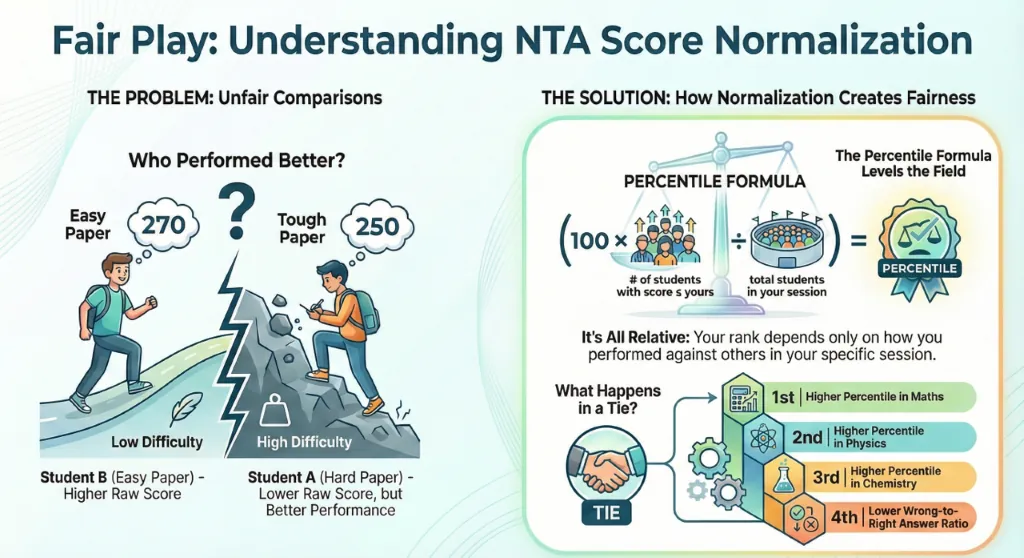
Imagine Student A gets a brutal Physics section and scores 250. Student B gets an easier paper and scores 270. Who performed better? Raw marks say Student B. But relatively, Student A might have outperformed everyone in his session while Student B was average in his.
This is exactly why normalization exists. It levels the playing field regardless of which session you write.
The Actual Formula NTA Uses
Percentile = (100 × number of students with score ≤ yours) ÷ total students in your session
Simple, right?
Let's break it down:
· If 9,500 students out of 10,000 scored equal to or less than you → you get 95 percentile
· If you're the topper in your session → automatic 100 percentile
· Everyone else gets calculated based on this formula
NTA calculates this to 7 decimal places. Why? Because at the top end, even 99.9876 vs 99.9875 can mean different ranks.
The process standardizes scores across all sessions, making comparison possible.
What Happens When Students Get Same Percentile
Sometimes multiple students end up with identical percentiles. When this happens, NTA follows a specific order to break ties:
Higher Maths percentile wins
If still tied: Higher Physics percentile
Still tied?: Higher Chemistry percentile
Final tie-breaker: Lower wrong-to-right answer ratio
This system ensures no two students get the exact same rank, even with identical overall percentiles.
Bottom line: Normalization isn't there to confuse you. It's there to make sure your performance is judged fairly, regardless of which session you appeared in.
Tools to Predict Your Rank and College 📊
Now that you understand how percentiles convert to ranks, let's talk about the tools that can predict your performance before the official results come out.
Waiting 2-3 weeks for JEE Main results is torture. You sit there thinking: "Did I cross 99 percentile?" "Can I get NIT Trichy CSE?" "Should I start preparing for the next attempt?"
These tools eliminate that anxiety and give you clarity within minutes of finishing your exam.
How to use eSaral Percentile to Rank Converter
eSaral's percentile predictor delivers exact percentile estimates in under 60 seconds, ending the weeks-long wait and anxiety after taking your JEE Main exam.
This tool utilizes the official JEE percentile formula:
100 × (Number of candidates with score equal to or less than yours) ÷ (Total candidates who appeared).
Unlike manual calculations, eSaral's tool accounts for NTA's normalization process, producing realistic predictions that closely match actual results.
The beauty of this tool? It doesn't just give you a random number. It factors in which shift you appeared in, the difficulty level of that specific session, and historical patterns from similar shifts.
Steps to use the tool effectively
Here's exactly how to get the most accurate predictions:
- Visit eSaral's official website and locate the JEE Main marks versus percentile predictor tool
- Register (takes approximately 30 seconds)
- Select "JEE Main" and choose the correct exam year
- Pick your specific exam session (crucial for accuracy)
- Enter your marks honestly—optimistic estimates won't help planning
- Click "Calculate" to instantly view your predicted percentile
One important tip: Don't inflate your expected marks. If you're unsure about 2-3 questions, mark them as wrong. Better to get a conservative prediction than a false hope.
The tool's algorithm has been tested across multiple JEE sessions and consistently matches actual NTA results. It factors in shift-specific difficulty levels, ensuring your prediction accounts for whether you faced an "easy shift" or a "tough shift".
Other tools: College predictor, cutoff checker
Once you know your predicted rank, the next question becomes: "Which colleges can I target?"
College predictors use previous years' cutoff data, seat availability information, and category considerations to generate customized college lists based on your rank. These predictors help with decision-making based on JEE marks vs percentile, allowing stress-free choice filling during counseling.
Cutoff checkers are equally valuable. They show you historical admission thresholds for specific colleges and branches. Want to know the last 5 years' closing ranks for NIT Warangal CSE? These tools have that data ready.
Pro tip: Don't just look at one year's cutoff. Check trends over 3-4 years to get a realistic picture of your chances.
Similarly, cutoff checkers provide historical admission thresholds, helping you assess chances at specific institutions while planning backup options.
The combination of these tools — percentile predictor + college predictor + cutoff checker — gives you a complete picture of your admission possibilities within hours of finishing your exam.
Your JEE Main Rank Journey Starts Now 🔥
"Sir, now I understand the percentile system. What should I do next?"
Simple. Use this knowledge to dominate your preparation strategy.
You now know exactly how the percentile-to-rank system works. You've seen the actual data from JEE Main 2025. You understand why a 99.5 percentile means rank 6,000, and why every 0.1 percentile matters at the top end.
This is not just information. This is your roadmap.
The percentile system is not your enemy — it's actually designed to give you a fair shot regardless of which paper you get. Whether you face a tough shift or an easy one, the normalization process ensures you compete on equal ground with everyone else .
Here's what you must remember:
Your target is not "scoring 200 marks." Your target is "beating 99% of students in my session." That's the mindset shift that changes everything.
For JEE 2026 aspirants:
· Target 99.5+ percentile if you want top NIT CSE branches
· Target 99.0+ percentile for good NIT core branches
· Target 98.0+ percentile for decent engineering colleges
Your action plan from today:
Use the percentile predictor tools after every mock test
Track your improvement in percentile terms, not just marks
Focus on consistency — small improvements compound into big percentile jumps
Plan your college list based on rank ranges, not wishful thinking
The competition is fierce, especially at 99+ percentile. But now you know exactly what you're competing for and how the game works.
Students who understand this system have a massive advantage during counseling. They make smart choices, avoid heartbreak, and end up in colleges that match their actual performance.
Your percentile will determine your next 4 years. Your rank will decide your career trajectory.
But remember — these numbers don't define your worth. They just determine which door opens first.
Now go, prepare with this knowledge, and make every practice session count.
All the best, beta. You've got this. 💪
Key Takeaways
Understanding JEE Main's percentile-to-rank system is crucial for strategic exam preparation and college admission planning.
• Percentile reflects relative performance, not raw marks - Your percentile shows what percentage of candidates scored equal to or below you, calculated up to 7 decimal places to avoid ties.
• Small percentile differences create massive rank gaps at top levels - A 0.1 percentile difference near 99+ can mean hundreds of rank positions, making every mark critical for premier institutes.
• Normalization ensures fairness across multiple exam sessions - NTA's percentile system prevents disadvantage from tougher papers, creating equal competition regardless of your assigned shift.
• Target 99+ percentile for top engineering programs - Securing admission to prestigious NITs and IIITs for Computer Science typically requires 99+ percentile, translating to 220+ marks out of 300.
• Use percentile predictors for strategic college planning - Digital tools provide instant rank estimates and college predictions, eliminating guesswork during counseling and helping optimize your admission strategy.
The percentile system transforms JEE Main from a simple scoring test into a sophisticated ranking mechanism that prioritizes relative performance over absolute marks, making strategic preparation essential for success.
FAQs
Q1. How is JEE Main percentile converted to rank?
To convert percentile to rank, use the formula: Rank = (100 - Percentile) × (Total candidates ÷ 100). For example, with 8.5 lakh candidates, a 99 percentile would translate to roughly 8,500 rank.
Q2. What percentile is typically needed for top NIT programs?
For top NIT programs, especially in Computer Science Engineering, you generally need 99.5+ percentile, which typically requires scoring between 250-265 marks out of 300.
Q3. Why does JEE Main use percentile instead of raw marks?
JEE Main uses percentiles to ensure fairness across multiple exam sessions with varying difficulty levels. This system normalizes scores, preventing candidates from being disadvantaged due to tougher question papers in their particular session.
Q4. How precise is the JEE Main percentile calculation?
The National Testing Agency (NTA) calculates JEE Main percentiles up to 7 decimal places. This high precision helps distinguish between candidates with minute performance differences, especially important at the top end of the scale.
Q5. What tools can help predict my JEE Main rank?
Several online tools like eSaral's Percentile to Rank Converter can help predict your rank based on your percentile. These tools use historical data and AI algorithms to provide quick and reasonably accurate estimates of your potential rank and college options.