JEE NEET Preparation From Class 8: Why Early Start Wins
Starting JEE NEET preparation from Class 8 helps students build strong concepts early, develop problem-solving skills gradually, and enter Class 11-12 with the syllabus already covered, leaving time for revision and reducing pressure during exam years. This article covers why early starters gain an edge, how a 5-year roadmap works, and what eSaral's JEE 2031 Vajra Course offers — including live interactive classes, personal mentorship, and guidance from N.K. Gupta and Kota's top IIT faculty.


eSaral ›Foundation courses ›JEE NEET Preparation From Class 8: Why Early Start Wins

Should You Start JEE NEET Preparation From Class 8?
Many parents and students wonder whether beginning JEE or NEET preparation alongside Class 8 is sensible or even possible. According to N.K. Gupta, who has been teaching in Kota for 37 years and has mentored over 9 lakh students, says this approach is not only correct but also common among India's top 10 and top 100 rankers.
The logic is simple: a task meant to be completed in two years, if started five years in advance, is done with far greater mastery. Students who begin early end up ahead of the curve and, in N.K. Gupta sir's words can ultimately "become toppers."
Why Starting Early Builds Stronger Concepts
When students study in Classes 8, 9, and 10 in a typical school setting, they often learn at a bookish level, focused only on scoring marks in exams. However, the same concepts taught in these classes form the base for JEE and NEET in Classes 11 and 12.
In an integrated program, the same Kota faculty who teach JEE and NEET aspirants in Class 11-12 also teach the Class 8 batch. Because these teachers already know which concepts will matter later, they focus on concept-building from Class 8 itself. This means students develop a deeper understanding of fundamentals at the same time their peers are studying only for marks.
💡 Expert Tip by N.K. Gupta, IIT Kanpur: The concepts taught in Class 8, 9, and 10 are the same ones used in JEE and NEET in Class 11-12. Students with strong concepts at this stage do not struggle later.
How Early Preparation Improves Problem-Solving Skills
In a normal Class 8 or 9 classroom, problems given to students stay at that grade's difficulty level. But when Kota's IIT-trained teachers handle an integrated batch, they introduce problems that touch Class 8, 9, and 10 levels together — and blend in JEE/NEET-style Previous Year Questions (PYQs) without the student even realising the jump in difficulty.
As a result, problem-solving skill — which N.K. Gupta sir identifies as the single most important factor for a top-10 JEE/NEET rank — develops gradually through Class 8, 9, and 10. By the time students reach Class 11-12, their problem-solving ability is already at a level that supports a rank-one outcome.
The Confidence and Study Habit Advantage
Competitive exams carry a "fear factor" for many students who haven't been exposed to that level of difficulty. Early exposure to PYQs and competitive-level problems, taught by Kota's top IIT faculty from Class 8 itself, removes this fear and builds genuine confidence by the end of Class 10.
This stage also builds consistent study habits — the discipline of studying for both board exams and competitive exams together, alongside regular and structured test-taking. Gupta notes that these habits carry significant value in the years that follow.
Another major advantage: by the time students reach Class 11-12, most of their peers are just beginning competitive preparation as "beginners." Students who started in Class 8 will have already covered most of the syllabus and will effectively be in revision mode while others are starting from scratch — a position N.K. Gupta sir says makes a top-100 rank is far more achievable.
Early starters also tend to outperform their classmates academically, becoming school toppers in Classes 8, 9, and 10. This, in turn, brings more attention from schools and greater confidence from parents — eventually leading to parental buy-in for full JEE/NEET preparation.
How the 5-Year Roadmap Works
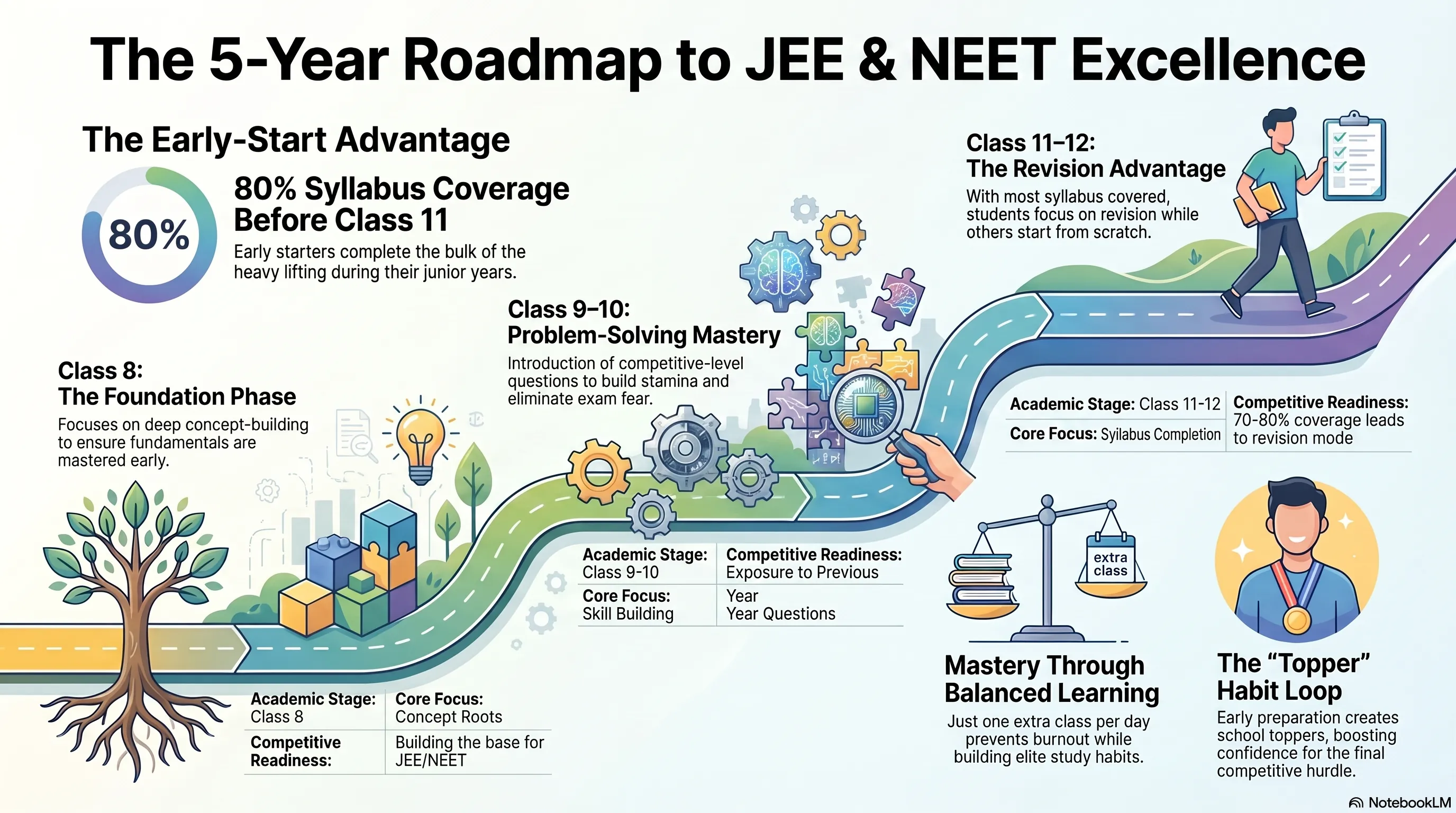
The program is structured as a 5-year roadmap: a little preparation alongside Class 8, building further with Class 9, continuing through Class 10, and culminating in Class 11-12 — by which point nearly 70-80% of the JEE/NEET-level syllabus is already covered.
Importantly, N.K. Gupta sir is clear that this is balanced learning, not an additional burden:
- Just one extra class per day, focused on JEE/NEET-flavoured content
- That extra class itself starts from the Class 8 basics and gradually touches Class 9-10 topics
- Students still get time to play and have free time
- No need to separately search for a school — school studies continue normally alongside
| Stage | Focus |
|---|---|
| Class 8 | Foundation concept-building begins |
| Class 9 | Concepts deepen, and problem-solving skill building continues |
| Class 10 | Competitive-level problem exposure increases, and confidence builds |
| Class 11-12 | Most of the JEE/NEET syllabus is already covered; students enter revision mode |
N.K. Gupta sir shares that his own two sons followed this same approach starting from Class 8-9-10 and both went on to graduate from IIT Bombay — an outcome he says has repeated for many other students he has guided this way.
What eSaral's JEE 2031 Vajra Course Offers
For students who want to follow this roadmap, eSaral offers the JEE 2031 Vajra Course, a 5-year program covering Class 8, 9, 10, and 11-12, combined with JEE and NEET preparation. It is available both online and offline (with an offline centre in Kota).
According to the transcript, the course includes:
- Teaching from Kota's top IIT faculty, including those who have produced AIR-1 and top-100 ranks
- Developed content spanning foundation modules (Class 8-10) and JEE/NEET-level integrated modules
- Practice material, weekly tests, fortnightly tests, and review tests across all 5 years, with test analysis
- Both subjective and objective tests
- Live interactive classes (not pre-recorded "chat-only" sessions) plus recorded visualisation lectures
- Small class sizes with audio-video interaction
- Daily doubt-solving classes
- Personal mentorship — every student is assigned a personal mentor who checks homework, tracks attendance, and conducts regular parent-teacher meetings (PTMs)
- Overall development sessions covering communication skills, alongside subject coverage in Physics, Chemistry, Maths, Biology, Social Science, English, and Olympiad prep
- A "School Saathi Program" where mentors connect online for an extra period to help with daily school homework doubts
Since this program runs alongside regular school education, students preparing for school-level exams may also find it useful to refer to structured resources such as NCERT Solutions for Class 8, including subject-wise material for Class 8 Maths and Class 8 Science, as the Class 8 fundamentals form the base for this entire roadmap.
As students progress, they can also refer to NCERT Solutions for Class 9 (Maths, Science) and NCERT Solutions for Class 10 (Maths, Science) to stay aligned with board-level concepts while their competitive-exam foundation builds.
By the time students reach Class 11 and 12, the same roadmap connects directly into JEE/NEET-level study, supported further by NCERT Solutions for Class 11 — covering Maths, Physics, and Chemistry — and NCERT Solutions for Class 12, including Maths, Physics, and Chemistry. Students who prefer book-format resources can also browse the full set of NCERT Books across Class 8, Class 9, Class 10, Class 11, and Class 12.
Frequently Asked Questions
Find answers to common questions.
Is it possible to prepare for JEE and NEET while still in Class 8?
Yes, it is both possible and advisable. An integrated approach taught by the same Kota faculty who teach Class 11-12 JEE/NEET students allows Class 8 students to build strong concepts early, without it being treated as an extra academic burden.
Will starting JEE NEET preparation from Class 8 create extra pressure on school studies?
No, the program is designed as balanced learning with just one extra class per day. School studies remain the priority, and students still get time to play, since the goal is gradual foundation-building, not early exam pressure.
What is the biggest advantage of starting preparation 5 years before JEE/NEET?
The biggest advantage is that by Class 11-12, around 70-80% of the JEE/NEET syllabus is already covered. While other students are just beginning as beginners, early starters are effectively revising, which significantly improves their chances of a top-100 rank.
Does early preparation help with school performance too?
Yes, students following this roadmap tend to perform above their classmates and often become school toppers in Class 8, 9, and 10, which also builds parental confidence in continuing JEE/NEET preparation.
What does eSaral's JEE 2031 Vajra Course include for Class 8 students?
It includes live interactive classes, recorded visualisation lectures, personal mentorship, weekly and fortnightly tests with analysis, and direct guidance from N.K. Gupta along with Kota's top IIT faculty, covering Class 8 through Class 11-12 plus JEE/NEET preparation.