Mensuration Formulas Class 8 Maths – Complete Formula Sheet -eSaral
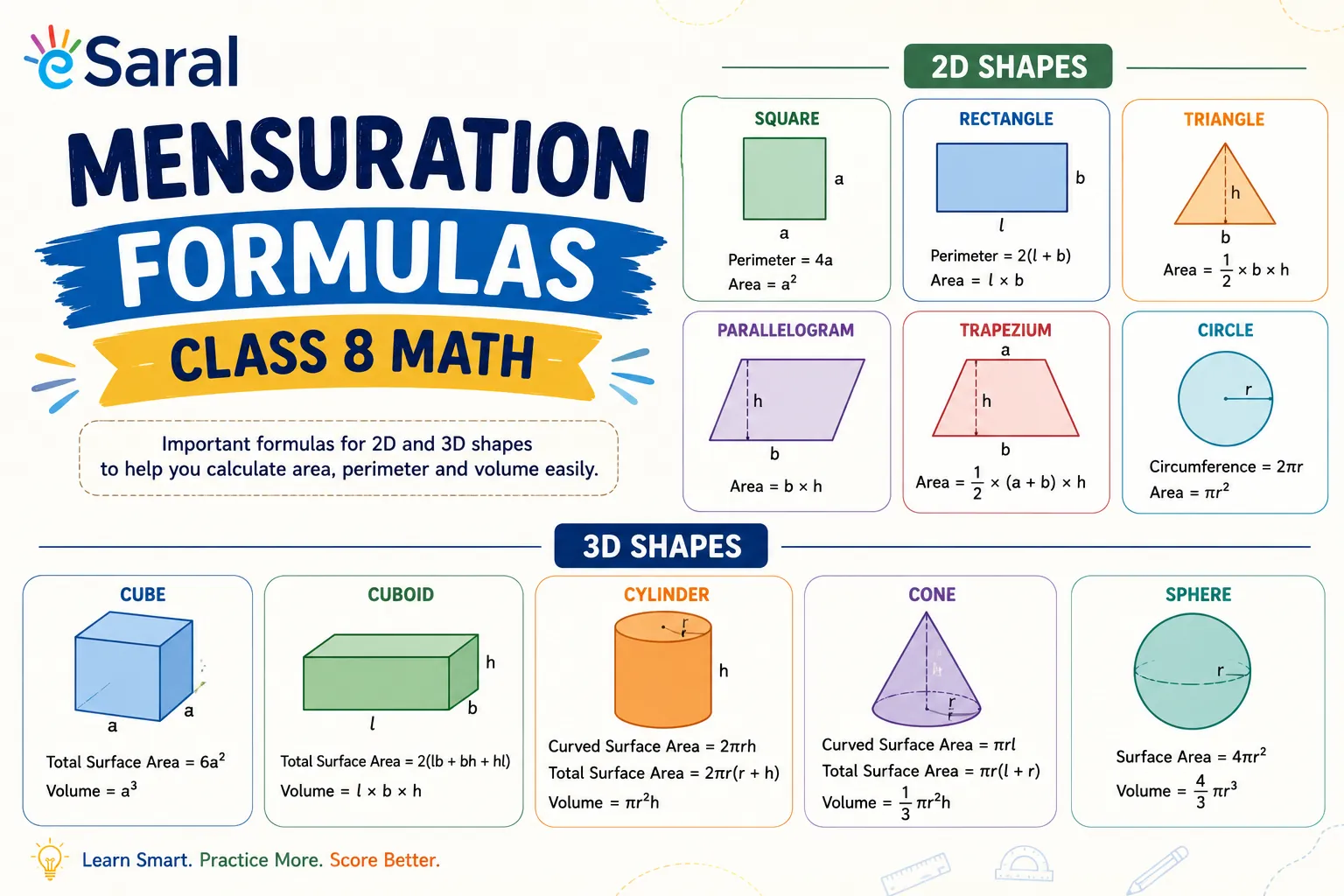
Table of Contents

eSaral › Class 8 › Maths › Mensuration Formulas for Class 8 Maths

Mensuration is the branch of mathematics that deals with the measurement of geometric shapes — their length, area, and volume. In NCERT Class 8 Maths (Chapter 11), mensuration extends what students learned in earlier classes by introducing 3D solids — the cube, cuboid, and cylinder — alongside a deeper treatment of 2D shapes.
Understanding these formulas does more than help you pass school exams. The concepts of surface area and volume appear directly in JEE Main and other competitive exams. Students who build a strong foundation at Class 8 find these topics significantly easier when they encounter them again in Class 10 and Class 12.
For step-by-step solutions to every exercise in this chapter, refer to the NCERT Solutions at eSaral, where problems are solved by experienced faculty using the most efficient methods.
Mensuration formulas class 8 Math
Area and perimeter of a rectangle and a square
- Area of rectangle (A) = length(l) × Breath(b), A = l× b
- Perimeter of a rectangle (P) = 2 × (Length(l) + Breath(b)), P = 2 × (l + b)
- Area of a square (A) = Length (l) × Length (l), A = l×l
- Perimeter of a square (P) = 4 × Length (l), P = 4 × l
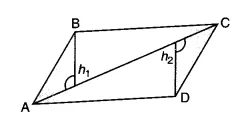
- Area of a quadrilateral = 1/2 d(h1 + h2) square unit, where, d denotes the length of diagonal AC.
- Area of parallelogram = Base $\times$ Height square unit.
- Area of trapezium $=\frac{1}{2} \times[$ Sum of parallel sides $] \times$ Height square unit.
- Area of an equilateral triangle $=\frac{\sqrt{3}}{4} \times(\text { Side })^{2}$ square unit.
- Area of a triangle $=\frac{1}{2} \times$ Base $\times$ Height square unit.
- The perimeter of a circle is called its circumference.
- The number $\pi$ is not a rational number. It is often used as a rational approximation and its value is $\frac{22}{7}$
- The ratio of the circumference of a circle to its diameter is always constant and denoted by the Greek letter $\pi$. Thus, $\frac{c}{d}=\pi$. The value of $\pi$ is $3.14$ correct to two decimal places.
- Area of a circle $=\pi \times$ (Radius) $^{2}=\pi r^{2}$ square unit.
- Circumference of a circle $=2 \pi \times$ Radius $=2 \pi r$ unit.
- Area of rhombus $=\frac{1}{2}$ (Product of diagonals) $=\frac{1}{2} \times \mathrm{d}_{1} \times \mathrm{d}_{2}$ square unit.
- Surface area of a cuboid $=2[\mathrm{lb}+\mathrm{bh}+\mathrm{hl}]$ square unit
- Surface area of a cube $=6 \mathrm{I}^{2}$ square unit
- Surface area of a cylinder $=2 \pi r(h+r)$ square unit
- Surface area of Diagonal of cuboid $=\sqrt{l^{2}+b^{2}+h^{2}}$ units
- Surface area of Lateral surface area of cuboid $=[2(l+b) \times h]$ square unit
- Surface area of Lateral surface area of the cube $=4 a^{2}$ square unit
- Surface area of Lateral (curved) surface area of a cylinder $=2 \pi$ rh square unit
- Volume of Cuboid $=\mid \times \mathrm{b} \times \mathrm{h}$ (unit) $^{3}$
- Volume of Cube $=I^{3}$ (unit) $^{3}$
- Volume of Cylinder $=\pi r^{2} h$ (unit) $^{3}$
- Volume of Diagonal of the cube $=(\sqrt{3} a)$ units.
- $1 \mathrm{~m}^{2}=100 \mathrm{dm}^{2}=10000 \mathrm{~cm}^{2}$
- $1 \mathrm{~cm}^{2}=100 \mathrm{~mm}^{2}$
- Area of a trapezium $=\frac{1}{2}$ (sum of parallel sides) $\times$ height
- Total surface area of a cuboid $=2(\mathrm{lb}+\mathrm{bh}+\mathrm{hl})$
- Lateral (curved) surface area of a cylinder $=2 \pi r h$
- Total surface area of a cylinder $=2 \pi r(h+r)$
- Volume of cuboid $=$ Ibh OR Volume of cuboid $=$ area of the base $\times$ height
- Total surface area of a cube $=6I^{2}$, where $I$ is the side of the cube.
- Volume of cylinder $=\pi r^{2} h$
Also Read,
Download NCERT Class 8 Math Book PDF
Download NCERT Class 8 Science Book PDF
Download NCERT Class 8 Science Exemplar PDF
Download NCERT Class 8 Math Exemplar PDF
If you have any Confusion related to Mensuration formulas class 8 Math, then feel free to ask in the comments section down below.
To watch Free Learning Videos on Class 8 Math by Kota’s top Faculties, install the eSaral App
Frequently Asked Questions
Find answers to common questions.
How do you find the volume of a cuboid?
Volume of a cuboid = length × breadth × height, written as V = l × b × h. You can also think of it as: Volume = Area of base × height. The answer is always in cubic units. For example, if l = 5 cm, b = 3 cm, h = 4 cm, then V = 5 × 3 × 4 = 60 cm³.
What is the difference between total surface area and lateral surface area of a cylinder?
Total Surface Area (TSA) of a cylinder = 2πr(h + r), which includes both circular ends. Lateral (Curved) Surface Area (CSA) = 2πrh, which covers only the curved side without the top and bottom circles. Use TSA when the solid is fully closed; use CSA for hollow pipes or open containers. Always check what the question is asking.
What is the formula for the area of a trapezium in Class 8?
The area of a trapezium = ½ × (sum of parallel sides) × height. If the two parallel sides are a and b and the perpendicular distance between them is h, then Area = ½ × (a + b) × h. This formula is derived by splitting the trapezium into a rectangle and triangles, which is why the factor of ½ appears.
What is the formula for the area of a rhombus using diagonals?
Area of a rhombus = ½ × d₁ × d₂, where d₁ and d₂ are the lengths of the two diagonals. This formula works because the diagonals of a rhombus bisect each other at right angles, forming four right triangles. The area of all four triangles combined equals half the product of the diagonals. This is the standard formula tested in NCERT Class 8 Chapter 11.
. Is mensuration in Class 8 important for competitive exams like JEE?
Yes. The mensuration concepts introduced in Class 8 — surface area, volume, and area of composite shapes — directly appear in JEE Main's Coordinate Geometry and 3D Geometry sections. Students who build strong visualisation skills with cubes, cuboids, and cylinders at Class 8 find Class 11 and 12 solid geometry significantly more manageable. eSaral's IIT Bombay faculty (including AIR-41 rankers) specifically design the Class 8 curriculum to build this competitive exam foundation early
What is the value of π used in Class 8 mensuration?
In Class 8 NCERT problems, π is used as 22/7 when the radius or diameter is a multiple of 7, and as 3.14 in other cases. The question will usually specify which value to use. Technically, π ≈ 3.14159… and is an irrational number — it cannot be expressed as a simple fraction, but 22/7 is a close rational approximation.