Mind Maps for Thermodynamics Revision - Class 11, JEE, NEET
Revise Thermodynamics quickly with concise mind maps covering key concepts, laws, processes, thermodynamic variables, and important formulas for Class 11, JEE, and NEET preparation.
.webp)

eSaral › Class 11›Mind Maps for Thermodynamics Revision - Class 11, JEE, NEET

Get to learn all the formulae and important points of Thermodynamics through this mindmap. Download and share with your friends also. Mind Map 1 Download
India's Best Exam Preparation for Class 11th - Download Now
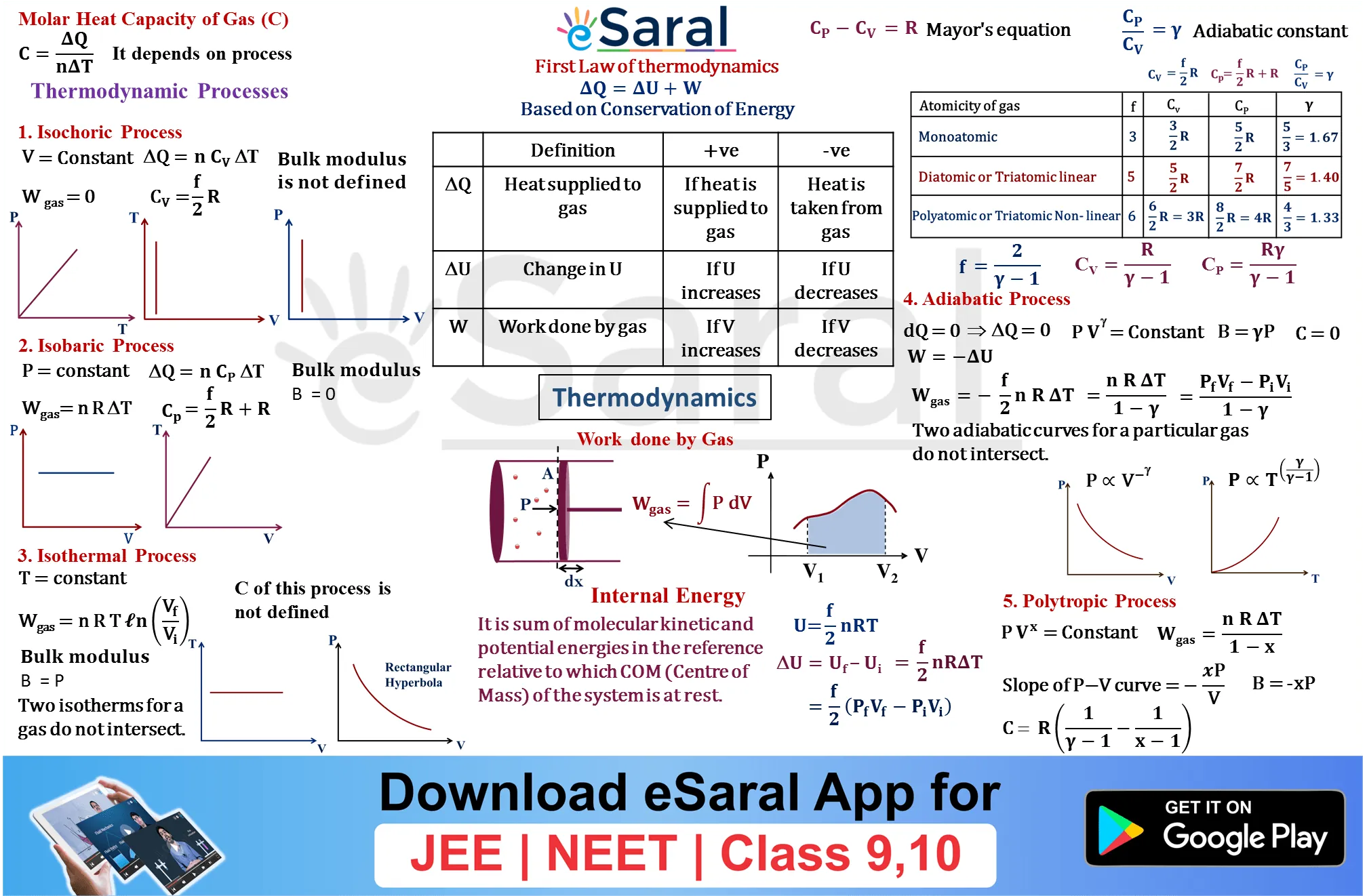
Mind Map 2 Download
India's Best Exam Preparation for Class 11th - Download Now
Frequently Asked Questions
Find answers to common questions.
What topics are covered in thermodynamics for Class 11 JEE and NEET?
Thermodynamics for Class 11 (NCERT Chapter 12) covers the Zeroth, First, Second, and Third Laws of thermodynamics, thermodynamic processes (isothermal, adiabatic, isochoric, isobaric), PV diagrams, Carnot engine efficiency, and entropy. JEE additionally tests deeper application of adiabatic relations and multi-process problems, while NEET focuses more on conceptual statements of the laws and basic numerical application.
How many questions come from thermodynamics in JEE Main?
JEE Main typically includes 2–4 questions from thermodynamics each year. According to NTA's historical paper pattern, the chapter is almost always represented, and questions frequently combine thermodynamic process formulas with ideal gas law concepts. High-frequency sub-topics include First Law calculations, Carnot efficiency, and PV diagram area interpretation
Is the thermodynamics mind map enough for last-minute revision?
Yes, for revision purposes the two mind maps on this page cover all the formulas, laws, and process relationships tested in JEE Main and NEET. However, mind maps work best after you have already studied the chapter in detail. Use them to consolidate knowledge, not as a first-time learning resource. Pair them with solved NCERT examples for best results.
What is the difference between isothermal and adiabatic processes?
In an isothermal process, temperature stays constant (ΔU = 0 for ideal gas), and all heat absorbed is converted to work. In an adiabatic process, no heat is exchanged (Q = 0), so any work done comes entirely from the internal energy of the gas. On a PV diagram, an adiabatic curve is always steeper than an isothermal curve at the same point.
What is the Carnot engine efficiency formula?
Carnot engine efficiency is η = 1 − T₂/T₁, where T₁ is the temperature of the hot reservoir and T₂ is the temperature of the cold reservoir (both in Kelvin). This is the maximum possible efficiency for any heat engine operating between these two temperatures. No real engine can match or exceed Carnot efficiency, as stated by the Second Law of Thermodynamics.