Draw the graph of the equation 2x − 3y = 5. From the graph
Learn to graph the linear equation 2x − 3y = 5 and use it to find unknown x and y values with step-by-step solutions for Class 10 Mathematics.
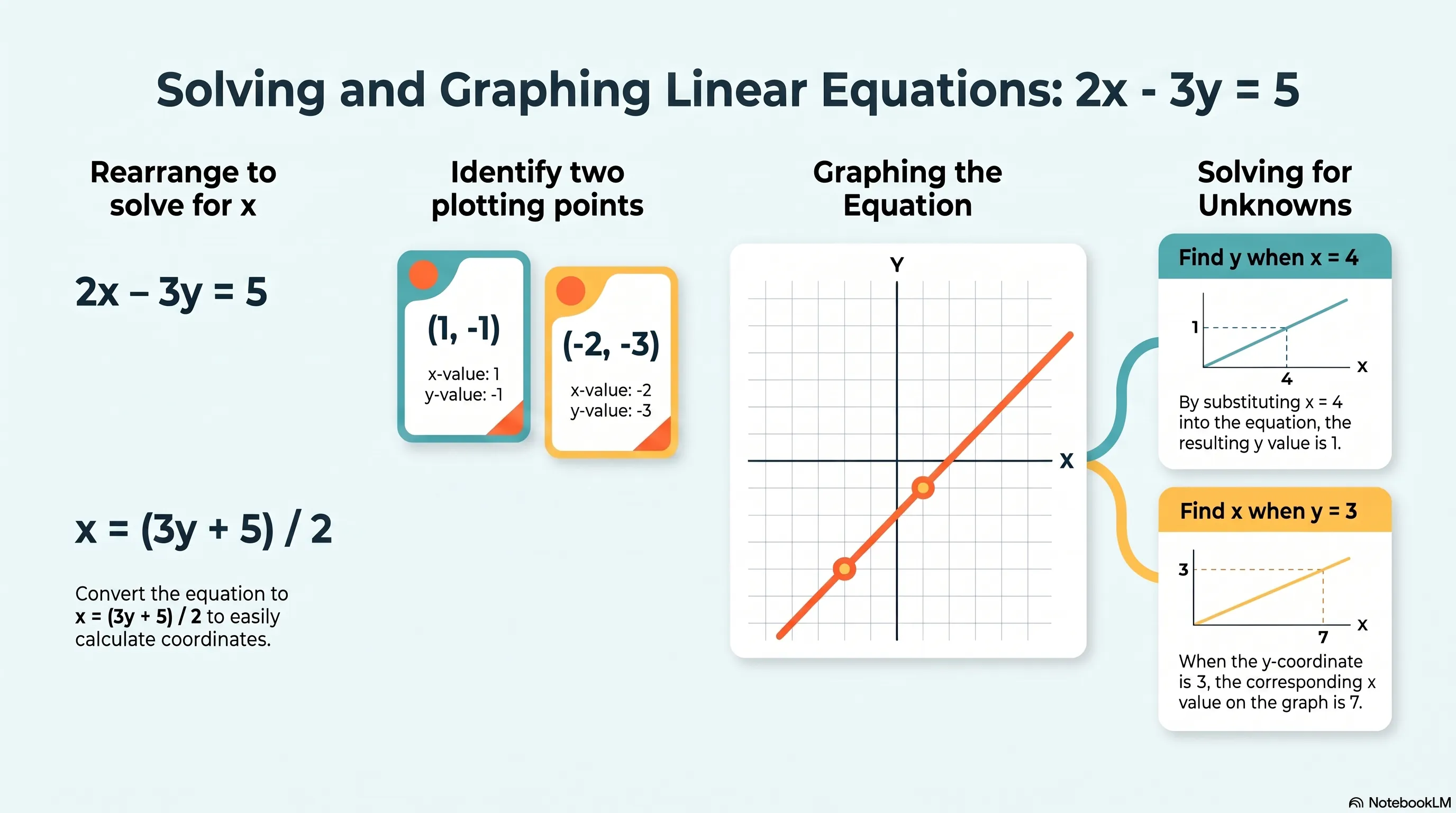


Draw the graph of the equation 2x − 3y = 5. From the graph, find (i) the value of y when x = 4 and (ii) the value of x when y = 3.
Given equation :
$2 x-3 y=5$
$\Rightarrow 2 x=3 y+5$
$\Rightarrow x=\frac{3 y+5}{2}$
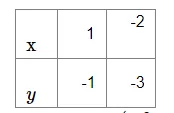
When, $y=-1, x=\frac{-3+5}{2}=\frac{2}{2}=1$
When, $y=-3, x=\frac{-9+5}{2}=\frac{-4}{2}=-2$
Thus, we have the following table:
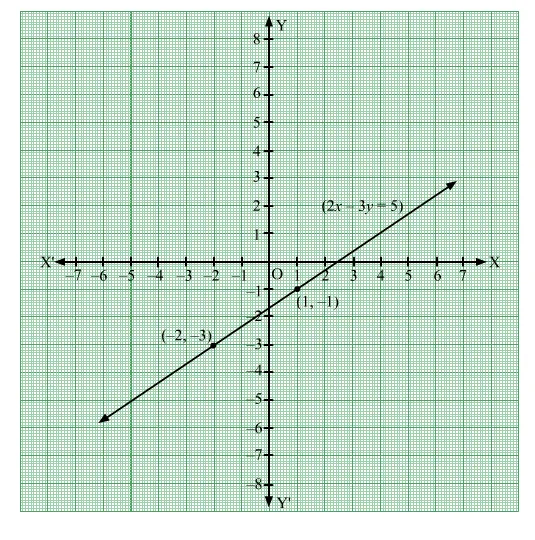
Plot the points $(-2,-3),(1,-1)$ on the graph paper and extend the line in both directions.
(i) When x = 4:
$4=\frac{3 y+5}{2} \Rightarrow 8=3 y+5$
$\Rightarrow 3 y=8-5=3$
$\Rightarrow 3 y=3$
$\Rightarrow y=1$
(ii) When y = 3:
$x=\frac{3 y+5}{2}=\frac{14}{2}=7$
Frequently Asked Questions
Find answers to common questions.
How do you draw the graph of the equation 2x − 3y = 5?
Rewrite the equation as x = (3y + 5)/2. Choose two values of y (e.g., y = −1 and y = −3) to get x = 1 and x = −2. Plot points (1, −1) and (−2, −3) on graph paper, join them with a straight line, and extend in both directions with arrows. The line represents all solutions of 2x − 3y = 5.
What is the value of y when x = 4 in the equation 2x − 3y = 5?
.
When x = 4, substitute into the equation: 2(4) − 3y = 5 → 8 − 3y = 5 → 3y = 3 → y = 1. You can also read this from the graph by drawing a vertical line at x = 4 to the plotted line and reading the corresponding y value, which is 1.
What is the value of x when y = 3 in the equation 2x − 3y = 5?
When y = 3, substitute into x = (3y + 5)/2: x = (9 + 5)/2 = 14/2 = 7. On the graph, draw a horizontal line at y = 3, find where it meets the plotted line, and draw a vertical line down to the x-axis — it reads x = 7.
How many points do you need to plot a straight-line graph?
Technically, two points are enough to define a straight line. However, always plot a third point as a check. If all three are collinear (fall on the same line), your working is correct. This is standard practice recommended by CBSE and NCERT.
Does equation 2x − 3y = 5 pass through the origin?
No. The origin is (0, 0). Substituting into 2x − 3y = 5: 2(0) − 3(0) = 0 ≠ 5. Since the equation does not satisfy (0, 0), the line does not pass through the origin. A line passes through the origin only if it can be written in the form ax + by = 0.