If a line is drawn parallel to one side of a triangle

If a line is drawn parallel to one side of a triangle to intersect the other two sides in distinct points, prove that the other two sides are divided in the same ratio.
Given that a  in which a line parallel to BC is drawn which meet the other two sides at the point D and E, then we have to prove that
$\frac{\mathrm{AD}}{\mathrm{DB}}=\frac{\mathrm{AE}}{\mathrm{EC}}$
We have the following diagram with some additional construction.
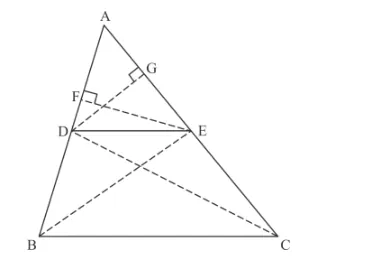
In the above figure, we can see that EF is perpendicular to AB. Therefore EF is the height of the .
.
Now we are finding the area of  and area of
Area of $\triangle \mathrm{ADE}=\frac{1}{2}($ base $\times$ hight $)$
$=\frac{1}{2} \mathrm{AD} \cdot \mathrm{EF}$..............(1)
Area of $\triangle \mathrm{DBE}=\frac{1}{2} \mathrm{DB} . \mathrm{EF}$............(2)
Now take the ratio of the two equation, we have
$\frac{\text { Area of } \triangle \mathrm{ADE}}{\text { Area of } \triangle \mathrm{DBE}}=\frac{\frac{1}{2} \mathrm{AD} . \mathrm{EF}}{\frac{1}{2} \mathrm{DB} \cdot \mathrm{EF}}$
$=\frac{\mathrm{AD}}{\mathrm{DB}}$............(3)
Similarly, In $\triangle \mathrm{ADE}$ and $\triangle \mathrm{DEC}$, we have
$\frac{\text { Area of } \triangle \mathrm{ADE}}{\text { Area of } \triangle \mathrm{DEC}}=\frac{\frac{1}{2} \mathrm{AE.DG}}{\frac{1}{2} \mathrm{EC.DG}}$
$=\frac{\mathrm{AE}}{\mathrm{EC}}$...............(4)
But, the area of triangle DBE and triangle DEC are same, therefore equation (4) can be written as
$\frac{\text { Area of } \triangle \mathrm{ADE}}{\text { Area of } \triangle \mathrm{DBE}}=\frac{\frac{1}{2} \mathrm{AE} \cdot \mathrm{DG}}{\frac{1}{2} \mathrm{EC} \cdot \mathrm{DG}}$
$=$..............(5)
From equation (3) and equation (5), we get
$\frac{\mathrm{AD}}{\mathrm{DB}}=\frac{\mathrm{AE}}{\mathrm{EC}}$
Hence, $\frac{\mathrm{AD}}{\mathrm{DB}}=\frac{\mathrm{AE}}{\mathrm{EC}}$