In a parallelogram PQRS, PQ = 12 cm and PS = 9 cm.
Using angle bisector properties, parallel lines, and isosceles triangle concepts, the required length of RT is found to be 3 cm.
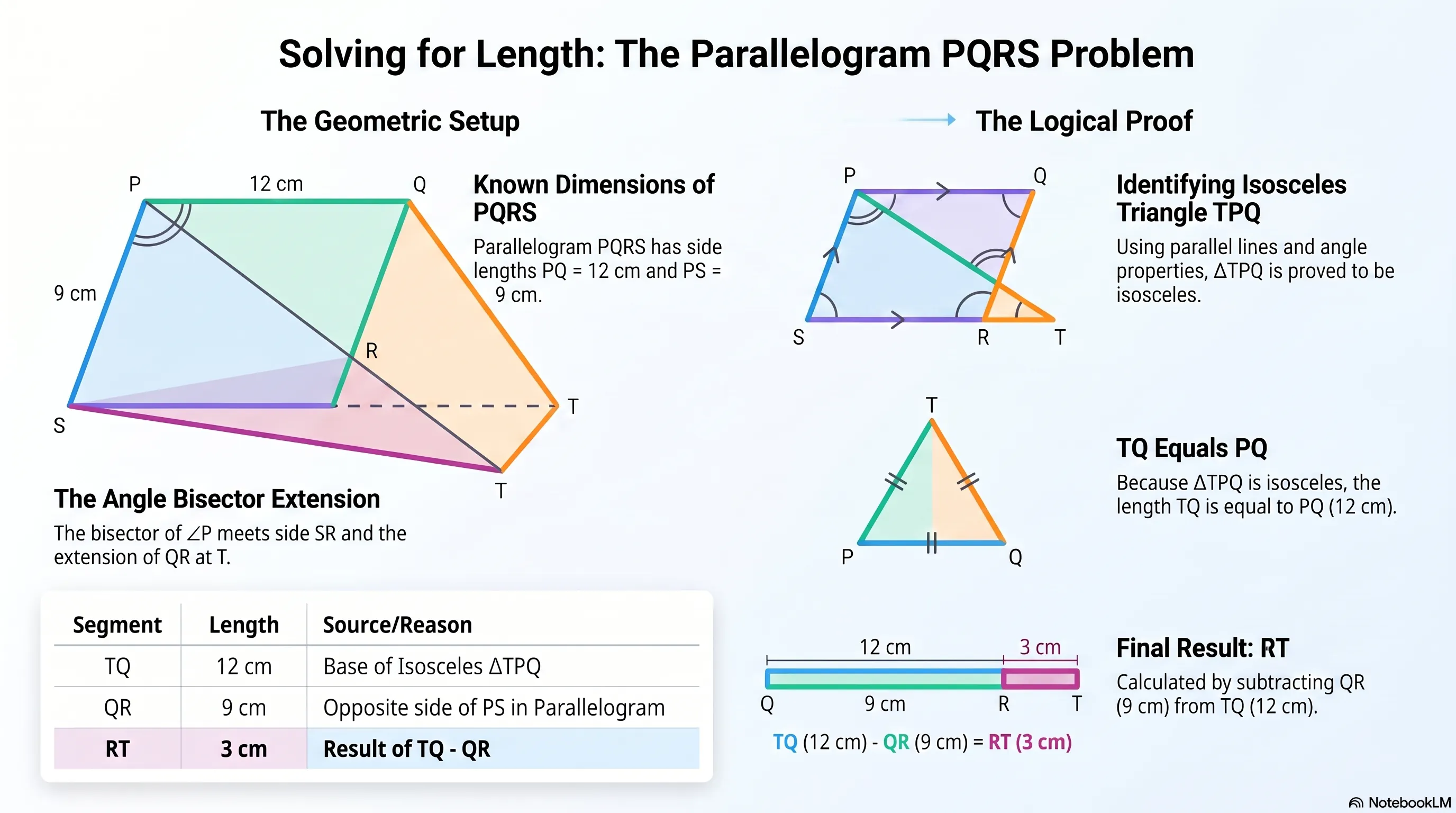


In a parallelogram PQRS, PQ = 12 cm and PS = 9 cm. The bisector of ∠P meets SR in M. PM and QR both when produced meet at T. Find the length of RT.
Given: In parallelogram PQRS, PQ = 12 cm and PS = 9 cm. The bisector of ∠SPQ meets SR at M.
Let ∠SPQ = 2x.
⇒ ∠SRQ = 2x and ∠TPQ = x.
Also, PQ ∥ SR
⇒ ∠TMR = ∠TPQ = x.
In △TMR, ∠SRQ is an exterior angle.
⇒ ∠SRQ = ∠TMR + ∠MTR
⇒ 2x = x + ∠MTR
⇒ ∠MTR = x
⇒ △TPQ is an isosceles triangle.
⇒ TQ = PQ = 12 cm
Now,
RT = TQ − QR
= TQ − PS
= 12 − 9
= 3 cm
Frequently Asked Questions
Find answers to common questions.
What is the length of RT in this parallelogram problem?
RT = 3 cm. When the bisector of ∠P in parallelogram PQRS (PQ = 12 cm, PS = 9 cm) meets SR at M, and PM and QR both produced meet at T, triangle TPQ becomes isosceles with TQ = PQ = 12 cm. Since QR = PS = 9 cm, RT = TQ − QR = 12 − 9 = 3 cm.
Why is triangle TPQ isosceles in this problem?
Triangle TPQ is isosceles because ∠TPQ = ∠TQP = x. This equality is established using the angle bisector condition (∠MPQ = x), alternate interior angles on parallel lines PQ ∥ SR (giving ∠TMR = x), and the exterior angle theorem at R (giving ∠MTR = x). Since two angles of the triangle are equal, the sides opposite them are also equal, so TQ = PQ = 12 cm.
Which theorems are needed to solve this parallelogram geometry problem?
Three theorems are essential: (1) Properties of a parallelogram — opposite sides are equal and parallel; (2) Alternate interior angles — when parallel lines are cut by a transversal; and (3) Exterior angle theorem — an exterior angle of a triangle equals the sum of the two non-adjacent interior angles. Together, these prove that △TPQ is isosceles, making the calculation straightforward.
What is the value of RT if PQ = 15 cm and PS = 11 cm instead?
Using the same method: TQ = PQ = 15 cm and QR = PS = 11 cm. Therefore RT = TQ − QR = 15 − 11 = 4 cm. The formula is always RT = PQ − PS, provided the angle bisector of ∠P is used and the same construction applies. This generalisation is worth noting for exam speed.