The Scholar’s Roadmap: The Ultimate Guide to Cracking JEE, NEET, and Board Exams
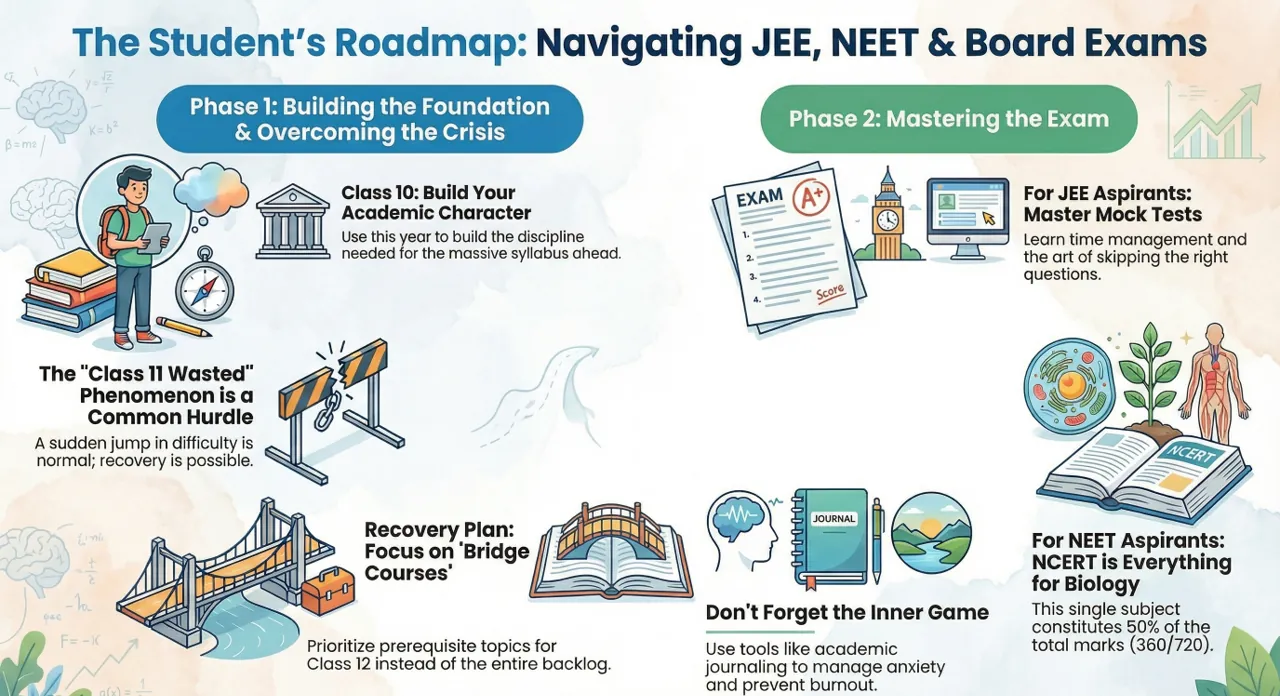
Table of Contents
- Introduction: The Landscape of Competitive Excellence
- Phase 1: The Foundation – Mastering Class 10
- Phase 2: The Crisis – "Class 11 is Wasted"
- Phase 3: The Engineer’s Path – Cracking JEE Main
- Phase 4: The Doctor’s Path – Conquering NEET
- Phase 5: Mental Resilience & Resource Library
- Conclusion: Your Journey Starts Now

Introduction: The Landscape of Competitive Excellence
In the high-stakes world of Indian education, the journey from Class 10 to the final entrance exam (JEE or NEET) is often compared to a marathon, not a sprint. Every year, millions of aspirants step into this arena with dreams of IITs and AIIMS, yet only a fraction cross the finish line. What separates the toppers from the rest? Is it raw intelligence? Is it 18 hours of daily study? Or is it something more fundamental—strategy?
Over the years, we have documented the journeys of thousands of students. We have seen the highs of Class 10 board results and the crushing lows of the "Class 11 wasted" phenomenon. We have witnessed students recover from impossible situations to secure top ranks. This page serves as a comprehensive archive of those strategies, stories, and resources.
Below, we have compiled our most impactful articles, slide decks, and personal success stories. Whether you are a Class 10 student looking to build a foundation, or a Class 12 aspirant looking to salvage a wasted year, this guide contains the blueprints you need.
Phase 1: The Foundation – Mastering Class 10
The Importance of Early Momentum
Many students make the mistake of treating Class 10 as a "rest year" before the storm of JEE/NEET. However, Class 10 is where your academic character is built. It is the first time you face a standardized national curriculum. The discipline you build here directly translates to your ability to handle the massive syllabus of Class 11.
Striking the Balance: Boards vs. Competitive Basics
The biggest challenge for a Class 10 student is managing the immediate pressure of Board exams while keeping an eye on the future. You don't need to solve Irodov in Class 10, but you do need to master your NCERTs to a level where you can teach them to others.
We have documented the specific schedules and mental frameworks required to dominate this year. For a detailed breakdown on balancing school pressure with high performance, you can read our guide on how I topped Class 10 and built a foundation for the future. This resource dives deep into the daily routine of a topper.
The "2-Month" Sprint Strategy
What if you haven't studied all year? Is it possible to score 95%+ with just two months of preparation? The answer is yes, but it requires a shift from "hard work" to "smart work." You need to identify high-weightage chapters, practice previous year papers relentlessly, and ruthlessly cut out distractions.
We have a specific case study of a student who utilized a 60-day intensive plan to achieve remarkable results. You can find the full strategy here: How I Scored 99% in CBSE Class 10: My 2-Month Strategy.
The transition from Class 9 to Class 10 is the first major milestone in a student’s life. While many see it as just "The Board Year," the most successful aspirants view it as the JEE/NEET Incubation Phase. If you can master the discipline required in Class 10, you have already won 50% of the battle for Class 11.
A Day in the Life of a Class 10 Topper
Success isn't about luck; it's about a repeatable routine. Below is the exact schedule used by our top-performing students who balanced 95%+ Board scores while starting their JEE/NEET foundation.
| Time Slot | Activity | Purpose |
| 06:00 AM – 06:30 AM | Wake up & Light Exercise | To boost oxygen flow to the brain. |
| 06:30 AM – 08:00 AM | Prime Learning Slot (Science/Maths) | Tackle the toughest concepts when the mind is fresh. |
| 08:00 AM – 02:30 PM | School Hours | Listen actively; finish assignments during free periods. |
| 02:30 PM – 03:30 PM | Lunch & Power Nap | Reset the brain for the second half of the day. |
| 03:30 PM – 05:30 PM | Foundation Study (Competitive Level) | Solving higher-order thinking skills (HOTS) and NTSE-level problems. |
| 05:30 PM – 06:30 PM | Outdoor Play / Hobby | Essential for preventing mental burnout. |
| 06:30 PM – 08:30 PM | Board Exam Focus (Social Science/Lang) | Focus on NCERT reading and answer writing practice. |
| 08:30 PM – 09:15 PM | Dinner | Family time; no screens. |
| 09:15 PM – 10:00 PM | Revision & Diary Entry | Reviewing what was learned and planning the next day. |
| 10:00 PM | Lights Out | 8 hours of sleep is non-negotiable for memory consolidation. |
Bridging the Gap: Board Exam vs. JEE Foundation
The biggest confusion for Class 10 students is whether to study for the Boards or for the "Future." The reality is that the Syllabus is the same, but the Depth is different. Below is a comparison to help you understand how to navigate both simultaneously:
| Subject / Topic | CBSE Board Focus (What they ask) | JEE/NEET Foundation Focus (The Logic) |
| Physics: Light | Definitions, Ray diagrams, Mirror formula. | Lateral shift, Apparent depth, Combination of mirrors & lenses. |
| Chemistry: Carbon | Nomenclature, Functional groups, Properties. | Hybridization basics, Inductive effect, Reaction mechanisms. |
| Biology: Life Proc. | Diagram labeling, Functions of organs. | Molecular level understanding of ATP, Enzyme kinetics. |
| Mathematics: Trig. | Identities, Heights and Distances. | Compound angles, Multiple angles, Inverse basics. |
The NTSE & Olympiad Factor
In Class 10, the NTSE (National Talent Search Examination) serves as the perfect "Warm-up" for JEE and NEET. It introduces you to the pressure of competitive exams, the OMR sheet format, and the Mental Ability Test (MAT).
If you are aiming for a top rank in Class 10, check out our comprehensive breakdown of how to strategize: How I Scored 99% in CBSE Class 10: My 2-Month Strategy.
Why Your "Character" Matters More Than Your Marks
In the long run, your 10th-grade percentage is a trophy, but your study habits are the engine. If you learn how to sit for 3 hours with absolute focus now, you won't struggle when you reach Class 11. Most students "waste" Class 11 because they never built the "Sitting Power" in Class 10.
To see how this character building led to ultimate success, read the full account: How I Topped Class 10 and Built a Foundation for the Future
Phase 2: The Crisis – "Class 11 is Wasted"
The "Class 11 Wasted" phenomenon is so common that it is almost a rite of passage for JEE and NEET aspirants. However, the difference between those who eventually make it to an IIT/AIIMS and those who give up lies in how they handle the months between December of Class 11 and April of Class 12.
The Psychology of the Backlog
When a student says "My Class 11 is wasted," they usually mean they have lost their momentum. The sheer volume of Physics (Mechanics), Chemistry (Ionic Equilibrium & GOC), and Mathematics (Conic Sections) is often 5x the volume of Class 10.
The biggest mistake students make at this stage is trying to finish everything at once. This leads to "Analysis Paralysis," where the student spends more time worrying about the backlog than actually studying. You must understand that you don't need to be a master of every Class 11 chapter to excel in Class 12. You only need to be a master of the "Bridge Chapters."
The "Rescue List": Top 10 Chapters to Save Your JEE/NEET Rank
If you have limited time before Class 12 begins, do not try to finish the whole syllabus. Instead, focus on these "High-Yield" topics that are essential prerequisites for the Class 12 syllabus.
| Subject | The "Must-Save" Chapter | Why it is Critical for Class 12 |
| Physics | Vectors & Kinematics | Without these, you cannot solve a single problem in Class 12 Electrostatics or Magnetism. |
| Physics | Newton’s Laws of Motion | The concept of Free Body Diagrams (FBD) is used in every single chapter of 12th. |
| Chemistry | Chemical Bonding | This is the backbone of Inorganic and Organic Chemistry. You cannot understand structures without it. |
| Chemistry | GOC (General Organic Chemistry) | If you skip this, you will find 12th Organic Chemistry (Alcohol, Phenols, Ethers) impossible to memorize. |
| Chemistry | Mole Concept | Essential for Solution Chemistry and Electrochemistry in Class 12. |
| Maths | Trigonometric Functions | Used as a tool in Calculus (Integration/Differentiation) which is 40% of the 12th syllabus. |
| Maths | Basic Algebra (Quadratic/Logs) | These are the "calculation tools" for every complex JEE problem. |
| Biology | Cell: The Unit of Life | You cannot understand Genetics or Biotechnology in 12th without knowing cell structures. |
| Biology | Biomolecules | Directly links to the Physiology and Molecular Biology chapters in the next grade. |
| Biology | Plant/Animal Kingdom | Provides the classification context for the entire 12th-grade Ecology section. |
The "Zero-Hour" Recovery Strategy
To recover, you need a split-study schedule. You cannot stop your current coaching/school topics to finish the backlog. Instead, use the 70/30 Rule:
-
70% of your time: Focus on current topics being taught in class. Do not let your "Current" become "Backlog."
-
30% of your time: Dedicate 2 hours every evening specifically to one "Rescue Chapter" from the list above.
This systematic approach ensures that while you are healing the past, you aren't poisoning the future. For a deep dive into how to manage this transition without burning out, read our viral guide: Class 11th is Wasted? How You Can Still Crack JEE/NEET.
Defying the Odds: The Mental Shift
The most dangerous thought a student can have is: "It’s too late." The IIT-JEE and NEET exams are tests of endurance. Many toppers had a "wasted" Class 11, but they had a "legendary" Class 12. The jump in maturity between age 16 and 17 is massive. You are now more capable of handling stress than you were a year ago.
We have documented a real-life story of a student who was at the bottom of their batch in Class 11 and climbed to the top 1% by the end of Class 12. This narrative is essential for any student currently feeling hopeless. Read it here: Everyone Said IIT Was Impossible After Class 11: Here’s What Changed Everything.
Academic Resilience and "Penzu" Journaling
How do you stay consistent when the results aren't immediate? You must track your progress. When you see that you have completed 5 out of the 10 "Rescue Chapters," your brain releases dopamine, which fuels further study.
We recommend using digital tools to keep an "Error Log" or a "Success Journal." By documenting your daily struggles, you turn them into data points rather than emotional burdens. Explore our thoughts on Reflective Journaling Techniques for Students to learn how to keep your mental health intact during this recovery phase.
The Recovery Roadmap
If you are currently staring at a mountain of backlog, do not panic. Panic leads to paralysis. The solution lies in distinct "Bridge Courses"—covering only the prerequisites needed for Class 12 (like Vectors, Basic Differentiation, Chemical Bonding) and leaving the heavy topics for later.
We have created a comprehensive rescue guide for this exact situation. If you feel you are behind, read this immediately: Class 11th is Wasted? Here is How You Can Still Crack JEE/NEET.
Defying the Odds
Sometimes, you need inspiration more than strategy. You need to know that someone else stood exactly where you are and still made it to IIT. There is a prevailing myth that if you haven't started by Class 9, you are too late. This is false.
Read this powerful narrative on how one student turned the tide when everyone else had written them off: Everyone Said IIT Was Impossible After Class 11: Here’s What Changed Everything.
Here is the expanded content for Phase 3, focusing on the technical and strategic aspects of cracking the JEE Main. This section will dive deep into subject-specific logic and the critical role of revision, helping you push toward that 6,000-word target.
Phase 3: The Engineer’s Path – Cracking JEE Main
If Class 11 is about building the engine, Class 12 and the months leading up to JEE Main are about fine-tuning it for maximum speed and efficiency. To reach the 99th percentile, you must transition from being a "learner" to being a "problem solver."
The Strategic Subject Split: Physics, Chemistry, and Maths
In JEE Main, each subject requires a different cognitive approach. Students who treat all three the same often struggle with time management during the actual exam.
1. Physics: The Bridge Between Logic and Calculation
Physics is often the most feared subject, but it is also the most logical. In JEE Main, Physics has shifted toward being more "formula-application" oriented rather than purely theoretical.
-
The 70% Rule: Roughly 70% of JEE Physics comes from high-weightage areas like Modern Physics, Electrostatics, and Magnetism.
-
Visualization: You cannot solve a Physics problem without a mental or physical diagram. Whether it’s a Free Body Diagram (FBD) or a circuit layout, visualization is key.
-
The Revision Secret: Because Physics has so many formulas and derivations, a "Revision Series" is essential. You need a way to scan through 2 years of syllabus in 2 hours. Our curated Physics Revision Series for Class 11 & 12 is designed for this exact purpose.
2. Mathematics: The Game of Endurance
Maths is the "rank decider." In recent years, JEE Main Mathematics has become increasingly lengthy and calculation-intensive.
-
Speed vs. Accuracy: You must develop "short-tricks" for chapters like Matrices, Determinants, and Vector 3D.
-
Pattern Recognition: Solving JEE Main Question Papers allows you to see that the NTA (National Testing Agency) often repeats specific types of calculus and coordinate geometry problems.
3. Chemistry: The Score Booster
Chemistry is where you "save" time to spend on Maths.
-
Physical Chemistry: Treat this like Physics—formula-based and logical.
-
Inorganic/Organic: This is where the NCERT-Based Preparation strategy shines. If you know your NCERT, you can finish the Chemistry section in 30–40 minutes.
The Power of Mock Tests and Sample Papers
Why do toppers solve 50+ mock tests? It’s not just for practice; it’s for data collection. After every test, you should have an "Error Analysis Table" that tells you exactly why you lost marks.
| Error Category | Description | Fix |
| Silly Mistake | Calculation error or misreading the question. | Slow down during the last 10 seconds of a problem. |
| Conceptual Gap | You didn't know how to start the problem. | Re-read the theory and solve 10 basic problems. |
| Time Out | You knew how to solve it but ran out of time. | Use timed practice for that specific chapter. |
To understand the psychological benefit of this process, view our presentation on the Benefits of Solving JEE Main Sample Papers and the Importance of Solving JEE Main Sample Papers.
The Ex-Topper’s Final Countdown
In the final 60 days, your "Revision to New Learning" ratio should be 80:20. You are no longer trying to learn new things; you are trying to ensure you don't forget what you already know.
We have hosted a full breakdown of this 99.8 percentile mindset. It covers everything from what to eat on exam day to how to handle the "Numerical Type" questions without negative marking. You can find this goldmine of information here: How to Prepare for JEE Mains: An Ex-Topper’s Proven Study Plan.
Collaborative Learning and Accountability
Sometimes, the journey is too heavy to walk alone. Joining a community of like-minded aspirants can provide the "Social Proof" you need to stay motivated. Whether it's through a Newsletter on Academic Resilience or by contributing to Student Writer Platforms, sharing your progress makes the goal feel more attainable.
Phase 4: The Doctor’s Path – Conquering NEET
The NEET (National Eligibility cum Entrance Test) is a different beast compared to JEE. While JEE rewards complex problem-solving and mathematical agility, NEET rewards speed, accuracy, and near-perfect retention. With over 20 lakh students competing for limited government MBBS seats, the margin for error is zero. You aren't just competing against other students; you are competing against the clock.
Biology: The 360-Mark Foundation
In NEET, Biology isn't just a subject—it’s your lifeline. It accounts for 50% of the total marks. To get into a top-tier government medical college, a score of 340+ in Biology is non-negotiable.
1. The "NCERT is God" Philosophy
For NEET Biology, every single question in the last five years has been derived from the NCERT. However, "reading" NCERT is not enough. You must decode it.
-
Diagrammatic Memory: Often, questions are asked from the labels of diagrams that aren't mentioned in the text.
-
The Summary Boxes: Many students skip the summary at the end of the chapter, but NTA often picks "Application-based" questions from these summaries.
-
Between the Lines: Note the "Note" and "Warning" sections in chapters like Genetics and Biotechnology.
To see exactly how to structure your Biology revision to hit that elusive 340+ mark, refer to our specialized guide: How to Score 340 in NEET Biology.
Physics for NEET: The "Med-Student" Struggle
Physics is usually the deciding factor for NEET ranks. Most medical aspirants love Biology but struggle with the mathematical rigor of Physics. The secret to cracking NEET Physics is different from JEE:
-
Focus on Modern Physics & Semiconductor Devices: These are high-weightage and relatively easier to score.
-
Formula Fluency: In NEET, you don't have time to derive formulas. You must have them on your fingertips.
-
Unit & Dimension Check: Many NEET Physics questions can be solved simply by checking the units of the options—a huge time-saving hack.
We have optimized a presentation specifically for this NCERT-centric approach to ensure you don't overcomplicate your preparation: NCERT Based Preparation for NEET.
Chemistry: The Balancing Act
Chemistry in NEET acts as the bridge between the "memory-based" Biology and "logic-based" Physics.
-
Organic Chemistry: Focus on named reactions. NTA loves direct conversions.
-
Inorganic Chemistry: Treat this exactly like Biology. Read NCERT 10–15 times until the periodic table trends are etched in your memory.
-
Physical Chemistry: Stick to the formula-based numericals. Unlike JEE, NEET rarely asks multi-concept calculation-heavy questions.
The Mock Test Cycle for NEET
Because NEET is an offline exam (OMR-based), your practice must reflect that.
-
The OMR Trap: Many students lose 10–15 marks because of "bubbling errors." You must practice filling OMR sheets while under time pressure.
-
Speed-Run Practice: Try to finish the 90 Biology questions in 30 minutes. This gives you a "time cushion" for the calculation-heavy Physics section.
-
The Analysis: If you miss a question in Biology, it’s a "Memory Gap." If you miss it in Physics, it’s a "Concept Gap." Address them differently.
Mindset: Handling the Pressure of a Single Day
Unlike JEE Main, which happens in multiple shifts, NEET is a one-day, one-shot exam. The pressure is immense. This is why mental resilience is your 4th subject.
-
Avoid Burnout: Use the Pomodoro technique.
-
Stay Consistent: A "wasted day" in NEET preparation feels 10x heavier because of the competition density.
For those looking for a complete "Vault" of resources, including formula sheets and previous year breakdowns that cover both engineering and medical nuances, access our Essential Study Resource Bundle.
Final Conclusion: The Road Ahead
We have covered the journey from the foundations of Class 10 to the high-pressure environments of JEE and NEET. Whether you are a student who has "wasted" time or a topper looking to sharpen your edge, remember that the resources on this media page are only as good as your execution.
Success in these exams is the result of thousands of small, boring, and disciplined decisions made every day. It’s choosing to solve 5 more problems when you’re tired. It’s choosing to analyze a mock test instead of just looking at the score. It’s choosing to believe in your recovery when everyone else says it's impossible.
Your engineering or medical dream is a marathon. We have provided the roadmap; now, it’s time for you to take the first step.
Phase 5: Mental Resilience & Resource Library
The Inner Game: Journaling and Mental Health
Competitive exams are a psychological war. Anxiety, fear of failure, and burnout are real enemies. One of the most effective tools we have found is "Academic Journaling"—writing down your daily goals, your fears, and your small wins.
-
Penzu Diaries: Keeping a private log of your mistakes helps in accepting them. Read more about our Reflective Journaling Techniques.
-
Public Accountability: Sometimes, sharing your journey helps. Check out our Newsletter on Academic Resilience.
-
The Power of Writing: Writing clears the mind. See our thoughts on The Student Writer’s Mindset.
The Vault: Downloadable Resources
Finally, strategy is nothing without resources. We have curated a set of essential PDFs, formula sheets, and tracker templates that you can download and print. These are the tools that will organize your chaos.
You can access the Essential Study Resource Bundle here.
Conclusion: Your Journey Starts Now
Whether you are struggling with Class 11 mechanics or trying to perfect your Biology memorization, the resources above cover every aspect of the journey. The path to IIT or AIIMS is not reserved for the geniuses; it is open to anyone willing to follow a plan, stay consistent, and pick themselves up when they fall.
Explore the links, download the resources, and build your own roadmap to success.