Thermodynamics Short Notes for Class 11, JEE & NEET
Thermodynamics is a high-weightage Physical Chemistry chapter for JEE and NEET covering energy changes, enthalpy, entropy, Gibbs free energy, Hess’s Law, and spontaneity, with formula-based questions appearing consistently every year.
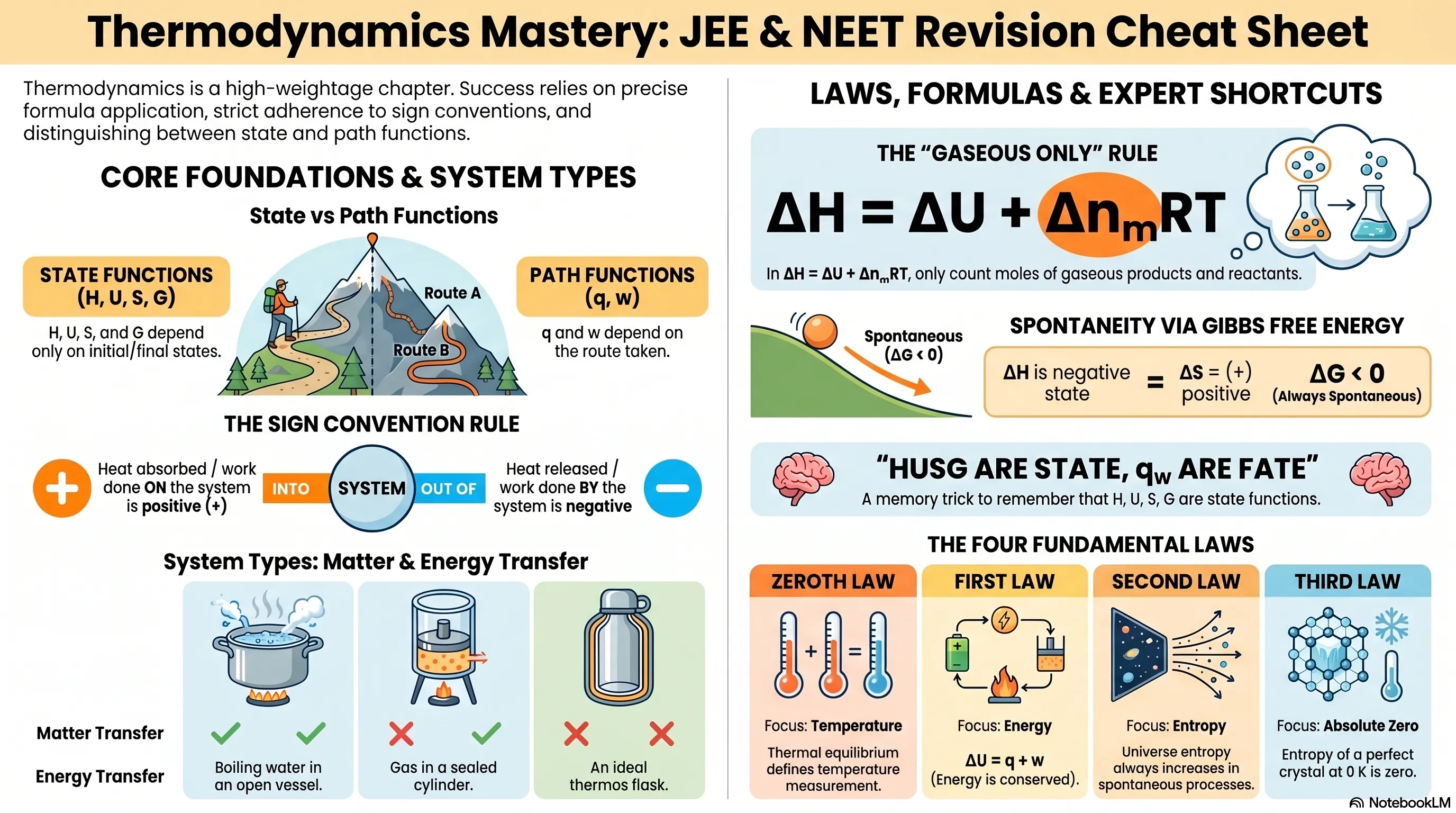
Table of Contents
- Thermodynamics Chapter Overview — Topics and JEE/NEET Weightage
- Thermodynamics Short Notes
- Key Definitions You Must Know
- Laws of Thermodynamics — Quick Revision
- Most Important Thermodynamics Formulas for JEE and NEET
- Hess's Law and Bond Enthalpy — Exam Shortcuts
- Common Mistakes Students Make in Thermodynamics
- How to Study Thermodynamics for JEE and NEET

eSaral › NEET › Thermodynamics Short Notes for Class 11, JEE & NEET

Thermodynamics Chapter Overview — Topics and JEE/NEET Weightage
Thermodynamics is part of Physical Chemistry in Class 11. It is one of the most consistently tested chapters across both JEE Main and NEET UG every year.
| Topic | JEE Main Weightage | NEET Weightage |
|---|---|---|
| First Law of Thermodynamics | High | Medium |
| Enthalpy and Hess's Law | High | High |
| Entropy and Second Law | High | Medium |
| Gibbs Free Energy | High | High |
| Bond Enthalpy Calculations | Medium | High |
| Spontaneity | Medium | Medium |
| Thermodynamic State Functions | Medium | Low |
Total chapter weightage: 3–4 marks in NEET; 1–2 questions in JEE Main every attempt.
💡 Expert Tip by Prateek Gupta, IIT Bombay: "In JEE Main, Thermodynamics questions are almost always formula-application based — not conceptual traps. If you know the formulas and the sign conventions cold, you pick up these marks in under 2 minutes per question. That is free time for harder questions."
Thermodynamics Short Notes
India's Best Exam Preparation for Class 11th - Download Now
India's Best Exam Preparation for Class 11th - Download Now
Key Definitions You Must Know
System, Surroundings, and Boundary
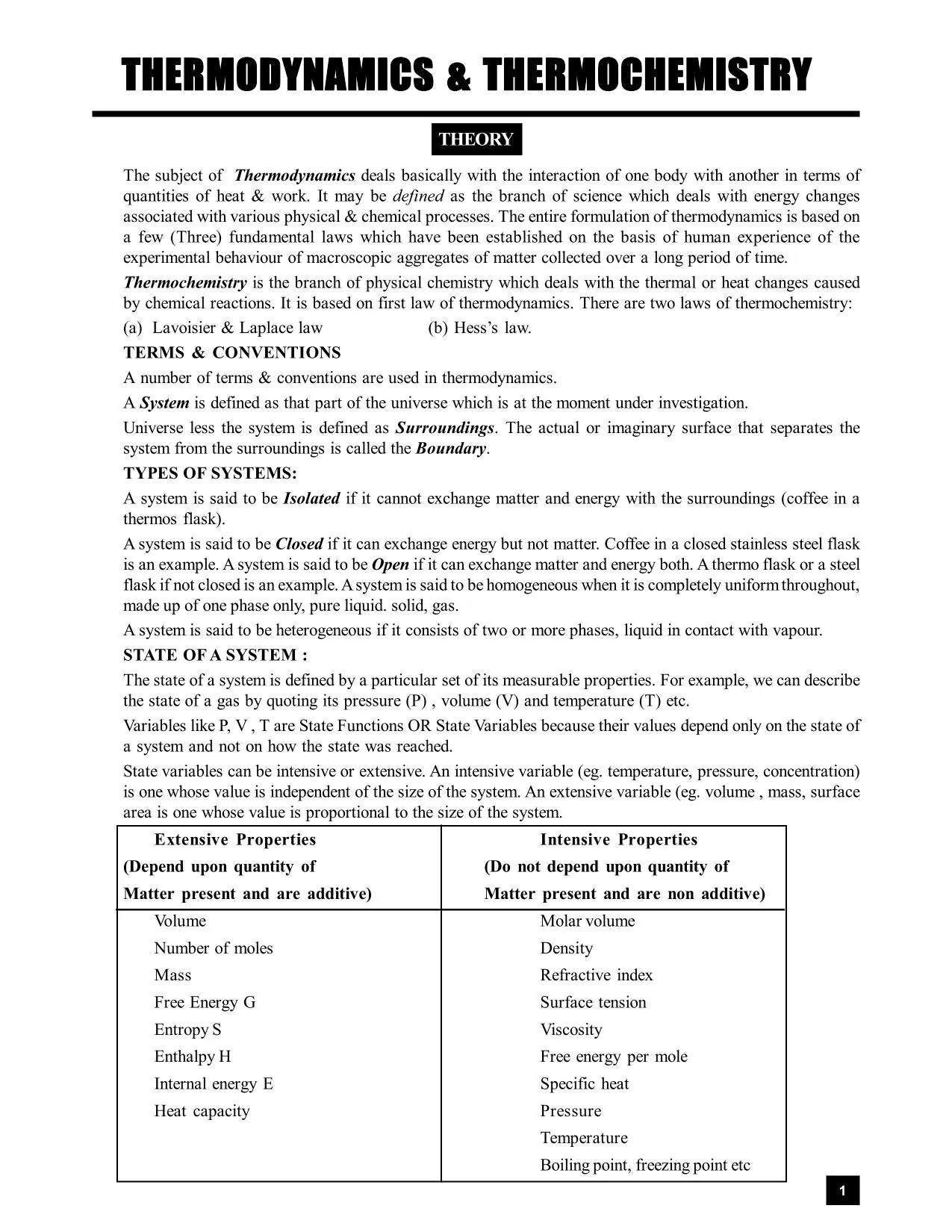
- System: The part of the universe under study
- Surroundings: Everything outside the system
- Boundary: The real or imaginary surface separating system from surroundings
Types of Systems
| Type | Matter Transfer | Energy Transfer | Example |
|---|---|---|---|
| Open | ✅ Yes | ✅ Yes | Boiling water in open vessel |
| Closed | ❌ No | ✅ Yes | Gas in sealed cylinder |
| Isolated | ❌ No | ❌ No | Thermos flask (ideal) |
State Functions vs Path Functions
This distinction is tested frequently in both JEE and NEET.
State Functions (depend only on initial and final state):
- Internal Energy (U), Enthalpy (H), Entropy (S), Gibbs Free Energy (G)
Path Functions (depend on the path taken):
- Heat (q), Work (w)
Memory trick: "HUSG are state, qw are fate" — state functions are fixed; path functions change with the route.
Types of Processes
- Isothermal: Constant temperature (ΔT = 0, so ΔU = 0 for ideal gas)
- Adiabatic: No heat exchange (q = 0)
- Isobaric: Constant pressure (ΔP = 0)
- Isochoric: Constant volume (ΔV = 0, so w = 0)
Laws of Thermodynamics — Quick Revision
Zeroth Law
If system A is in thermal equilibrium with system B, and system B is in thermal equilibrium with system C, then A and C are also in thermal equilibrium. This is the basis of temperature measurement.
First Law of Thermodynamics
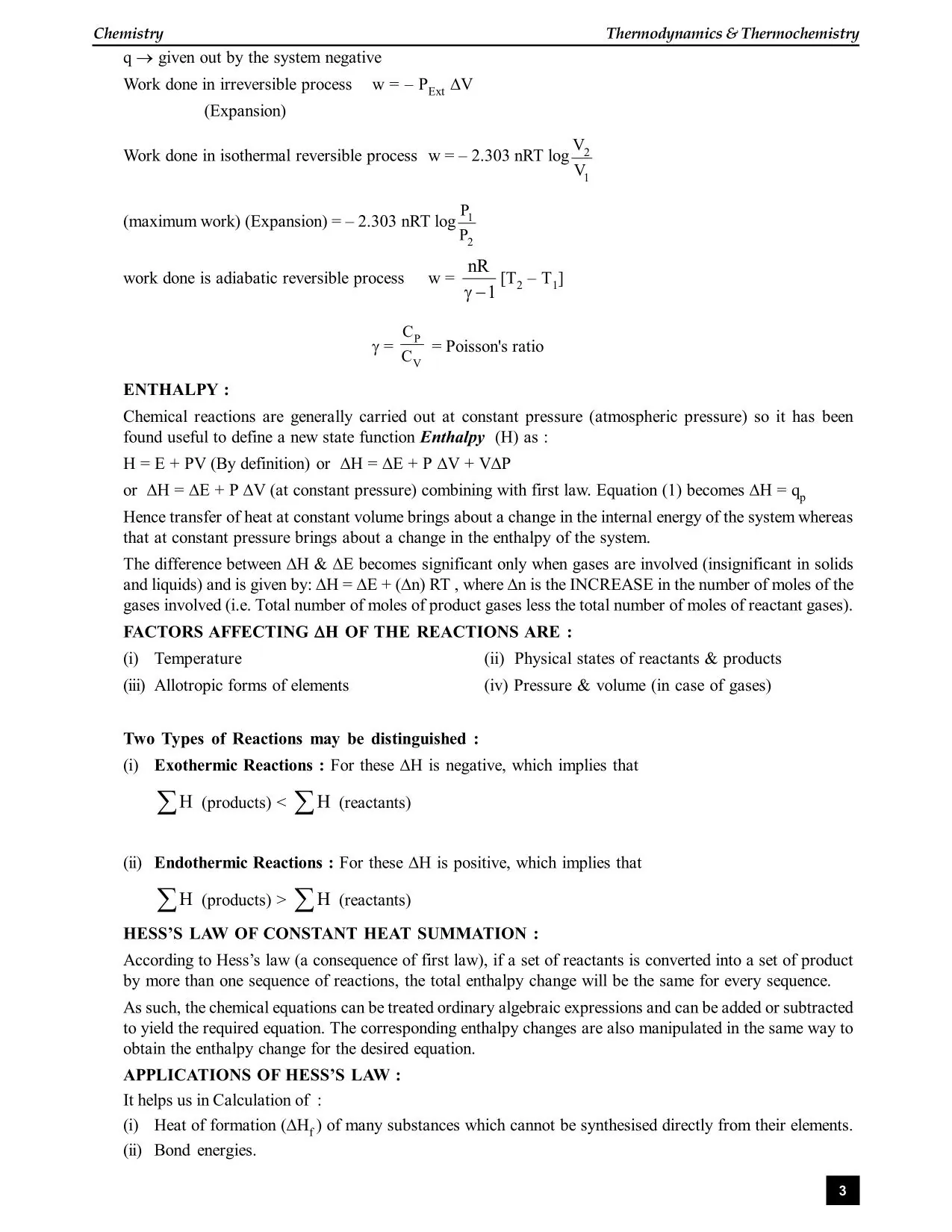
ΔU = q + w
Where:
- ΔU = change in internal energy
- q = heat absorbed by the system (+ve if absorbed, −ve if released)
- w = work done on the system (+ve if done on system, −ve if done by system)
For work done in expansion/compression: w = −P_ext × ΔV
For reversible isothermal expansion of an ideal gas: w = −nRT ln(V₂/V₁)
Second Law of Thermodynamics
The entropy of the universe always increases in a spontaneous process.
ΔS_universe = ΔS_system + ΔS_surroundings > 0 (for spontaneous process)
Third Law of Thermodynamics
The entropy of a perfectly crystalline substance at absolute zero (0 K) is zero.
S = 0 at T = 0 K (for perfect crystal)
Most Important Thermodynamics Formulas for JEE and NEET
Enthalpy
H = U + PV
ΔH = ΔU + ΔnₘRT
Where Δnₘ = moles of gaseous products − moles of gaseous reactants
💡 Expert Tip by Prateek Gupta, IIT Bombay: "The ΔH = ΔU + ΔnₘRT formula is tested in almost every JEE Main session. Students who forget to count only gaseous moles — not all moles — lose this mark every time. Write 'gaseous only' next to this formula in your notes."
Standard Enthalpy of Reaction
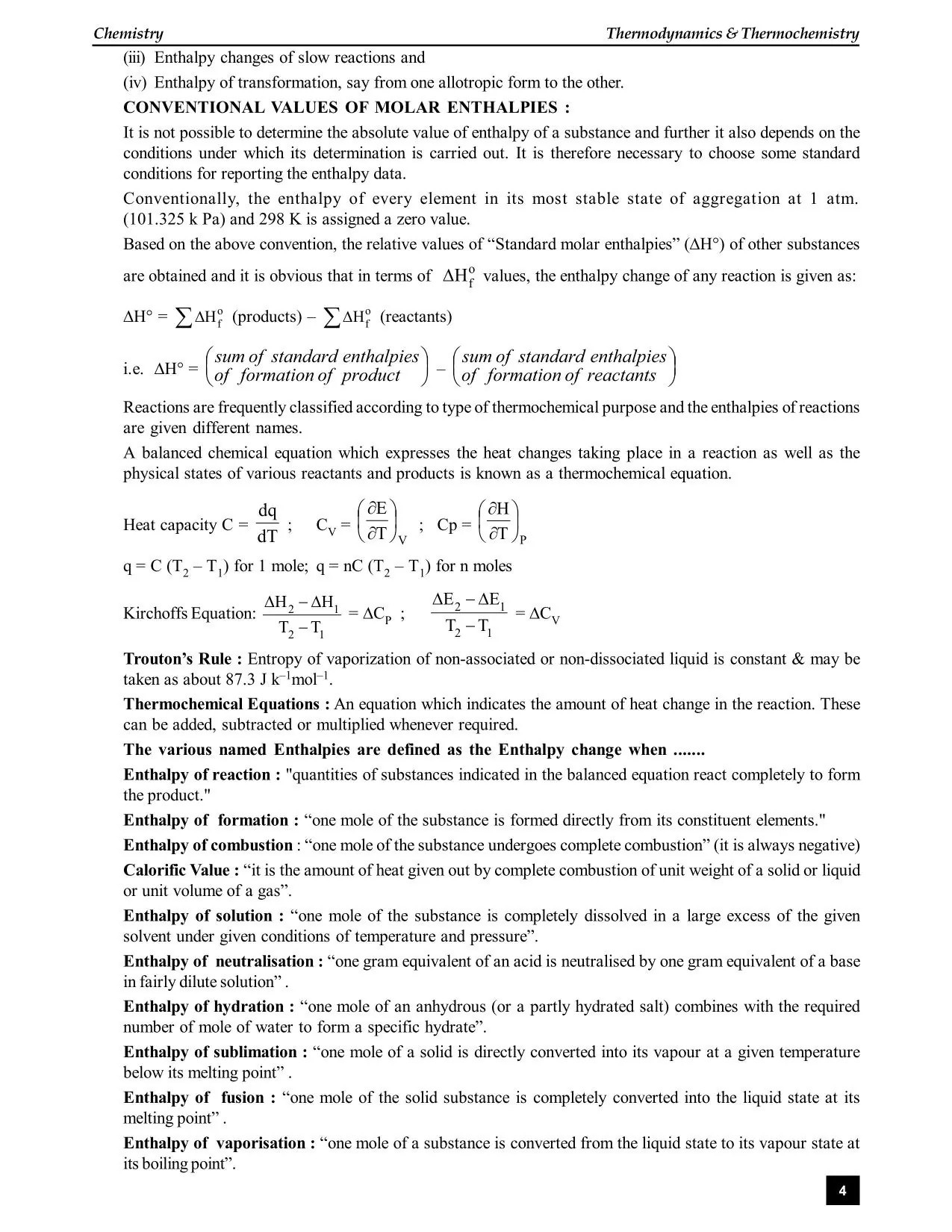
ΔH°rxn = Σ ΔH°f (products) − Σ ΔH°f (reactants)
Entropy
ΔS = q_rev / T
For a reaction: ΔS°rxn = Σ S° (products) − Σ S° (reactants)
Gibbs Free Energy
ΔG = ΔH − TΔS
ΔG° = −RT ln K (K = equilibrium constant)
ΔG° = −nFE° (for electrochemical cells)
Spontaneity Rules (Must Memorise)
| ΔH | ΔS | Spontaneous? |
|---|---|---|
| − | + | Always spontaneous |
| + | − | Never spontaneous |
| − | − | Spontaneous at low temperature |
| + | + | Spontaneous at high temperature |
Hess's Law and Bond Enthalpy — Exam Shortcuts
Hess's Law
The total enthalpy change for a reaction is the same regardless of whether it occurs in one step or multiple steps.
Practical use: When you cannot measure ΔH directly, add known reactions to get the target reaction. Multiply, reverse, and add equations — ΔH follows the same operations.
Step-by-step method:
- Write the target reaction clearly
- Identify the given reactions
- Reverse any reaction whose product needs to appear as a reactant
- Multiply reactions by the required coefficients
- Add all ΔH values (accounting for reversals and multiplications)
Bond Enthalpy Method
ΔH°rxn = Σ Bond Enthalpies of Bonds Broken − Σ Bond Enthalpies of Bonds Formed
Remember: Breaking bonds requires energy (endothermic, +ve). Forming bonds releases energy (exothermic, −ve).
NEET shortcut: Bond enthalpy questions always give you a table of values. Apply the formula directly — do not try to derive it from first principles in the exam.
Common Mistakes Students Make in Thermodynamics
Most marks lost in Thermodynamics come from a small set of repeated errors:
- Wrong sign for work: Confusing work done BY the system vs ON the system. Always check whether the formula uses the IUPAC convention (w = −PΔV means expansion is negative work).
- Including non-gaseous moles in Δnₘ: The formula ΔH = ΔU + ΔnₘRT uses only gaseous moles. Solids and liquids are excluded.
- Forgetting to reverse ΔH when reversing a reaction: If you flip a reaction in Hess's Law, the sign of ΔH must also flip.
- Confusing ΔG° with ΔG: ΔG° applies at standard conditions. ΔG = ΔG° + RT ln Q for non-standard conditions.
- Misreading spontaneity: A negative ΔG means spontaneous — not a negative ΔH alone.
How to Study Thermodynamics for JEE and NEET
Step 1 — Read NCERT Chapter 6 Once, Fully
NEET is largely NCERT-based. Read the chapter once without taking notes. Understand the logic behind each law before memorising formulas.
Step 2 — Write All Formulas on One Page
Create a single-page formula sheet: First Law, ΔH = ΔU + ΔnₘRT, Gibbs equation, Hess's Law, Bond Enthalpy. This becomes your revision anchor.
Step 3 — Solve Numerical Practice in Order
- Start with ΔU and q calculations (isothermal, adiabatic, isochoric)
- Move to ΔH calculations using Hess's Law
- Then Gibbs Free Energy and spontaneity
- Finally bond enthalpy numerical problems
Step 4 — Attempt Previous Year Questions
Thermodynamics PYQs from JEE Main and NEET follow predictable patterns. Solving 5 years of PYQs for this chapter alone covers 80% of question types you will face.
Step 5 — Revise Sign Conventions Every Week
Write the sign convention rules on a sticky note. Review them before every test. This single habit prevents the most common error category in this chapter.
Frequently Asked Questions
Find answers to common questions.
What are the most important topics in Thermodynamics for NEET?
The most important Thermodynamics topics for NEET are Gibbs Free Energy and spontaneity, Hess's Law and standard enthalpy of reaction, bond enthalpy calculations, and the First Law with internal energy. These four topic areas account for the majority of NEET Thermodynamics questions. NCERT examples and exercises are sufficient for NEET-level questions on this chapter.
How many questions come from Thermodynamics in JEE Main?
JEE Main typically has 1–2 questions from Thermodynamics per attempt. These questions are almost always numerical — applying ΔH = ΔU + ΔnₘRT, Gibbs free energy calculations, or Hess's Law. Students who memorise all key formulas and their sign conventions can solve these in under 2 minutes each.
What is the difference between ΔH and ΔU in Thermodynamics?
ΔU is the change in internal energy of a system, measured at constant volume. ΔH is the enthalpy change, measured at constant pressure. The relationship between them is ΔH = ΔU + ΔnₘRT, where Δnₘ is the change in moles of gaseous species only. For reactions with no change in gaseous moles, ΔH equals ΔU.
How to study Thermodynamics for JEE and NEET quickly?
Study Thermodynamics for JEE and NEET by first reading NCERT Chapter 6 fully, then creating a one-page formula sheet, then solving numericals in order from basic (First Law) to advanced (Gibbs energy). Finish with 5 years of previous year questions for this chapter. This sequence takes 4–5 days for first-time study and 1–2 days for revision.
What is Gibbs Free Energy and why is it important for JEE and NEET?
Gibbs Free Energy (G) is a thermodynamic quantity that predicts spontaneity of a reaction. The formula is ΔG = ΔH − TΔS. A reaction is spontaneous when ΔG is negative. For JEE and NEET, the most tested applications are: predicting spontaneity from ΔH and ΔS values, calculating ΔG° from equilibrium constant K using ΔG° = −RT ln K, and identifying temperature conditions for spontaneity.