Can an Average Student Crack IIT?
Yes, an average student can crack IIT — but the numbers are demanding. Out of roughly 15.4 lakh students who appeared for JEE Main 2026, only around 56,880 qualified JEE Advanced, and just about 18,000 got an actual IIT seat — close to a 1-in-85 chance from the full applicant pool. Consistent, structured preparation matters far more than raw natural talent.
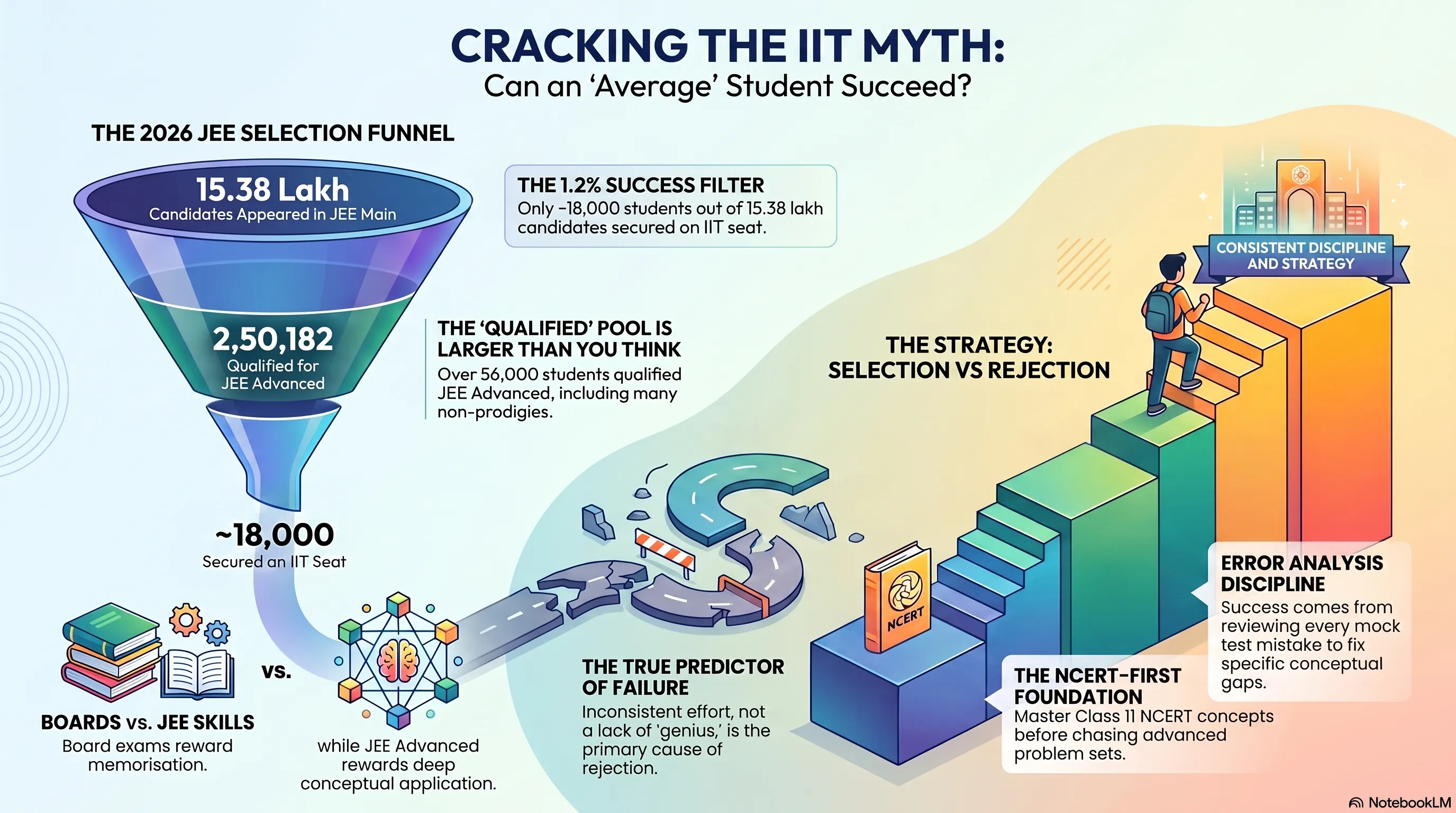
Table of Contents
- What Do the Real JEE Numbers Actually Show?
- What Does "Average Student" Even Mean in This Context?
- How Many Average Students Actually Crack IIT Each Year?
- What Actually Separates Selection From Rejection?
- Is JEE Advanced the Only Way Into a Good Engineering College?
- A Realistic Preparation Approach for an Average Student

eSaral › JEE › JEE Main ›Can an Average Student Crack IIT?

What Do the Real JEE Numbers Actually Show?
In 2026, around 15.38 lakh unique candidates appeared for JEE Main across both sessions. Of these, the top 2,50,182 candidates qualified for JEE Advanced. Of the candidates who appeared for JEE Advanced, 56,880 qualified, and only around 17,760–18,200 IIT seats were available across all 23 IITs.
| Stage | Number of Candidates |
|---|---|
| Appeared in JEE Main 2026 | ~15,38,000 |
| Qualified for JEE Advanced | 2,50,182 |
| Appeared in JEE Advanced | 1,79,694 |
| Qualified JEE Advanced | 56,880 |
| Got an actual IIT seat | ~18,000 |
Do the math on this and the picture is clear: less than 1.2% of all JEE Main candidates end up with an IIT seat. That's a genuinely tough filter — but it also means over 56,000 students qualified for JEE Advanced, and a large share of them were not lifelong toppers or child prodigies.
💡 Expert Tip from eSaral's JEE Faculty Panel: Don't read these numbers as "it's nearly impossible." Read them as "less than 2 out of every 100 candidates prepare well enough and consistently enough to make it" — which is a very different, much more actionable statement.
You can look at the full stage-wise structure on the JEE Main page and the JEE Advanced page.
What Does "Average Student" Even Mean in This Context?
This is where most discussions on this topic go wrong. "Average" gets used to mean at least three different things:
- Average school marks — a student who scores 75–85% in board exams, not 95%+.
- Average starting point in JEE-level concepts — a student who isn't naturally fast at Physics/Math problem-solving when they begin preparation.
- Average effort or consistency — a student who studies inconsistently, which is really a different problem altogether.
The first two types of "average" students crack IIT every single year. The third type — inconsistent effort — is the actual predictor of failure, far more than natural ability ever is. This distinction matters because it changes the entire question from "am I smart enough?" to "can I be consistent enough?"
How Many Average Students Actually Crack IIT Each Year?
There's no official "average student" tracking, but the structure of the exam itself tells the story. JEE Advanced draws its pool from the top 2.5 lakh JEE Main performers — a group that includes plenty of students who were mid-tier or even below-average in their early school years but improved sharply through 1–2 years of focused JEE preparation.
Does Board Exam Performance Predict IIT Selection?
Not reliably. Board exams and JEE test different skills — board exams reward broad syllabus coverage and memorization, while JEE Advanced rewards deep conceptual application under time pressure. Many students with solid-but-unspectacular board scores outperform toppers on JEE because they trained specifically for the exam's problem-solving style.
💡 Expert Tip from eSaral's JEE Faculty Panel: If your board percentage feels "just okay," that alone tells you very little about your JEE Advanced potential. The better predictor is how you perform on JEE-style mock tests after a few months of focused practice — not how you performed in school before you ever trained for this exam.
What Actually Separates Selection From Rejection?
Across the 56,880 students who qualified for JEE Advanced in 2026, a few patterns consistently show up more than raw intelligence:
- Early, structured start — students who began serious preparation in Class 11 rather than late in Class 12 had far more time to close conceptual gaps.
- Consistent mock test practice — regular full-length tests under exam conditions, not just chapter-wise practice, build the speed and stamina JEE Advanced demands.
- NCERT-first foundation, especially for Class 11 topics that many students skip while chasing advanced problem sets.
- Error analysis discipline — reviewing every mock test to fix specific mistakes, rather than just taking more tests.
- Realistic target-setting — aiming for a steady rank improvement rather than comparing themselves to toppers throughout the two-year prep window.
None of these require exceptional natural ability. All of them require sustained discipline over 1–2 years, which is a very different bar than "genius."
Is JEE Advanced the Only Way Into a Good Engineering College?
No — and this matters for any student worried they might not make the roughly 1.2% cut. A JEE Main rank alone (without JEE Advanced) opens seats at NITs, IIITs, and GFTIs, several of which have placement records and academic quality close to or matching mid-tier IITs in specific branches.
Checking realistic options beyond the top IITs is a practical part of planning, not a fallback mentality. You can review strong non-IIT options on the top NIT colleges page, and see exactly how competitive individual IIT branches are on the IIT Bombay cutoff page and the JEE Advanced marks vs rank page.
A Realistic Preparation Approach for an Average Student
- Start with the NCERT syllabus seriously, especially Class 11 Physics and Chemistry, since gaps here compound into Class 12. Refer to the JEE Main syllabus page, NCERT Class 11 Physics solutions, and NCERT Class 11 Chemistry solutions as your base layer.
- Set a realistic timeline using the JEE Main exam date page and eligibility criteria page so your preparation schedule matches the actual exam calendar.
- Take full-length mocks regularly, not just topic tests, once the basic syllabus is covered.
- Track your rank trend over months, not single test scores — a steadily improving trend matters more than any one mock result.
- Reassess with real data, not assumptions, by revisiting your progress against actual cutoffs and weightage every few months.
Frequently Asked Questions
Find answers to common questions.
Can an average student crack IIT?
Yes, an average student can crack IIT with consistent, structured preparation over 1–2 years. The real barrier is usually inconsistent effort, not a lack of natural ability, since JEE Advanced tests trained problem-solving skills rather than innate genius.
What percentage of JEE Main students actually get an IIT seat?
Roughly 1.2% of JEE Main candidates end up with an actual IIT seat, based on 2026 data of about 18,000 seats against 15.38 lakh appearing candidates. This makes IIT admission tough by the numbers, but not impossible with the right preparation.
Does a low board exam percentage mean I can't crack JEE Advanced?
No, board exams and JEE Advanced test different skills, so board performance is not a reliable predictor of JEE Advanced potential. Many students with average board scores clear JEE Advanced after focused, exam-specific preparation.
How many students qualify JEE Advanced compared to how many get IIT seats?
In 2026, 56,880 students qualified JEE Advanced, but only around 18,000 IIT seats were available. This means even qualifying JEE Advanced does not guarantee an IIT seat, especially for students targeting the most competitive branches.
What matters more for cracking JEE, intelligence or consistency?
Consistency generally matters more than raw intelligence for JEE Advanced selection. Students who start early, practice mock tests regularly, and fix specific errors tend to outperform naturally quick students who prepare inconsistently.