CBSE Class 10 Maths Mind Maps: Free Chapter-Wise PDFs for Fast Revision
Download free chapter-wise CBSE Class 10 Maths Mind Map PDFs covering all 14 NCERT chapters. Revise formulas, concepts, and problem-solving methods faster with visual mind maps, a three-pass revision strategy, and expert tips for board exam preparation.
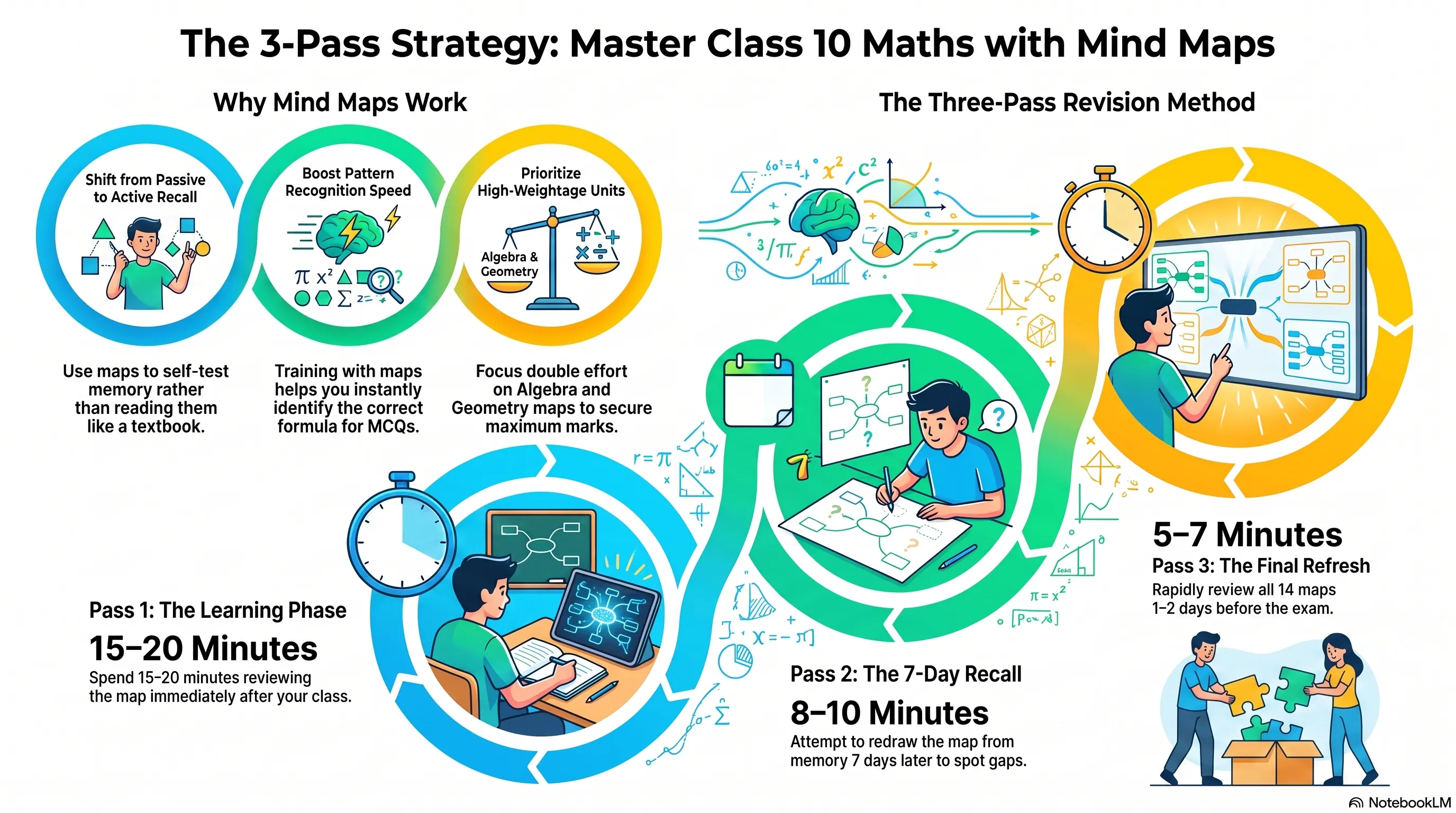
Table of Contents

eSaral > CBSE Class 10 >CBSE Class 10 Maths Mind Maps: Free Chapter-Wise PDFs for Fast Revision

Why Mind Maps Work for Class 10 Maths Revision
Maths revision usually fails for one of two reasons: either you re-solve every example from scratch (too slow), or you skim the chapter without practising anything (too shallow). A mind map sits in between — it shows you the full method or formula chain at a glance, so you can check your memory before jumping into practice questions.
💡 Expert Tip by eSaral Academic Team: Use the mind map as a self-test, not a first read. Look only at the chapter title, then try to recall every formula and method on your own before opening the mind map to check. This single change turns passive revision into active recall, which is what actually sticks under exam pressure.
Three reasons mind maps work especially well for Class 10 Maths:
- Formula-heavy chapters need quick recall, not re-learning. Trigonometry, Circles, and Mensuration each carry multiple formulas that are easy to mix up without a single reference page.
- Algebra and Geometry build on method sequences. Chapters like Quadratic Equations or Triangles rely on remembering a sequence of steps, which a flowchart-style mind map captures better than a worked example.
- Board papers reward speed on recognition-based questions. MCQs and case-based questions test whether you instantly recognise which formula applies — a mind map trains exactly that kind of fast pattern recognition.
Chapter-Wise Mind Map Download Table
All 14 NCERT chapters are covered below, organised by unit in the order CBSE teaches them across the year.
| Unit | Chapter | Download |
|---|---|---|
| Number Systems | Real Numbers | ⬇ Download PDF |
| Algebra | Polynomials | ⬇ Download PDF |
| Algebra | Pair of Linear Equations in Two Variables | ⬇ Download PDF |
| Algebra | Quadratic Equations | ⬇ Download PDF |
| Algebra | Arithmetic Progressions | ⬇ Download PDF |
| Coordinate Geometry | Coordinate Geometry | ⬇ Download PDF |
| Geometry | Triangles | ⬇ Download PDF |
| Geometry | Circles | ⬇ Download PDF |
| Trigonometry | Introduction to Trigonometry | ⬇ Download PDF |
| Trigonometry | Some Applications of Trigonometry | ⬇ Download PDF |
| Mensuration | Areas Related to Circles | ⬇ Download PDF |
| Mensuration | Surface Areas and Volumes | ⬇ Download PDF |
| Statistics and Probability | Statistics | ⬇ Download PDF |
| Statistics and Probability | Probability | ⬇ Download PDF |
(Placeholder links — swap for your real hosted PDF URLs before publishing.)
💡 Expert Tip by eSaral Academic Team: Algebra and Geometry together carry the highest weightage in the Class 10 Maths board paper, so revise the Polynomials, Quadratic Equations, Pair of Linear Equations, Triangles, and Circles mind maps at least twice before your final revision pass — these five chapters decide most of your score.
Why Do Trigonometry and Mensuration Chapters Need Separate Mind Maps for Each Sub-Topic?
Introduction to Trigonometry and Some Applications of Trigonometry use the same trigonometric ratios but apply them completely differently — one is about identities and ratios, the other is about heights and distances problems. Keeping them as separate mind maps prevents you from mixing up formula recall with the applied problem-solving steps, which is where most students lose marks in this unit.
How Should You Use These Mind Maps to Revise?
Downloading all 14 PDFs is the easy part. Using them well is what actually moves your score. Follow this sequence:
- First pass (learning phase): Study the mind map right after finishing the chapter in class, and use it to confirm you've covered every formula and method type.
- Second pass (7 days later): Try recalling the entire mind map from memory on a blank page, then compare it against the original to spot gaps.
- Third pass (final revision, 1–2 days before the exam): Go through all 14 mind maps in one sitting, unit by unit, following the table order above.
- Practice check: After each mind map, solve two to three questions from that chapter without referring back to the textbook, to confirm recall translates into actual problem-solving.
| Revision Stage | When to Do It | Time Needed per Chapter |
|---|---|---|
| First pass | Right after the chapter is taught | 15–20 minutes |
| Second pass | 7 days later | 8–10 minutes |
| Final revision | 1–2 days before the exam | 5–7 minutes |
Students following this three-pass method typically spend far less time hunting through the textbook for "which formula was that again," since the mind map keeps every method for a chapter in one place.
Frequently Asked Questions
Find answers to common questions.
What are Class 10 Maths mind maps used for?
They're used for quick formula and method recall before board exams. Each mind map lays out a chapter's formulas, theorems, and problem types on a single page, making revision faster than flipping through the textbook.
Are mind maps enough to prepare for Class 10 Maths boards on their own?
No, mind maps support revision but don't replace practice. Solve NCERT exercises and sample papers to build problem-solving speed, and use these mind maps to quickly recall formulas and methods before and during revision.
How many chapters does the Class 10 Maths mind map series cover?
It covers all 14 NCERT Class 10 Maths chapters across Number Systems, Algebra, Coordinate Geometry, Geometry, Trigonometry, Mensuration, and Statistics and Probability.
Are the Class 10 Maths mind maps free to download?
Yes, all 14 chapter-wise mind maps are available as free PDF downloads. No payment is required to access them.
Which Class 10 Maths chapters carry the highest weightage in the board exam?
Algebra and Geometry traditionally carry the highest weightage among Class 10 Maths units, which is why chapters like Quadratic Equations, Pair of Linear Equations, Triangles, and Circles deserve extra revision time.