CBSE Class 10 Sample Question Papers - PDF Download
Class 10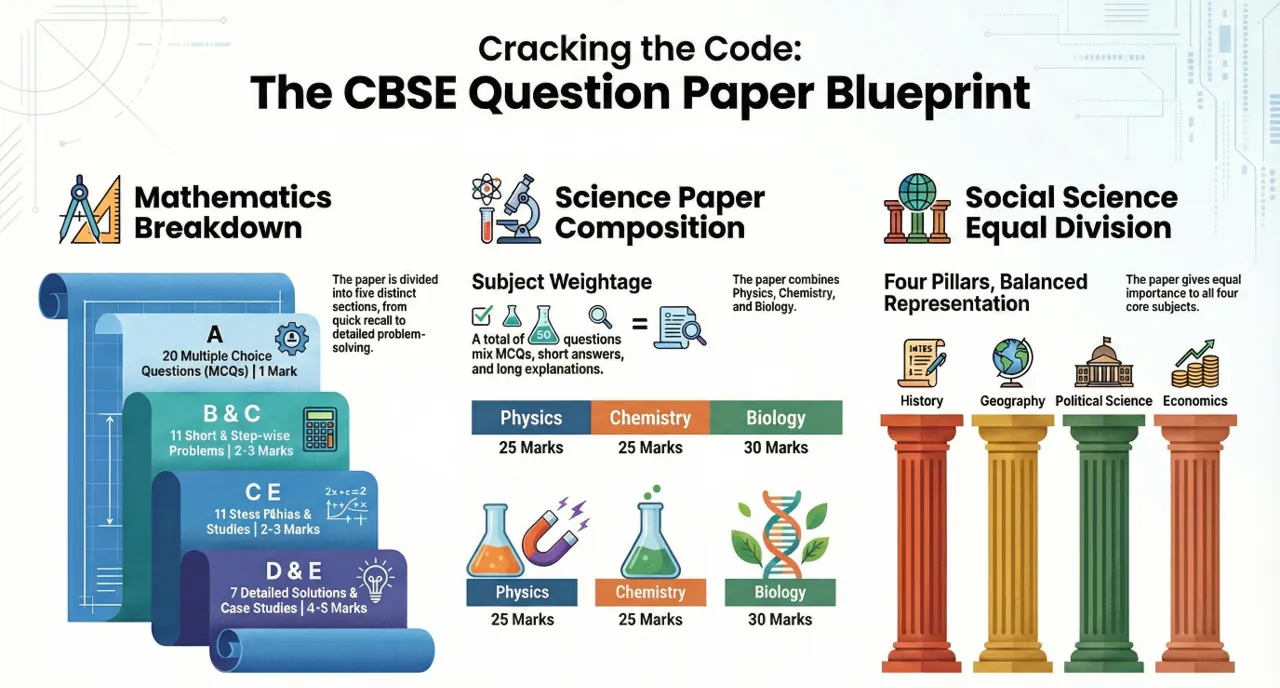

"Sir, CBSE sample papers se kitne marks improve hote hai?"
Beta, if you're asking this question, then listen carefully. The Central Board of Secondary Education released the official CBSE sample paper class 10 for 2025-26 on September 16, 2024. These are not just "practice materials" — they are your direct roadmap to scoring 90+ in boards.
Every year, students who solve these sample papers systematically see massive jumps:
- 70 to 85+ in Maths
- 75 to 88+ in Science
- Weak English students reaching 80+
Why? Because these CBSE Class 10 sample papers 2025-26 follow the exact pattern you'll face in the exam hall. Single annual exam format, case-based questions, situation-based problems — everything is here.
The biggest advantage? You get the examiner's mindset before sitting for the actual exam. These papers show you exactly what question types to expect, how marks are distributed, and which topics carry maximum weightage. Plus, they're completely free as PDF downloads.
Think about it: students who practice with official sample papers know exactly how to manage their 3-hour exam time. They walk into the exam hall with confidence, not confusion.
Read this blog completely. We'll give you direct download links and the exact strategy to use these sample papers for maximum score improvement.
Complete CBSE Sample Papers Collection – All Subjects, All PDFs
Here's your complete arsenal: every official sample question paper for Class 10 released by CBSE for 2025-26. No searching, no confusion — just direct access to what you need.
Mathematics, Science, English, Hindi, SST, Sanskrit — Everything Here
Mathematics: Two versions available because CBSE knows not everyone has the same goals.
- Standard: For students targeting science stream or engineering. Complex problem-solving, application-heavy questions.
- Basic: For those choosing commerce/arts. Fundamental concepts, straightforward applications.
Science: Complete PCB coverage. Physics numerical problems, Chemistry equations, Biology diagrams — all question types you'll face.
English: Language & Literature + Communicative versions. Choose based on your school's curriculum.
Hindi: Both Hindi A and Hindi B with complete marking schemes.
Social Science: History dates, Geography maps, Civics concepts, Economics graphs — comprehensive coverage across all four areas.
Sanskrit: Standard Sanskrit + Sanskrit Communicative papers following latest format.
Bonus subjects: Computer Applications, Home Science, Painting, plus language options like French, German, Tamil, Urdu.
Every major subject. Every question pattern. All in one place.
Why Two Math Versions Matter
The marking pattern stays identical for both Standard and Basic:
Section-wise Distribution (80 marks total):
- Section A: MCQs (18 × 1 mark) + Assertion-Reason (2 × 1 mark) = 20 marks
- Section B: Very Short Answers (5 × 2 marks) = 10 marks
- Section C: Short Answers (6 × 3 marks) = 18 marks
- Section D: Long Answers (4 × 5 marks) = 20 marks
- Section E: Case-based Questions (3 × 4 marks) = 12 marks
Internal assessment adds 20 marks = 100 total.
The difference? Standard papers include advanced applications, while Basic focuses on core mathematical reasoning. Same structure, different complexity levels.
Marking Schemes = Your Secret Weapon
Every sample paper comes with its official marking scheme PDF. This is where most students miss out on easy marks.
What these marking schemes reveal:
- Exact step-by-step solutions for every question
- How many marks each step carries
- Alternative methods that also get full credit
- Common mistakes that cost students marks
Subject-wise marking insights:
Mathematics: Step marking is crucial. Even if your final answer is wrong, you can still score 3-4 marks out of 5 by showing correct method.
Science: Numerical problems have specific mark allocation for formula, substitution, calculation, and units. Diagram questions award marks for labeling, neatness, and accuracy.
Social Science: Key point marking. Each major point in your answer carries specific marks. The scheme shows exactly which points examiners look for.
Languages: Essay structure, grammar usage, and content relevance all have separate mark allocations.
The reality: Students who study with marking schemes alongside sample papers score 15-20 marks higher than those who don't.
Think about it — you're seeing exactly how the examiner will evaluate your paper. This is the closest you can get to the actual evaluation process before sitting in the exam.
Use both together: sample paper + marking scheme = maximum score potential.
Why Sample Papers Are Your Secret Weapon for 90+ Marks
Most Class 10 students make the same mistake: they think CBSE board exams are just about "studying harder." Reality is different. The students who consistently score 85+ don't just read more — they practice smarter.
Sample paper class 10 is not just another "study resource." It's your direct window into the examiner's mind. These papers reveal exactly what CBSE wants from you and how they will test it.
Here's why sample papers create the biggest rank jumps:
You Decode the Real Exam Blueprint
CBSE changes its pattern every few years, and many students get caught off-guard. Sample question paper class 10 eliminates all surprises:
Mark Distribution Clarity: You know exactly where your 80 marks come from — MCQs carry 20 marks, case studies give 12 marks, long answers decide 20 marks.
Weightage Pattern: Some chapters contribute 15-20% of the paper while others give only 5%. Sample papers show you which topics to prioritize.
Internal Choice Strategy: You discover which sections offer alternatives, helping you play to your strengths during the exam.
The current CBSE pattern focuses on application over memorization. When you solve CBSE class 10 sample paper regularly, you train your brain to think like the exam demands — not like your textbook teaches.
Question Type Mastery = Higher Accuracy
The exam hall is not the place to see a question format for the first time. Each question type requires a different approach:
MCQs: Quick elimination techniques and smart guessing methods Short Answers: Precise point-based writing within word limits
Long Answers: Structured responses with proper introduction-body-conclusion Case Studies: Real-world application and analytical thinking Competency Questions: Problem-solving approach over formula dumping
Students who practice with cbse sample paper class 10 develop automatic responses to these formats. When they see a case study in the exam, they instantly know the approach — no time wasted figuring out "what does this question want?"
Time Management = Rank Booster
Here's the hard truth: 60% of students who know the answers still lose marks due to poor time management.
Sample paper class 10 2025 teaches you the 3-hour game plan:
- MCQs: 25 minutes maximum
- Short answers: 40 minutes
- Long answers: 60 minutes
- Case studies: 45 minutes
- Revision: 10 minutes
Regular timed practice with class 10 sample paper 2025-26 creates muscle memory. Your hand automatically writes faster, your brain processes questions quicker, and you develop exam stamina.
The students who solve 8-10 sample papers under timed conditions report something interesting: the actual board exam feels "easier" because they've already experienced that pressure multiple times.
Bottom line: Sample question paper class 10 practice transforms you from someone who "hopes to finish on time" to someone who completes the paper with confidence and time to spare.
This is not theory — this is what separates 75% scorers from 90+ achievers.
Subject-Wise Battle Plan: How Each Paper Can Boost Your Score
Now that you understand the power of sample papers, let's break down exactly what each subject offers. Each CBSE Class 10 sample paper has a unique structure designed to test different skills. Knowing these patterns gives you a massive advantage.
Mathematics: Your Rank-Maker or Rank-Breaker
Two versions, one goal: maximum marks.
Mathematics sample paper class 10 comes in Standard and Basic versions. Choose wisely based on your future plans. Standard version = higher difficulty but opens doors for science stream. Basic version = focuses on fundamental concepts for students not continuing with math.
Here's the exact structure both versions follow:
- Section A: 18 MCQs + 2 Assertion-Reason (1 mark each) = 20 marks
- Section B: 5 Very Short Answers (2 marks each) = 10 marks
- Section C: 6 Short Answers (3 marks each) = 18 marks
- Section D: 4 Long Answers (5 marks each) = 20 marks
- Section E: 3 Case Studies (4 marks each) = 12 marks
Smart Strategy: Section A gives you 25% of total marks in just 30-40 minutes. Master this section first. Internal choices in Sections B, C, and D mean you can skip tougher questions.
Science: The 80-Mark Goldmine
The cbse class 10 sample paper for Science splits 80 marks across three subjects:
- Biology: 30 marks (highest weightage)
- Chemistry: 25 marks
- Physics: 25 marks
Pro Tip: Biology questions are mostly theoretical and NCERT-based. If you're weak in Physics calculations, compensate by perfecting Biology. The paper includes alternate questions for diagram-based problems.
Most students lose marks in Physics numericals. But here's the secret: Chemistry and Biology can easily give you 50+ marks if you focus on them first.
English: The Scoring Subject Everyone Ignores
English sample question paper class 10 has 11 questions across three sections:
- Reading Skills: 20 marks (pure scoring if you practice)
- Grammar + Writing: Mix of marks
- Literature: 40 marks (your textbook knowledge)
Reality check: Students who score 90+ in English follow this pattern: Perfect the reading section first, then focus on literature. Grammar questions are predictable if you solve 5-6 sample papers.
Social Science: The Memory + Application Test
Social Science sample paper class 10 2025 covers four subjects in 38 questions:
- History: Nationalism, industrialization periods
- Geography: Resources, agriculture + map work
- Political Science: Democracy concepts
- Economics: Development, sectors
Map questions = guaranteed 5 marks. Don't skip map practice. History and Geography maps together give you easy marks if you practice 10-15 times.
Hindi A vs Hindi B: Know the Difference
Both Hindi versions carry 80 marks but test different skills:
Hindi A = Literature heavy (30 marks from textbooks)
Hindi B = Communication focused
Choose based on your strength. Literature students prefer Hindi A. Practical communication learners prefer Hindi B.
Computer Applications: Theory + Practical Balance
Computer Applications sample paper 2025-26 has 26 questions for 50 marks theory. But remember: practical carries equal weightage (50 marks). Many students focus only on theory and lose 50% marks.
Sanskrit follows standard language paper pattern - comprehension, grammar, literature.
Bottom line: Each subject tests specific skills. Math tests problem-solving. Science tests application. English tests comprehension. Social Science tests memory + analysis. Choose your strongest areas first, then work on weaker ones.
The students who score 90+ don't master everything. They master the high-scoring sections first.
The Secret Science Behind CBSE Marking: What Examiners Actually Look For 📊
Here's something most students don't know: the marking scheme is more important than the question paper itself.
Every year, thousands of students lose 15-20 marks simply because they don't understand how examiners think. They write correct answers but present them wrong. They solve problems correctly but skip steps that carry marks.
This ends now.
The 80-Mark Formula: How Every Mark is Distributed
The cbse class 10 sample paper follows a scientific marks distribution that never changes:
Mathematics (80 marks breakdown):
- Section A: 20 marks (MCQs + Assertion-Reason) → Easy picking, no partial marking
- Section B: 10 marks (5 questions × 2 marks) → Show method, get marks
- Section C: 18 marks (6 questions × 3 marks) → Steps matter more than final answer
- Section D: 20 marks (4 questions × 5 marks) → Detailed working = full marks
- Section E: 12 marks (3 case studies × 4 marks) → Application-based, high scoring
Science paper pattern (80 marks):
- Biology: 30 marks (highest weightage)
- Chemistry: 25 marks
- Physics: 25 marks
Social Science strategy: Each subject gets exactly 20 marks. History, Geography, Political Science, Economics — equal weightage, equal importance.
English structure:
- Reading Skills: 20 marks
- Writing + Grammar: 20 marks
- Literature: 40 marks (maximum impact area)
Question Types That Decide Your Rank
The class 10 sample paper 2025-26 has 5 distinct question formats. Master these, master your exam:
MCQs (Multiple Choice Questions)
Quick decision, no second chances. These questions test whether you know concepts or just think you know them.
2-Mark Questions (VSA)
40 words maximum. Write more = examiner gets annoyed. Write less = you lose marks.
3-Mark Questions (Short Answer)
60 words limit. The secret: write in points, not paragraphs. Examiners love bullet points.
5-Mark Questions (Long Answer)
120 words. Here's where step marking saves you. Even if your final answer is wrong, correct method gets you 3-4 marks.
Case-Based Questions (4 marks each)
Real-world application. This is where students either score full marks or lose everything. There's no middle ground.
Internal Choices: Your Strategic Advantage
Smart students use internal choices like secret weapons:
- Mathematics: 2 choices each in Sections B, C, and D
- Science: Internal choices in long answer questions only
- Social Science: Select questions offer alternatives
Golden Rule: Always read BOTH options before choosing. Don't pick the first one that looks easy.
Step Marking: The Marks You're Missing
Step marking is where average students become toppers.
Example: 5-mark Maths problem
- Correct approach: 2 marks
- Accurate calculation: 2 marks
- Final answer: 1 mark
Most students focus only on the final answer. Smart students focus on showing their working clearly.
For Science numericals:
- Formula writing: 1 mark
- Substitution: 1 mark
- Calculation: 2 marks
- Result with unit: 1 mark
For Social Science:
- Key points identification: 50% marks
- Examples/case studies: 30% marks
- Conclusion: 20% marks
The sample question paper class 10 marking schemes show you exactly which steps carry marks and which don't.
Special note for visually impaired students: Alternative questions replace all diagram-based questions, ensuring fair evaluation for everyone.
Your goal is simple: understand what the examiner wants to see, then give exactly that. No more, no less.
The 4-Step Sample Paper Strategy That Gets You 90+
Most students download sample papers and solve them randomly. Wrong approach. Here's the exact method used by toppers who jump from 70s to 90s in just 2 months.
Step 1: Set Your Timer to Exactly 3 Hours — No Mercy
When you sit to solve cbse sample paper class 10, your phone should be on airplane mode. Timer set to exactly 3 hours. No bathroom breaks, no water sipping, no "just one quick doubt".
Why this works? Your brain learns to function under real exam pressure. Many students know the answers but panic during the actual 3-hour exam. Timed practice removes this fear completely.
Start this brutal 3-hour practice at least 2-3 months before boards. After 4-5 such sessions, you'll naturally finish your paper in 2 hours 45 minutes, leaving 15 minutes for review.
Step 2: Use the Official Marking Scheme Like a Detective
Here's what separates average students from toppers: how they check their answers.
After completing sample question paper class 10, sit with the official CBSE marking scheme for 45 minutes. This document shows you exactly how examiners think and distribute marks.
Pay attention to step marking. Even if your final answer is wrong, you can still get 3 out of 5 marks if your method is correct. The marking scheme reveals these hidden scoring opportunities.
Most importantly, note down the "expected key points" for subjective answers. This shows you what language and points examiners want to see.
Step 3: Create Your Weakness Elimination List
After every sample paper, create three columns in a notebook:
- Formula Forgot: Which formulas did you blank out on?
- Concept Weak: Which topics need more theory revision?
- Time Wasted: Which questions took too much time?
This analysis tells you exactly where to focus your next 2 weeks of study. Don't just solve papers randomly — fix the gaps systematically.
Step 4: Follow the 5+5 Rule
Solve at least 5 official sample papers + 5 previous years' papers. This combination gives you the best pattern recognition for recurring question types.
Keep a simple progress tracker:
- Paper 1: Score, weak areas
- Paper 2: Score, improvement areas
- Paper 3: Score, consistent mistakes
By Paper 5, you should see clear improvement in your weak areas. This method builds both skill and confidence for the final exam.
Remember: Sample papers are not just practice — they are your blueprint for exam day success.
Why Sample Papers Are Your Secret Weapon for 90+ Marks
Working with sample paper class 10 regularly creates a massive advantage that most students miss. These practice sessions don't just teach you the exam pattern — they rewire your brain for board exam success.
Confidence Boost That Changes Everything
Regular practice with cbse sample paper class 10 eliminates exam fear completely. After solving 4-5 sample papers, something magical happens — you stop feeling nervous about the exam. The exam hall becomes familiar territory, not a scary unknown place.
The confidence transformation is real. With each sample question paper class 10 you complete, your self-doubt fades away. This mental strength directly translates to better performance because you're not wasting energy on anxiety. You walk into the exam focused on scoring, not on surviving.
Speed + Accuracy = Rank Jump
Speed development requires systematic training. When you practice class 10 sample paper 2025 26 under strict 3-hour limits, your brain learns to work under pressure. No breaks, no phone checks — just pure exam simulation.
Accuracy improvement comes from mistake analysis. Every error teaches you something — wrong formula application, calculation slip, or time pressure panic. Students who maintain an "Error Log" see their silly mistakes drop dramatically within 2-3 papers.
The combination is powerful: faster solving + fewer mistakes = significantly higher marks.
Your Personal Diagnostic Tool
Sample paper class 10 cbse 2025-26 shows you exactly where you stand across all subjects. No guessing, no false confidence — just clear data on your preparation level.
Smart students create a progress tracking sheet after each paper. They record subject-wise scores, time taken per section, and mistake patterns. This data-driven approach ensures you focus your remaining preparation time on topics that will actually improve your rank.
Think of it this way: every sample paper solved is like getting a free coaching session that shows you exactly what to fix before boards.
Your CBSE Boards Success Story Starts Now
Listen, beta. You now have everything you need to dominate your Class 10 boards.
CBSE sample papers are not just "practice material" — they are your secret weapon. You've learned exactly how these official resources work, how to use them strategically, and how they can push your marks from average to exceptional.
Think about what we've covered:
- Direct download links for all subjects with marking schemes
- Subject-wise strategies for Maths, Science, English, Social Science, and more
- Exact marking patterns that examiners follow
- Step-by-step preparation method to maximize your scores
But here's the reality: knowing the strategy is not enough. Execution decides your rank.
Students who score 90+ don't just read about sample papers — they solve them religiously. They sit with a timer for exactly 3 hours. They analyze every mistake. They track their progress week by week.
Your action plan from today:
- Download the sample papers for your subjects
- Start with one paper under timed conditions
- Check answers using the marking scheme
- Note your weak areas in a notebook
- Repeat this process 5-6 times before boards
Remember what toppers do differently: they don't just prepare for the exam — they prepare to excel in the exam.
Your Class 10 result is not written anywhere. With these sample papers and the right execution, you can still reach 95+ across subjects.
All the best. Go make these next few months count! 🔥💪
Key Takeaways
CBSE Class 10 sample papers are essential preparation tools that provide authentic practice for the 2025-26 board exams, helping students understand the latest exam patterns and question formats.
• Practice under timed conditions - Solve sample papers in exactly 3 hours to develop crucial pacing skills and exam pressure management.
• Use marking schemes strategically - Check answers against official CBSE marking schemes to understand step-by-step evaluation and maximize scoring potential.
• Target weak areas systematically - Identify knowledge gaps through practice, then create focused revision plans for topics where you lose marks.
• Build confidence through repetition - Regular practice with 5-6 different sample papers eliminates exam anxiety and improves both speed and accuracy.
• Leverage subject-specific formats - Mathematics offers Standard/Basic versions, while Science divides into three sections, requiring tailored preparation approaches.
The key to board exam success lies not just in knowing the content, but in understanding exactly how to present that knowledge within the CBSE examination framework through consistent sample paper practice.
FAQs
Q1. How many CBSE Class 10 sample papers should I solve for effective preparation?
It's recommended to solve at least 5-6 different sample papers, including previous years' papers. This varied practice helps identify recurring question patterns and frequently tested topics, ensuring comprehensive preparation.
Q2. What is the importance of solving sample papers under timed conditions?
Solving sample papers under timed conditions (3 hours) creates authentic exam pressure, helping you develop crucial pacing skills and learn to work efficiently without breaks. This practice trains your brain to perform optimally during the actual exam.
Q3. How can I use the marking scheme effectively while preparing?
After completing a sample paper, evaluate your answers using the official CBSE marking scheme. It provides step-by-step solutions, shows mark distribution, and highlights common errors. This helps you understand examiners' expectations and improve your answer presentation.
Q4. Are there different versions of Mathematics sample papers for Class 10?
Yes, CBSE offers two versions of Mathematics sample papers: Standard and Basic. The Standard version is for students planning to pursue Mathematics in higher studies, while the Basic version is for those who may not continue with the subject.
Q5. How do sample papers help in reducing exam anxiety?
Regular practice with sample papers familiarizes you with the exam environment, boosting your confidence. As you complete more papers, you develop a sense of comfort with the format and question types, which naturally reduces exam-related stress and anxiety.