CBSE Class 10 Maths Revision Notes: Chapter-Wise Notes With Marks Weightage (2026-27)
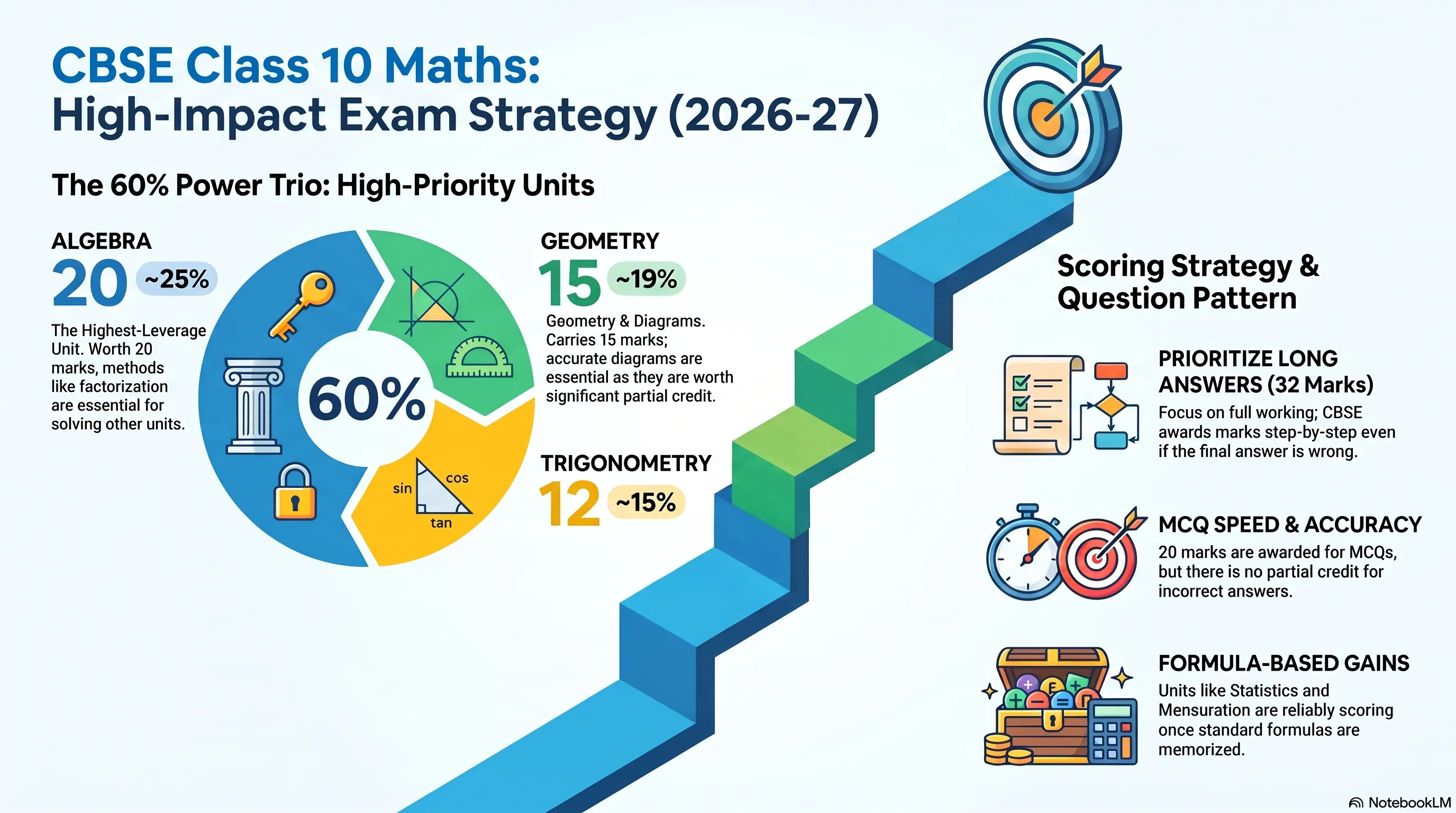
Table of Contents
- How the 80 Theory Marks Are Actually Distributed
- Chapter-by-Chapter Marks and Focus Areas {#chapter-breakdown}
- Question Pattern: Where Your 80 Marks Come From
- The Formulas You Actually Need to Memorise
- Mistakes That Quietly Cost Students Marks
- A 9-Week Revision Plan Using These Notes
- Pairing Notes with NCERT Solutions

eSaral ›Foundation courses ›Class 10›CBSE Class 10 Maths Revision Notes: Chapter-Wise Notes With Marks Weightage (2026-27)

|
CBSE Class 10 Maths Revision Notes Chapter Wise |
|
How the 80 Theory Marks Are Actually Distributed
The Class 10 Maths paper carries 100 marks: 80 for theory, 20 for internal assessment (two pen-paper tests worth 5 marks each, a 5-mark portfolio, and a 5-mark lab practical). CBSE doesn't spread the 80 theory marks evenly across units — some chapters carry far more weight than others.
💡 Expert Tip: Algebra, Geometry, and Trigonometry together make up close to 60% of the theory paper. Getting these three units exam-ready before polishing the smaller chapters is the single highest-leverage move you can make.
| Priority | Unit | Approx. Marks | Share of Theory Paper |
|---|---|---|---|
| High | Algebra | 20 | ~25% |
| High | Geometry | 15 | ~19% |
| High | Trigonometry | 12 | ~15% |
| Medium | Statistics & Probability | 11 | ~14% |
| Medium | Mensuration | 10 | ~12.5% |
| Lower | Number Systems | 6 | ~7.5% |
| Lower | Coordinate Geometry | 6 | ~7.5% |
Which Unit Should I Revise First in Class 10 Maths?
Algebra should generally come first, since it carries the largest share of the theory paper, and its methods — factorisation, the quadratic formula, solving simultaneous equations — reappear in Geometry and Trigonometry questions as well. Thoroughly revising Algebra makes every subsequent unit easier to revise.
Chapter-by-Chapter Marks and Focus Areas {#chapter-breakdown}
| Unit | Chapter | Approx. Marks | Focus Area |
|---|---|---|---|
| Algebra | Pair of Linear Equations in Two Variables | 6 | Highest volume of questions in this unit |
| Algebra | Quadratic Equations | 6 | Formula-heavy; the discriminant is central |
| Algebra | Polynomials | 4 | Zeros-and-coefficients relationship, factorisation |
| Algebra | Arithmetic Progressions | 4 | nth-term and sum formulas, generally scoring |
| Geometry | Triangles | 8 | Similarity, congruence, Pythagoras theorem |
| Geometry | Circles | 7 | Tangent properties and standard theorems |
| Trigonometry | Introduction to Trigonometry | 8 | Ratios and identities — the larger of the two chapters |
| Trigonometry | Some Applications of Trigonometry | 4 | Angle of elevation/depression word problems |
Real Numbers, Coordinate Geometry, Surface Areas and Volumes, and Statistics and Probability are largely formula-based chapters. They carry smaller individual weightage but tend to be some of the most reliably scoring sections once the standard question types are practised.
Why Do Triangles and Circles Carry So Much Weight in Geometry?
Triangles and Circles together carry 15 of Geometry's marks because they combine theorem-based proofs with diagram-based reasoning, which CBSE tests through both short and long-answer questions. Accurate figures matter here — a large share of the marks in these chapters depend on the diagram being drawn correctly, not just the final answer.
Question Pattern: Where Your 80 Marks Come From
| Question Type | Total Marks | What It Rewards |
|---|---|---|
| MCQs | 20 | Speed and accuracy — there's no partial credit |
| Short Answer | 28 | A clear method shown in 2–3 logical steps |
| Long Answer | 32 | Full working; every correct step earns marks even if the final answer is wrong |
MCQs build momentum early in the paper, short answers form the bulk of your score, and long answers usually decide whether that score becomes a distinction. In a Long Answer question, writing the correct formula and the first few steps is worth doing even when you're unsure of the final answer, since CBSE awards marks step-by-step rather than only for the final figure.
The Formulas You Actually Need to Memorise
A short, exam-ready formula list beats a long one you never actually revise:
- Quadratic formula: x = [-b ± √(b² - 4ac)] / 2a
- AP nth term: a + (n-1)d; AP sum: n/2 [2a + (n-1)d]
- Distance formula: d = √[(x₂-x₁)² + (y₂-y₁)²]
- Basic trig ratios: sin θ = P/H, cos θ = B/H, tan θ = P/B
- Circle: Area = πr², Circumference = 2πr
- Sphere: Surface area = 4πr², Volume = 4/3 πr³
- Probability: P(E) = Favourable outcomes / Total outcomes
Alongside these, keep Pythagoras' theorem, the Basic Proportionality Theorem, Euclid's Division Lemma, and the Fundamental Theorem of Arithmetic within easy recall — every composite number breaking down uniquely into prime factors is the idea behind several Real Numbers questions.
Mistakes That Quietly Cost Students Marks
Some of the most common errors aren't about not knowing a concept — they're small slips that examiners are specifically trained to catch:
- Distribution errors: writing 3(2x² - 6) = 6x² - 6 instead of 6x² - 18
- Power errors: writing (3x)² as 3x² instead of 9x²
- Trigonometric identity errors: treating sin(x+y) as sin x + sin y, which is incorrect
- Losing a root: dividing a quadratic equation by x without checking whether x = 0
- Complementary angle mix-ups: writing cos 85° = sin 5° incorrectly
- Similar vs. congruent confusion: applying CPCT to similar triangles, when it only applies to congruent ones
- Negative sign placement: writing -2² = -4 instead of (-2)² = 4
- Weak diagrams: an inaccurate figure in Geometry can cost marks even when the reasoning is correct
💡 Expert Tip: Keep a short "mistakes notebook" through your revision. Most students repeat the same two or three error types across multiple tests — once you can name yours, they're far easier to stop making.
A 9-Week Revision Plan Using These Notes
Notes work best inside a structured plan rather than random daily study. A sequence that works well for most students:
- Weeks 1–2 — Foundation. Work through each chapter's core concepts using NCERT first, then the revision notes. No problem-solving speed drills yet.
- Weeks 3–4 — Daily practice. Solve 30–40 basic questions a day to build calculation speed and comfort with standard question types.
- Weeks 5–6 — Advanced problems. Move to application-based and higher-difficulty questions, especially in Algebra, Geometry, and Trigonometry.
- Weeks 7–8 — Mock tests. Take full-length, timed tests regularly. Review every mistake and log it before moving to the next test.
- Week 9 — Final polish. Revise formulas only. No new topics this close to the exam.
A simple daily habit that compounds well: spend a focused 30 minutes each evening revising formulas and theorems from that day's study, using the notes rather than the full textbook. Short, repeated sessions build recall better than occasional long ones.
How Do I Know Which Chapters Need More Revision Time?
Track your marks chapter-wise across every test you take, rather than relying on how confident a chapter feels. A simple log — date, chapter, marks lost, and the type of mistake — usually reveals a pattern within four or five tests, showing exactly where your revision time is best spent.
Pairing Notes with NCERT Solutions
These notes are built for quick recall of formulas and methods — not for practising full, step-marked answers. For that, use the NCERT Solutions for Class 10 Maths, which walk through every textbook question with complete, CBSE-aligned working.
If a chapter's fundamentals still feel shaky after revising the notes, it's often faster to return to the source than to re-read the notes again. The official Class 10 Maths NCERT Book PDF is available for download, along with the Hindi-medium version at NCERT Maths Book Class 10 in Hindi.
For your other subjects, the NCERT Solutions for Class 10 and NCERT Solutions for Class 10 Science follow the same revise-then-practise approach, backed by the complete NCERT Books for Class 10.
A revision video like this one only makes sense a few weeks out from the exam — which is also exactly when this is worth a look: class X crash course.
Frequently Asked Questions
Find answers to common questions.
How is the CBSE Class 10 Maths syllabus weighted?
The 80 theory marks are split roughly as Algebra 25%, Geometry 19%, Trigonometry 15%, Statistics & Probability 14%, Mensuration 12.5%, and Number Systems and Coordinate Geometry at 7.5% each. The remaining 20 marks come from internal assessment.
Which Class 10 Maths chapters should I focus on first?
Algebra deserves the most attention since it carries the highest weightage and its methods reappear in later units. Within Algebra, prioritise Linear Equations, Quadratic Equations, Polynomials, and Arithmetic Progressions in that order.
How many chapters are there in CBSE Class 10 Maths?
There are 14 chapters in total under the 2026-27 CBSE syllabus, spanning Algebra, Geometry, Trigonometry, Mensuration, Statistics, and Probability. Not all chapters carry equal weightage, so revision time should follow the marks distribution rather than the chapter order.
How should I use revision notes alongside NCERT for Maths?
Learn each chapter from NCERT first, since board questions are set directly from it, then switch to revision notes for repeated recall of formulas and methods. Notes work best as a revision tool, not as the first source for learning a new topic.
What is the best way to build a Class 10 Maths revision timetable?
Allocate more time to high-weightage units like Algebra, Geometry, and Trigonometry, while still covering smaller chapters like Number Systems, which can offer easy, reliable marks. A structured multi-week plan — concepts, then practice, then mock tests, then formula revision — works better than open-ended daily study.