Chemical Kinetics - NEET Previous Year Questions with Complete Solutions
Chemical Kinetics is a high-scoring NEET Chemistry chapter focused on reaction rates, order and molecularity, first-order reactions, half-life, Arrhenius equation, and rate constants, with most NEET questions based on standard formulas, conceptual differences, and numerical problem-solving.
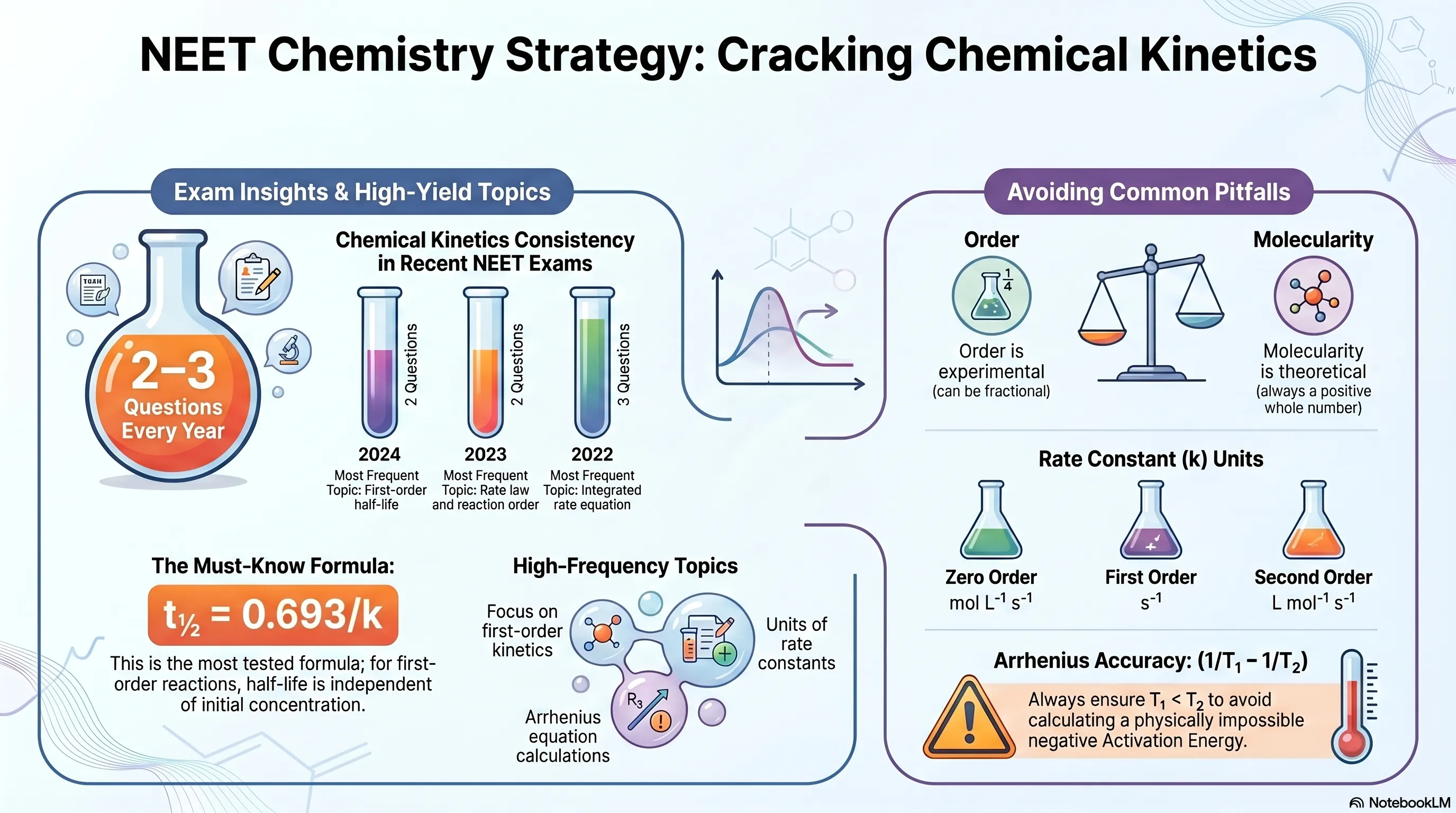
Table of Contents

eSaral › NEET › Neet test-series›Chemical Kinetics

Chemical Kinetics in NEET: Weightage and Key Topics
How Many Questions Come from Chemical Kinetics in NEET?
Chemical Kinetics is one of the most consistently tested chapters in NEET Chemistry, contributing 2–3 questions almost every year. It rewards students who understand both the conceptual distinctions (order vs molecularity, rate law vs stoichiometry) and the numerical applications (half-life, Arrhenius calculations).
| Year | Questions from Chemical Kinetics | Topics Tested |
|---|---|---|
| NEET 2024 | 2 | First-order half-life, Arrhenius equation |
| NEET 2023 | 2 | Rate law, order of reaction determination |
| NEET 2022 | 3 | Integrated rate equation, activation energy, molecularity |
| NEET 2021 | 2 | Half-life, rate constant units |
| NEET 2020 | 2 | Arrhenius equation, pseudo-first-order reaction |
| NEET 2019 | 3 | Rate of reaction, order determination, t½ |
| NEET 2018 | 2 | First-order kinetics, activation energy |
Which Topics Are Most Frequently Tested?
Based on NEET papers from 2010 to 2024, the six highest-frequency topics in Chemical Kinetics are:
- First order reaction — integrated rate equation and half-life (t½ = 0.693/k)
- Order of reaction determination from experimental rate data
- Arrhenius equation — calculating activation energy or rate constant at different temperatures
- Units of rate constant for zero, first, and second order reactions
- Molecularity vs order — conceptual distinction
- Pseudo first-order reactions — examples and conditions
💡 Expert Tip by eSaral Faculty: At least one NEET question every year is directly solvable using t½ = 0.693/k for first order reactions. This is the single most tested formula in the chapter. If you know nothing else about Chemical Kinetics, know this formula — and know that for first order reactions, half-life is independent of initial concentration.
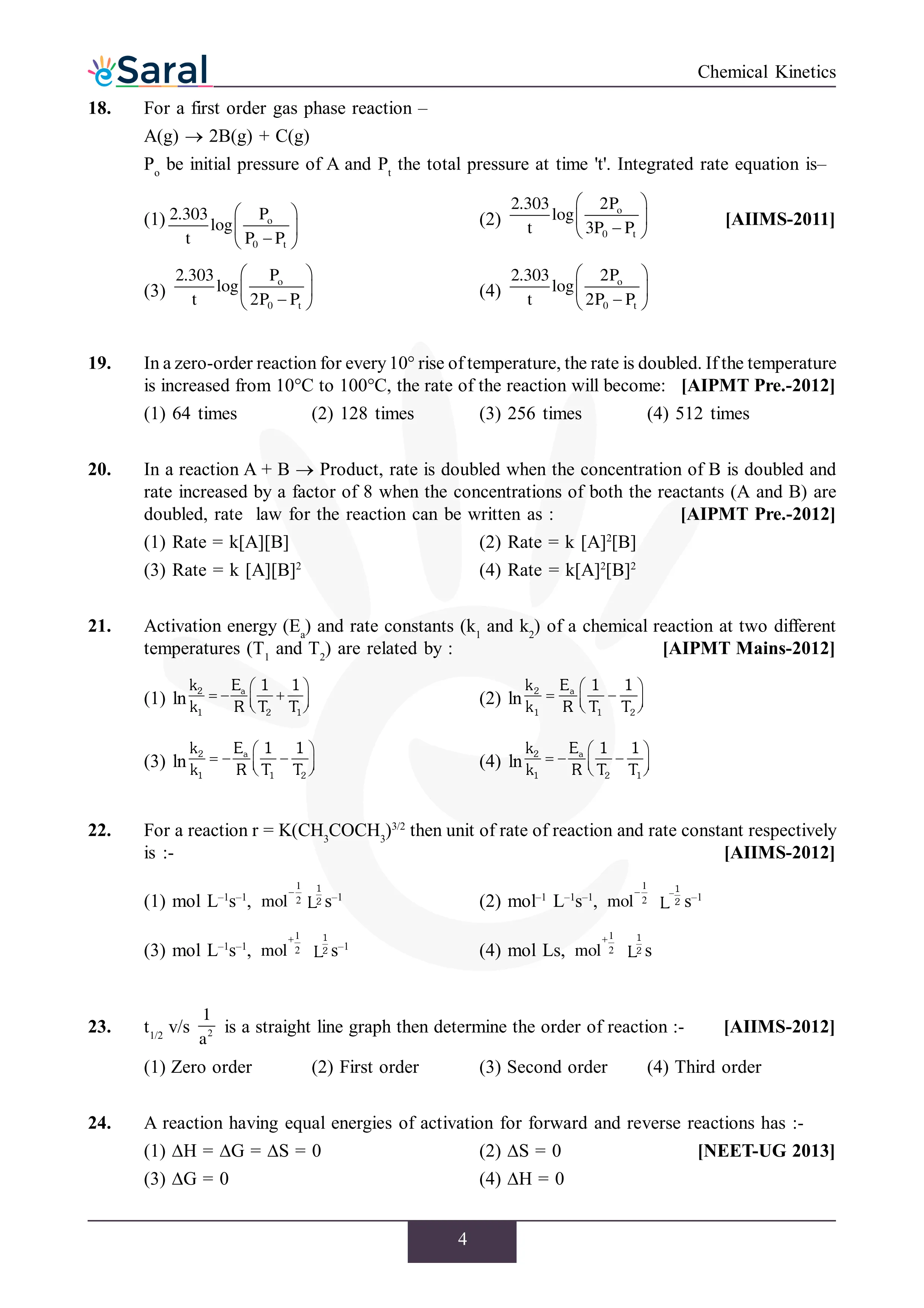
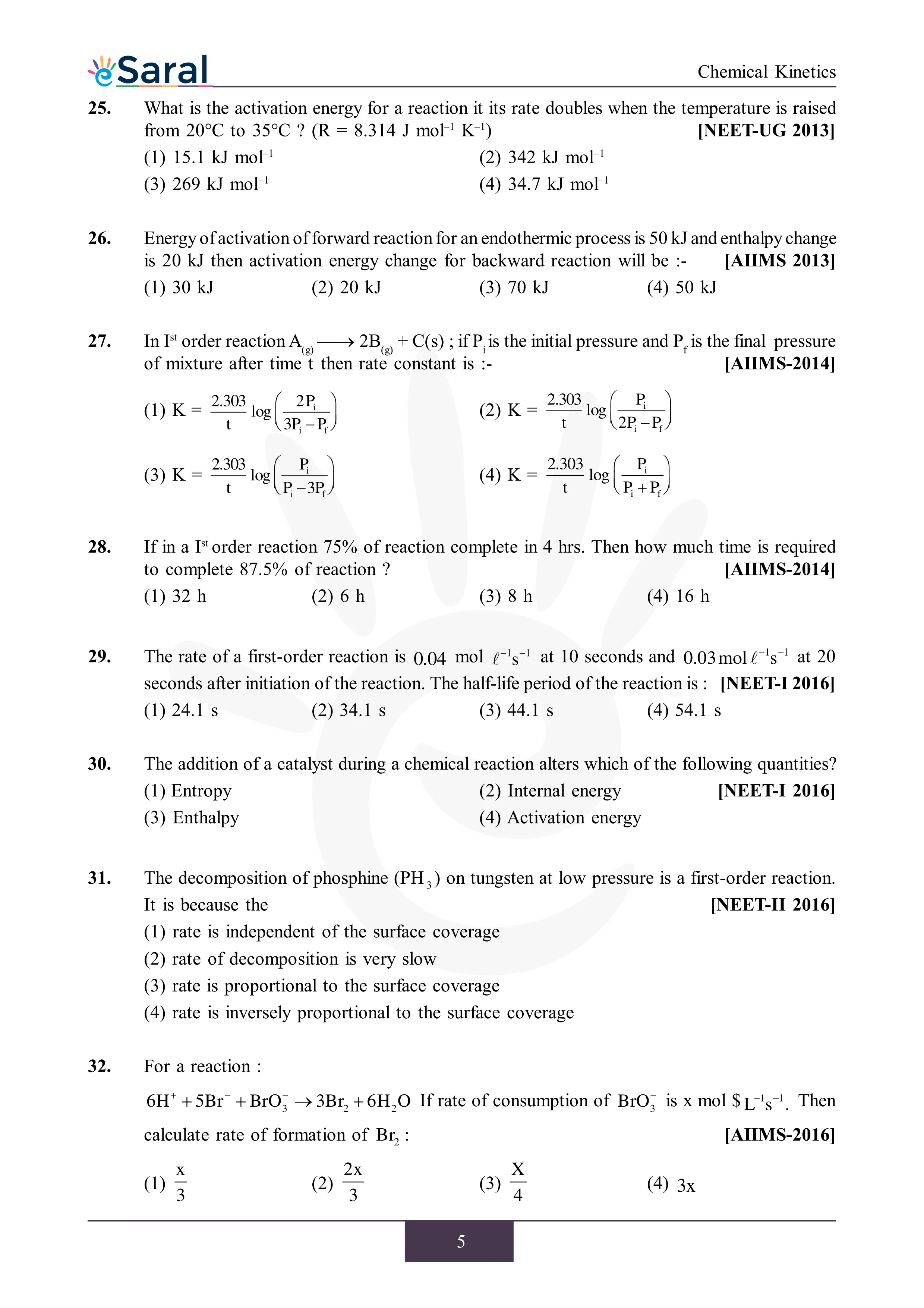
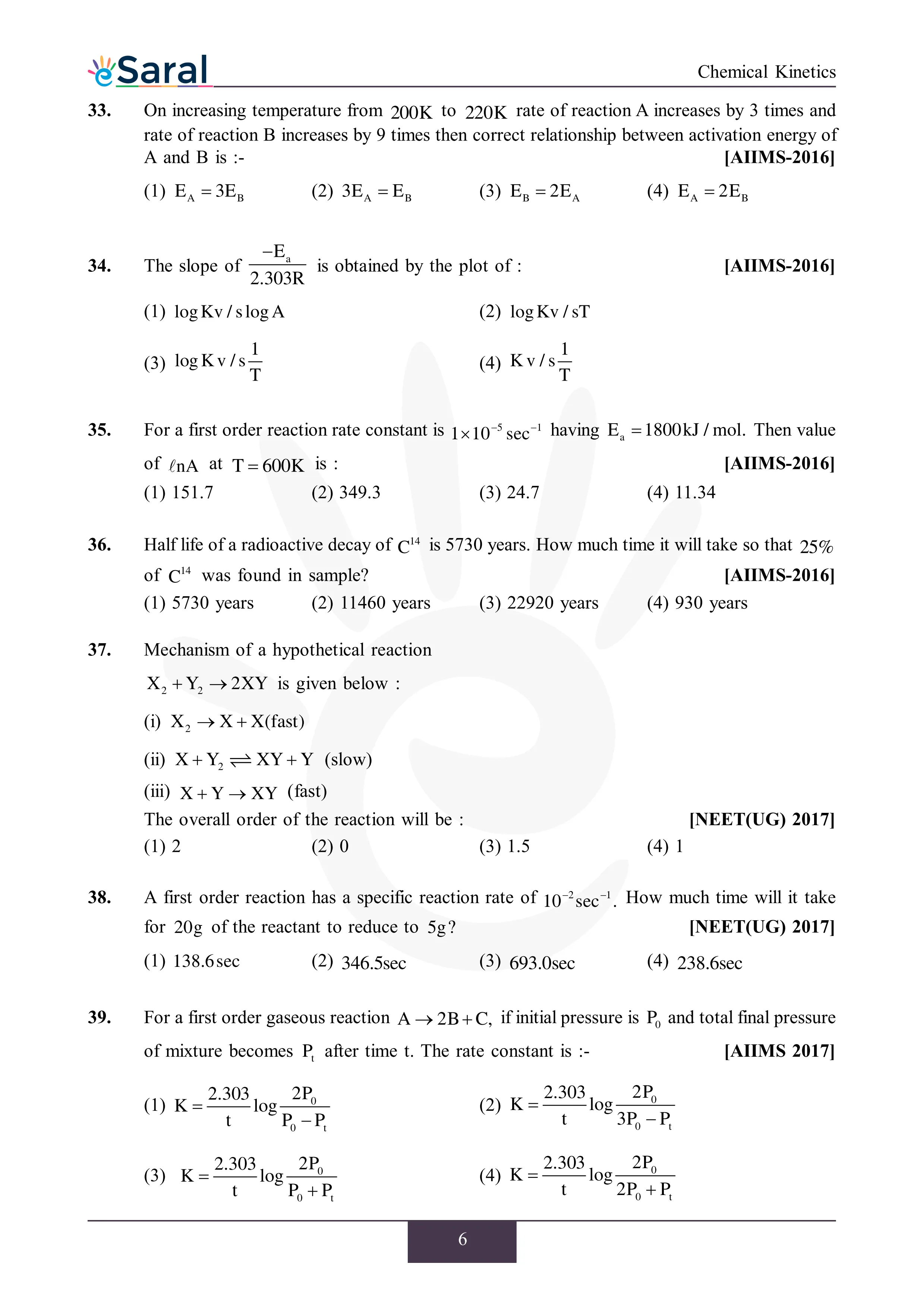
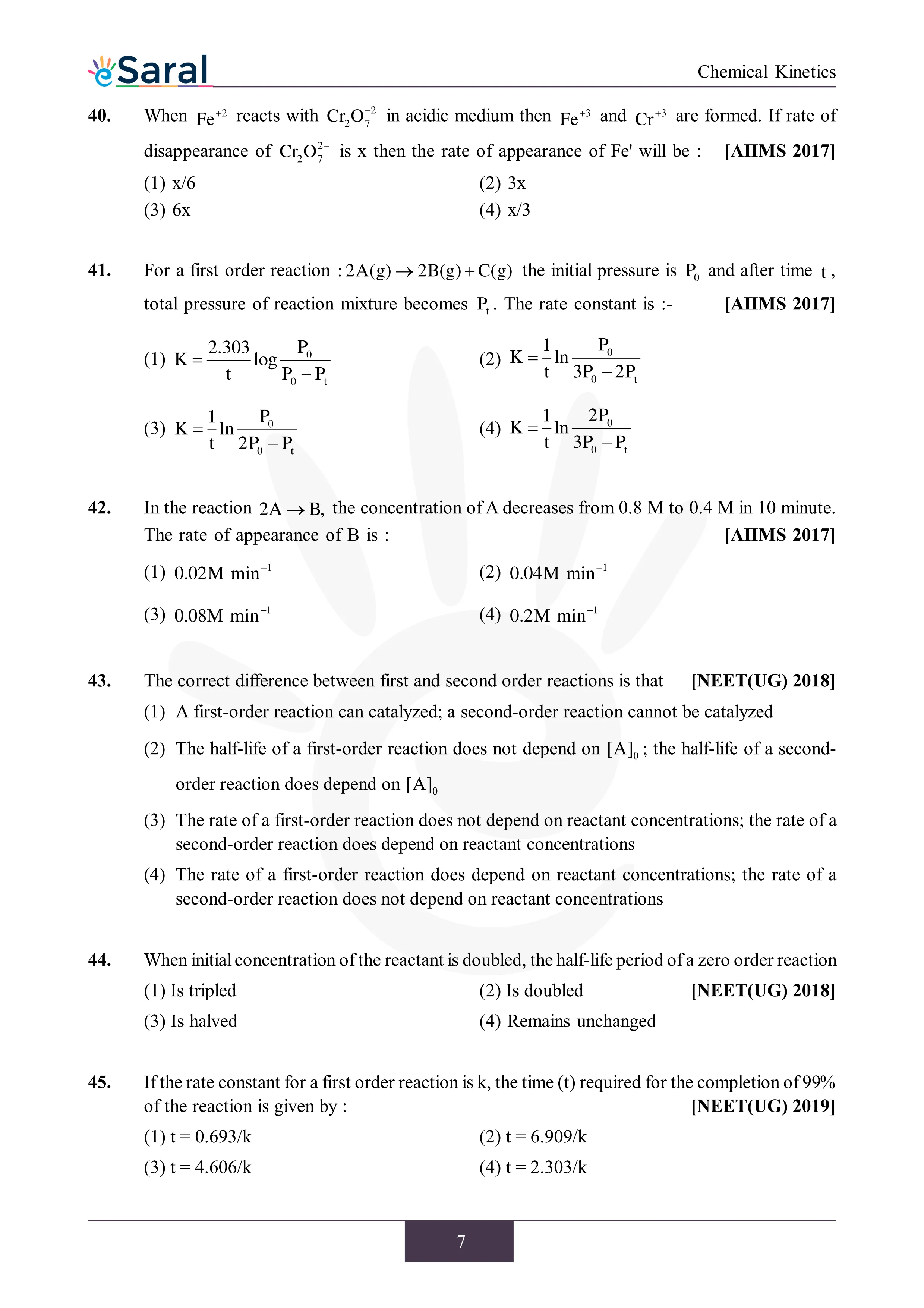
NEET PYQs: Rate of Reaction and Rate Law


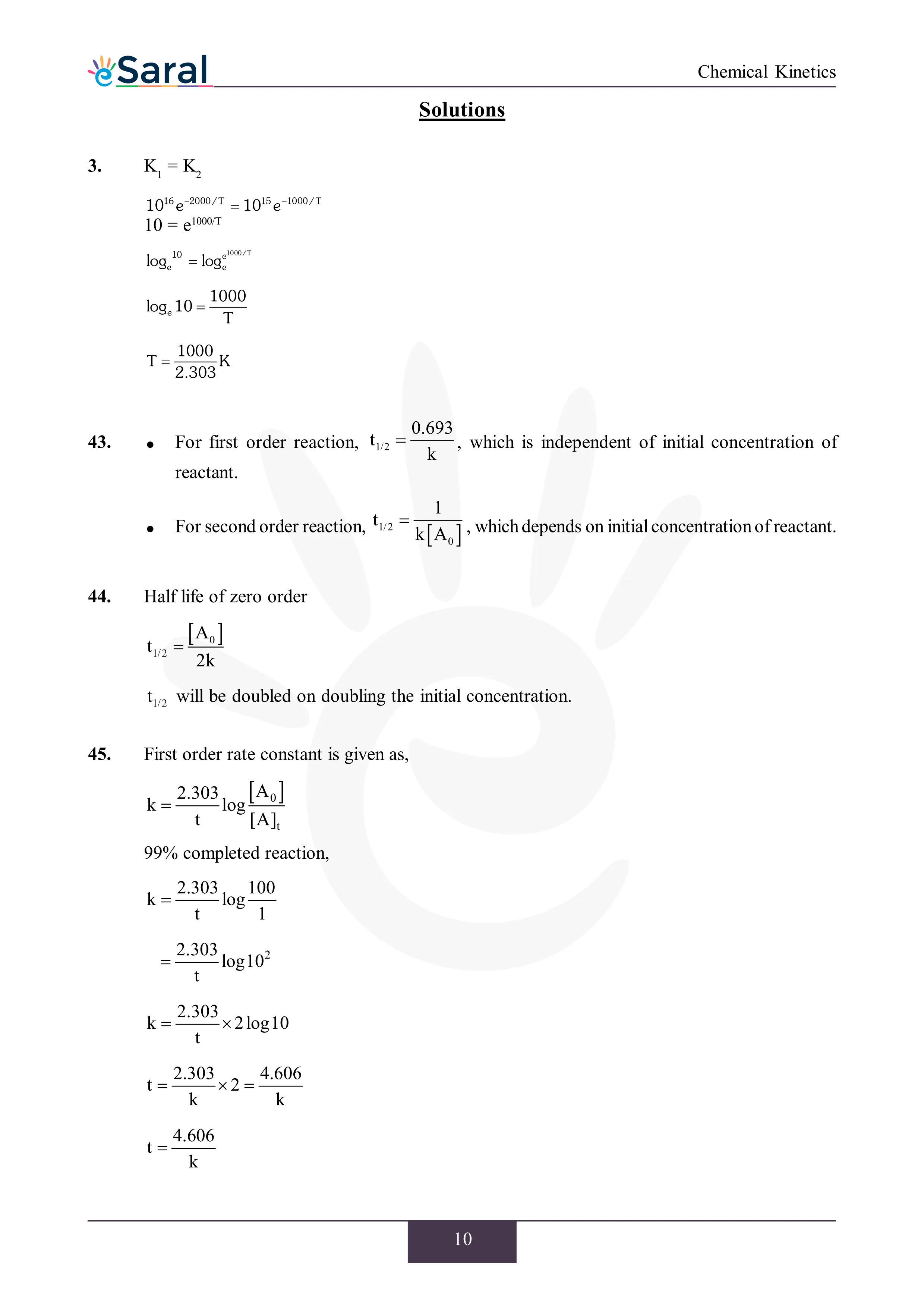

Common Mistakes in Chemical Kinetics NEET Questions
Mistake 1 — Confusing Order with Molecularity
Order is experimentally determined and can be zero, fractional, or any whole number. Molecularity is a theoretical concept for elementary reactions and is always a positive whole number (1, 2, or 3). They are equal only for elementary reactions.
Mistake 2 — Using Wrong Units for Rate Constant
Units of k depend entirely on reaction order:
- Zero order: mol L⁻¹ s⁻¹
- First order: s⁻¹
- Second order: L mol⁻¹ s⁻¹
Memorise these. NEET asks unit-identification questions directly.
Mistake 3 — Assuming Half-Life Depends on Concentration for First Order
For first order reactions, t½ = 0.693/k — completely independent of initial concentration. Only for zero and second order reactions does half-life depend on [A]₀. This distinction is tested conceptually in NEET almost every year.
Mistake 4 — Wrong Sign in Arrhenius Log Formula
The correct form is: log(k₂/k₁) = (Ea/2.303R)(1/T₁ – 1/T₂)
Note the order: 1/T₁ – 1/T₂ where T₁ < T₂. Students who reverse this get a negative Ea — which is physically impossible for most reactions.
| Mistake | How to Avoid |
|---|---|
| Confusing order with molecularity | Order = experimental; molecularity = theoretical, whole number only |
| Wrong rate constant units | Zero = mol/L/s; First = 1/s; Second = L/mol/s |
| Thinking first order t½ depends on [A]₀ | First order t½ = 0.693/k — always constant |
| Reversing T₁ and T₂ in Arrhenius | Use 1/T₁ – 1/T₂ where T₁ is lower temperature |
| Mixing up rate law with stoichiometry | Rate law coefficients come from experiment, not balanced equation |
Frequently Asked Questions
Find answers to common questions.
How many questions come from Chemical Kinetics in NEET every year?
Chemical Kinetics contributes 2–3 questions in NEET Chemistry almost every year, making it one of the most reliably tested chapters. Topics appearing most consistently include first order half-life, order of reaction determination from data, Arrhenius equation calculations, units of rate constant, and pseudo first-order reactions.
What is the weightage of Chemical Kinetics in NEET Chemistry?
Chemical Kinetics carries approximately 5–8% weightage in NEET Chemistry, contributing 2–3 questions worth 8–12 marks. Along with Electrochemistry and Liquid Solutions, it is one of the three most consistently tested chapters from Class 12 Chemistry in NEET every year.
What is the half-life of a first order reaction?
The half-life of a first order reaction is t½ = 0.693/k, where k is the rate constant. A key feature of first order reactions is that half-life is completely independent of initial concentration — it remains constant throughout the reaction. This is one of the most tested facts in Chemical Kinetics NEET questions.
What is the difference between order and molecularity of a reaction?
Order of reaction is determined experimentally from the rate law — it can be zero, fractional, or any whole number, and applies to both elementary and complex reactions. Molecularity is a theoretical concept that applies only to elementary reactions — it is always a positive whole number (1, 2, or 3) representing the number of species colliding in a single step.
How do I use the Arrhenius equation in NEET numericals?
For NEET, use the log form: log(k₂/k₁) = (Ea/2.303R) × (1/T₁ – 1/T₂), where T₁ is the lower temperature and T₂ is the higher temperature. Substitute R = 8.314 J/mol·K, temperatures in Kelvin, and solve for Ea or k₂. Always check that Ea comes out positive — if it is negative, you have reversed T₁ and T₂.