Class 10 Periodic Test Preparation: 5-Step System to Score High
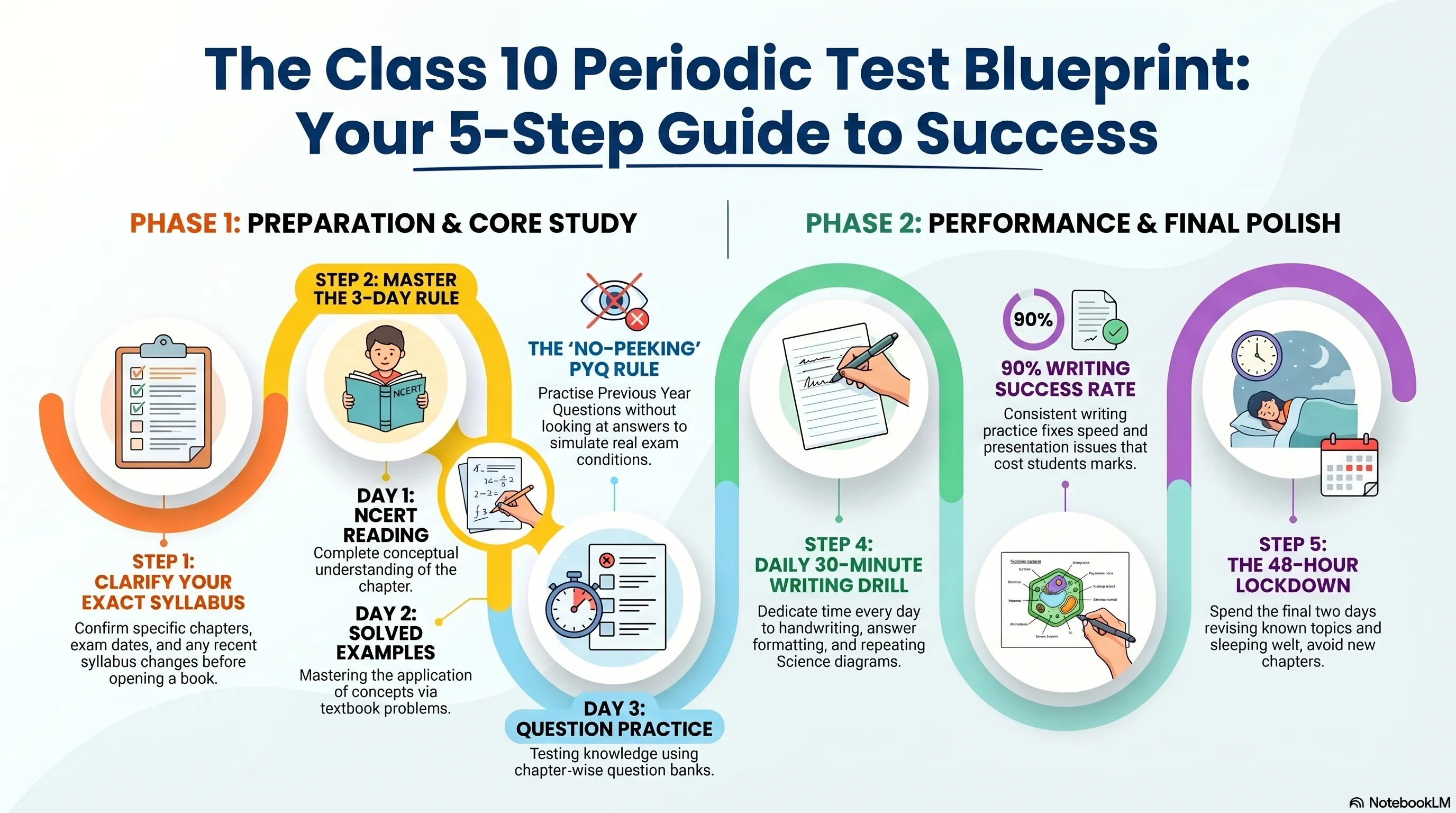
Class 10 periodic test preparation works best with a clear 5-step system: clarify your exact syllabus, read NCERT and solve all examples, practise PYQs without looking at answers, do 30 minutes of daily writing practice, and in the final 2 days revise everything, identify weak topics, and avoid studying anything new.

Table of Contents
- Why the Class 10 Periodic Test Is Your Most Important Opportunity Right Now
- Step 1: Clarify Your Exact Periodic Test Syllabus First
- Step 2: Follow the 3-Day Rule — NCERT, Solved Examples, and Question Practice
- Step 3: Practise PYQs and Important Questions Like a Real Test
- Step 4: Daily Writing and Diagram Practice — 30 Minutes Every Day
- Step 5: What to Do in the Last 2 Days Before Your Periodic Test

eSaral ›Foundation courses ›Class 10 Periodic Test Preparation: 5-Step System to Score High

Why the Class 10 Periodic Test Is Your Most Important Opportunity Right Now
The periodic test is not just a formality. It is the first measurable moment in Class 10 — the first chance to show your parents that this year is different. Students who scored 60–70% in Class 9 and then joined the right course and followed this system were able to bring that number up significantly and make their parents proud.
This test is also low-stakes enough that you can go in with full preparation. The syllabus is defined, the window is fixed, and the subjects are the same ones you have been building on — Maths, Science, SST, and English.
Use this window well.
Step 1: Clarify Your Exact Periodic Test Syllabus First
The first and most important step is knowing your exact syllabus. Half the students who underperform in periodic tests do so not because they did not study — but because they did not know exactly what was going to be tested.
💡 Faculty Tip, eSaral: "आधे बच्चों को क्लियर नहीं है कि क्या सिलेबस होने वाला है।" Half the students do not even know their syllabus clearly before the test. That is the first gap to fix.
Before you open a single book, confirm:
- Which chapters are included for each subject
- The exam date for each subject
- Whether any chapters have been added or removed recently
Once you have this clarity, everything else in this guide applies directly to those chapters.
Step 2: Follow the 3-Day Rule — NCERT, Solved Examples, and Question Practice
What Is the 3-Day Rule?
For each chapter, follow this sequence:
- Day 1 — Read NCERT for that chapter completely. One chapter = full NCERT reading of that chapter. Two chapters = both NCERT readings done on Day 1.
- After NCERT — Solved Examples — solve every solved example in the textbook for that chapter.
- Question Practice — after examples, do focused question practice for that chapter.
This sequence applies to Maths, Science, SST, and English equally.
Where to Find Question Practice
The faculty is clear on this: you do not need to look far. Google has chapter-wise question banks available for every subject. The eSaral app also has a large bank of questions available chapter-wise.
For NCERT-based practice, NCERT Solutions Class 10 covers both Maths and Science in detail. Subject-specific options:
You can also download the textbook itself from NCERT Books Class 10 — including the Class 10 Maths NCERT Book PDF and Class 10 Science NCERT Book PDF.
Step 3: Practise PYQs and Important Questions Like a Real Test
Why PYQs Matter for Periodic Tests
After chapter-wise question practice comes the most important part — PYQs (Previous Year Questions) and important questions. These must be practised in a specific way.
The rule is: do not look at the answers while solving.
The faculty is direct about this: treat every PYQ session as if it is the actual test. Sit down, attempt the question without referring to solutions, and simulate real exam conditions. This is the only way this practice builds the skill you actually need on exam day.
For past paper practice across subjects:
- CBSE Class 10 Maths Question Paper 2023
- CBSE Class 10 Science Question Paper 2023
- CBSE Class 10 English Question Paper 2023
- CBSE Class 10 Social Science Question Paper 2023
Attempting these without looking at solutions first is what separates students who practise from students who prepare.
Step 4: Daily Writing and Diagram Practice — 30 Minutes Every Day
Why Writing Practice Is Non-Negotiable
Reading and solving questions mentally is not enough. 90% of students have a writing problem — messy handwriting, slow writing speed, or no habit of writing answers in exam format. When it is time to write in the actual exam, they cannot execute what they know.
The fix is simple: 30 minutes of daily writing practice, every single day without exception.
When you do this consistently, two things improve by the time you sit for board exams:
- Your presentation improves — the examiner checking your answer sheet will be impressed.
- Your speed and accuracy improve — you can write what you know in the time available.
Diagram Practice for Science, Biology, and Physics
For subjects where diagrams appear — Biology, Physics, or any Science chapter with labelled figures — practise drawing each diagram 2 to 3 times daily. Diagrams are a direct source of marks and one of the easiest things to improve with daily repetition.
This is one of the ways good marks are secured beyond just knowing the content.
Step 5: What to Do in the Last 2 Days Before Your Periodic Test
When your exam is 2 days away, the strategy changes. The faculty lays out exactly three things to do — and one thing to absolutely avoid.
The 3-Step Last-2-Days Plan
- Revise everything you have already studied. Whatever chapters you covered — revise them fully. Every student's first job in the final 2 days is revision, not new learning.
- Identify your weak topics using your previous tests or question practice. If Polynomials in Maths gave you trouble, revise Polynomials. If Light in Physics was weak, go back to Light. Your test results and question practice sessions already tell you where the gaps are — use that data.
- Do not study any new topic. If a chapter has not been covered in your preparation, do not start it 2 days before the exam. Revise what you know deeply. Sleep well the night before.
💡 Faculty Tip, eSaral: "कोई नया टॉपिक नहीं पढ़ना है। जितना पढ़ा है उसी को रिवाइज करके जाना है और रात को अच्छी नींद लेनी है।" No new topics. Revise what you have. Sleep properly.
For students building on Class 9 foundations, NCERT Solutions Class 9 is a useful reference for any carry-forward concepts.
Frequently Asked Questions
Find answers to common questions.
How should I start my Class 10 periodic test preparation?
Start by clarifying your exact syllabus for each subject. Half the students who underperform in periodic tests simply do not know what is going to be tested. Once the syllabus is confirmed, follow the 3-day rule: read NCERT for the chapter, solve all examples, then do focused question practice.
Why is NCERT the starting point for Class 10 periodic test preparation?
NCERT is the base for every CBSE periodic test. The faculty's 3-day rule begins with full NCERT reading for the chapters in your syllabus, followed by all solved examples in the textbook. Only after this is question practice added. You can access textbooks from NCERT Books Class 10.
Why is writing practice important for Class 10 exams?
90% of students have a writing problem — slow speed, messy handwriting, or poor answer presentation. Daily 30-minute writing practice improves both speed and presentation. When you go for your board exam, the examiner checking your answer sheet will be fully impressed by clean, well-presented answers.
How should I practise PYQs for Class 10 periodic tests?
Practise PYQs and important questions without looking at the answers. Treat every practice session as a real test — sit down and attempt the questions as if it is the actual exam day. This is the only way the practice translates into exam performance. Past papers are available at CBSE Class 10 Science Question Paper 2023 and CBSE Class 10 Maths Question Paper 2023.
What should I do the day before my Class 10 periodic test?
In the last 2 days, revise all chapters you have already covered. Identify weak topics from your previous test performance and question practice sessions, and give those extra time. Do not pick up any new topic. Sleep well the night before — going in rested is part of the preparation.