Class 10 Summer Vacation Study Plan 2025: Score 95%+ in Boards
Start Class 10 board preparation in June with a consistent 2–3 hour daily study routine covering Maths, Science, and SST, using NCERT, practice questions, self-written notes, and weekly tests to complete a major portion of the syllabus early and boost your chances of scoring 95%+.

Table of Contents
- Why June and July Decide Your Class 10 Board Result
- How to Build a Daily Study Habit During Vacation
- Maths Study Plan for Summer Vacation — Chapter by Chapter
- Science Study Plan for June and July — Physics, Chemistry, Biology
- Social Science: Why You Should Not Leave It for Last
- Weekly Study Schedule: How to Plan Each Week
- How to Test Yourself and Track Progress

eSaral ›Foundation courses ›Class 10 Summer Vacation Study Plan 2025: Score 95%+ in Boards

Why June and July Decide Your Class 10 Board Result
Many Class 10 students make one costly assumption: that last-minute preparation in December and January is enough to score 95%+. The students who actually achieve that score tell a different story.
The students who top Class 10 boards are not the ones who studied the hardest in February. They are the ones who used June and July — their vacation months — to build a foundation that made everything else easier. By the time the rest of their class was starting their first revision, these students were on their second or third.
Even if your Class 9 result was only 60%, that number does not determine your Class 10 result. What determines it is what you do with the next two months.
The Class 10 CBSE board exam is typically scheduled for February. That means you have approximately 7–8 months from June. Starting now — even with just 2–3 focused hours daily — creates a significant advantage over students who start in October or November.
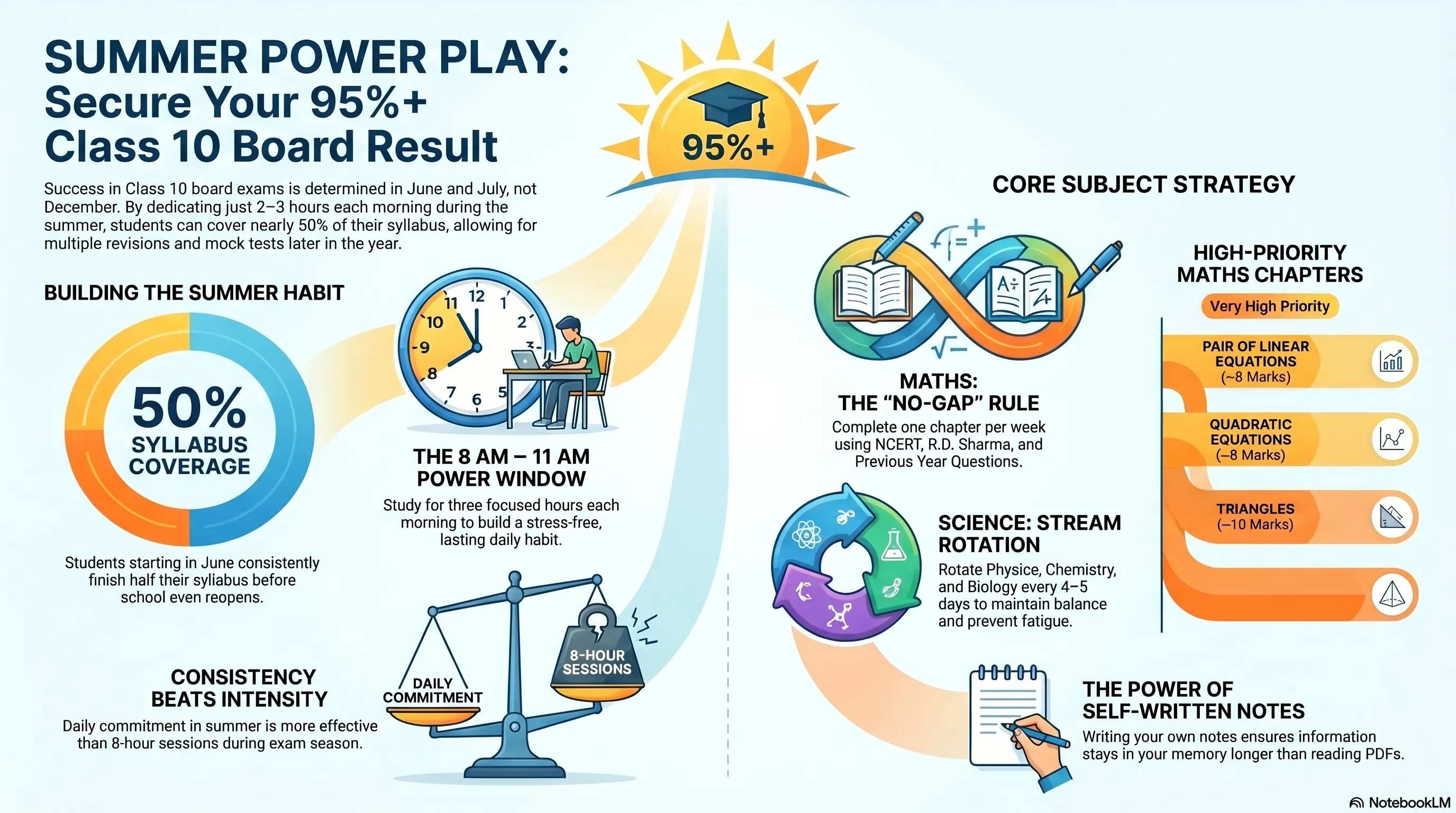
💡 Expert Tip by eSaral Academic Team: "Students who join eSaral's Foundation course and begin summer preparation in June consistently cover 40–50% of their syllabus before school reopens. That buffer gives them time for revision, mock tests, and error correction — the three things that actually push scores from 80% to 95%+."
The time to start is not when exams are one month away. The time to start is right now, in June.
How to Build a Daily Study Habit During Vacation
The biggest mistake students make during summer vacation is treating every day as a holiday. The biggest opportunity is building a study habit before school pressure arrives — because habits formed without stress are habits that stick.
Why 2–3 Hours Daily Is Enough Right Now
You do not need to study 8 hours a day in June. Two to three focused hours in the morning is sufficient — and far more effective than 6 hours of distracted study in the evening.
When school is on, you wake up early automatically. Use that same rhythm now. Study from 8 AM to 10 or 11 AM, then enjoy the rest of your day. This small daily commitment compounds into enormous progress over 30–60 days.
How to Structure Your Daily Study Time
| Time Slot | Activity |
|---|---|
| 8:00 – 9:00 AM | Maths — new chapter or practice questions |
| 9:00 – 10:00 AM | Science — new chapter (Physics / Chemistry / Bio rotation) |
| 10:00 – 10:30 AM | SST — reading 1 lesson or writing notes |
| Evening (optional) | Revision of morning topics, 30 minutes |
This is a starting structure. Adjust based on which subjects need more attention. The key rule: do not skip Maths. Even one day of gap in Maths practice creates a mental block that takes twice the time to overcome.
The 30-Day Challenge
Take a 30-day challenge starting today. Commit to studying daily for one month — no exceptions. At the end of 30 days, review how many chapters you have covered. Students who complete this challenge typically finish 4–5 Maths chapters and 6–8 Science chapters before school reopens.
Maths Study Plan for Summer Vacation — Chapter by Chapter
Maths is the subject where backlogs are most dangerous. One skipped chapter in Class 9 or early Class 10 can become a permanent weak spot that pulls your overall percentage down significantly.
Which Chapters Should You Cover in June and July?
The highest-weightage chapters in CBSE Class 10 Maths for boards are:
| Chapter | Marks Weightage | Priority |
|---|---|---|
| Real Numbers | ~6 marks | High |
| Polynomials | ~4 marks | High |
| Pair of Linear Equations in Two Variables | ~8 marks | Very High |
| Quadratic Equations | ~8 marks | Very High |
| Arithmetic Progressions | ~8 marks | High |
| Triangles | ~10 marks | Very High |
| Coordinate Geometry | ~6 marks | High |
Real Numbers, Polynomials, and Linear Equations together carry 26+ marks of weightage. These chapters are also the ones most commonly skipped by students who think they are "easy enough to do later." Do not make that mistake. Cover them thoroughly in June.
How to Study Each Maths Chapter
Follow this sequence for every chapter:
- Watch a lecture — use eSaral's app, YouTube, or your school material
- Read NCERT — every example, every exercise question
- Solve R.D. Sharma — for harder problems beyond NCERT
- Attempt PYQs — previous year board questions for that chapter
- Solve NCERT Exemplar — for the greatest difficulty level
NCERT alone is not enough for 95%+ in the current board paper. The paper level has increased. Students who only practice NCERT questions often find the actual board paper difficult in the computation-heavy sections. R.D. Sharma and PYQs are non-negotiable for top scores.
💡 Expert Tip by eSaral Academic Team: "One chapter per week in Maths is a realistic and achievable target. At this pace, you will complete 8 chapters by the end of July — roughly 60% of the entire syllabus — before school even reopens for Class 10."
Science Study Plan for June and July — Physics, Chemistry, Biology
Science is the subject where students most commonly make a subject-balance mistake. Many students prioritise Physics, push Chemistry to "later," and tell themselves Biology is easy enough to handle in December. Every one of these decisions costs marks.
The Right Approach: Rotate All Three
Start one chapter from each of the three Science streams simultaneously. This keeps your preparation balanced and prevents subject fatigue.
Target: 1 Science chapter every 4–5 days
At this pace, covering 2 chapters per week across the three subjects means you finish 16–18 Science chapters during June and July alone.
How to Study Each Science Chapter
- Watch a complete lecture — one-shot videos work well for concept building in June
- Make self-written notes — this is the most important step. Do not use pre-made notes from YouTube or other teachers. Write your own, in your own words.
- Read NCERT — line by line for every chapter. For Biology especially, every line of NCERT can be a board question.
- Answer NCERT back-of-chapter questions — attempt all of them, every time
- Test yourself — one small self-test per chapter before moving on
Why Self-Written Notes Matter
Many students copy notes from YouTube teachers or download PDFs and consider their preparation done. This does not work. When you write notes yourself — even if they are shorter and messier — your brain processes the information differently. Things you write stay in memory far longer than things you read or watch.
Teachers' notes are a reference. Your notes are a learning tool. They are not the same thing.
Social Science: Why You Should Not Leave It for Last
SST is the subject almost every Class 10 student plans to "do later." It is also the subject that most commonly causes students to drop from 90% to 85% overall — because "later" becomes December, and there are 20 chapters to cover in 3 weeks.
SST Is Not Boring — Change How You See It
Social Science is not just a scoring subject. History, Geography, Economics, and Political Science tell you about your country, your world, and systems that affect daily life. Students preparing for competitive exams like UPSC later in life find this foundation genuinely useful.
When you approach SST as knowledge rather than as a burden, you retain it much better. Stories stick. Dates memorised with context stick. Random facts crammed the night before do not.
The One-Chapter-Per-Week Rule
Target: 1 SST chapter per week during June and July
At this pace, you cover 8 SST chapters by the time school reopens. That is nearly half the syllabus — with zero exam pressure, no school homework competing for your time, and full attention available for each chapter.
| Week | Target |
|---|---|
| Week 1 | History Chapter 1 |
| Week 2 | Geography Chapter 1 |
| Week 3 | History Chapter 2 |
| Week 4 | Economics Chapter 1 |
| Week 5 | Political Science Chapter 1 |
| Week 6 | Geography Chapter 2 |
| Week 7 | History Chapter 3 |
| Week 8 | Economics Chapter 2 |
This rotation keeps all four SST subjects moving simultaneously — so nothing falls behind.
Weekly Study Schedule: How to Plan Each Week
A weekly plan prevents the biggest enemy of vacation study: wasted time due to indecision. When you sit down and don't know what to study, you end up studying nothing.
Sample Week Plan (Class 10 Summer Vacation)
| Day | Morning Focus | Evening (Optional) |
|---|---|---|
| Monday | Maths — new chapter lecture + NCERT | Revision of the previous Maths chapter |
| Tuesday | Science Physics — lecture + notes | Read SST chapter (first 5 pages) |
| Wednesday | Maths — R.D. Sharma + PYQs | Science Chemistry — lecture |
| Thursday | Science Biology — lecture + notes | SST — complete chapter + notes |
| Friday | Maths — Exemplar + self-test | Science Chemistry — NCERT questions |
| Saturday | Full SST chapter revision | Maths — all chapter PYQs |
| Sunday | Weekly self-test (all subjects) | Relax — no forced study |
Sunday's self-test is the most important part of the week. It tells you what actually stuck and what needs revisiting — before you carry a misunderstood concept into the next chapter.
How to Test Yourself and Track Progress
Studying without testing is like practising cricket without ever facing a ball. You feel prepared until the actual game — and then you realise you were not.
How to Run Your Own Weekly Test
You do not need a formal test series for this. Here is a simple process:
- Pick 10–20 random questions from the chapters you covered that week
- Sit in test conditions — no notes, no phone, timed (30–40 minutes)
- Check your answers honestly
- Note every question you got wrong — these are your weak points
- Revisit those specific concepts before moving to the next chapter
One weekly test per subject is the minimum. Two is better.
Track Your Chapters in a Simple Table
Keep a notebook or phone note with this tracker:
| Subject | Chapter | Lecture Done | Notes Done | NCERT Done | PYQs Done | Test Done |
|---|---|---|---|---|---|---|
| Maths | Real Numbers | ✅ | ✅ | ✅ | ✅ | ✅ |
| Science | Light — Reflection | ✅ | ✅ | ✅ | ❌ | ❌ |
This tracker does two things. It prevents you from fooling yourself into thinking a chapter is "done" when only the lecture is watched. And it gives you a clear view of how much you have actually covered.
Students who track their progress consistently cover 30–40% more syllabus than students who study without a tracker — because the tracker creates accountability.
If you want access to chapter-wise PYQs, practice questions, and guided lecture videos for Class 10, eSaral's Foundation course covers all subjects with the same structured approach described in this article.
Frequently Asked Questions
Find answers to common questions.
How to use summer vacation for Class 10 board exam preparation?
Use June and July to cover 1 Maths chapter per week, 1 Science chapter every 4–5 days, and 1 SST chapter per week. Study 2–3 hours every morning. Make self-written notes for every chapter and take a weekly self-test. Students who follow this schedule consistently score 95%+ in CBSE Class 10 boards.
Which chapters should I study first in Class 10 Maths during summer vacation?
Start with Real Numbers, Polynomials, and Linear Equations in Two Variables. These three chapters carry over 26 marks in the CBSE board paper and form the conceptual base for later chapters like Quadratic Equations and Arithmetic Progressions. Complete NCERT, then R.D. Sharma, then PYQs for each chapter before moving on.
How many hours should a Class 10 student study in summer vacation?
2–3 focused hours every morning is sufficient during summer vacation. Quality matters more than quantity at this stage. Morning study — from 8 AM to 10 or 11 AM — is more effective than evening sessions because the brain is fresh. Add a 30-minute revision session in the evening if needed.
Is NCERT enough for scoring 95% in Class 10 Maths?
No. NCERT alone is not sufficient for 95%+ in the current CBSE board pattern. NCERT is the foundation — every example and exercise must be done thoroughly. But students targeting 95%+ must also solve R.D. Sharma for harder problems, NCERT Exemplar for the highest difficulty, and PYQs for board-specific practice.
How should I study Science in summer vacation for Class 10?
Rotate across Physics, Chemistry, and Biology — cover one chapter from each stream rather than finishing one subject entirely before moving to the next. Watch a lecture, write self-made notes, complete NCERT exercises, and take a short self-test before moving to the next chapter. Target one Science chapter every 4–5 days.