Common Terms in Arithmetic Progression: JEE Main & Advanced Guide
Learn how to identify common terms between two or more arithmetic progressions using the first common term, LCM of common differences, and AP formulas to find their count and sum for JEE Main & Advanced.

Table of Contents
- AP Basics: Formulas You Need Before Starting
- What Are Common Terms in Two APs?
- How to Find the First Common Term Between Two APs
- How to Find the Number of Common Terms in Two APs
- How to Find the Sum of Common Terms in Two APs
- Worked Example 1: Finding Number of Common Terms (JEE Main Level)
- Worked Example 2: Directly Given Last Term Values (JEE Main Level)
- Worked Example 3: Three APs and JEE Advanced 2019 Question

eSaral ›Foundation courses ›Common Terms in Arithmetic Progression: JEE Main & Advanced Guide

AP Basics: Formulas You Need Before Starting
Before working with common terms in arithmetic progressions, these standard AP formulas are essential.
The nth term of an AP:
an=a+(n−1)⋅da_n = a + (n-1) \cdot d
Where:
- a = first term
- d = common difference
- n = term number
Sum of n terms of an AP:
Sn=n2[2a+(n−1)⋅d]=n2(a+l)S_n = \frac{n}{2} \left[2a + (n-1) \cdot d\right] = \frac{n}{2}(a + l)
Where l is the last term.
These are the only two formulas you will need throughout this entire topic. The common terms concept is built entirely on top of them.
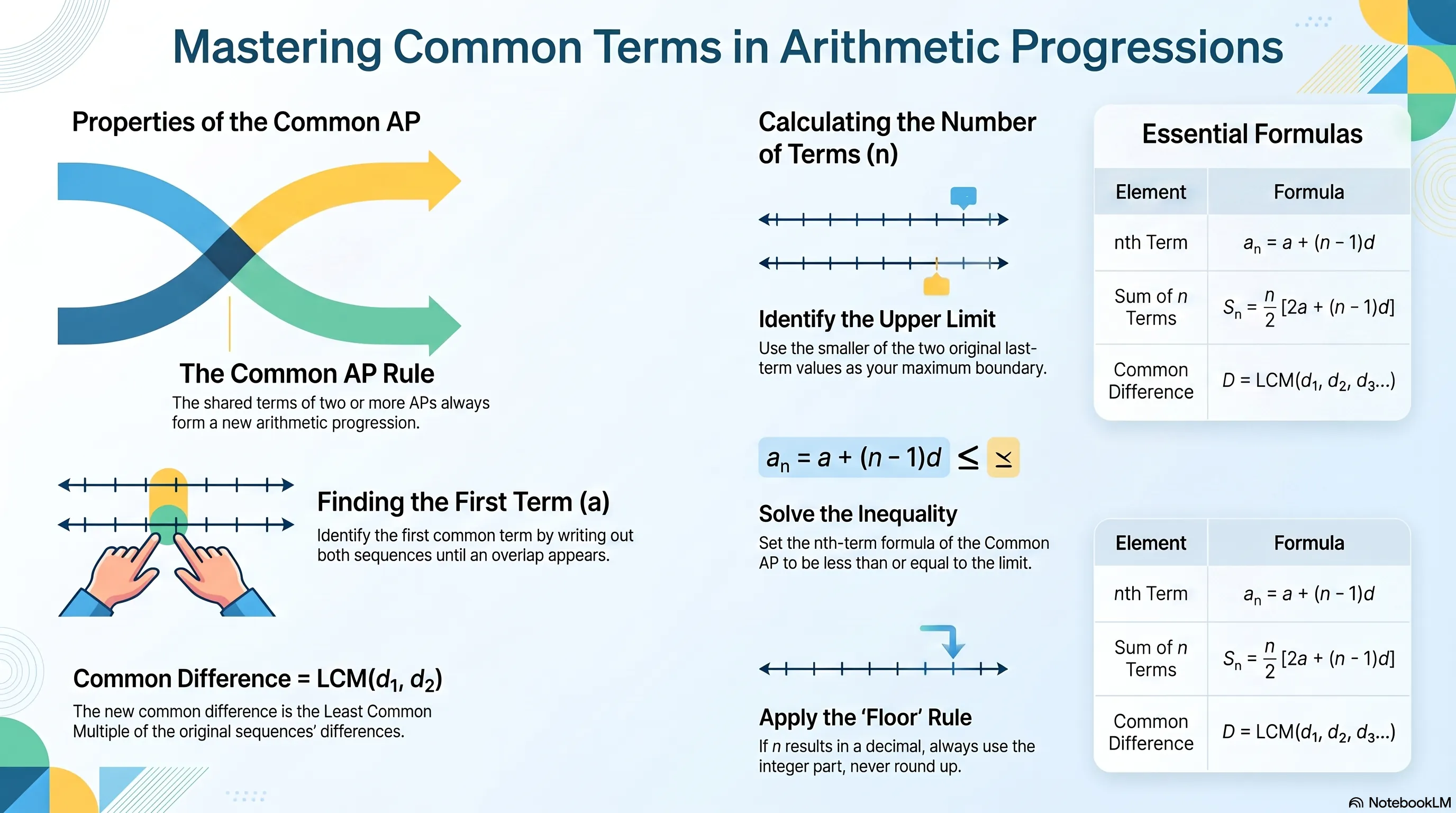
💡 Key Reminder: The number of terms in any AP is always a positive integer. If your calculation gives a decimal value for n, always take the integer part (floor value) — never round up.
For a solid foundation in AP from Class 10 NCERT, refer to NCERT Solutions Class 10 Maths. The Class 11 extension of this topic is covered in NCERT Solutions Class 11 Maths.
What Are Common Terms in Two APs?
Consider two arithmetic progressions — call them AP₁ and AP₂. Each has its own first term and its own common difference. Some terms will appear in both APs. These shared values are called the common terms of the two APs.
The key property to know:
The common terms of two APs always form another AP.
This new AP — call it the Common AP — has the following properties:
| Property | Value |
|---|---|
| First term | The first common term between AP₁ and AP₂ |
| Common difference | LCM of d₁ and d₂ (the common differences of the two original APs) |
This result extends naturally to three APs. The common terms of three APs also form an AP, where the common difference is the LCM of d₁, d₂, and d₃.
How to Find the First Common Term Between Two APs
Finding the first common term requires observation. Write out both APs term by term until you spot a value that appears in both sequences.
Example:
- AP₁: 1, 5, 9, 13, 17, 21 ... (first term = 1, common difference = 4)
- AP₂: 2, 7, 12, 17, 22 ... (first term = 2, common difference = 5)
Scanning both, the value 17 appears in AP₁ and also in AP₂. That is the first common term. So the Common AP starts at 17.
Its common difference = LCM(4, 5) = 20.
Therefore, the Common AP is: 17, 37, 57, 77 ...
For small APs, writing terms by hand is fine. For larger APs with many terms, spotting the first common term by observation is still the right method — once identified, the LCM handles the rest automatically.
How to Find the Number of Common Terms in Two APs
Once you have the Common AP (first term and common difference), follow these steps:
- Find the last term of AP₁ and the last term of AP₂ using the nth term formula.
- Take the smaller of the two last-term values. This is the upper limit for the Common AP.
- Set up the inequality: the nth term of the Common AP ≤ smaller last-term value.
- Solve for n. If n is not an integer, take the floor value (integer part only).
This floor value is your number of common terms.
💡 Why use the smaller last term? A common term must exist in both APs. If a value is in AP₁ but exceeds the last term of AP₂, it cannot be common. So the effective range is limited by whichever AP ends earlier — in terms of value, not count.
How to Find the Sum of Common Terms in Two APs
Once you know:
- Number of common terms (n)
- First common term (a)
- Common difference of the Common AP (d = LCM of d₁ and d₂)
Apply the standard sum formula directly:
Sn=n2[2a+(n−1)⋅d]S_n = \frac{n}{2}\left[2a + (n-1) \cdot d\right]
No new formula is needed. The Common AP behaves exactly like any other AP.
Worked Example 1: Finding Number of Common Terms (JEE Main Level)
Question: Find the number of common terms in the AP 4, 9, 14, … up to 25 terms, and the AP 3, 6, 9, 12, … up to 37 terms.
Step 1: Identify both APs.
- AP₁: first term a₁ = 4, common difference d₁ = 5, number of terms = 25
- AP₂: first term a₂ = 3, common difference d₂ = 3, number of terms = 37
Step 2: Find the last terms.
a25=4+24×5=4+120=124a_{25} = 4 + 24 \times 5 = 4 + 120 = 124 a37=3+36×3=3+108=111a_{37} = 3 + 36 \times 3 = 3 + 108 = 111
Step 3: Find the first common term.
Writing both APs: 4, 9, 14, 19, 24 ... and 3, 6, 9, 12, 15 ...
The value 9 appears in both. First common term = 9.
Step 4: Find the common difference of the Common AP.
LCM(5,3)=15\text{LCM}(5, 3) = 15
Common AP: 9, 24, 39, 54, 69, 84, 99 ...
Step 5: Find the number of common terms.
Smaller last term = 111 (from AP₂).
Set up: 9+(n−1)×15≤1119 + (n-1) \times 15 \leq 111
(n−1)×15≤102(n-1) \times 15 \leq 102
n−1≤6.8n - 1 \leq 6.8
n≤7.8n \leq 7.8
Since n must be an integer: n = 7.
Answer: 7 common terms.
Worked Example 2: Directly Given Last Term Values (JEE Main Level)
Question: Find the number of terms common to the two APs: 3, 7, 11, … up to 407, and 2, 9, 16, … up to 709.
Here the last term values (407 and 709) are given directly — no need to calculate them.
Step 1: Identify both APs.
- AP₁: a₁ = 3, d₁ = 4, last term = 407
- AP₂: a₂ = 2, d₂ = 7, last term = 709
Step 2: Find the first common term.
Writing terms: AP₁ gives 3, 7, 11, 15, 19, 23 ... AP₂ gives 2, 9, 16, 23 ...
The value 23 appears in both. First common term = 23.
Step 3: Common difference of Common AP.
LCM(4,7)=28\text{LCM}(4, 7) = 28
Common AP: 23, 51, 79 ...
Step 4: Number of common terms.
Smaller last term = 407 (from AP₁).
Set up: 23+(n−1)×28≤40723 + (n-1) \times 28 \leq 407
(n−1)×28≤384(n-1) \times 28 \leq 384
n−1≤13.7...n - 1 \leq 13.7...
n≤14.7...n \leq 14.7...
Answer: n = 14 common terms.
Worked Example 3: Three APs and JEE Advanced 2019 Question
This question appeared in JEE Advanced 2019. It demonstrates that the same concept extends directly from two APs to three.
Question (paraphrased from transcript): Three infinite APs are given:
- AP₁: 1, 4, 7, 10, ... (d₁ = 3)
- AP₂: 2, 7, 12, 17, 22, ... (d₂ = 5)
- AP₃: 3, 10, 17, 24, ... (d₃ = 7)
Find the first term (A) and common difference (D) of the AP formed by terms common to all three. Then find A + D.
Step 1: Common difference of the Common AP.
D=LCM(3,5,7)=105D = \text{LCM}(3, 5, 7) = 105
Step 2: Find the first common term.
For three APs, writing all three term by term and finding the first triple overlap is the approach. A smart shortcut: since AP₂ has d₂ = 5, its unit digits cycle between 2 and 7 only (adding 5 repeatedly). So any common term must end in 2 or 7.
Now scan AP₃ (which has the largest common difference, so fewest terms to check per range): 3, 10, 17, 24, 31, 38, 45, 52 ...
52 ends in 2 — it qualifies as a candidate. Check whether 52 is in AP₁:
52=1+(n−1)×3⇒51=(n−1)×3⇒n=1852 = 1 + (n-1) \times 3 \Rightarrow 51 = (n-1) \times 3 \Rightarrow n = 18
18 is an integer. So 52 is the 18th term of AP₁. ✓
52 is also in AP₂ (ends in 2, consistent with AP₂'s pattern). ✓
52 is also in AP₃ (we found it there directly). ✓
First common term A = 52.
Step 3: Answer.
A+D=52+105=157A + D = 52 + 105 = 157
💡 Faculty insight: "This question appeared in JEE Advanced 2019. It looks difficult — but when you read it carefully, the concept is exactly the same: find the first common term, take LCM of common differences, done. Questions that look dangerous in the paper are often the easiest ones if you know the concept."
For further practice with Class 12 Maths exam questions, refer to the Class 12 Maths Question Paper 2023. For Class 10 AP foundation, see Class 10 Maths Question Paper 2023.
Frequently Asked Questions
Find answers to common questions.
How do you find common terms between two arithmetic progressions?
Common terms between two APs form a new AP. The first term of this Common AP is the first value that appears in both sequences — found by observation. The common difference of the Common AP is the LCM of the common differences of the two original APs. From there, all standard AP formulas apply.
What is the common difference of the AP formed by the common terms of two APs?
The common difference of the AP formed by common terms of two APs is the LCM of their individual common differences. For example, if AP₁ has d = 4 and AP₂ has d = 5, the Common AP has common difference LCM(4, 5) = 20. For three APs with d₁, d₂, d₃, the common difference is LCM(d₁, d₂, d₃).
How do you find the number of common terms in two arithmetic progressions for JEE?
First build the Common AP using the first common term and LCM of common differences. Then find the last term of each original AP. Take the smaller of the two last-term values as the upper limit. Set the nth term of the Common AP ≤ that limit. Solve for n and take the integer part (floor value). That is the number of common terms in arithmetic progression.
Why must the number of terms always be an integer?
Because terms are counted in whole numbers — you cannot have 7.8 terms. If the formula gives a decimal like 7.8, the actual number of common terms is 7. You always take the floor value (round down), never round up, since the next integer would exceed the range of the APs.
How does the common terms concept extend to three APs?
The extension is direct. The common terms of three APs also form an AP. The common difference of this AP is the LCM of all three individual common differences. The first term is the first value common to all three APs, found by scanning terms or using unit-digit analysis when one AP has a predictable pattern (such as one with common difference 5, which cycles between only two unit digits).