Coordination Compounds Class 12 Notes for IIT JEE & NEET
Master Coordination Compounds Class 12 with complete notes on Werner’s theory, IUPAC nomenclature, isomerism, VBT, CFT, magnetic properties, colour, EAN rule, and important JEE Main, JEE Advanced, NEET, and CBSE concepts.
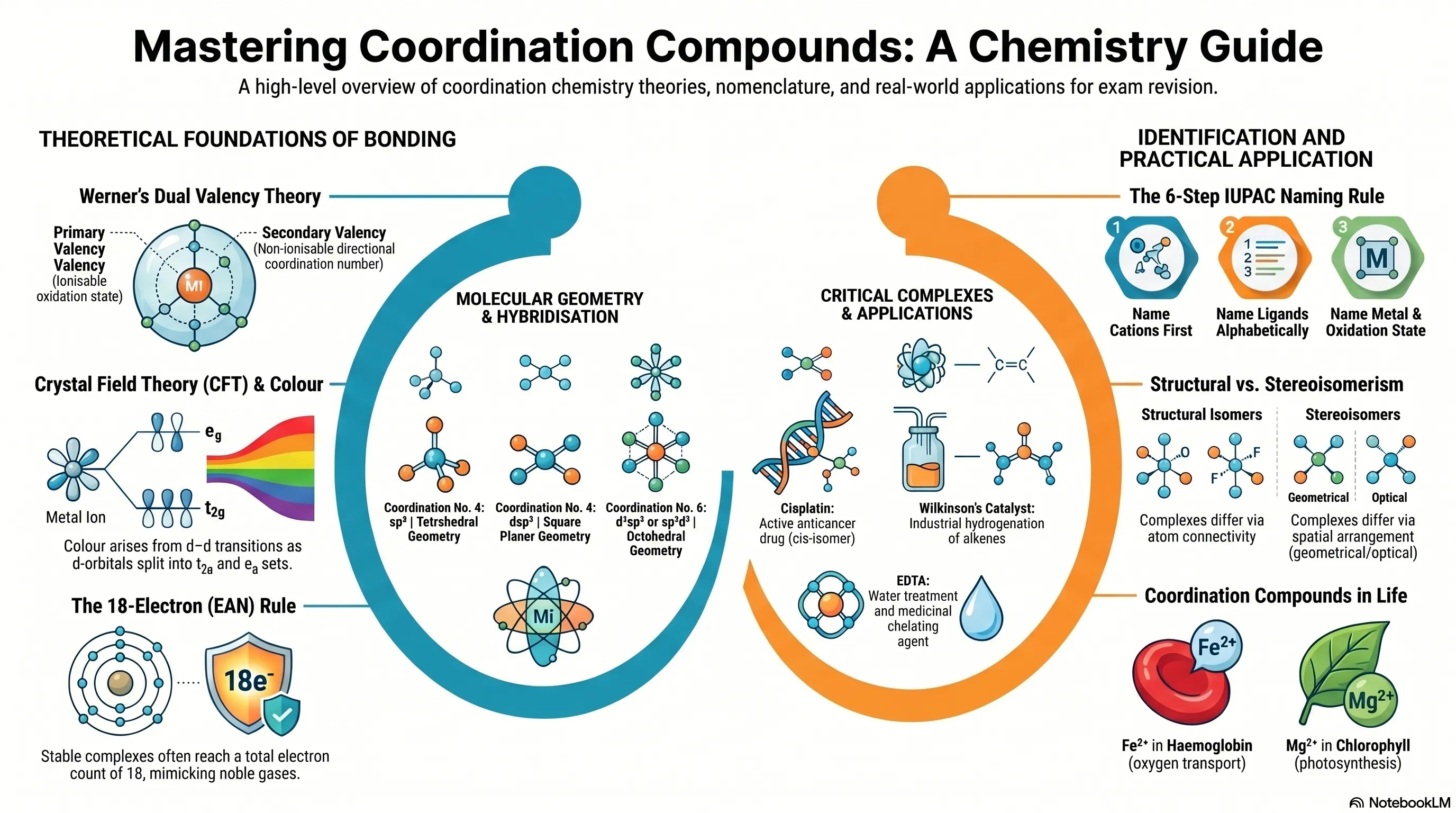
Table of Contents
- Chapter Overview and Exam Weightage
- Coordination Compounds Class 12 Notes
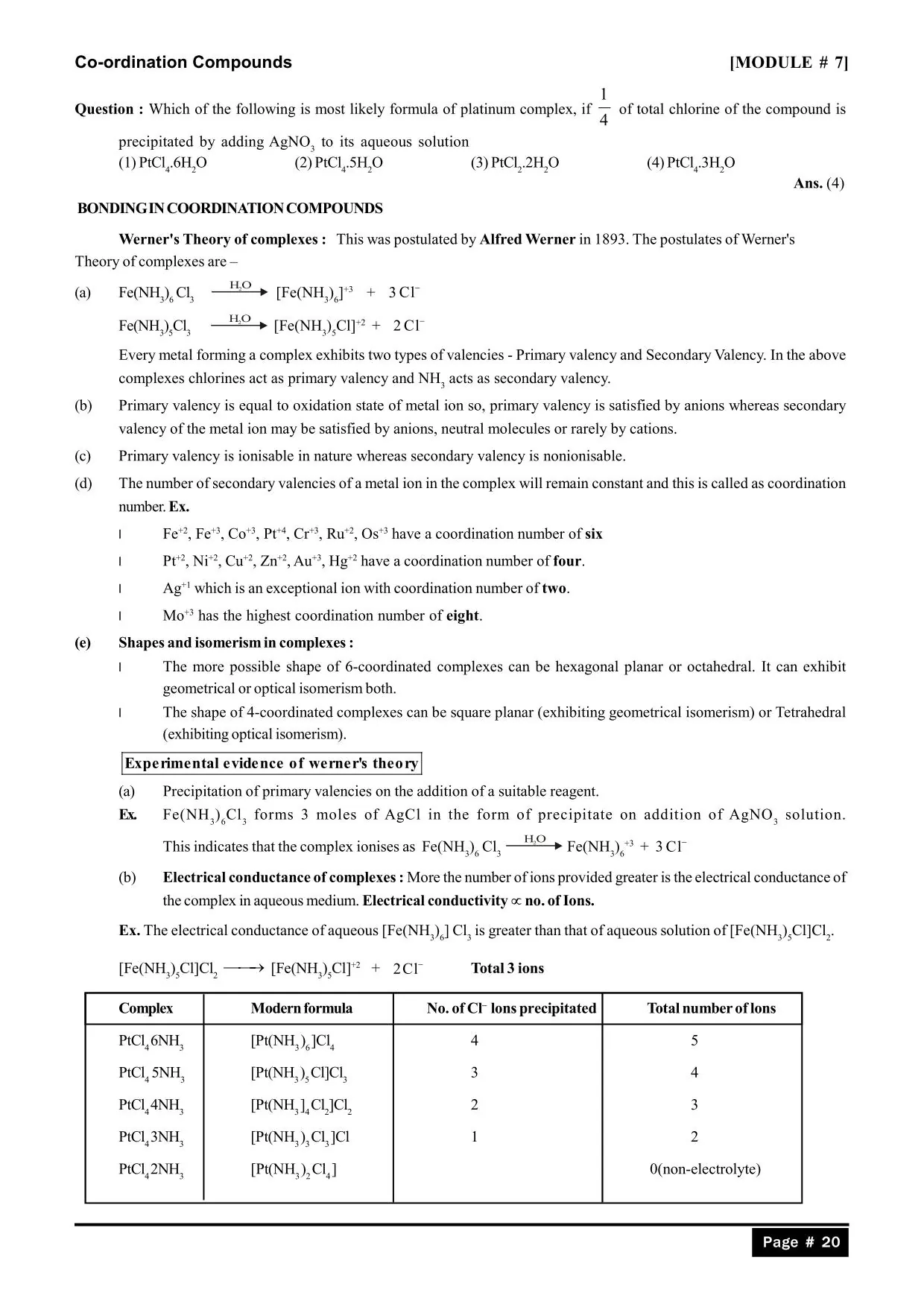
- Werner's Theory of Coordination Compounds
- Key Terminology: Ligands, Central Metal, Coordination Number
- IUPAC Nomenclature of Coordination Compounds
- Isomerism in Coordination Compounds
- Bonding in Coordination Compounds: VBT and CFT
- Colour, Magnetic Properties, and Stability of Complexes
- Biological and Industrial Importance
- Important Facts

eSaral ›Coordination Compounds Class 12 Notes for IIT JEE & NEET

Chapter Overview and Exam Weightage
Coordination Compounds is one of the most concept-rich chapters in Class 12 Chemistry. It connects inorganic chemistry, bonding theory, and even biological chemistry — making it intellectually satisfying and exam-relevant at the same time.
Why This Chapter Matters for JEE and NEET
| Exam | Average Questions | Marks | Key Sub-Topics Tested |
|---|---|---|---|
| JEE Main | 2–3 questions | 8–12 marks | IUPAC naming, isomerism, EAN rule, CFT |
| JEE Advanced | 1–2 questions | 4–8 marks | Structural and stereoisomerism, CFT splitting |
| NEET | 2 questions | 8 marks | IUPAC nomenclature, magnetic properties, VBT |
| CBSE Boards | 5–7 marks | Direct application | Nomenclature, Werner's theory, CFT basics |
💡 Expert Tip by eSaral Chemistry Faculty (IITian, Kota): "Coordination Compounds is a chapter where students who understand the logic of IUPAC rules score every single mark in nomenclature questions. Don't memorise names — understand the rules. Name any complex by following the same 6 steps every time and you will never go wrong."
Coordination Compounds Class 12 Notes
India's Best Exam Preparation for Class 12th - Download Now
India's Best Exam Preparation for Class 12th - Download Now
India's Best Exam Preparation for Class 12th - Download Now
India's Best Exam Preparation for Class 12th - Download Now
India's Best Exam Preparation for Class 12th - Download Now
Werner's Theory of Coordination Compounds
Alfred Werner (Nobel Prize, 1913) proposed the first systematic theory of coordination compounds in 1893.
Key Postulates of Werner's Theory
- Metals in coordination compounds show two types of valency:
- Primary valency (ionisable) — satisfied by negative ions, shown by oxidation state
- Secondary valency (non-ionisable) — satisfied by neutral molecules or negative ions directly attached to the metal; equal to the coordination number
- Secondary valencies are directed in space around the central metal atom, giving complexes their definite geometry.
- Primary valencies are non-directional; secondary valencies are directional.
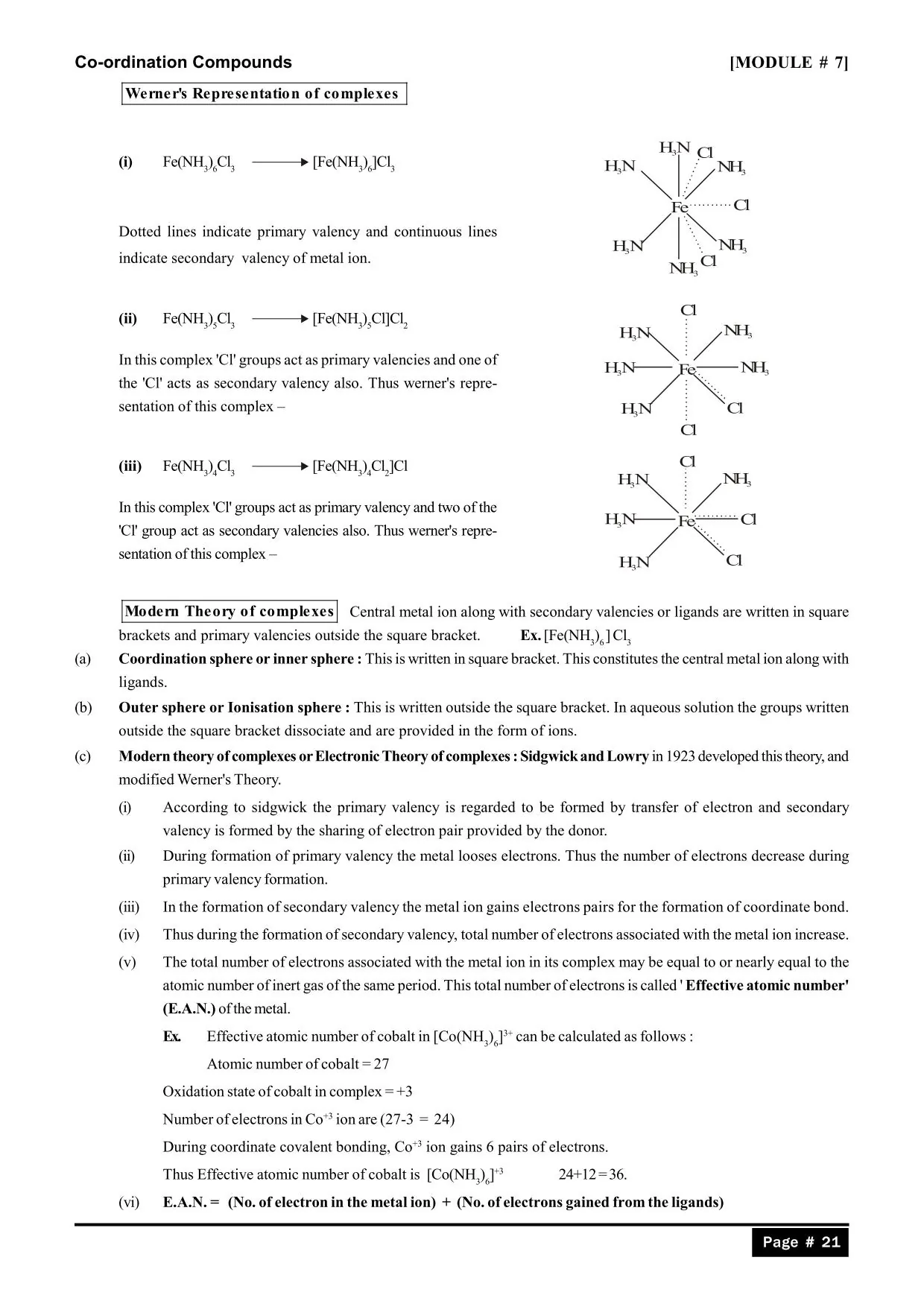
Example: [Co(NH₃)₆]Cl₃
- Central metal: Co
- Primary valency: 3 (satisfied by 3 Cl⁻ ions)
- Secondary valency / Coordination number: 6 (satisfied by 6 NH₃ molecules)
- Geometry: Octahedral
Werner proved his theory by studying ionisation in solution. [Co(NH₃)₆]Cl₃ gives 4 ions in solution (1 complex cation + 3 Cl⁻), while [Co(NH₃)₄Cl₂]Cl gives only 2 ions — confirming which Cl⁻ ions are inside vs outside the coordination sphere.
Key Terminology: Ligands, Central Metal, Coordination Number
Central Metal Atom / Ion
The metal atom or ion at the centre of a complex that accepts electron pairs from ligands. Examples: Fe²⁺, Co³⁺, Pt²⁺, Cu²⁺.
Ligands
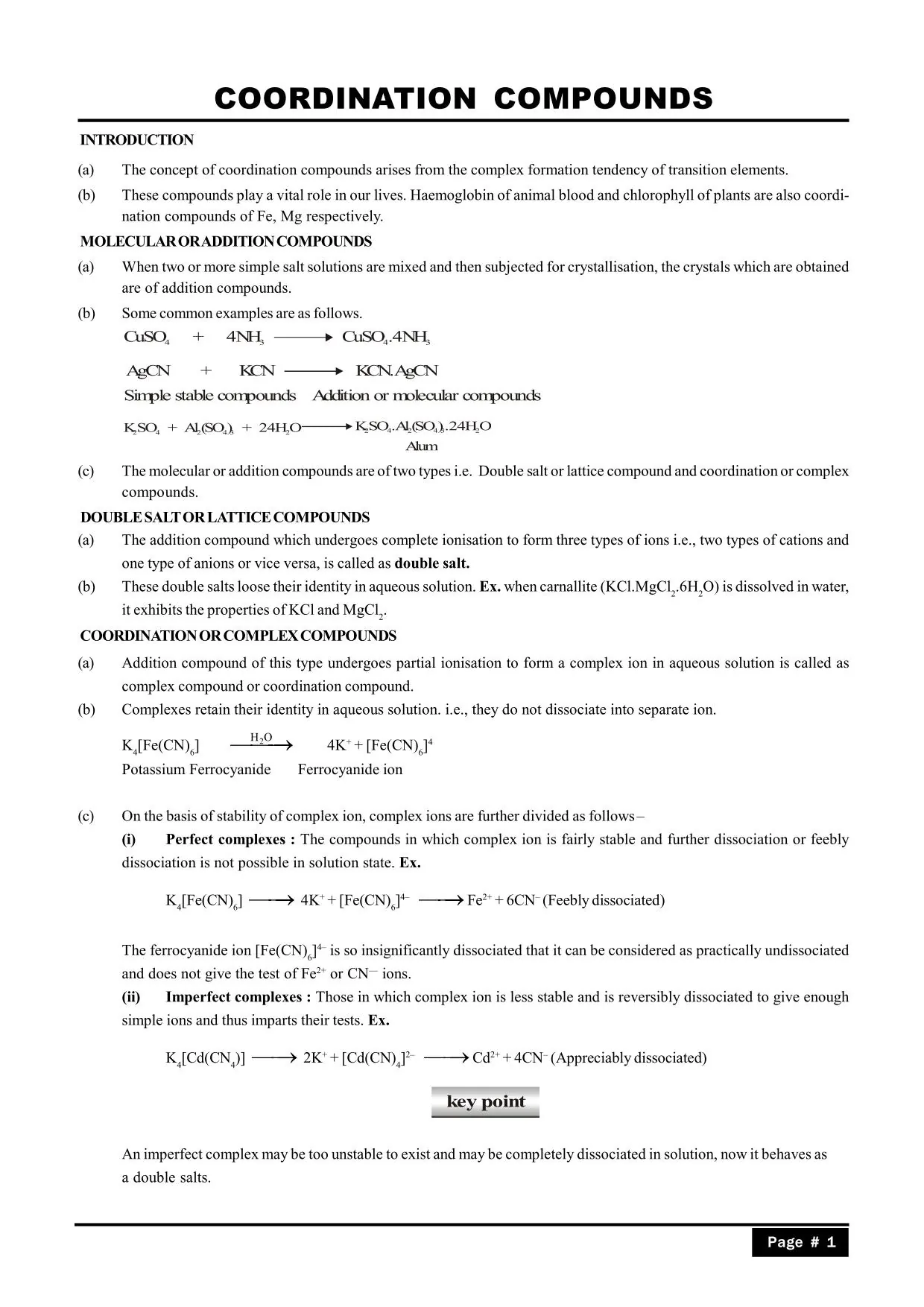
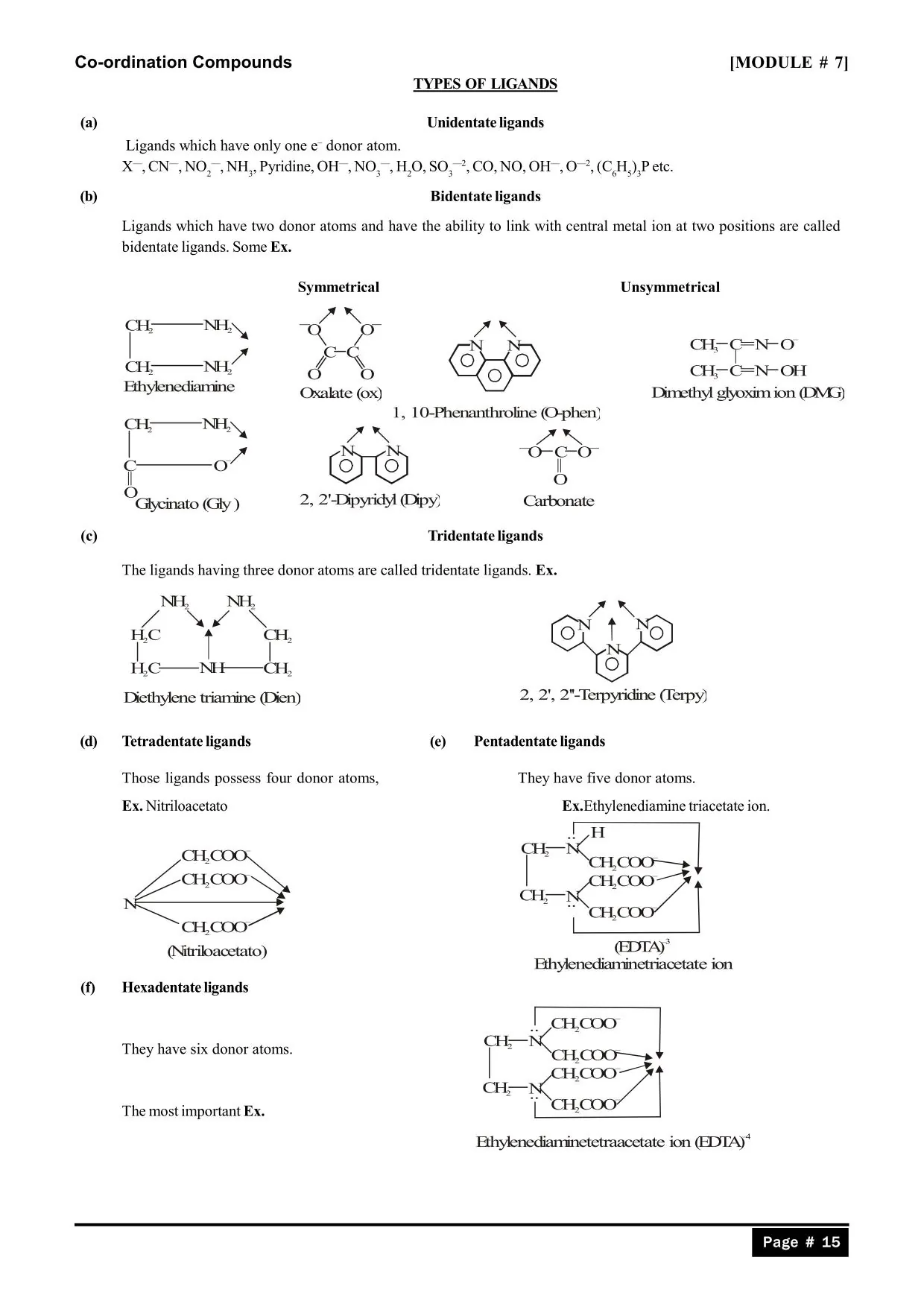
Ligands are ions or molecules that donate one or more lone pairs of electrons to the central metal.
| Ligand Type | Donor Atoms | Examples |
|---|---|---|
| Monodentate | 1 | Cl⁻, NH₃, H₂O, CN⁻, CO |
| Bidentate | 2 | en (ethylenediamine), C₂O₄²⁻ (oxalate) |
| Tridentate | 3 | dien (diethylenetriamine) |
| Tetradentate | 4 | trien |
| Hexadentate | 6 | EDTA (ethylenediaminetetraacetate) |
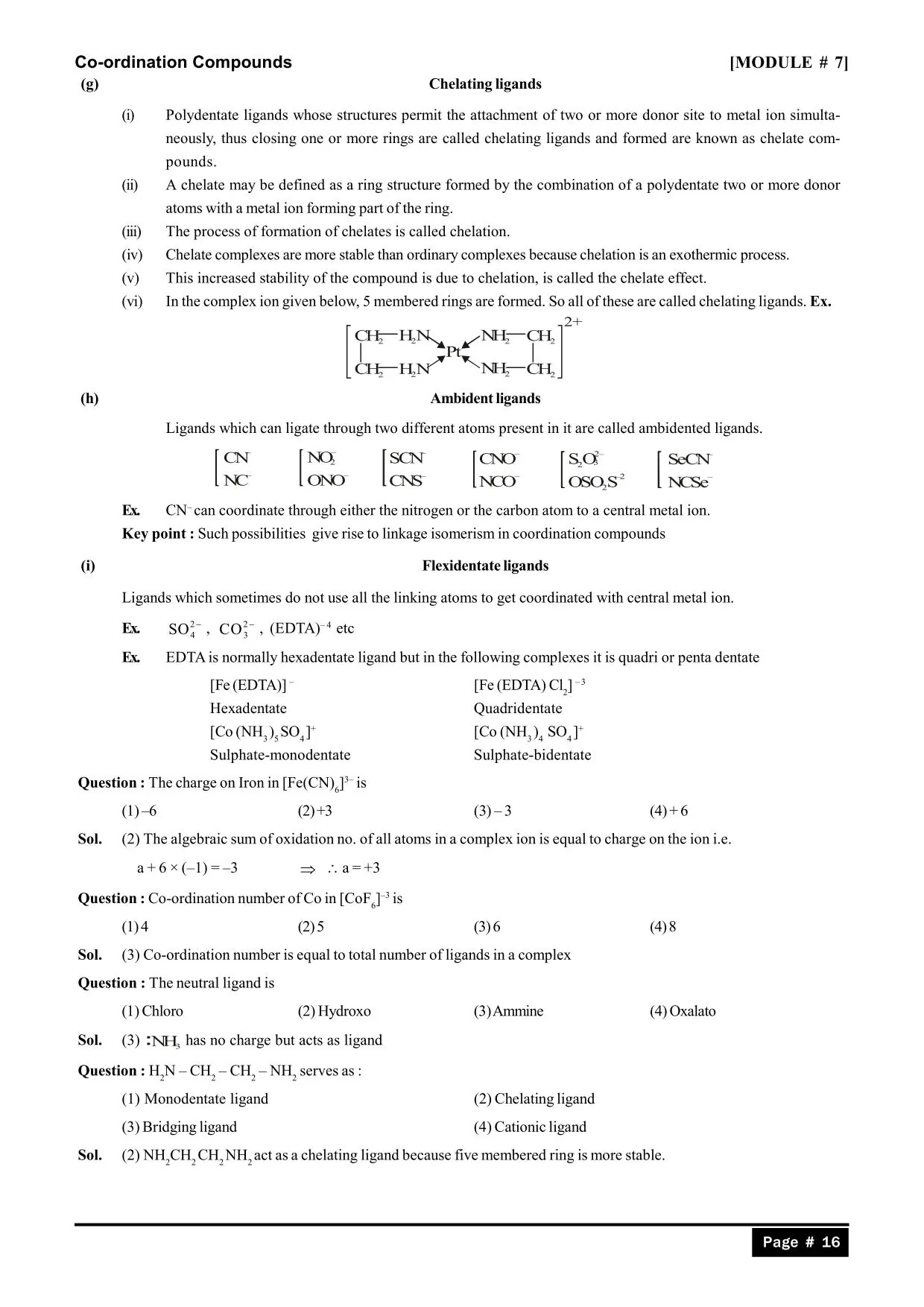
| Ambidentate | 1 (but two possible donor atoms) | SCN⁻ (via S or N), NO₂⁻ (via N or O) |
Chelate complexes are formed when bidentate or polydentate ligands bind to the same metal atom, forming a ring. They are more stable than non-chelate complexes (chelate effect).
Coordination Number
The total number of coordinate bonds formed between the central metal and the ligands. Common coordination numbers: 2, 4, 6.
- CN = 2 → Linear (e.g., [Ag(NH₃)₂]⁺)
- CN = 4 → Tetrahedral or Square Planar
- CN = 6 → Octahedral (most common)
IUPAC Nomenclature of Coordination Compounds
How to Name a Coordination Compound — 6-Step Rule
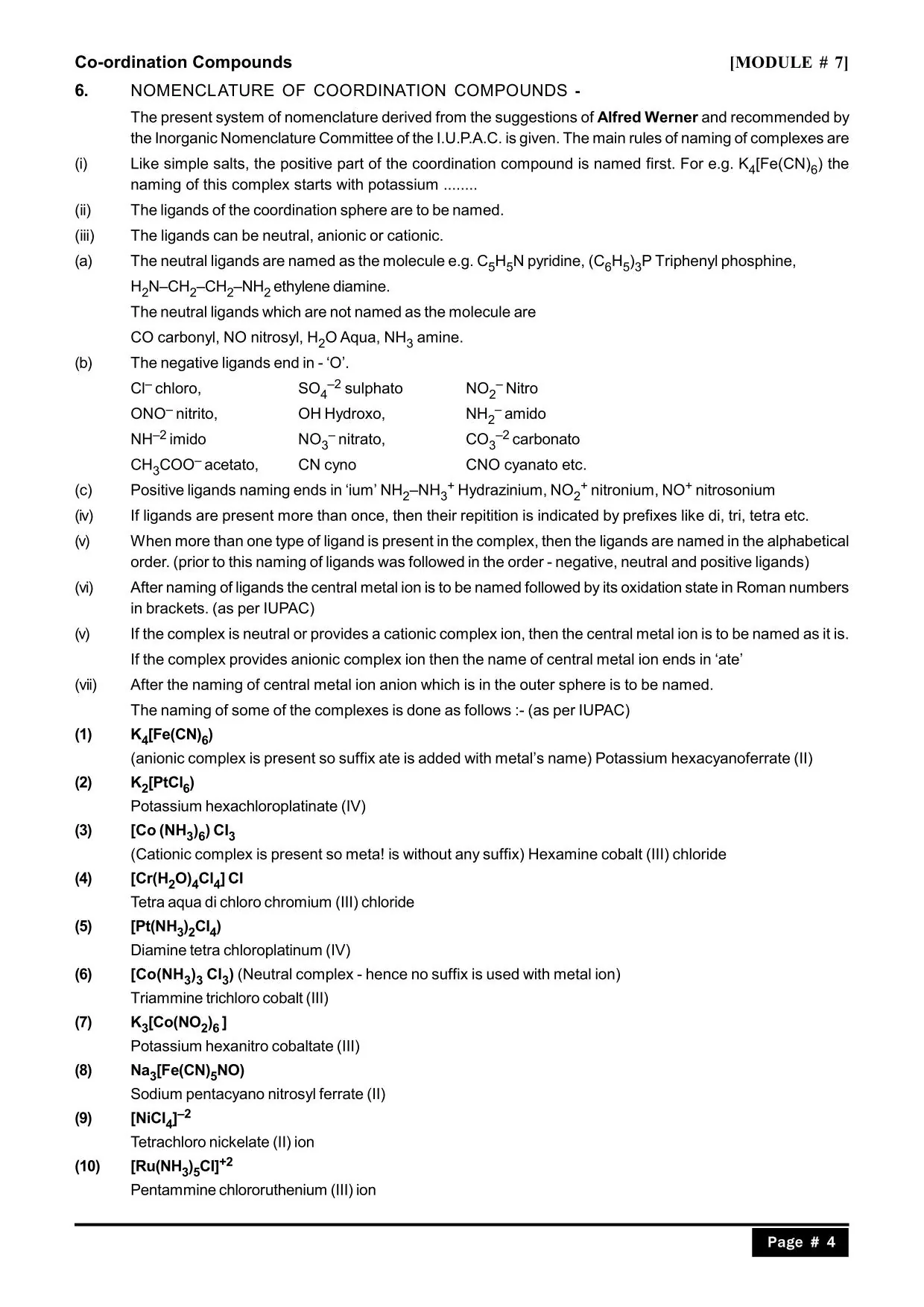
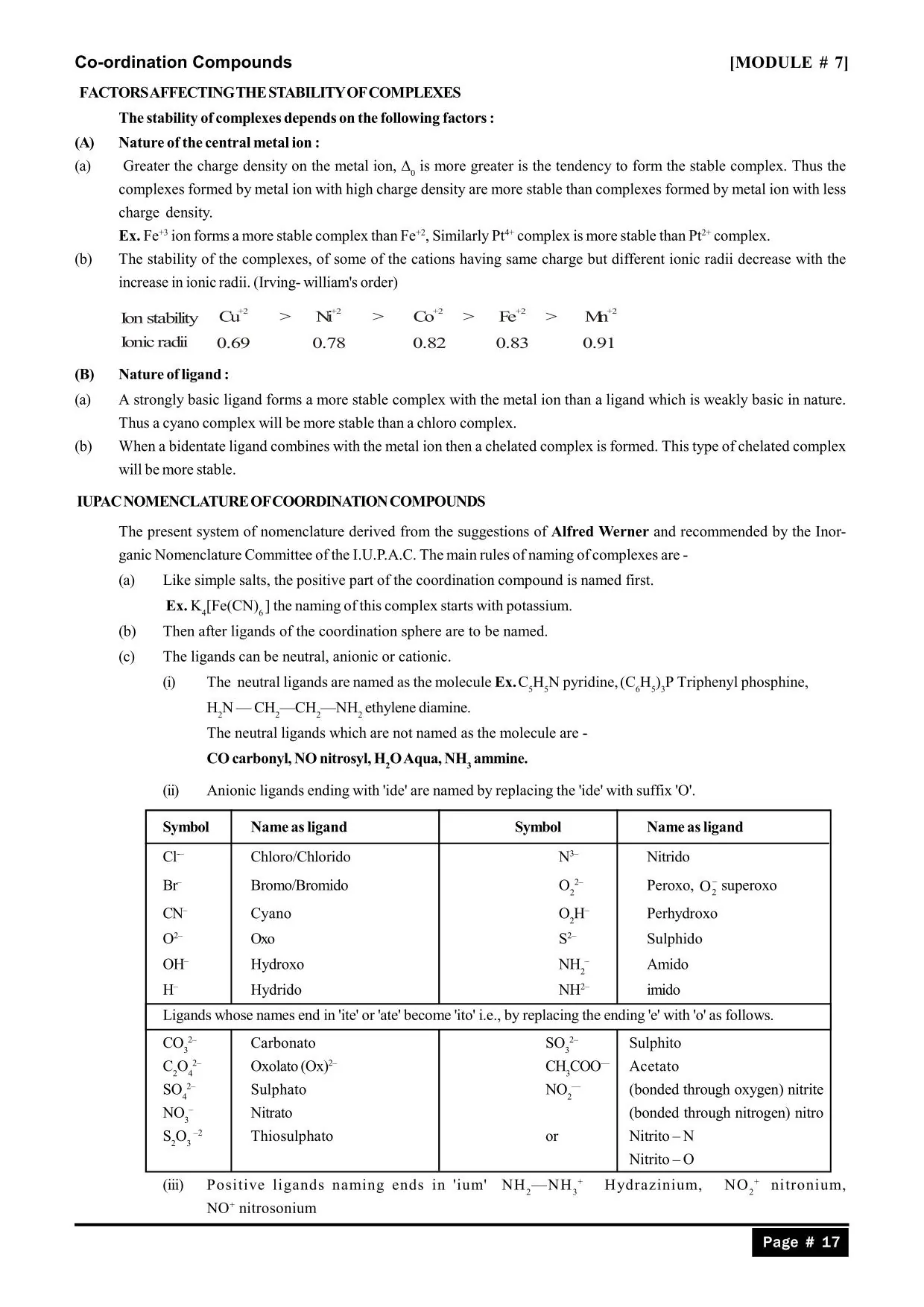
- Name the cation first, then the anion (same as ionic compounds)
- Within the complex ion: name ligands alphabetically before the central metal
- Anionic ligands end in -o (e.g., Cl⁻ = chlorido, CN⁻ = cyanido, OH⁻ = hydroxido)
- Neutral ligands use their molecule name (exceptions: H₂O = aqua, NH₃ = ammine, CO = carbonyl, NO = nitrosyl)
- Number of ligands shown by Greek prefixes: di, tri, tetra, penta, hexa (use bis, tris, tetrakis for complex ligands)
- Oxidation state of metal shown in Roman numerals in parentheses immediately after the metal name
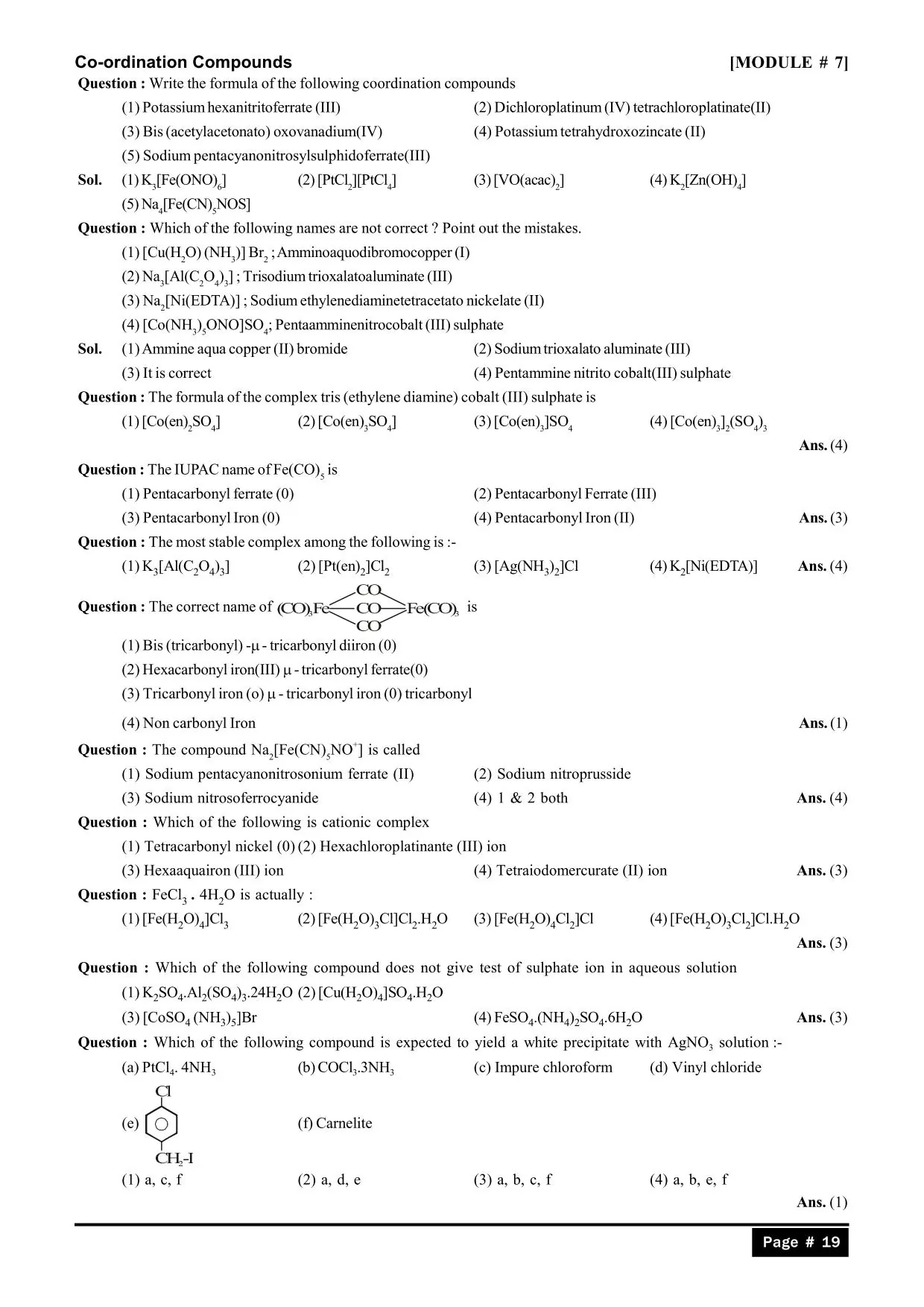
Worked Examples
| Formula | IUPAC Name |
|---|---|
| [Co(NH₃)₆]Cl₃ | Hexaamminecobalt(III) chloride |
| K₄[Fe(CN)₆] | Potassium hexacyanidoferrate(II) |
| [Pt(NH₃)₂Cl₂] | Diamminedichloridoplatinum(II) |
| [CoCl₂(en)₂]Cl | Dichloridodi(ethylenediamine)cobalt(III) chloride |
| [Cr(H₂O)₄Cl₂]Cl | Tetraaquadichloridochromium(III) chloride |
💡 Expert Tip by eSaral Chemistry Faculty (IITian, Kota): "In JEE and NEET, IUPAC nomenclature questions give you the formula and ask for the name — or give you the name and ask for the formula. Practise both directions. The most common error is alphabetical order of ligands (en comes before aqua, but ammine comes before chlorido). Always list ligands A–Z."
Isomerism in Coordination Compounds
Coordination compounds show two main types of isomerism — structural and stereoisomerism.
Structural Isomerism
| Type | Description | Example |
|---|---|---|
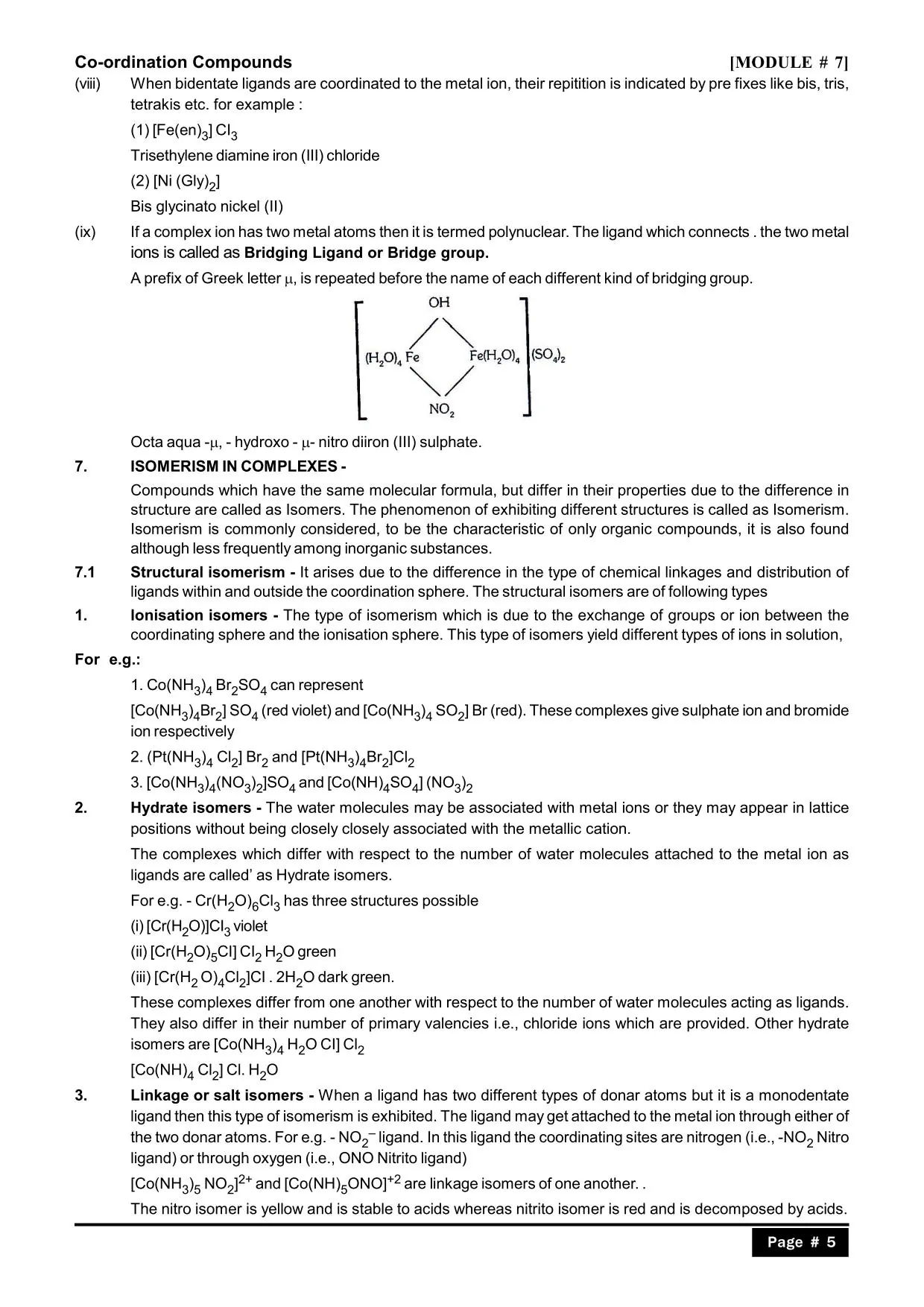
| Ionisation isomerism | Different ions inside vs outside coordination sphere | [Co(NH₃)₅Br]SO₄ vs [Co(NH₃)₅SO₄]Br |
| Hydrate (solvate) isomerism | Water inside vs outside coordination sphere | [Cr(H₂O)₆]Cl₃ vs [Cr(H₂O)₅Cl]Cl₂·H₂O |
| Linkage isomerism | Ambidentate ligand binds through different atoms | [Co(NH₃)₅NO₂]Cl₂ vs [Co(NH₃)₅ONO]Cl₂ |
| Coordination isomerism | Exchange of ligands between cation and anion complexes | [Co(NH₃)₆][Cr(CN)₆] vs [Cr(NH₃)₆][Co(CN)₆] |
Stereoisomerism
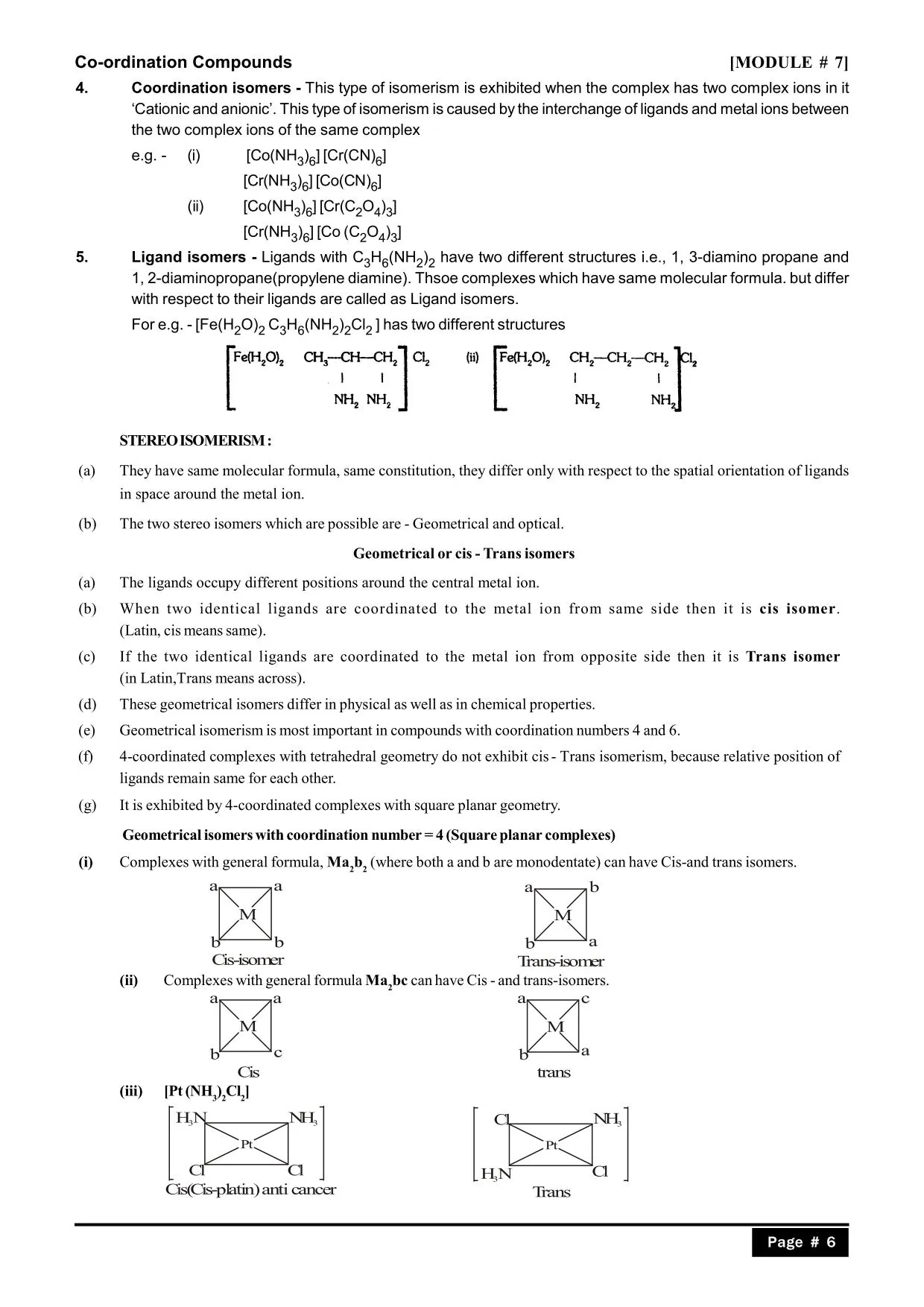
Geometrical (cis-trans) isomerism:
- Square planar MA₂B₂ type: cis (same groups adjacent) vs trans (same groups opposite)
- Octahedral MA₄B₂ type: cis (B groups at 90°) vs trans (B groups at 180°)
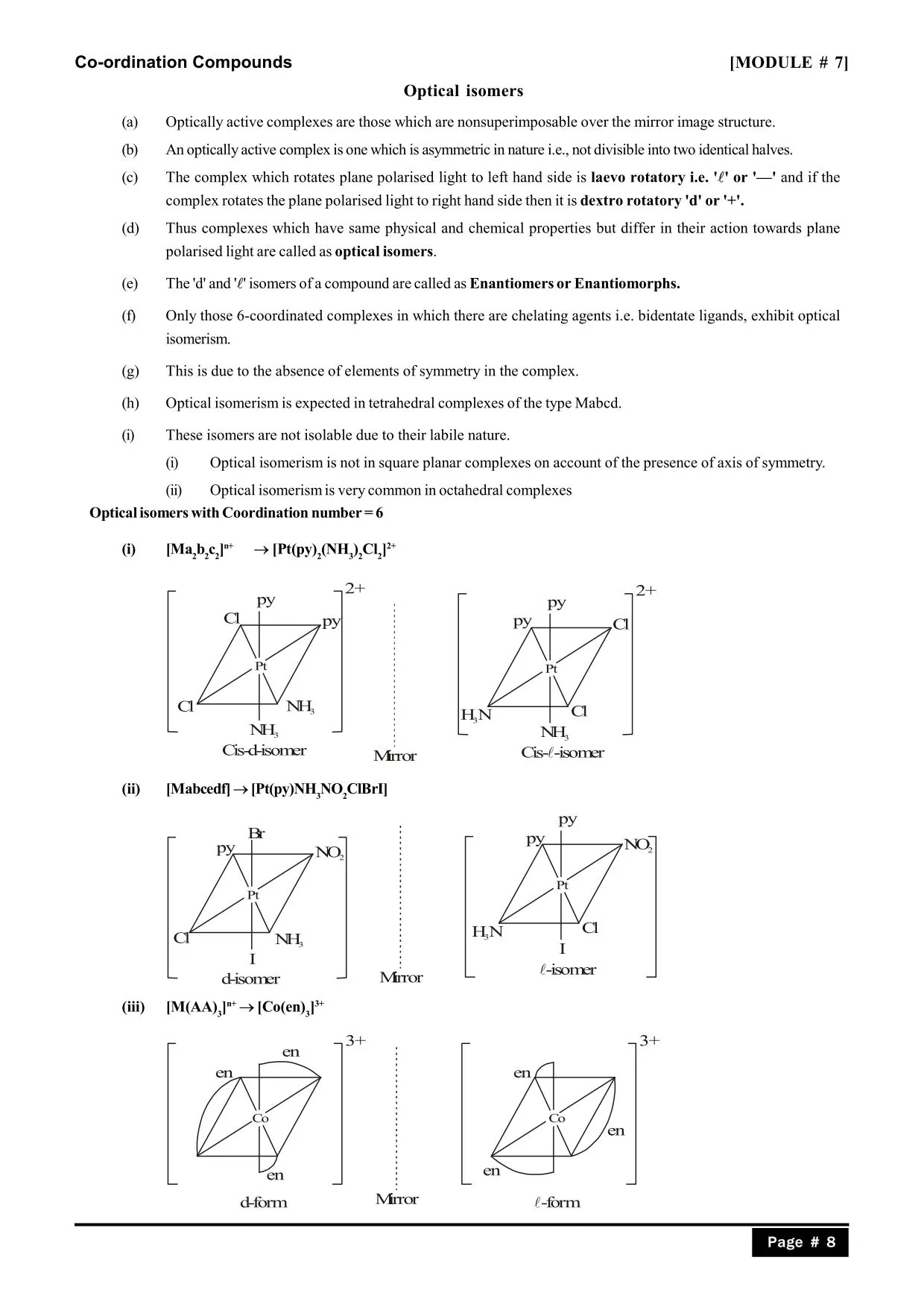
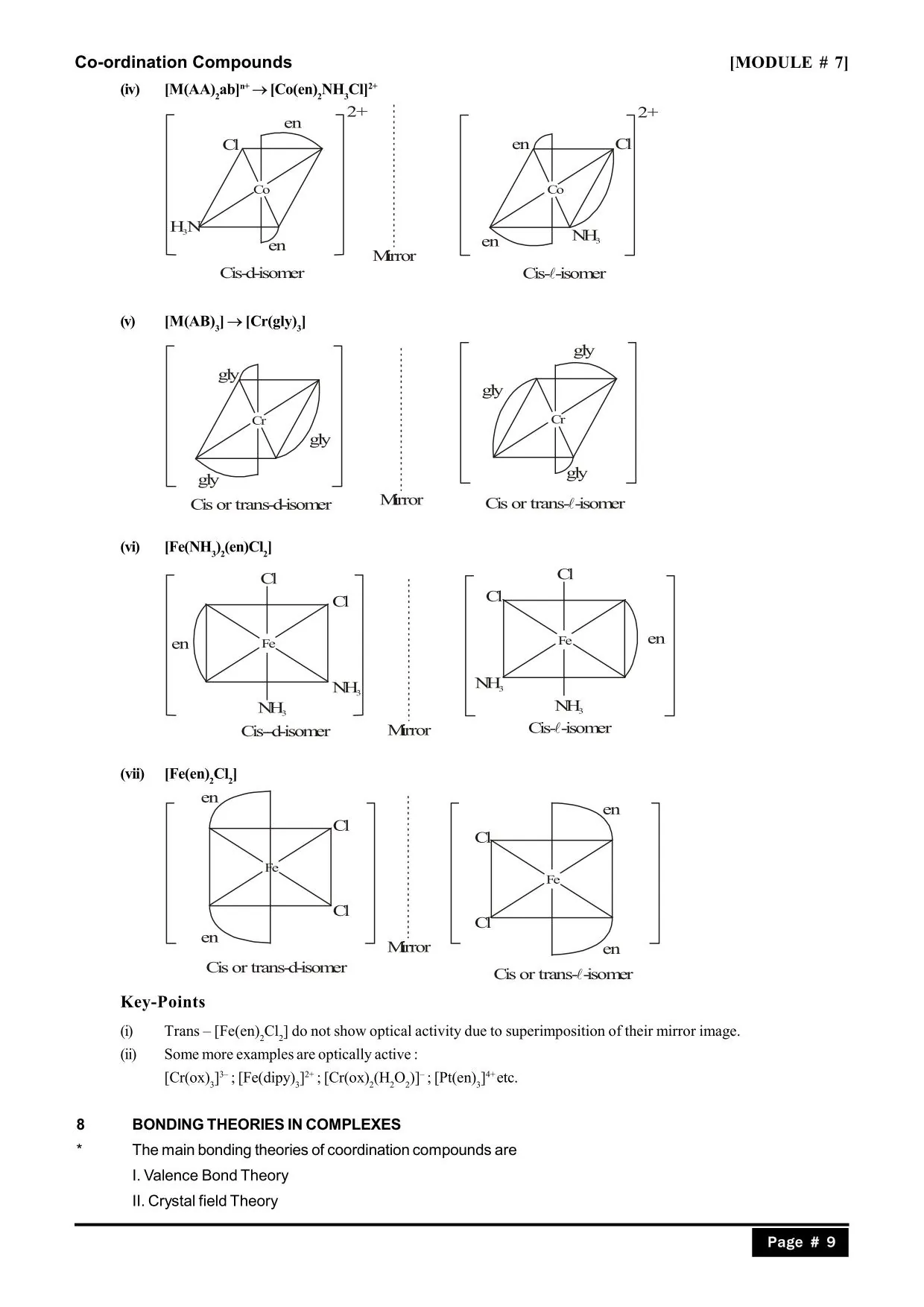
Optical isomerism:
- Complexes with no plane of symmetry are optically active
- [Co(en)₃]³⁺ shows optical isomerism (d and l forms)
- Cis-[CoCl₂(en)₂]⁺ shows optical isomerism; trans form does not
Bonding in Coordination Compounds: VBT and CFT
Valence Bond Theory (VBT)
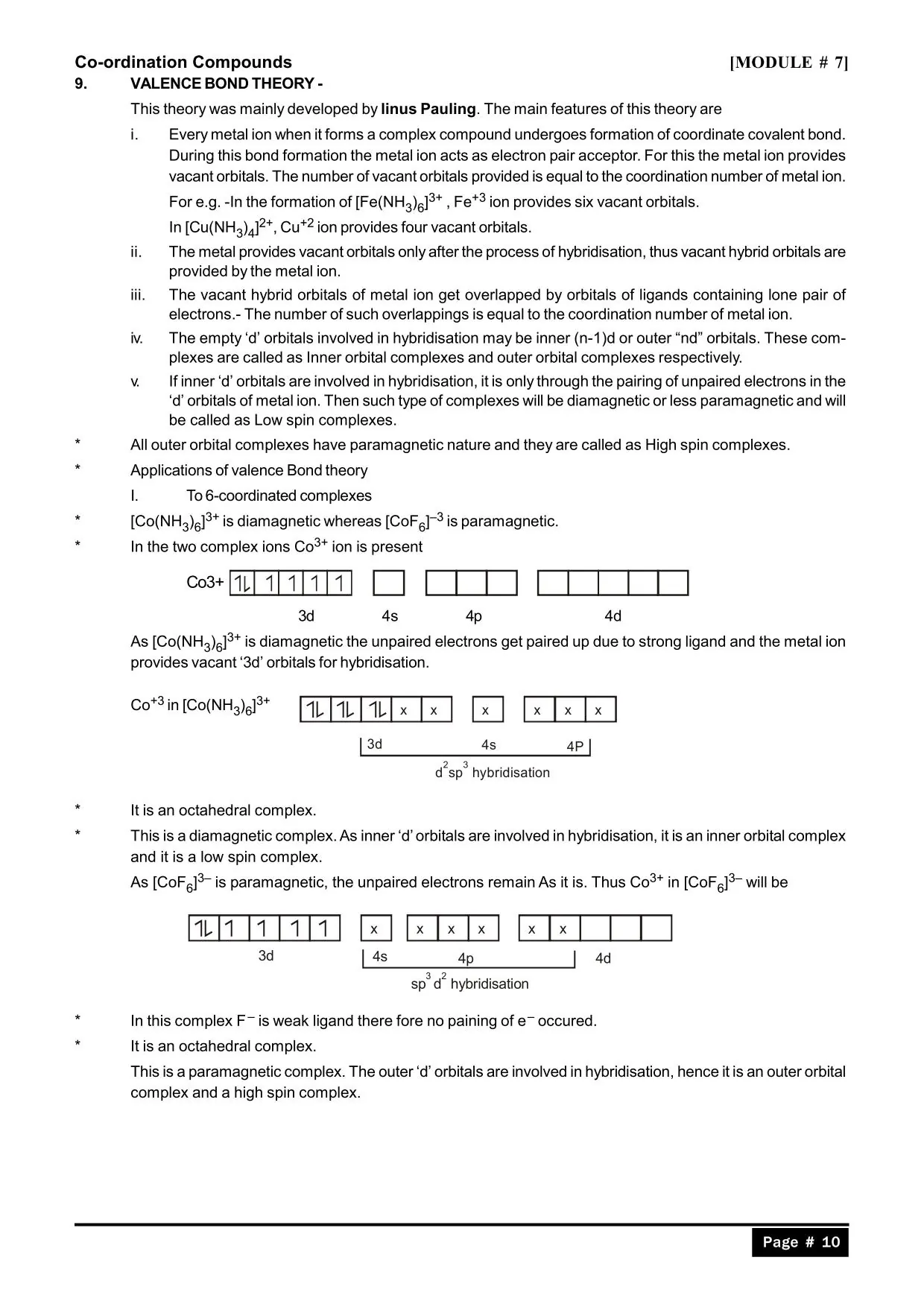
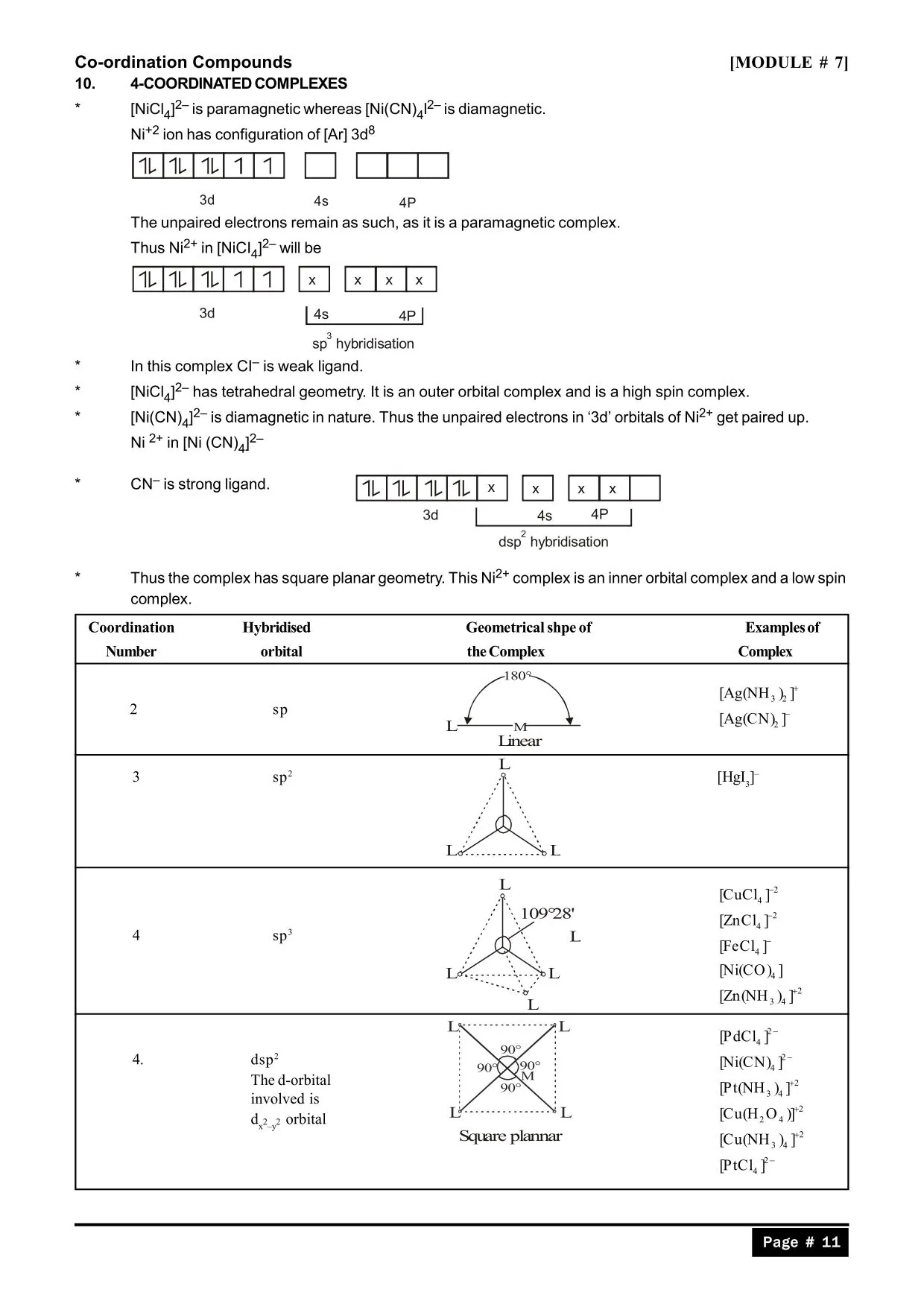
VBT explains the geometry and magnetic properties of complexes in terms of hybridisation of the central metal's atomic orbitals.
| Coordination Number | Hybridisation | Geometry | Example |
|---|---|---|---|
| 2 | sp | Linear | [Ag(NH₃)₂]⁺ |
| 4 | sp³ | Tetrahedral | [NiCl₄]²⁻ |
| 4 | dsp² | Square Planar | [Ni(CN)₄]²⁻ |
| 6 | sp³d² | Octahedral (outer orbital) | [CoF₆]³⁻ |
| 6 | d²sp³ | Octahedral (inner orbital) | [Co(NH₃)₆]³⁺ |
Outer orbital complexes (sp³d² hybridisation) use 4s, 4p, and 4d orbitals → high spin, paramagnetic.
Inner orbital complexes (d²sp³ hybridisation) use 3d, 4s, and 4p orbitals → low spin, often diamagnetic.
Crystal Field Theory (CFT)
CFT treats ligands as point charges and explains d-orbital splitting when ligands approach the metal.
In an octahedral field: d orbitals split into two sets:
- t₂g (d_xy, d_xz, d_yz) — lower energy
- e_g (d_z², d_x²-y²) — higher energy
- Energy gap = Δ_o (crystal field splitting energy)
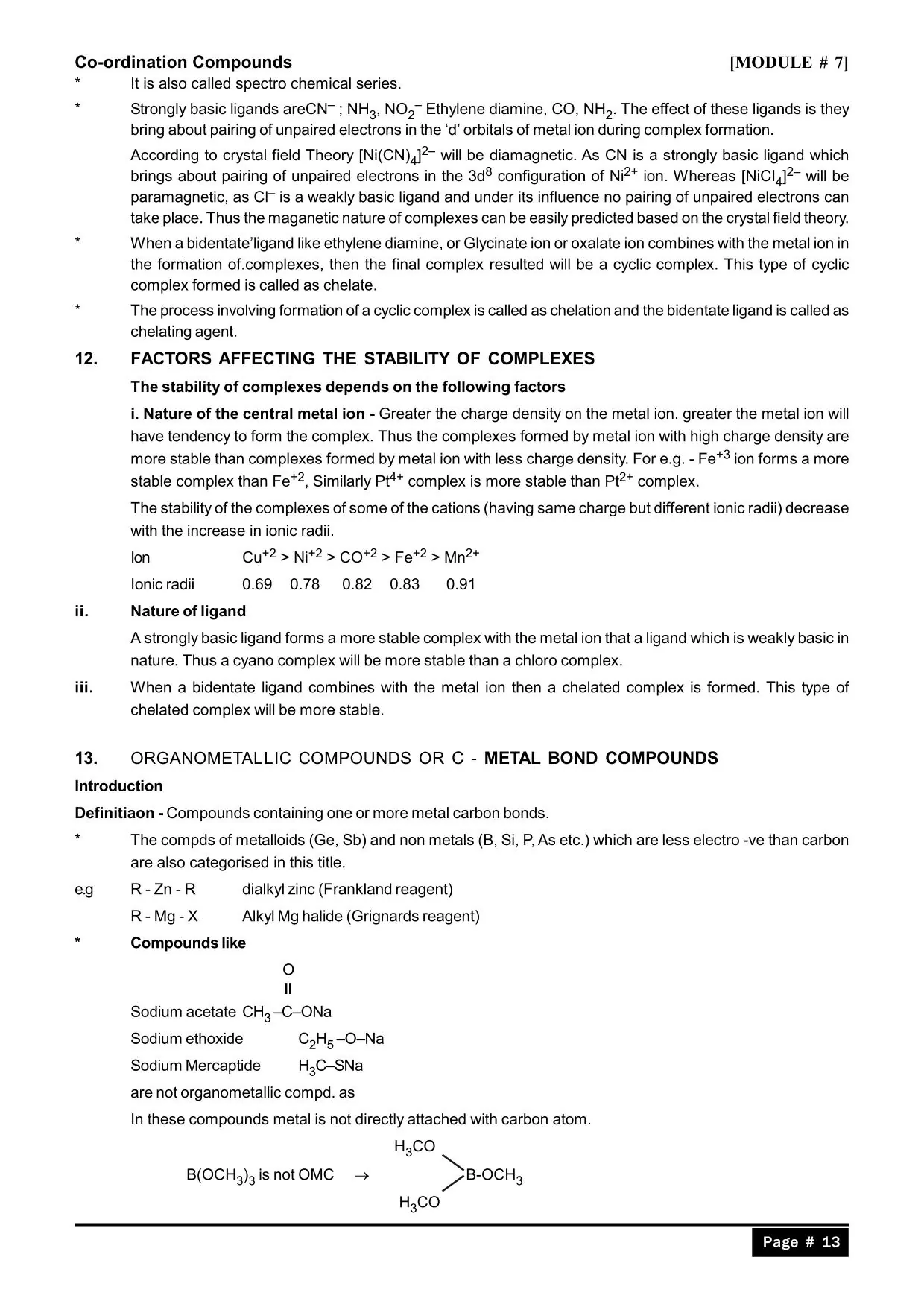
Strong field ligands (large Δ_o) → low spin complexes: CO > CN⁻ > NO₂⁻ > en > NH₃
Weak field ligands (small Δ_o) → high spin complexes: I⁻ < Br⁻ < Cl⁻ < F⁻ < OH⁻ < H₂O
Spectrochemical Series (partial, weak to strong): I⁻ < Br⁻ < Cl⁻ < F⁻ < OH⁻ < H₂O < NH₃ < en < CN⁻ < CO
In a tetrahedral field: Splitting is 4/9 of Δ_o (i.e., Δ_t = 4/9 Δ_o) — always weaker → tetrahedral complexes are almost always high spin.
Colour, Magnetic Properties, and Stability of Complexes
Why Are Coordination Compounds Coloured?
Colour arises from d–d transitions: electrons absorb visible light to jump from t₂g to e_g orbitals. The colour observed is the complementary colour of the light absorbed.
- [Ti(H₂O)₆]³⁺ absorbs green light → appears violet/purple
- Complexes with d⁰ (like Sc³⁺) or d¹⁰ (like Zn²⁺) have no d–d transitions → are colourless
Magnetic Properties
- Paramagnetic: Contains unpaired electrons → attracted by a magnetic field
- Diamagnetic: All electrons paired → repelled by a magnetic field
Magnetic moment formula:
μ=n(n+2) BM\mu = \sqrt{n(n+2)} \text{ BM}
Where n = number of unpaired electrons. (BM = Bohr Magneton)
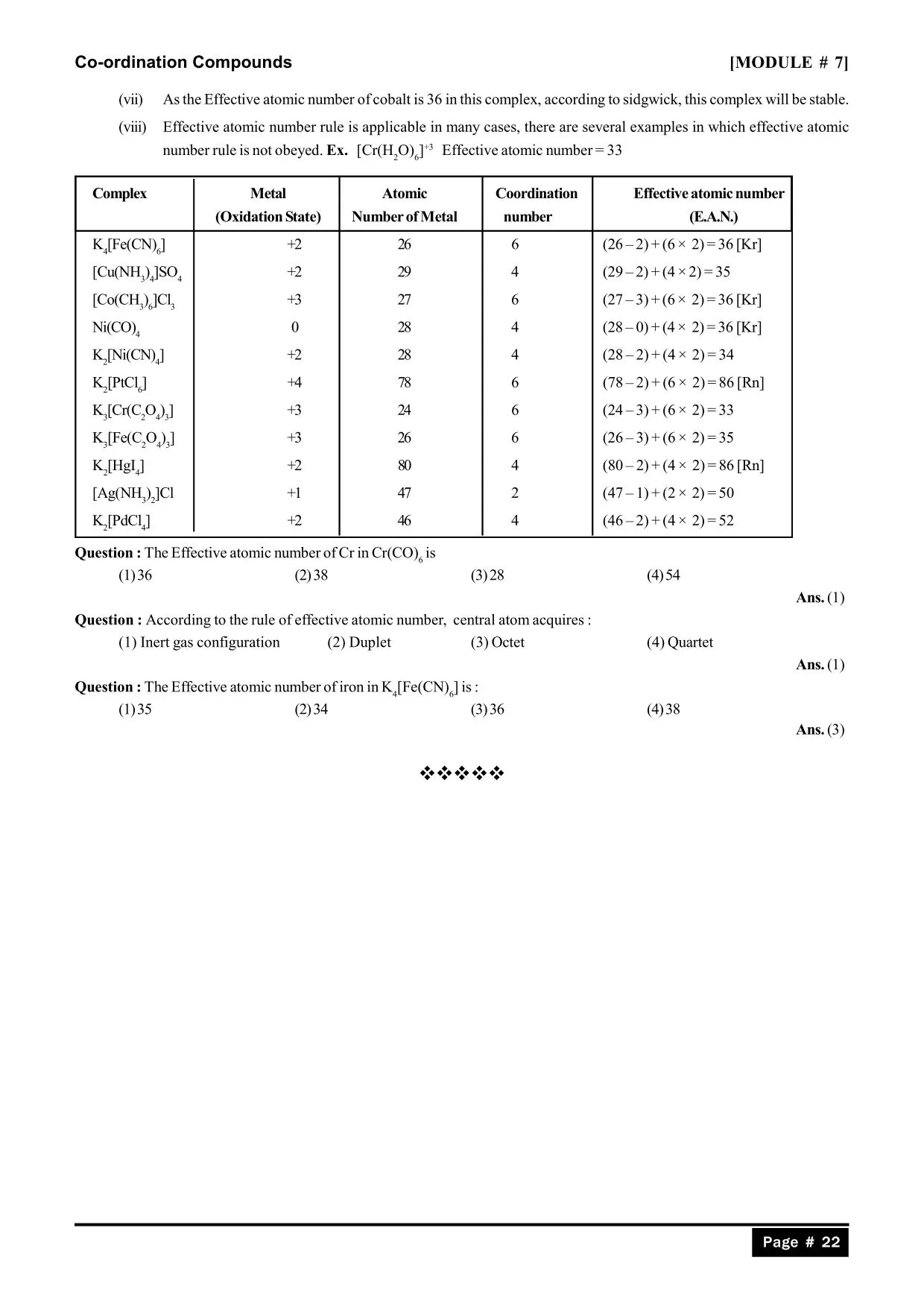
Stability — EAN Rule (Effective Atomic Number)
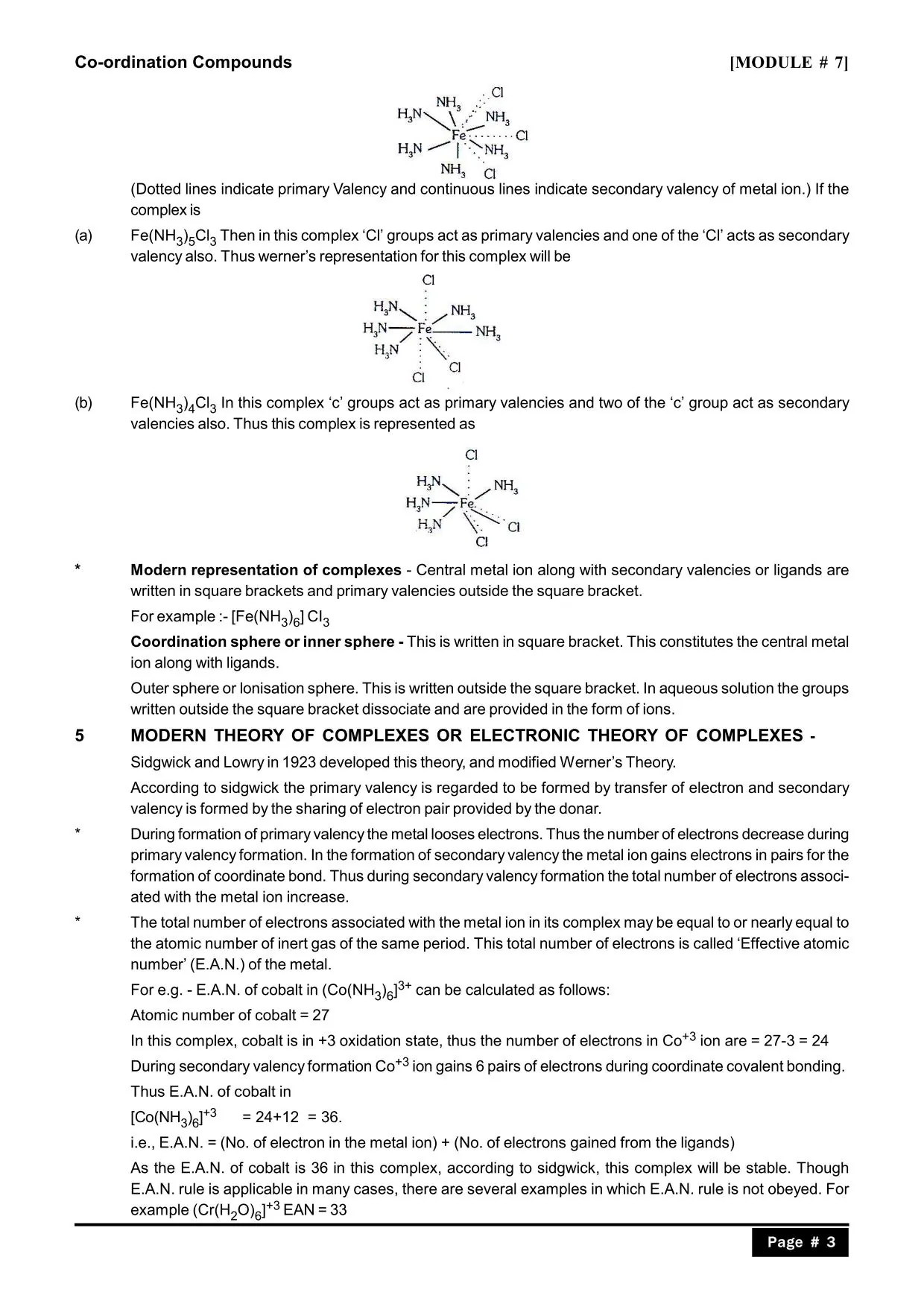
Many stable complexes obey the 18-electron rule (EAN rule): the total electron count around the metal equals 18 (noble gas configuration).
Biological and Industrial Importance
Biological Importance
| Complex | Metal | Function |
|---|---|---|
| Haemoglobin | Fe²⁺ | Oxygen transport in blood |
| Chlorophyll | Mg²⁺ | Photosynthesis |
| Vitamin B₁₂ (Cyanocobalamin) | Co³⁺ | Red blood cell formation |
| Carbonic anhydrase enzyme | Zn²⁺ | CO₂ transport |
Industrial and Medical Applications
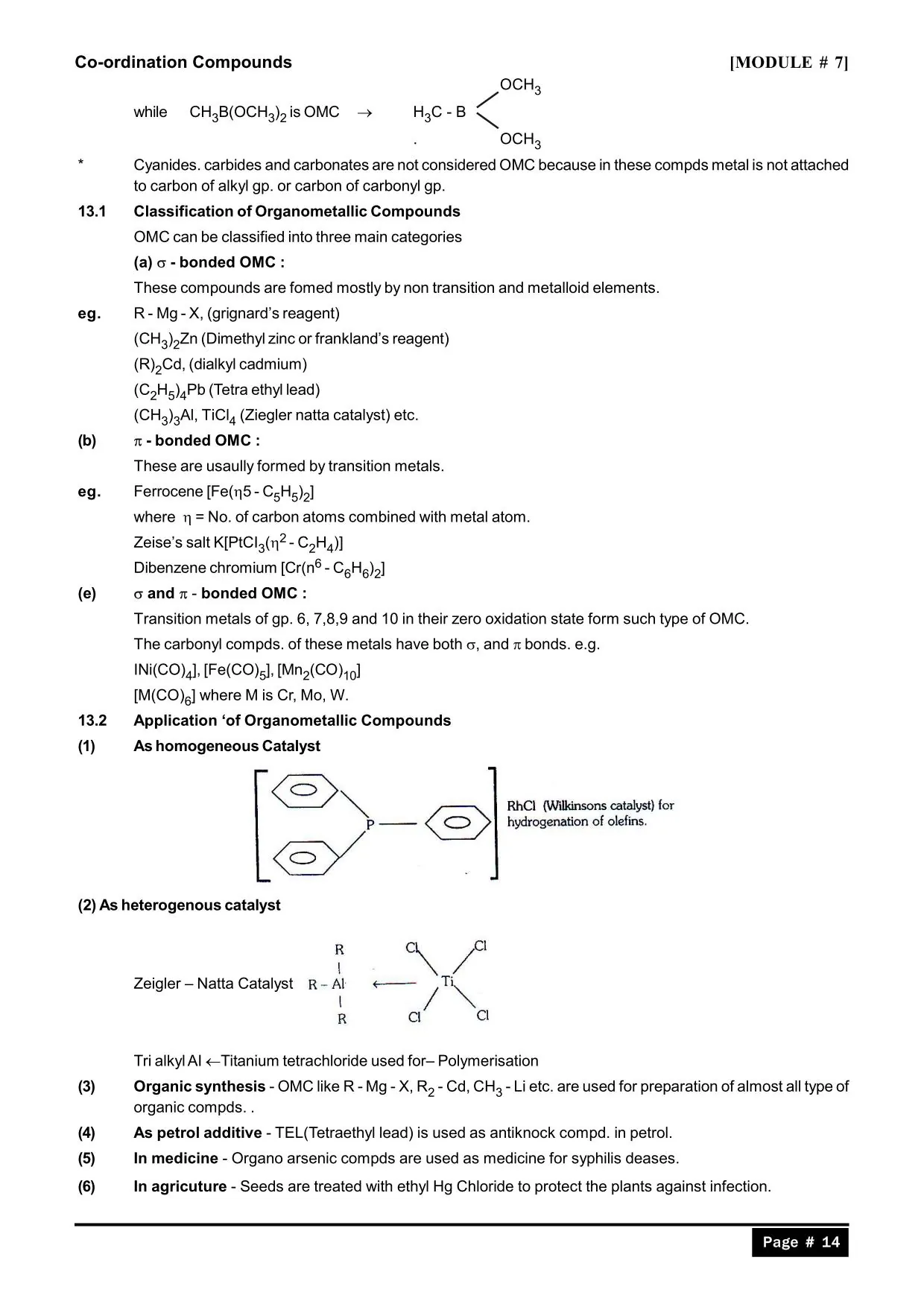
- Wilkinson's catalyst [RhCl(PPh₃)₃] — used in hydrogenation reactions
- Cisplatin [Pt(NH₃)₂Cl₂] — anticancer drug (cis isomer is active; trans isomer is inactive)
- EDTA complexes — used in water treatment and as chelating agents in medicine
- Cyanide complexes — used in silver and gold extraction (hydrometallurgy)
- Photographic processing — Na₂S₂O₃ dissolves AgBr by forming a stable complex
Important Facts
| Concept | Key Point |
|---|---|
| Werner's primary valency | = oxidation state of metal |
| Werner's secondary valency | = coordination number |
| Chelate effect | Polydentate ligands form more stable complexes |
| Strong field ligands | Low spin, low Δ_o → diamagnetic tendencies |
| Weak field ligands | High spin, high Δ_o → paramagnetic tendencies |
| Tetrahedral vs octahedral CFT | Δ_t = 4/9 Δ_o |
| Cisplatin | cis-[Pt(NH₃)₂Cl₂] → anticancer; trans isomer inactive |
| Haemoglobin | Fe²⁺ coordination complex; becomes methaemoglobin with CO |
| Colour rule | d⁰ and d¹⁰ complexes are colourless |
| Magnetic moment | μ = √n(n+2) BM |
📥 Download the Free eSaral App for complete Class 12 Chemistry Notes, video lectures by IITian faculty, and JEE/NEET practice questions: 👉 India's Best Exam Preparation for Class 12 — Download Now
Frequently Asked Questions
Find answers to common questions.
What are the most important topics in Coordination Compounds for JEE Main?
The most important topics for JEE Main are IUPAC nomenclature, isomerism (especially geometrical and optical), Crystal Field Theory (CFT splitting, spectrochemical series), hybridisation and geometry via VBT, and the EAN rule. Nomenclature and isomerism together typically account for 60–70% of JEE Main questions from this chapter.
How many questions come from Coordination Compounds in NEET every year?
Coordination Compounds typically contributes 2 questions in NEET UG every year, worth 8 marks. NEET focuses on IUPAC nomenclature, identification of complex types, magnetic properties, and the biological significance of coordination compounds like haemoglobin, chlorophyll, and Vitamin B₁₂.
What is the difference between inner orbital and outer orbital complexes?
Inner orbital complexes use d²sp³ hybridisation (inner 3d orbitals involved) and are low spin, often diamagnetic — formed with strong field ligands. Outer orbital complexes use sp³d² hybridisation (outer 4d orbitals involved) and are high spin, paramagnetic — formed with weak field ligands. Example: [Co(NH₃)₆]³⁺ is inner orbital; [CoF₆]³⁻ is outer orbital.
What is the spectrochemical series and why does it matter for JEE?
The spectrochemical series ranks ligands from weakest to strongest crystal field: I⁻ < Br⁻ < Cl⁻ < F⁻ < OH⁻ < H₂O < NH₃ < en < CN⁻ < CO. Strong field ligands cause large d-orbital splitting (large Δ_o), leading to low-spin complexes with fewer unpaired electrons. JEE frequently asks whether a given complex is high-spin or low-spin and how many unpaired electrons it has.
Why are d⁰ and d¹⁰ metal complexes colourless?
\
Colour in coordination compounds arises from d–d electronic transitions where an electron absorbs visible light and jumps from a lower to a higher d orbital. In d⁰ complexes there are no d electrons to excite, and in d¹⁰ complexes all d orbitals are full with no vacancy to accept an electron. So no d–d transition is possible, and the complex absorbs no visible light — it appears colourless.