Danish’s eSaral JEE Success Story: From 97 to 98.6 Percentile and IIT Kharagpur
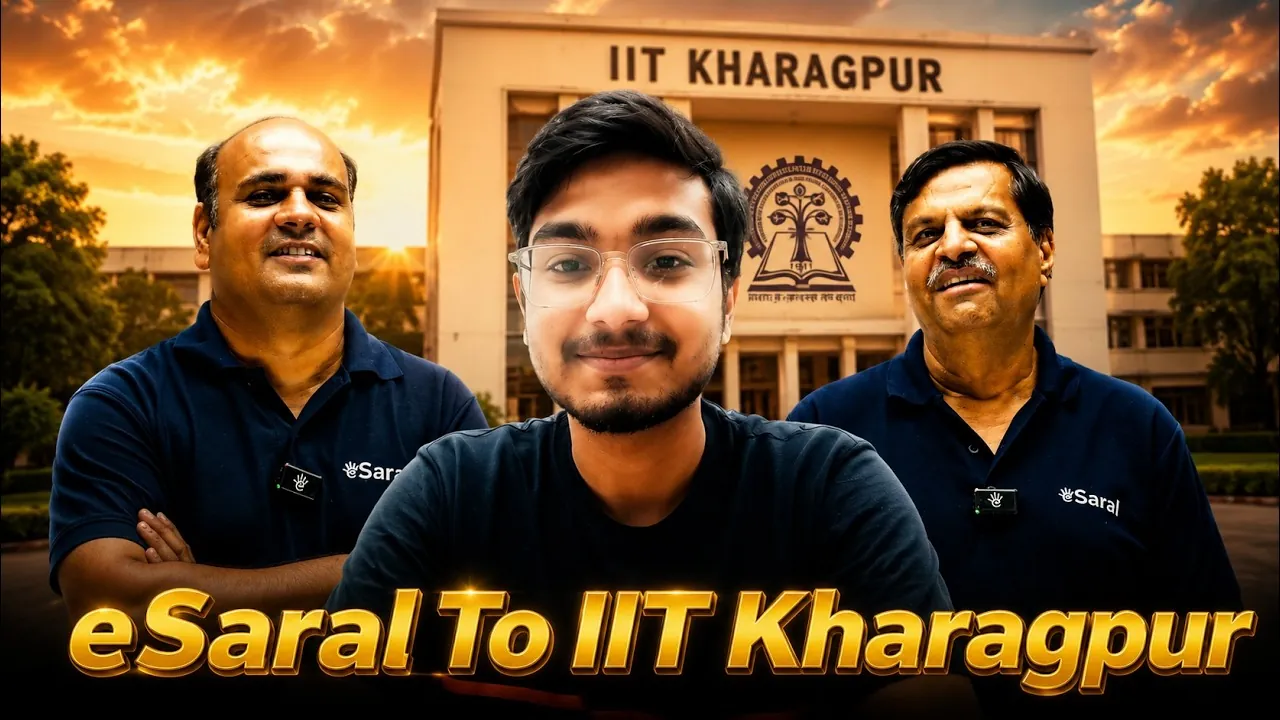
Table of Contents
- How Can Class 12 Students Prepare for JEE Without Losing Board Marks?
- What Are the Three Most Important Things to Do Before JEE Advanced?
- How Should Preparation Change After the JEE Main April Attempt?
- Why Does Question Practice Become More Important Near JEE Advanced?
- Can Students Improve Significantly Between the Two JEE Main Attempts?
- How Can Students Manage Self-Study After Long Coaching Hours?
- Are Mock Tests Necessary Even When the Syllabus Is Not Perfect?
- When Should Students Use Extra Online Resources Along With Offline Coaching?
- How Can Mentorship Help During the Final JEE Advanced Phase?
- What Is More Important for IIT Selection: Study Hours or Study Quality?
- What Can Future IIT Aspirants Learn From This Journey?

eSaral › Success stories › Danish’s eSaral JEE Success Story: From 97 to 98.6 Percentile and IIT Kharagpur

Cracking JEE Advanced with Class 12 means preparing for more than one examination at the same time.
Danish had to manage his school Boards, two JEE Main attempts and then JEE Advanced—all within the same academic year.
His January JEE Main result was 97 percentile.
In the April attempt, he improved to 98.6 percentile.
Alongside JEE, he secured 90% in his Class 12 Boards.
And finally, he achieved the result he had been working towards—IIT Kharagpur.
The transcript does not mention Danish’s exact JEE Advanced marks, rank or IIT Kharagpur branch. Those details should therefore not be added without separate verification.
What his interview does reveal clearly is the preparation process behind the result.
For Danish, three things mattered most:
Revision, understanding concepts in depth, and Advanced-level question practice.
▶ Watch the complete success-story interview: Hear Danish explain how he balanced JEE with Boards, what changed after JEE Main and how eSaral’s tests, chapter-wise support and mentorship helped during his Advanced preparation.
How Can Class 12 Students Prepare for JEE Without Losing Board Marks?
Boards and JEE often feel like two separate battles to Class 12 students.
Danish handled them by keeping JEE preparation as his main academic foundation.
Before individual Board papers, he focused more directly on the relevant Board theory for a short period. He said that before a paper he would use the preceding days to revise the required material, including quick online theory revision.
Because his concepts were already being prepared at JEE level, he felt Board preparation became manageable.
The outcome was 90% in Class 12 Boards while simultaneously preparing for IIT.
This does not mean every student should prepare for Boards only at the last moment.
The useful takeaway is different: strong conceptual preparation for Physics, Chemistry and Mathematics can reduce duplication between Board and JEE study.
Students should still identify early whether they need additional writing practice, derivations or Board-specific presentation.
What Are the Three Most Important Things to Do Before JEE Advanced?
When Danish was asked about the main reasons behind his performance, he did not give a complicated strategy.
He identified three areas.
1. Revise the syllabus properly
Studying a chapter once is not enough for JEE Advanced.
Concepts learned several months earlier need to become quickly retrievable during the examination.
2. Understand concepts in depth
Advanced questions may combine concepts rather than asking a familiar direct application.
Knowing only formulas can therefore become limiting.
3. Solve Advanced-level problems
Danish specifically emphasised higher-level question practice.
Once concepts are revised, students need questions that force them to think beyond straightforward Main patterns.
A practical way to start this phase is to solve JEE Advanced chapter-wise previous-year questions before moving to complete papers.
How Should Preparation Change After the JEE Main April Attempt?
The phase after JEE Main requires a mental reset.
Main is finished, but Advanced still demands significant preparation.
For Danish, the final two months became substantially more intensive.
He reported studying around 12–13 hours during the last couple of months, with the Advanced phase after Main going to roughly 13–14 hours on some days.
These numbers should not become a target for every aspirant.
What matters more is what those hours contained.
Danish focused on revision, deeper concepts and Advanced-level questions.
Students entering this stage can use complete JEE Advanced previous-year papers to shift gradually from chapter-level preparation to full-paper decision-making. eSaral’s current resource includes previous Advanced papers across recent years.
Why Does Question Practice Become More Important Near JEE Advanced?
Reading a solved problem can make a concept feel easy.
Attempting a new problem without hints reveals whether that understanding is genuine.
That difference becomes increasingly important in JEE Advanced.
Danish identified question practice—particularly Advanced-level practice—as one of the main pillars of his preparation.
Students should therefore avoid spending the entire final phase only revising notes.
A better cycle is:
Revise → Solve → Analyse → Revise Again
First recall the concept.
Then solve questions without looking at solutions.
Analyse why mistakes occurred.
Finally, return only to the concept that caused the error.
This makes revision active rather than repetitive.
Can Students Improve Significantly Between the Two JEE Main Attempts?
Danish’s own result shows that the second session can still matter.
His January percentile was 97.
His April percentile improved to 98.6.
At an already competitive percentile, improvement requires more than simply completing a few additional chapters.
Students need to identify where marks were lost in Session 1.
Was the problem accuracy?
Was one subject weaker?
Were questions being left because of poor time management?
Was revision incomplete?
After identifying those gaps, aspirants can use JEE Main previous-year papers to practise complete exam-style papers rather than preparing only chapter by chapter. eSaral’s current archive includes JEE Main papers through 2026.
How Can Students Manage Self-Study After Long Coaching Hours?
Danish’s routine is particularly relevant for students who already spend a large part of their day in coaching.
His offline coaching in Delhi could run roughly from 8:00 a.m. to 3:00 p.m.
After that, he still had homework, revision, tests and independent preparation to manage.
The interview highlights the amount of consistency required to continue working after long class hours.
Students in such a schedule should prioritise work rather than trying to do everything every evening.
Finish important homework first
Fresh class concepts should be reinforced before they become backlog.
Revise high-priority weak areas
Do not spend equal time on chapters that already feel comfortable.
Keep mock-test analysis pending for as little time as possible
Mistakes become less useful when analysed several weeks later.
The goal is not to create the longest timetable.
The goal is to protect the tasks that actually improve the final score.
Are Mock Tests Necessary Even When the Syllabus Is Not Perfect?
Danish said he attempted all the eSaral tests available to him during this phase.
This matters because students often skip mocks for one common reason:
“My syllabus is not fully ready yet.”
But waiting for perfect preparation can reduce real exam practice.
A mock test can still show:
- which completed chapters are genuinely strong,
- where accuracy breaks,
- whether time is being distributed correctly,
- which questions should have been skipped,
- and how well revision is working.
Students can use the eSaral JEE Test Series for structured Main and Advanced mock practice. The current series includes dedicated formats for both exams.
▶ See how Danish used the final JEE phase: Watch the full interview for his comments on attempting eSaral tests, managing long study days and strengthening Advanced-level preparation after Main.
When Should Students Use Extra Online Resources Along With Offline Coaching?
Danish already had offline coaching.
He did not join eSaral because every part of his previous preparation had failed.
Instead, he started using eSaral after JEE Main and opened chapter-wise resources particularly where he felt a problem or needed additional support.
This is an important way to use online learning.
Additional resources should solve an identified academic gap.
They should not create a second complete syllabus that competes with the first.
Students who need broader structured support can explore eSaral’s JEE Main and Advanced courses, while students with specific weak areas can combine targeted revision with PYQs and tests.
How Can Mentorship Help During the Final JEE Advanced Phase?
Danish also specifically appreciated eSaral’s mentorship programme.
The Main-to-Advanced window can become confusing because the student has very little time and too many possible resources.
Should another book be solved?
Should notes be revised?
Should another mock be attempted?
Which weak chapters deserve attention?
Mentorship can help bring structure to such decisions.
For Danish, eSaral was not only a source of chapter-wise content. Tests and mentor interaction were also part of the preparation he used after Main.
That combination gave him academic support during one of the shortest and most intense phases of the JEE journey.
What Is More Important for IIT Selection: Study Hours or Study Quality?
Danish’s final preparation did involve long hours.
But focusing only on the number would miss the useful part of his story.
Thirteen hours of random study is not automatically better than eight focused hours.
Aspirants should measure:
How many important questions were solved?
Which weak concepts were corrected?
Was yesterday’s test analysed?
Did revision actually improve recall?
Danish’s long hours were connected to a demanding phase immediately before Advanced.
Students should increase preparation intensity when required without turning sleep deprivation into a strategy.
Consistency across weeks matters more than one dramatic 16-hour study day.
What Can Future IIT Aspirants Learn From This Journey?
Danish’s journey brought together several demanding targets.
He was in Class 12.
He attended long offline classes.
He had Boards.
He had two JEE Main sessions.
Then came JEE Advanced.
His January JEE Main percentile of 97 increased to 98.6 in April.
He also scored 90% in Boards.
After Main, he used eSaral’s online chapter-wise resources where required, attempted the available tests and found the mentorship programme useful.
His three main lessons remained simple:
Revise.
Understand concepts deeply.
Practise Advanced-level questions.
Those habits eventually contributed to an outcome that left him almost speechless during the interview:
IIT Kharagpur.
The larger lesson for aspirants is not to search endlessly for a hidden topper strategy.
Most successful preparation still depends on repeatedly doing the difficult basic things—revision, questions, tests and consistent execution.
▶ Watch Danish’s complete eSaral success story: Hear the IIT Kharagpur result reaction and his own advice on Boards, revision, study hours, Advanced practice, tests and mentorship.
| Timestamp | Earlier Situation | Verified Change |
|---|---|---|
| 0:40–1:18 | Danish was preparing for JEE while appearing for Class 12. | He scored 90% in Boards, moved from 97 percentile in January to 98.6 in April and secured IIT Kharagpur. |
| 1:19–1:44 | Consistent performance was required across Main, Advanced and Boards. | He identified revision, conceptual depth and Advanced-level question practice as his three main preparation pillars. |
| 2:08–2:59 | Boards and the final Advanced preparation phase competed for limited time. | He kept JEE as the central preparation focus and reported roughly 13–14 hours during the post-Main Advanced phase. |
| 4:58–5:24 | Some chapters still needed additional support after Main. | He used eSaral chapter-wise resources, attempted all the tests and appreciated the online mentorship programme. |
Frequently Asked Questions
Find answers to common questions.