Determinants Notes for Class 12 & IIT JEE
Determinants Notes for Class 12 & IIT JEE cover determinant concepts, properties, minors, cofactors, inverse of matrices, and system of equations with step-by-step explanations to strengthen Board and JEE preparation.
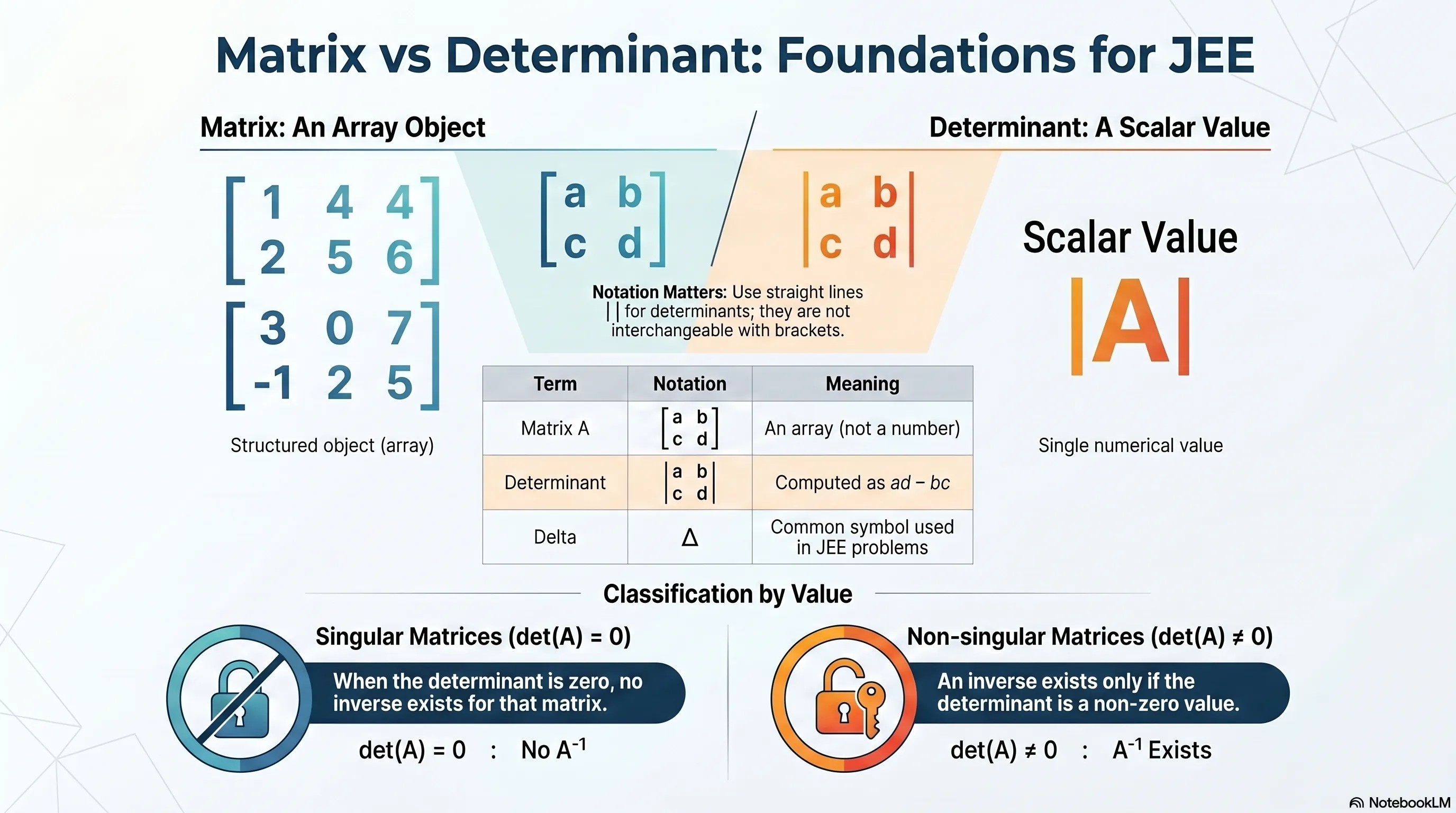
Table of Contents

eSaral › JEE › JEE Main ›Determinants Notes for Class 12 & IIT JEE

🚀 Checkout eSaral Courses
What Is a Determinant? Definition and Notation
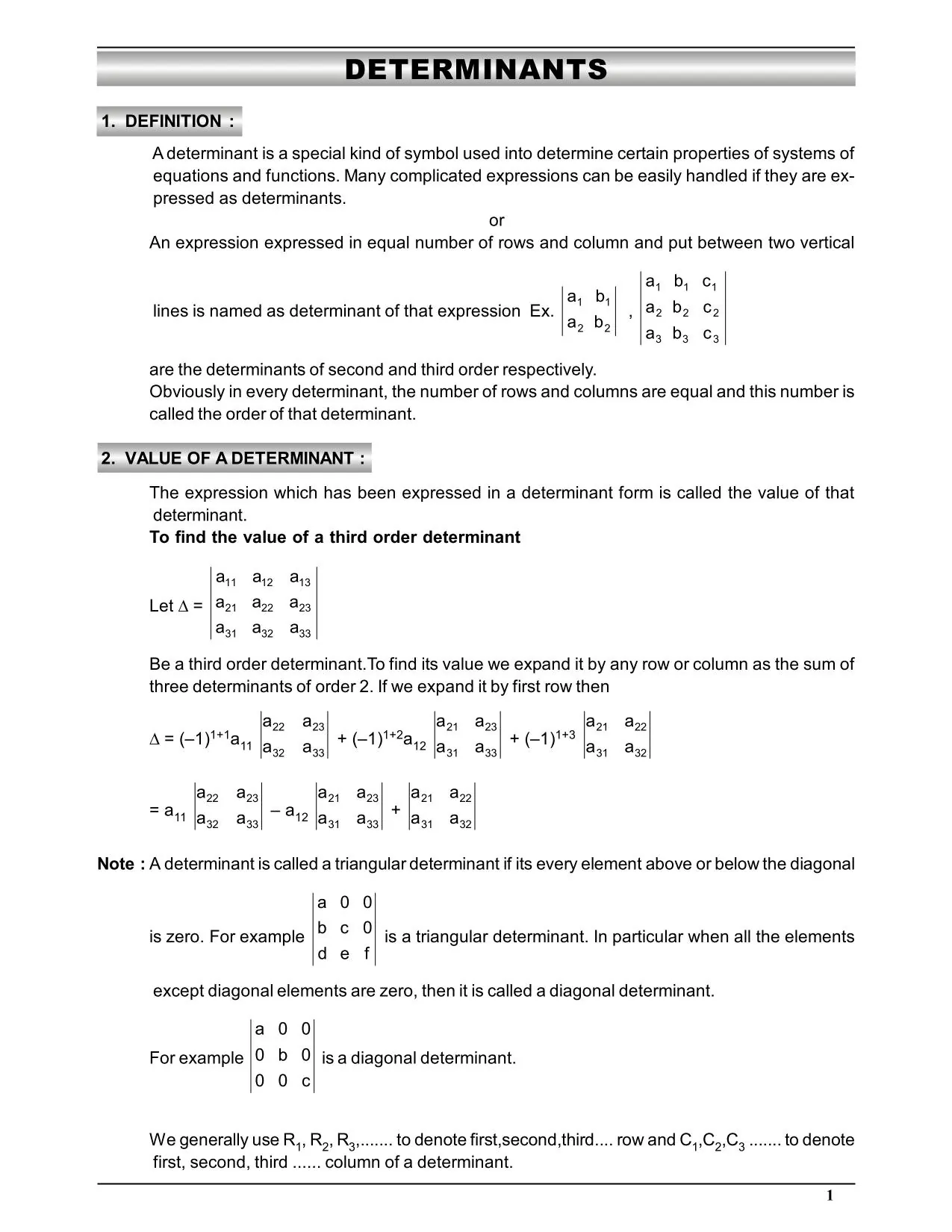
A determinant is a unique scalar (real number) associated with every square matrix. It is defined only for square matrices — matrices where the number of rows equals the number of columns.
For a square matrix A, the determinant is written as:
- det(A), or
- |A|, or
- Δ (Delta — commonly used in JEE problems)
Key distinction for Class 12 and JEE: A matrix is an array of numbers enclosed in brackets [ ] or ( ). A determinant is the scalar value computed from that matrix and is written with straight lines | |. Students frequently lose marks by treating the two as interchangeable — they are not. A matrix is an object; a determinant is a number.
| Term | Notation | What It Is |
|---|---|---|
| Matrix A | [a b; c d] | An array of numbers (not a number itself) |
| Determinant of A | |a b; c d| = ad−bc | A single scalar value |
| Singular matrix | det(A) = 0 | No inverse exists |
| Non-singular matrix | det(A) ≠ 0 | Inverse exists |
Determinants Notes for Class 12 & IIT JEE
India's Best Exam Preparation for Class 12th - Download Now
India's Best Exam Preparation for Class 12th - Download Now
India's Best Exam Preparation for Class 12th - Download Now
India's Best Exam Preparation for Class 12th - Download Now
India's Best Exam Preparation for Class 12th - Download Now
Frequently Asked Questions
Find answers to common questions.
What is a determinant in Class 12 Maths?
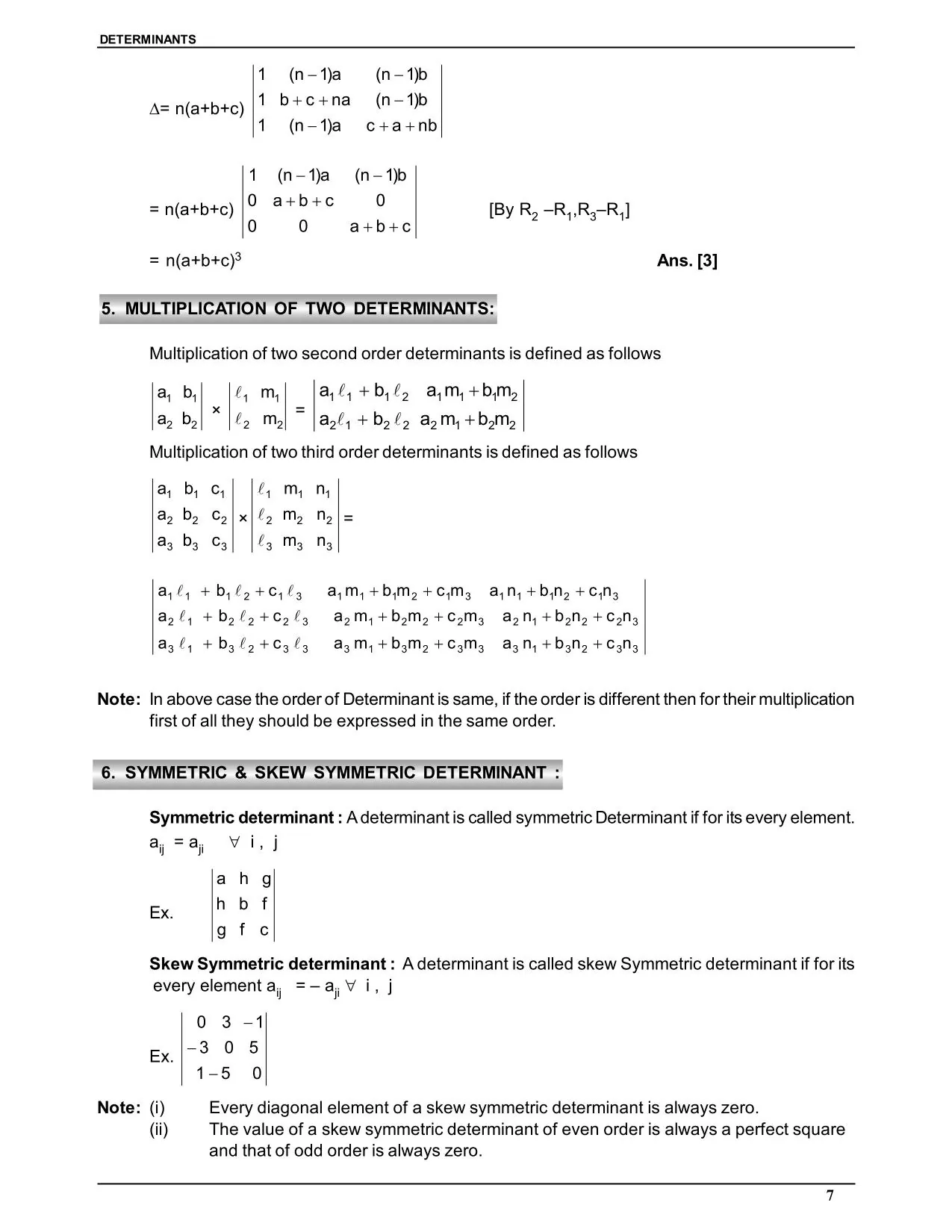
A determinant is a unique scalar value associated with every square matrix. For a 2×2 matrix [[a,b],[c,d]], the determinant = ad − bc. For a 3×3 matrix, it is computed by expanding along any row or column using cofactors. Determinants are used to find triangle areas, solve linear systems via Cramer's rule, and check matrix invertibility.
What are the properties of determinants for Class 12 and JEE?
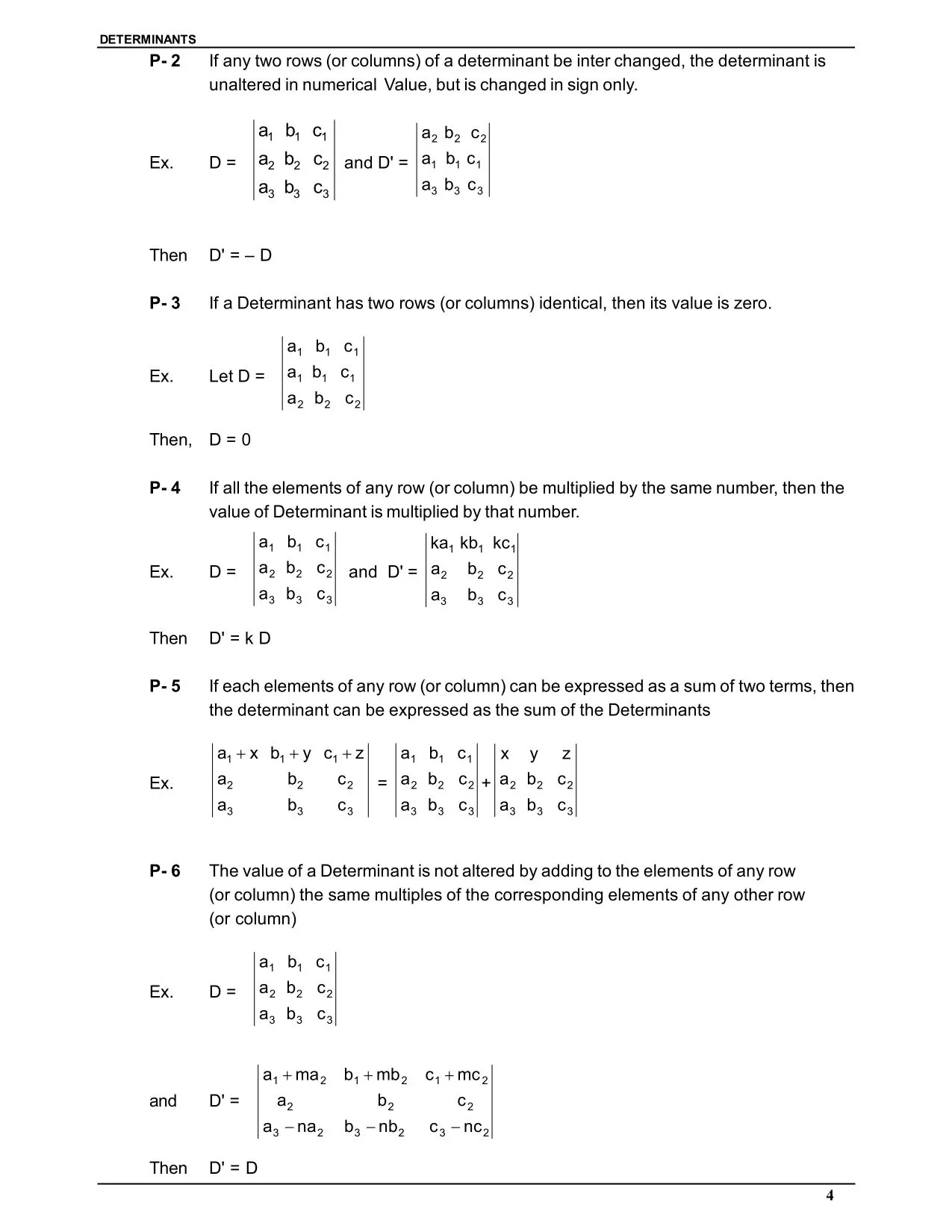
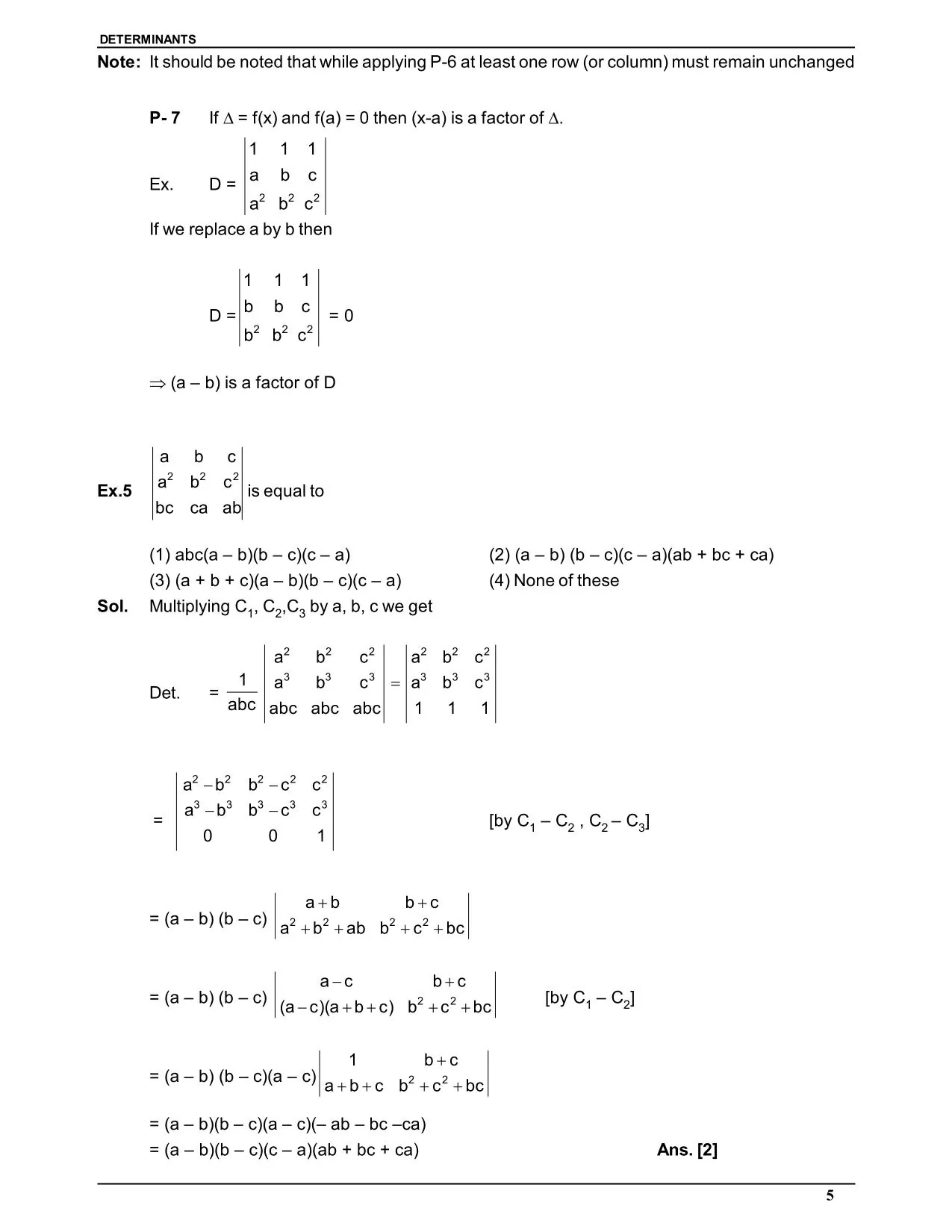
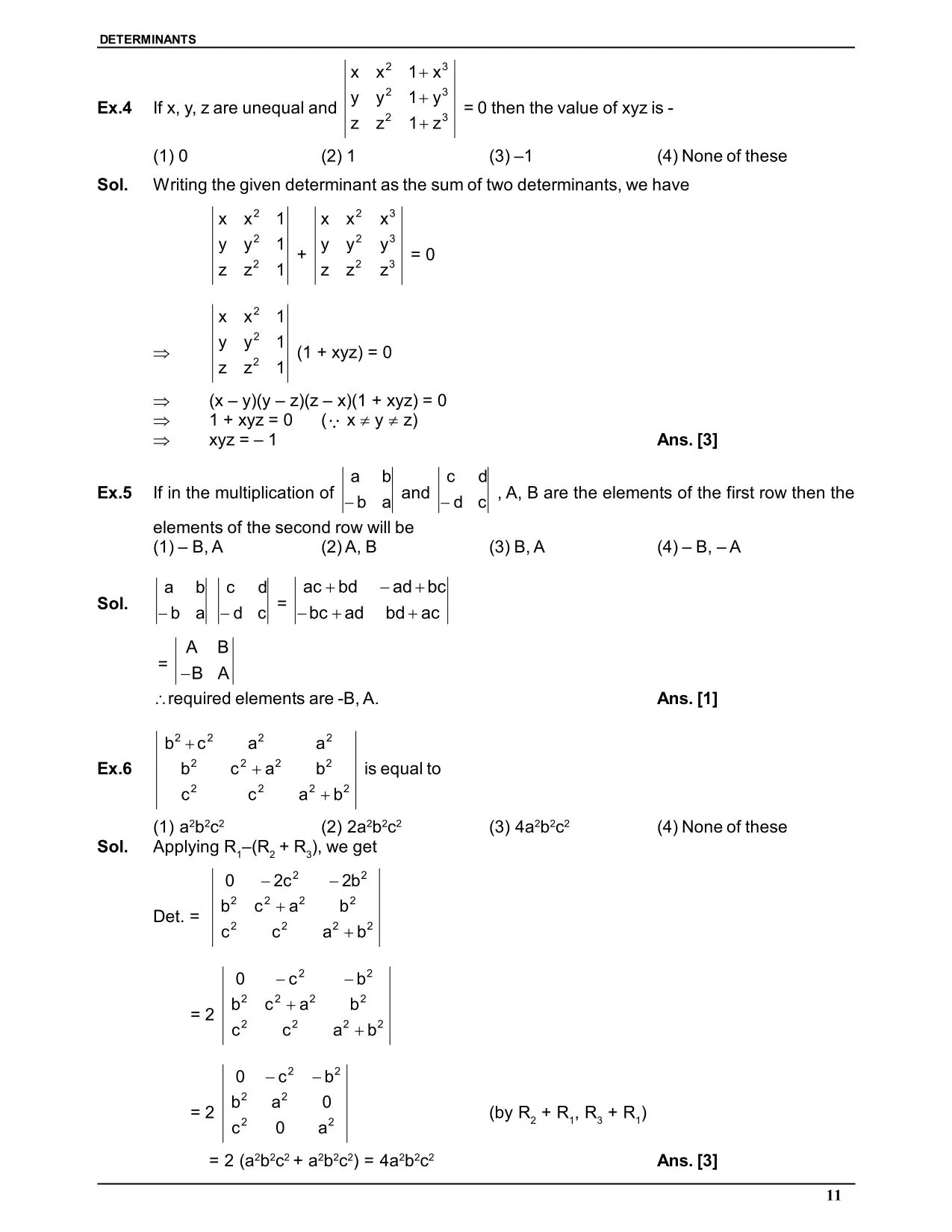
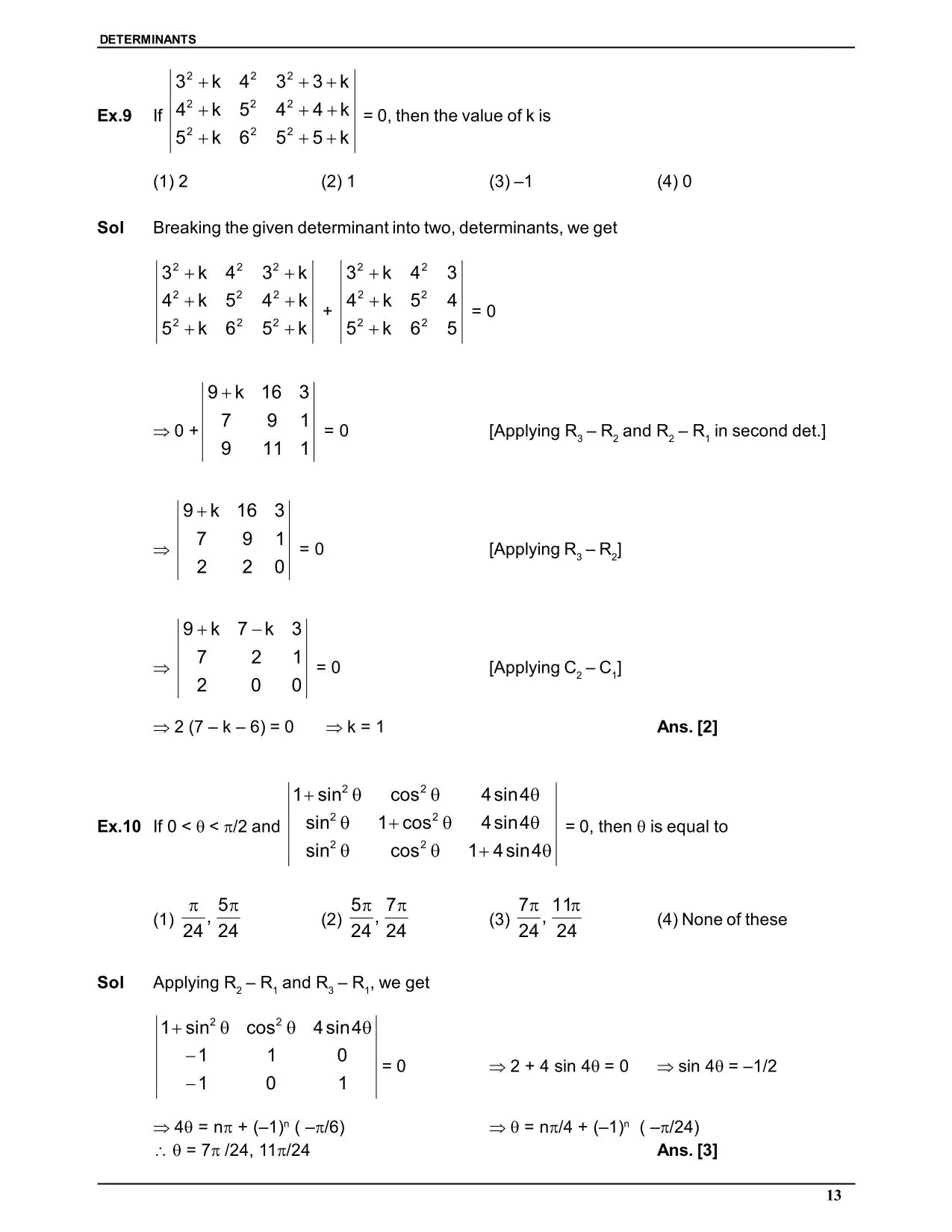
The 10 key properties are: transposition (|A^T| = |A|), row/column swap changes sign, identical rows/columns give zero, scalar multiple, zero row/column gives zero, proportional rows/columns give zero, sum property, row operation leaves value unchanged, triangular matrix determinant equals product of diagonals, and |AB| = |A||B|. Properties 6 and 8 are the most used in JEE simplification.
What is the formula for area of triangle using determinants?
Area = (1/2)|det M|, where M is the 3×3 matrix with rows [x₁, y₁, 1], [x₂, y₂, 1], [x₃, y₃, 1] for the three vertices. The absolute value ensures area is positive. If this determinant equals zero, the three points are collinear — this is the standard collinearity condition tested in JEE Main.
What is Cramer's rule and when does it apply?
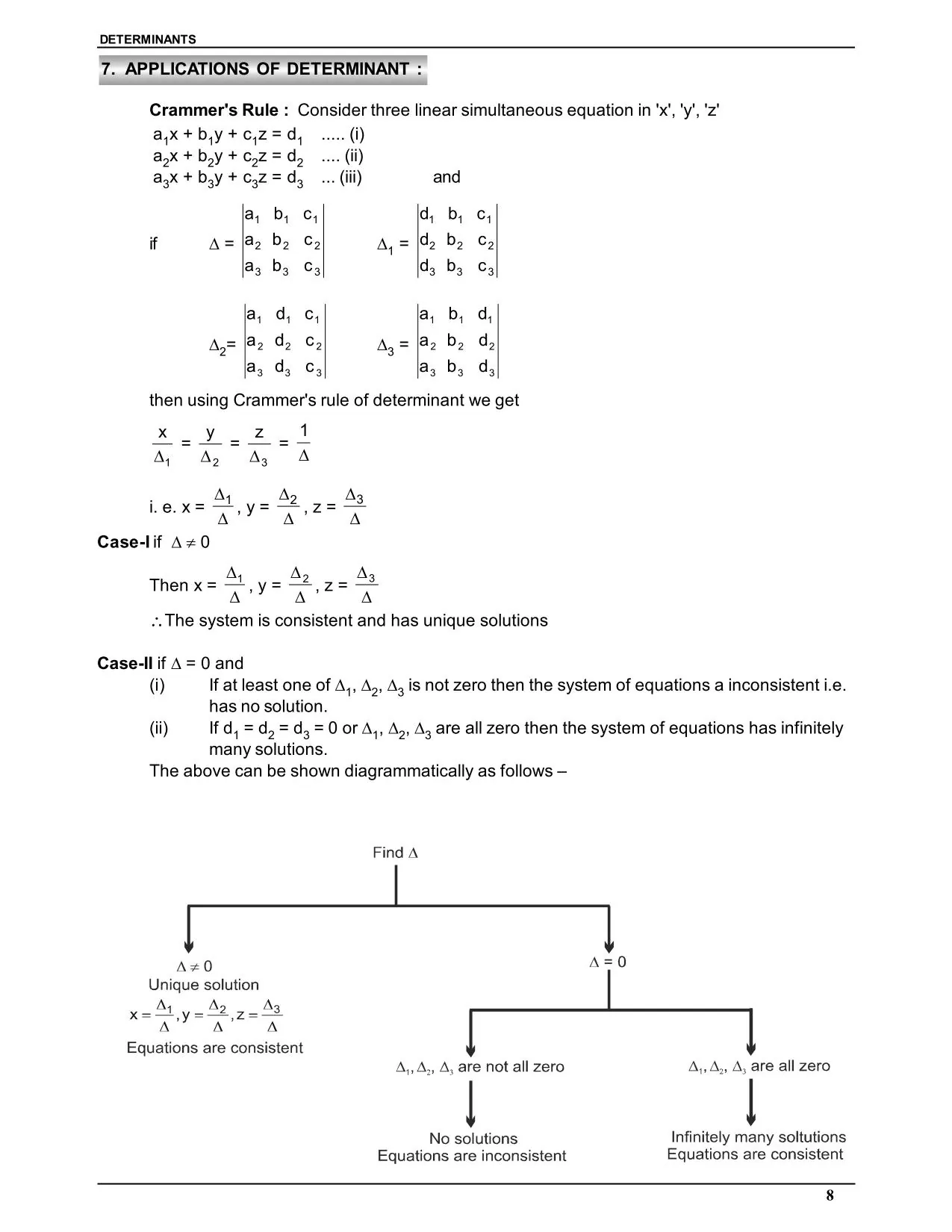
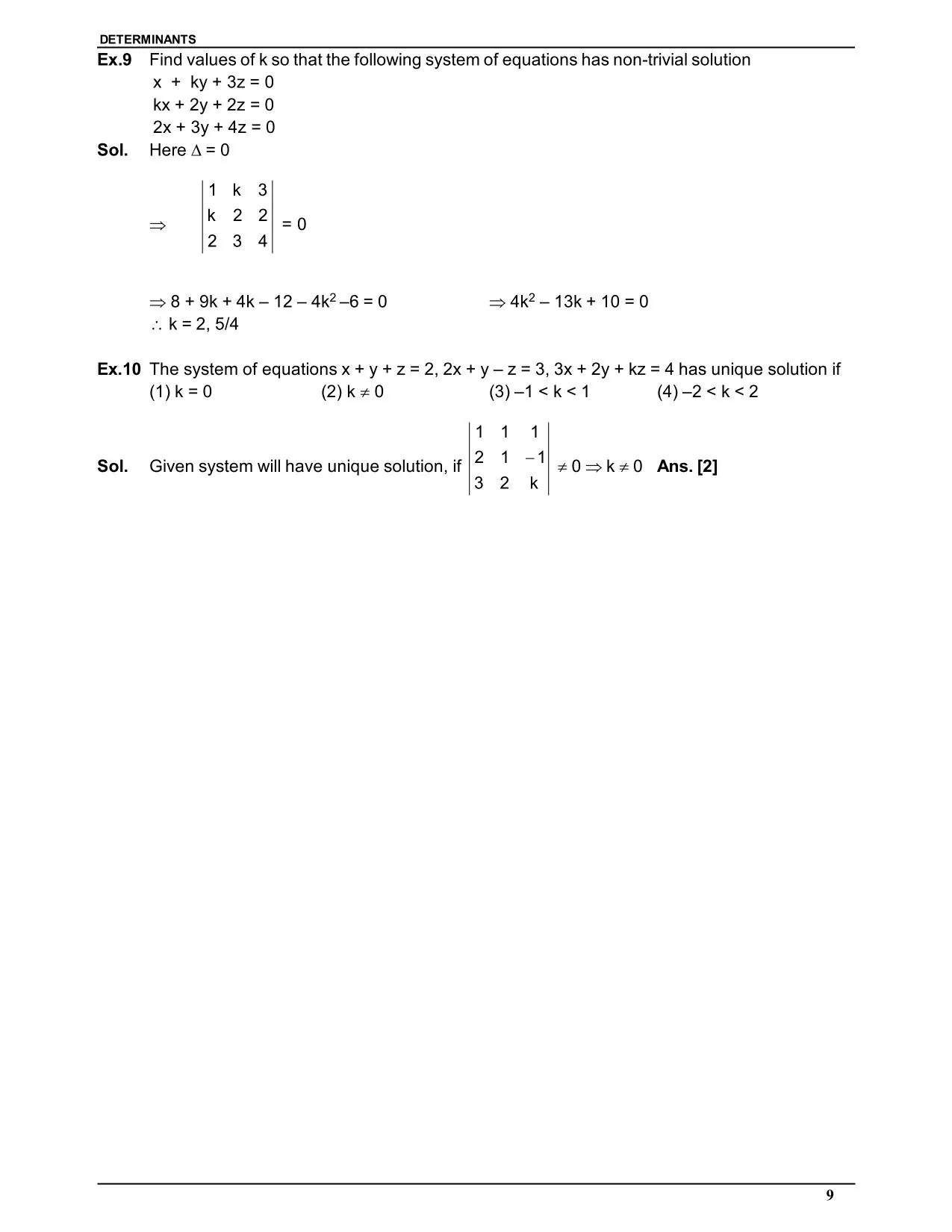
Cramer's rule solves a system of n linear equations in n unknowns using determinants. For AX = B, compute D = det(A), D₁ (D with column 1 replaced by B), D₂, D₃. Then x = D₁/D, y = D₂/D, z = D₃/D — valid only when D ≠ 0. If D = 0, Cramer's rule does not apply; the system is either inconsistent or has infinitely many solutions.
What is the difference between a minor and a cofactor?
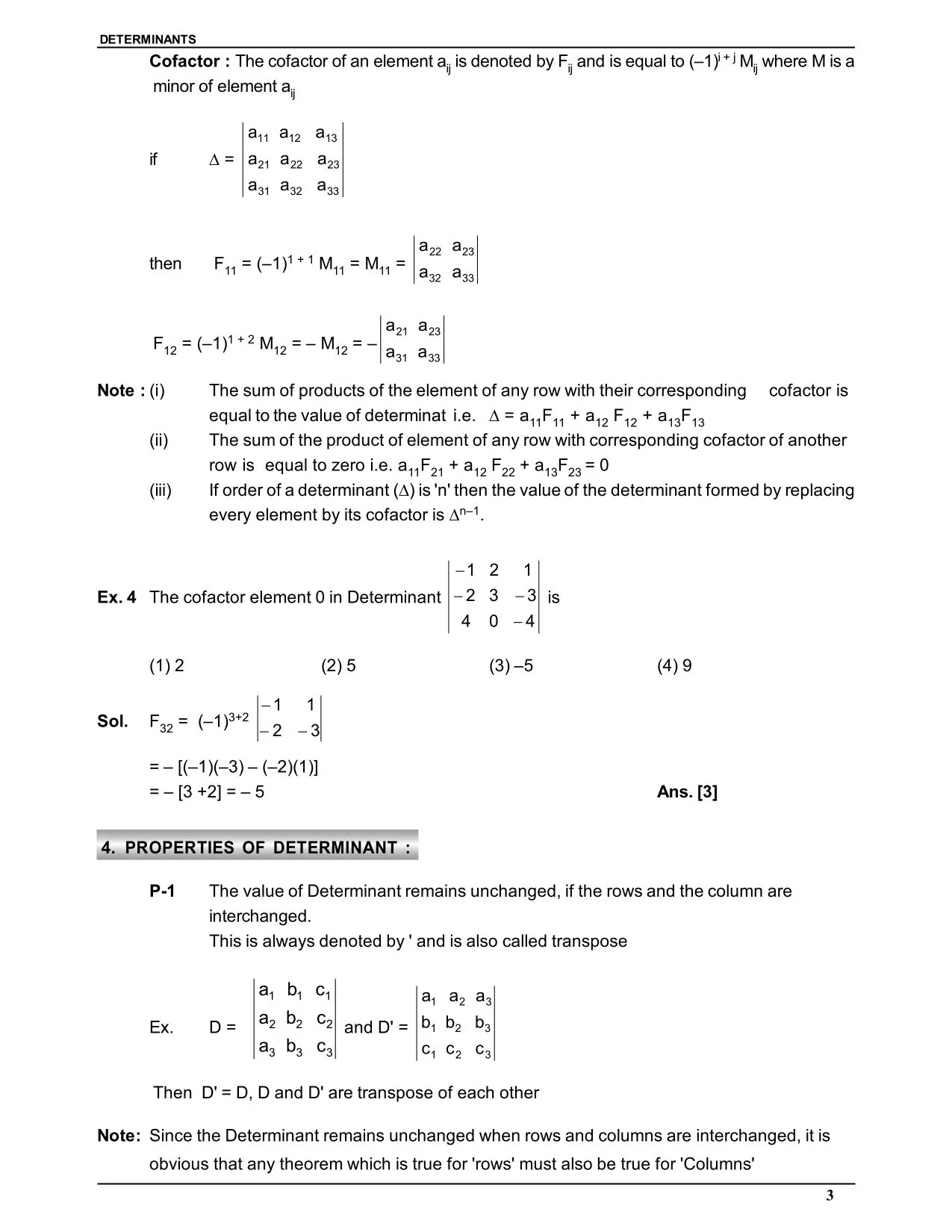
The minor M_ij of element a_ij is the determinant of the submatrix obtained by deleting row i and column j. The cofactor A_ij is the signed minor: A_ij = (−1)^(i+j) × M_ij. Cofactors are used to expand determinants and to compute the adjoint of a matrix, which in turn gives the inverse via A⁻¹ = adj(A)/|A|.