Distance and Displacement in Physics: Complete JEE Concept Guide
Distance travelled is the actual path length a body covers, while displacement is the shortest straight-line distance between the initial and final position, regardless of the path taken. In circular motion, a body completing a semicircle of radius r has distance = πr but displacement = 2r. For a quarter circle, displacement = r√2 using Pythagoras' theorem.
Table of Contents

eSaral ›Foundation courses ›Distance and Displacement in Physics: Complete JEE Concept Guide

What is Motion in Physics?
Motion, in scientific terms, means a body's position is changing with respect to time. If a body is at one position at one moment and at a different position sometime later, that body is said to be in motion.
Examples of motion are everywhere in daily life:
- A student walking from home to school — the position keeps changing, so the student is in motion.
- The Earth revolves around the Sun — its position changes continuously, so Earth is in motion.
- Birds flying, animals moving from place to place — all are in motion.
- Even pouring yourself a glass of water involves motion, because your body moves from one room to another.
The key scientific condition is this: if a body's position is changing with respect to time, the body is in motion.
What is Kinematics? Kinematics vs Dynamics
Motion in physics is studied under two broad branches: Kinematics and Dynamics.
What Does Kinematics Study?
Kinematics is the study of motion without knowing its causes. In kinematics, the focus is on:
- What is the body's velocity at a given time?
- What is its acceleration?
- What is its position at any point in time?
- How much distance has it covered?
- What is its displacement?
The forces that cause the motion are not part of kinematics.
What Does Dynamics Study?
Dynamics deals with the causes of motion — specifically, the forces responsible for making a body move. This is covered in later chapters. For now, the focus remains on kinematics.
💡 Key Distinction: Kinematics tells you how a body moves. Dynamics tells you why it moves.
Types of Motion: 1D, 2D, and Motion in Space
To make kinematics easier to study, motion is classified into three types:
Kinematics 1D — Motion in a Straight Line
When a body moves along a single straight line — either horizontally, vertically, or at any angle — it is called motion in a straight line or Kinematics 1D. The body can only go forward or backward along that line.
Kinematics 2D — Motion in a Plane
When a body moves within a flat surface (a plane), it is called motion in a plane or Kinematics 2D. Examples include:
- A ball thrown at an angle (projectile motion) — it moves within a flat surface in space.
- A body moving in a circle on a flat ground.
Motion in Space
When a body moves freely in three dimensions — up, down, left, right, in any direction — it is motion in space. Examples include birds in flight, flies, and aeroplanes moving through the sky.
All three types share the same foundational definitions of distance, displacement, velocity, and acceleration, which is why these terms are studied first.
For a structured foundation, NCERT Class 11 Physics solutions break down these exact chapters with step-by-step answers.
What is Distance Travelled in Physics?
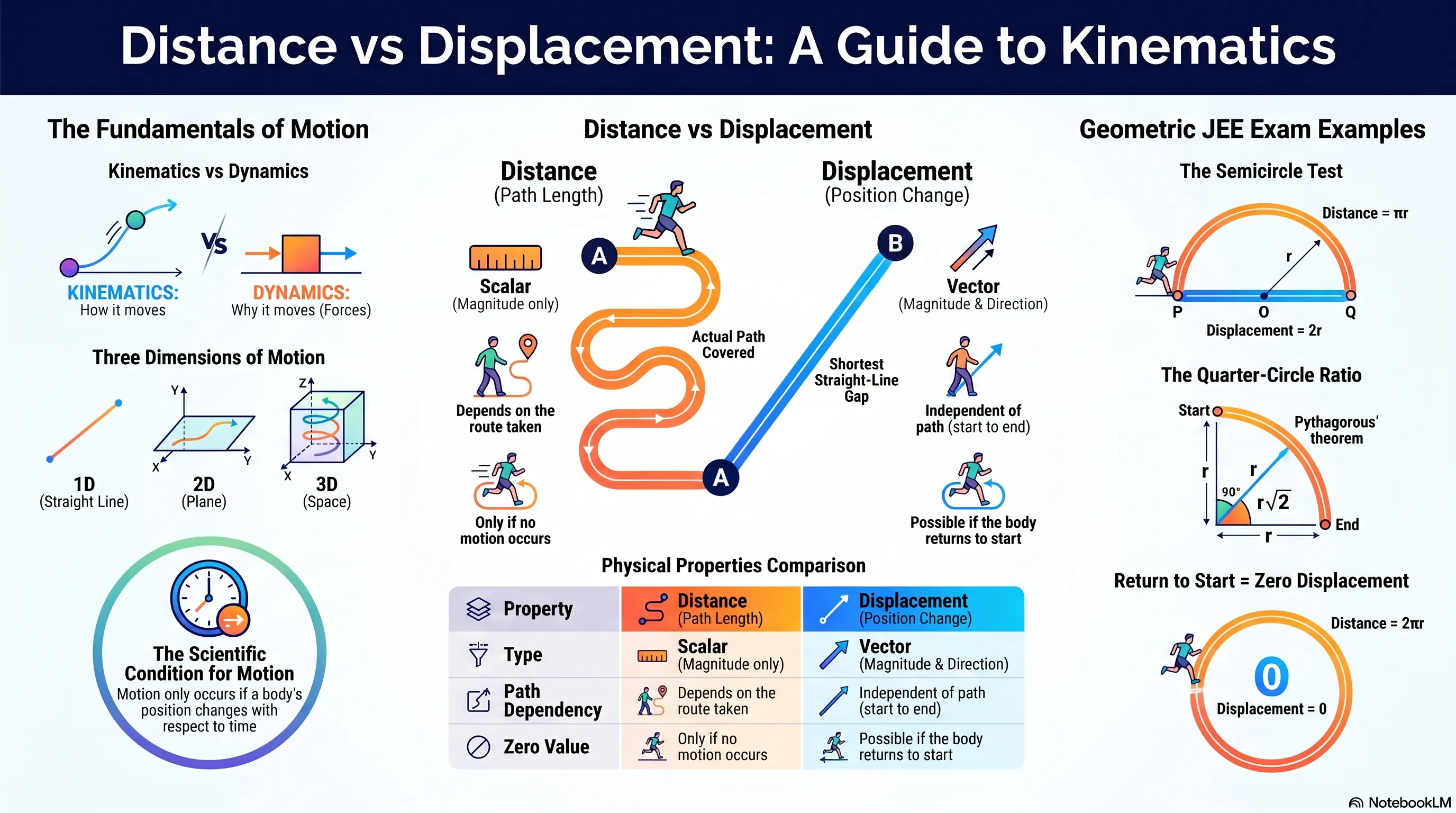
Distance travelled is the total length of the actual path a body covers during its motion. It is also called path length.
Important Points About Distance
- Distance depends entirely on which path the body takes.
- Different paths between the same start and end points give different distances.
- Distance is always a positive value — it can never be zero (unless there is no motion at all) or negative.
Example: Multiple Paths, Multiple Distances
Imagine a body starting from point A and reaching point B. It can take Path 1, Path 2, or Path 3 — each a different route. Each path has a different length. That length is the distance travelled for that particular journey.
A real-world analogy: Google Maps shows multiple routes from Kota to Delhi — via Jaipur, via Alwar, or other routes. Whichever route you choose, the length of that route is your distance travelled.
What is Displacement in Physics?
Displacement is the change in position of a body. In simpler terms, it is the shortest straight-line distance between the initial position and the final position, drawn as a directed arrow (vector) from start to finish.
How to Find Displacement
- Mark the initial position (where the body started).
- Mark the final position (where the body ended up).
- Draw a straight arrow from initial to final position.
- The length of that arrow is the displacement.
Key Properties of Displacement
- Displacement depends only on initial and final positions — not on the path taken.
- For the same start and end points, displacement is the same regardless of which path was used.
- Displacement can be zero (if the body returns to the starting point) or even negative (depending on direction).
- Displacement is a vector quantity — it has both magnitude and direction.
Displacement vs Distance: The Core Difference
| Property | Distance Travelled | Displacement |
|---|---|---|
| Definition | Total path length actually covered | Shortest straight-line distance from start to end |
| Depends on the path? | Yes | No |
| Can it be zero? | Only if no movement | Yes (if body returns to start) |
| Type | Scalar | Vector |
| Same for all paths between A and B? | No | Yes |
Distance vs Displacement: Key Differences with Examples
Example 1 — Ball Thrown from a Tower
A ball is thrown upward from the top of a 20-metre tower. It goes 5 metres above the tower's top, then comes back down and reaches the ground.
Distance Travelled: The ball goes 5 m up + 5 m back down to the tower level + 20 m to the ground = 30 metres.
Displacement: The initial position is the top of the tower (20 m above ground). The final position is the ground (0 m). The shortest straight-line distance between these two points = 20 metres (directed downward).
Example 2 — Semicircular Path
A particle travels from point A to point B along a semicircular path of radius r.
Distance Travelled: Half the circumference of a full circle = (2πr) / 2 = πr
Displacement: Draw a straight arrow from A to B. Since the diameter of the semicircle connects A and B directly, displacement = 2r
Example 3 — Quarter Circle (Ratio Problem)
A particle moves along a quarter-circle (90°) of radius r from initial to final position.
Distance Travelled: One-quarter of the full circumference = 2πr / 4 = πr / 2
Displacement: The two radii (r and r) form a right-angle triangle. By Pythagoras' theorem: Displacement = √(r² + r²) = √(2r²) = r√2
Ratio of Distance to Displacement: = (πr/2) ÷ (r√2) = π / (2√2)
This type of ratio question has appeared in JEE exams — understanding the geometry is the key.
Solved JEE Main Problems on Distance and Displacement
JEE Main 2024 — Cyclist on a Circular Ground
Problem: A cyclist starts from point P on a circular ground of radius 2 km and travels along the circumference to point S. Find the displacement of the cyclist.
Solution:
The initial position is P and the final position is S. To find displacement, draw a straight arrow from P to S. Since both P and S lie on the circle and are connected by radii, this forms a right-angled triangle with two sides each equal to 2 km.
Using Pythagoras' theorem: Displacement = √(2² + 2²) = √(4 + 4) = √8 = 2√2 km
Since r = 2 km: Displacement = 2 × √2 = 2√2 km ≈ 2.83 km
JEE Main 2025 — Sportsman Running on a Circular Track
Problem: A sportsman runs along a circular track of radius R such that he travels A → B → A → B. Find the distance travelled and the displacement.
Solution:
Distance Travelled:
- A → B is a semicircle: length = πR
- B → A is another semicircle (completing a full circle): length = πR
- A → B again is a semicircle: length = πR
- Total Distance = πR + πR + πR = 3πR
Displacement:
- Initial position: A
- Final position: B
- These are diametrically opposite on the circle, connected by the diameter.
- Displacement = 2R
Correct Answer: Distance = 3πR, Displacement = 2R
These two JEE Main problems demonstrate exactly how distance and displacement definitions are applied under exam conditions. Practice more problems using NCERT Solutions for Class 11 Physics and NCERT Class 11 Books to build your problem-solving speed.
You can also access NCERT Solutions for Class 11 Maths and NCERT Solutions for Class 11 Chemistry for cross-subject preparation.
Frequently Asked Questions
Find answers to common questions.
What is the difference between distance and displacement in physics?
Distance travelled is the total length of the path a body actually covers during its motion. Displacement is the shortest straight-line distance from the initial to the final position, shown as a directed arrow. The key difference is that distance depends on which path is taken, while displacement depends only on where the body started and where it ended up.
Can displacement be zero while distance travelled is non-zero?
Yes. If a body starts and ends at the same position — for example, after completing one full circle — the displacement is zero because the initial and final positions are the same. But the distance travelled equals the full circumference of the circle, which is 2πr. This is an important distinction tested in JEE Main.
How do you calculate displacement in circular motion?
To find displacement in circular motion, identify the initial and final positions on the circle, then draw a straight-line arrow connecting them. The length of this straight line is the displacement. For a semicircle of radius r, displacement = 2r (the diameter). For a quarter circle, use Pythagoras' theorem: displacement = √(r² + r²) = r√2.
What is kinematics in physics for JEE?
Kinematics is the branch of physics that studies the motion of bodies — including their position, velocity, acceleration, distance, and displacement — without considering the forces that cause the motion. For JEE, kinematics is divided into 1D motion (straight line), 2D motion (in a plane), and motion in space. All three share the same core definitions of distance and displacement.
Is displacement a scalar or vector quantity?
Displacement is a vector quantity — it has both magnitude (how far) and direction (which way). Distance, by contrast, is a scalar quantity with only magnitude. This is why displacement can be zero or negative depending on direction, while distance is always a positive value.