Elasticity (Physics) - NEET Previous Year Questions with Solutions
Elasticity is a key NEET Physics topic under Mechanical Properties of Solids that explains how materials regain their original shape after deformation, focusing on stress, strain, elastic moduli, and their practical applications.
Table of Contents

eSaral › NEET › Elasticity (Physics)

What Is Elasticity and Why Does NEET Ask It Every Year?
Elasticity is the property of a material that allows it to regain its original shape and size after the deforming force is removed. In the NEET Physics syllabus, this topic falls under Mechanical Properties of Solids (Class 11, Chapter 9) — one of the most predictable scoring chapters in the entire paper.
NTA (National Testing Agency) has consistently placed 1 to 2 questions from this chapter in almost every NEET paper since 2013. Unlike chapters such as Rotational Motion or Thermodynamics, elasticity questions are typically formula-based and logic-driven, which means a student who has practised enough PYQs can solve them in under 60 seconds.
The chapter tests your understanding of:
- How materials deform under applied forces
- The relationship between stress, strain, and the elastic moduli
- Real-world applications like wire stretching, rubber bands, and structural materials
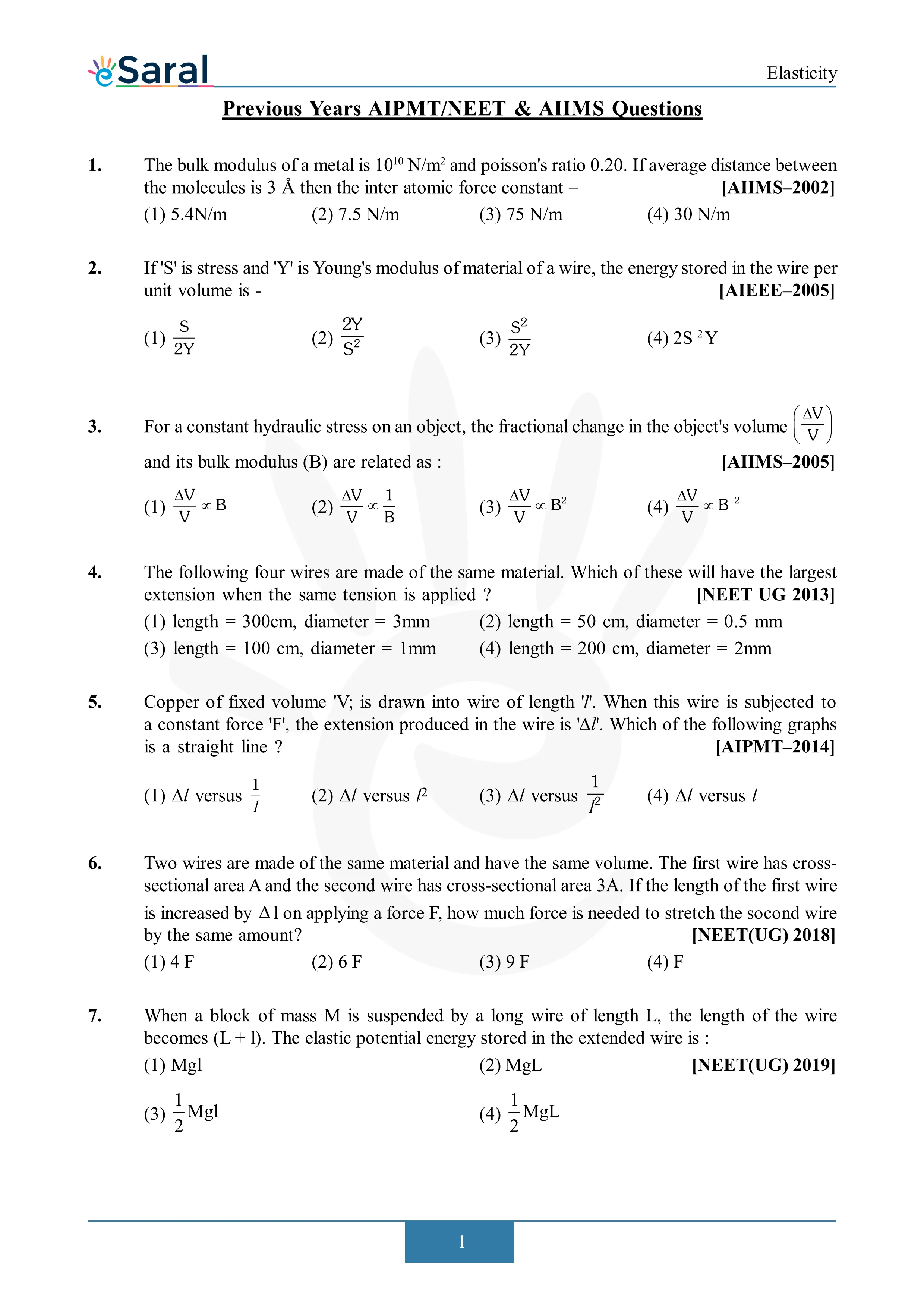
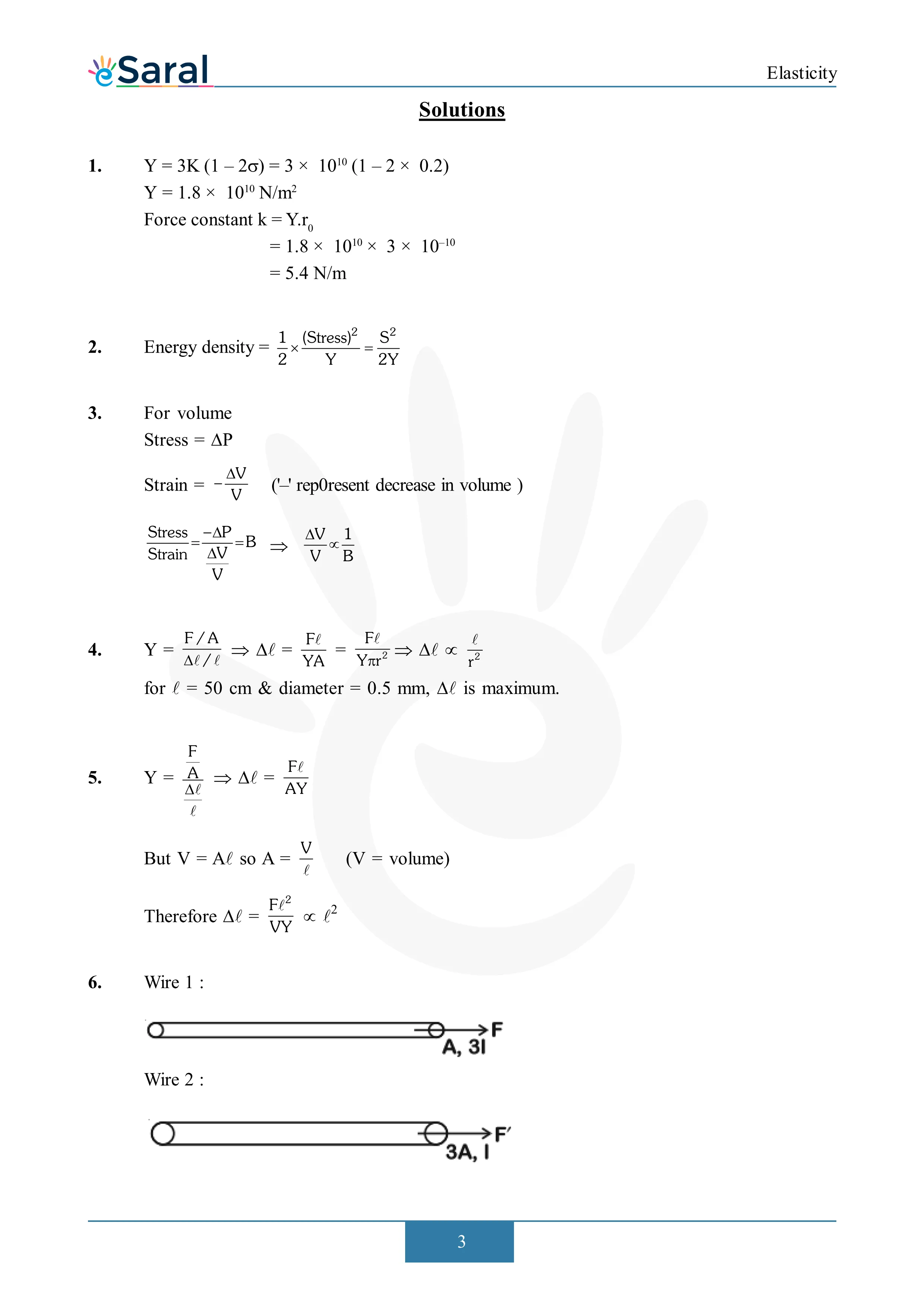
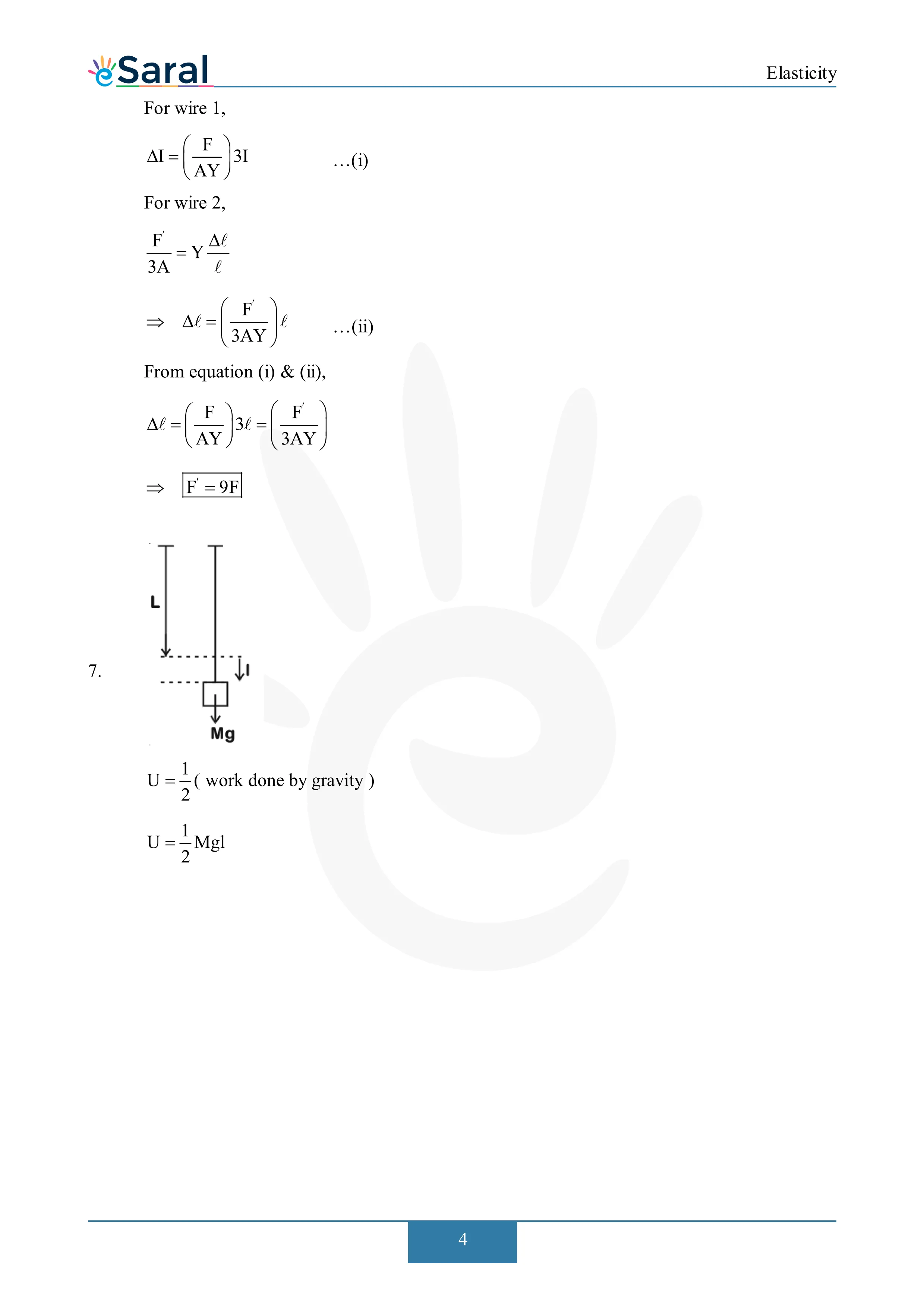
NEET PYQ with Solutions

Frequently Asked Questions
Find answers to common questions.
How many questions come from Elasticity in NEET every year?
NTA typically asks 1 to 2 questions from the Elasticity (Mechanical Properties of Solids) chapter in NEET. Each question carries 4 marks for a correct answer and results in a −1 deduction for a wrong answer. Given the formula-driven nature of this chapter, these are among the most reliably scorable questions in Physics.
Is Elasticity important for NEET, or can I skip it?
Elasticity should not be skipped. It consistently appears in NEET and requires relatively low study time compared to the marks it offers. The chapter has a fixed, predictable set of formulas and concepts. Students who prepare this chapter well almost always score full marks on it — making it a high-return topic in your NEET preparation strategy.
What is the difference between Young's modulus, Bulk modulus, and Shear modulus?
Young's modulus measures resistance to longitudinal (stretching/compressing) stress. Bulk modulus measures resistance to uniform pressure applied from all directions (volumetric change). Shear modulus (rigidity modulus) measures resistance to shape change without volume change. NEET tests all three, but Young's modulus appears most frequently in numerical problems.
Which is more elastic — steel or rubber? Why does NEET ask this?
Steel is more elastic than rubber. Elasticity in physics means the ability to return to original shape — not the ability to stretch far. Steel returns to its exact original shape under small deformations, giving it a very high Young's modulus. Rubber stretches a lot but does not follow Hooke's Law precisely. NEET asks this as a conceptual trap question.
Does Poisson's ratio have a unit? What is its value range?
Poisson's ratio has no unit — it is a dimensionless quantity. Its theoretical range is −1 to 0.5. For most common engineering materials (steel, copper, aluminium), Poisson's ratio lies between 0.25 and 0.35. A value of 0.5 indicates an incompressible material. NEET occasionally asks about its range and dimensions.