Electrochemistry - NEET Previous Year Questions with Complete Solutions
Practice Electrochemistry NEET Previous Year Questions with complete solutions covering Nernst equation, Faraday’s laws, EMF calculations, electrochemical cells, molar conductivity, and high-weightage NEET Chemistry concepts.
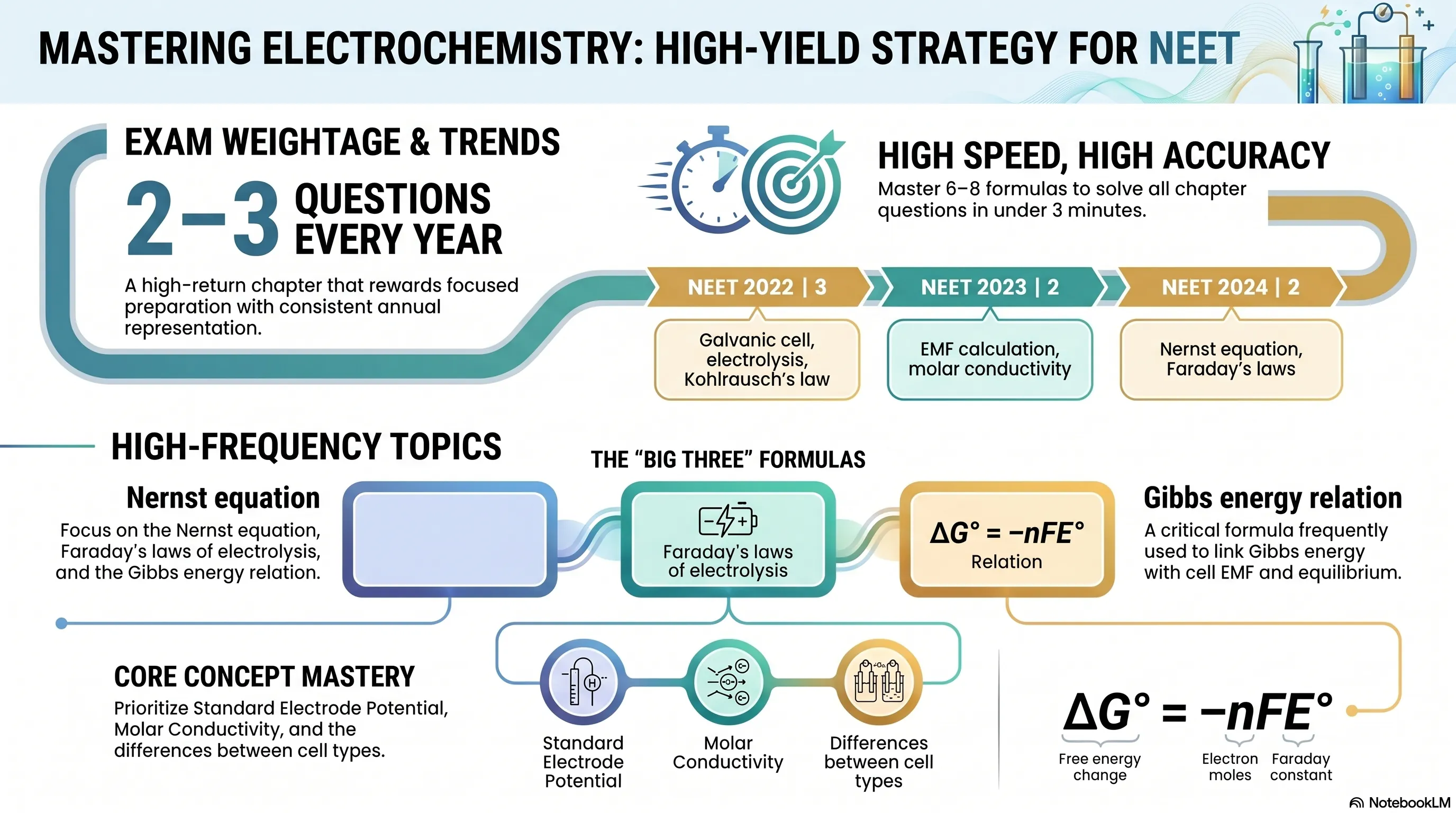
Table of Contents

eSaral › NEET ›Electrochemistry - NEET Previous Year Questions with Complete Solutions

Electrochemistry in NEET: Weightage and Key Topics
How Many Questions Come from Electrochemistry in NEET?
Electrochemistry is one of the most consistently tested chapters in NEET Chemistry. It contributes 2–3 questions almost every year — making it a high-return chapter that rewards focused preparation.
| Year | Questions from Electrochemistry | Topics Tested |
|---|---|---|
| NEET 2024 | 2 | Nernst equation, Faraday's laws |
| NEET 2023 | 2 | EMF calculation, molar conductivity |
| NEET 2022 | 3 | Galvanic cell, electrolysis, Kohlrausch's law |
| NEET 2021 | 2 | Standard electrode potential, Gibbs energy |
| NEET 2020 | 2 | Nernst equation, conductance |
| NEET 2019 | 3 | Faraday's laws, cell notation, EMF |
| NEET 2018 | 2 | Electrochemical cell, electrolysis |
Which Topics Are Most Frequently Tested?
Based on NEET papers from 2010 to 2024, the six highest-frequency topics in Electrochemistry are:
- Nernst equation and its application to calculate cell EMF
- Faraday's first and second law of electrolysis (mass deposited calculations)
- Standard electrode potential and cell EMF = E°cathode – E°anode
- Molar conductivity and Kohlrausch's law
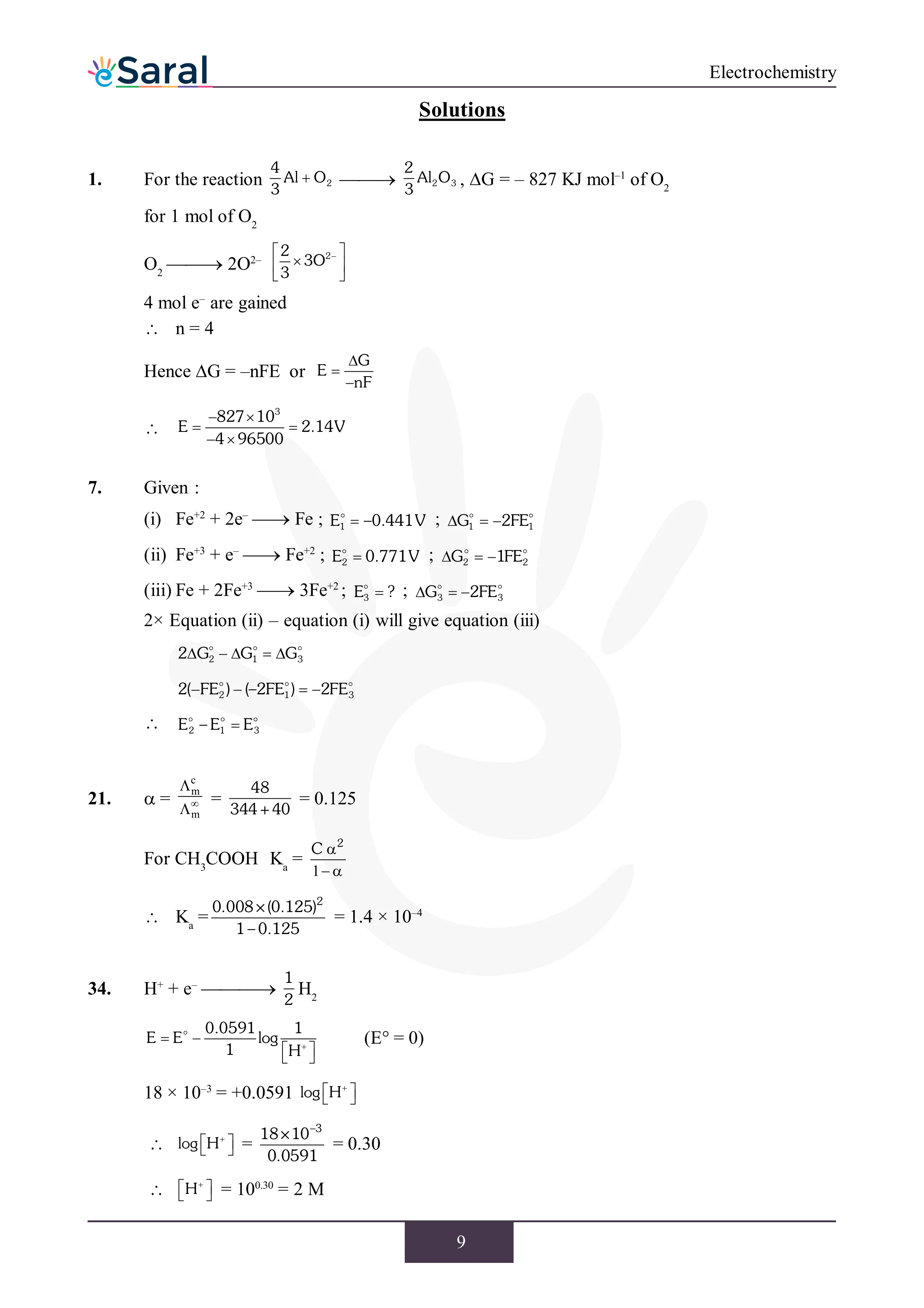
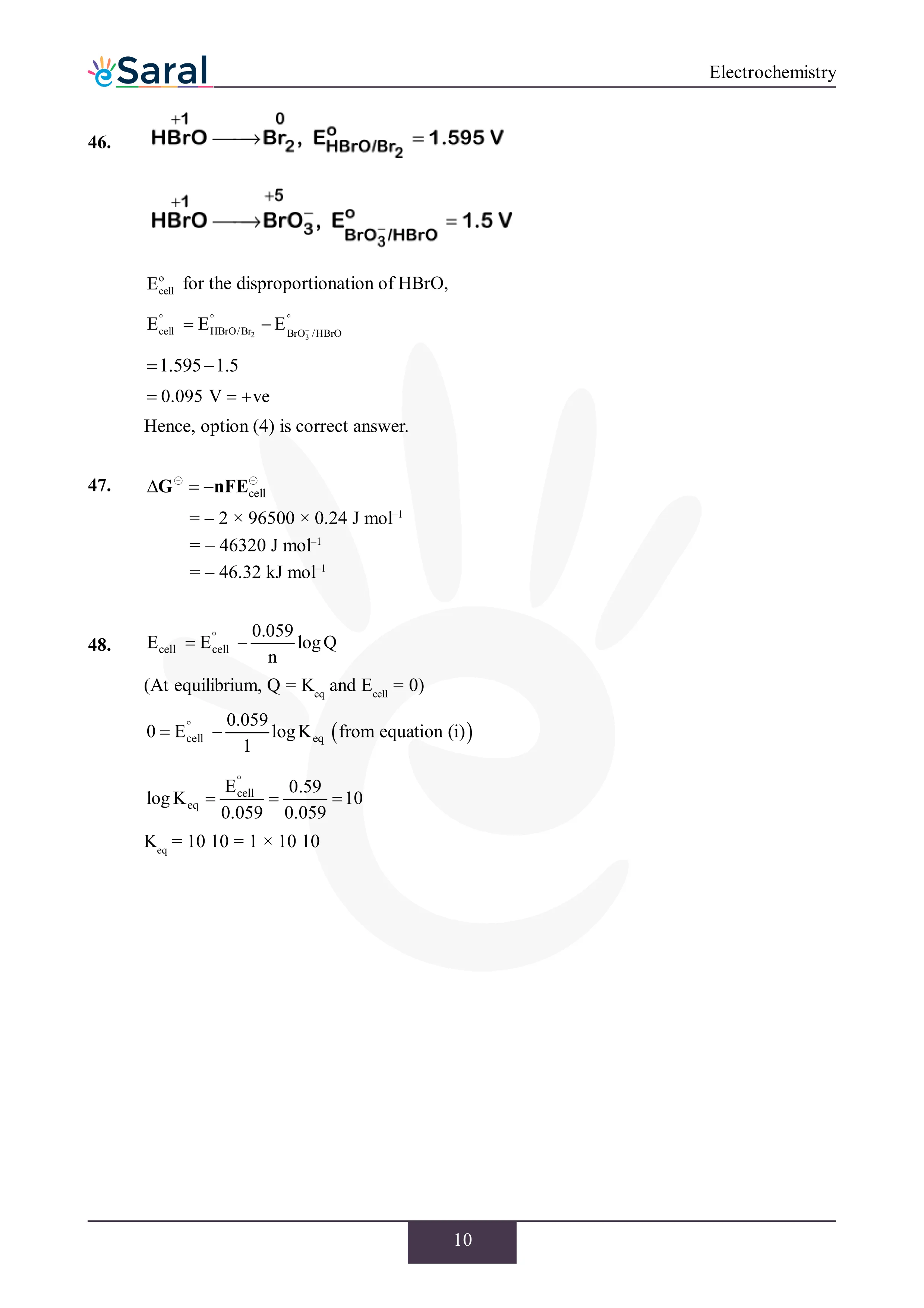
- Relationship between ΔG°, E°cell, and equilibrium constant (K)
- Types of electrochemical cells — galvanic vs electrolytic
💡 Expert Tip by eSaral IIT Faculty: Electrochemistry is one of those NEET Chemistry chapters where the same 6–8 formulas are tested in slightly different numerical setups every year. A student who can apply the Nernst equation, Faraday's laws, and the ΔG° = –nFE° relation confidently will score full marks from this chapter in under 3 minutes.
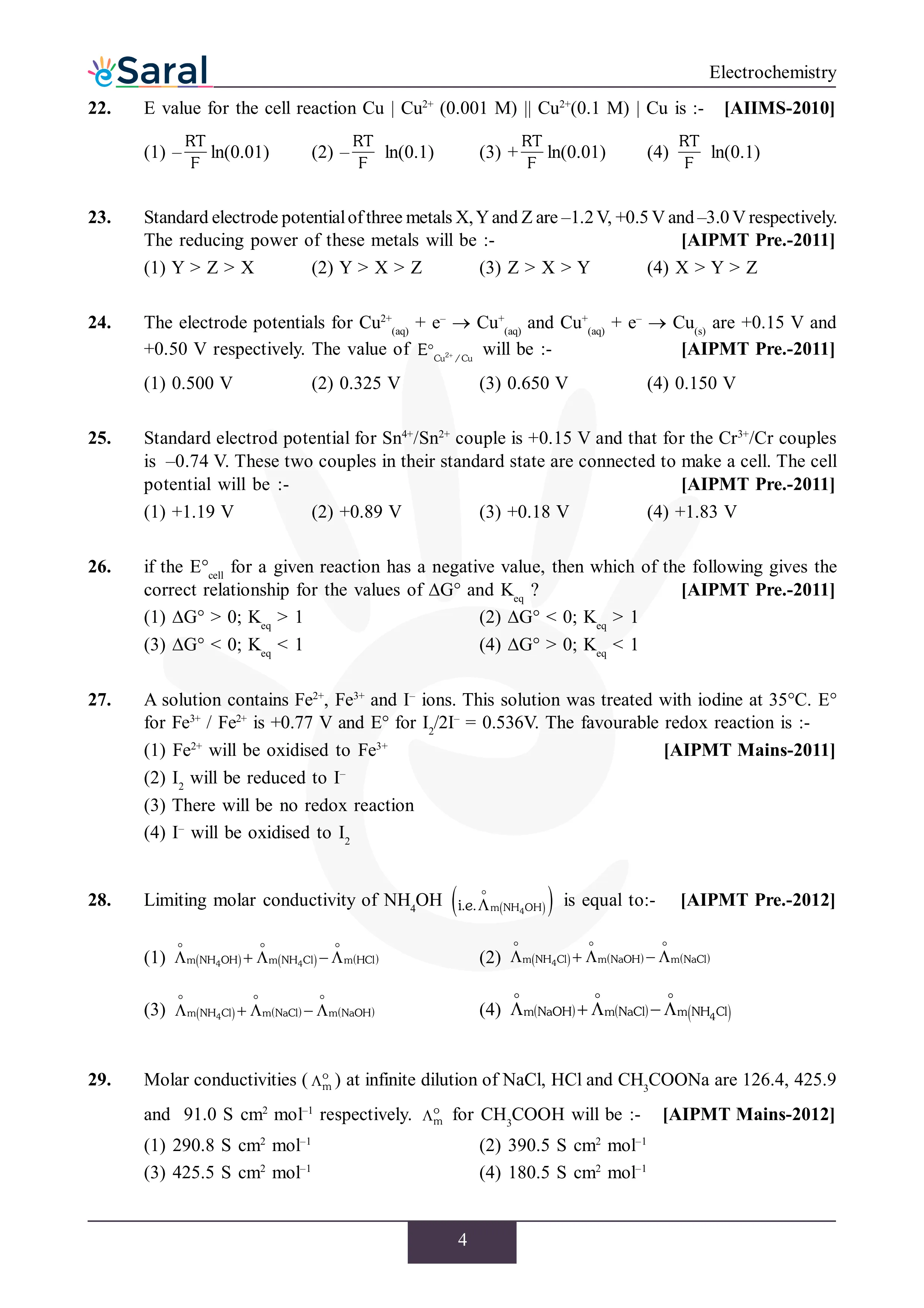
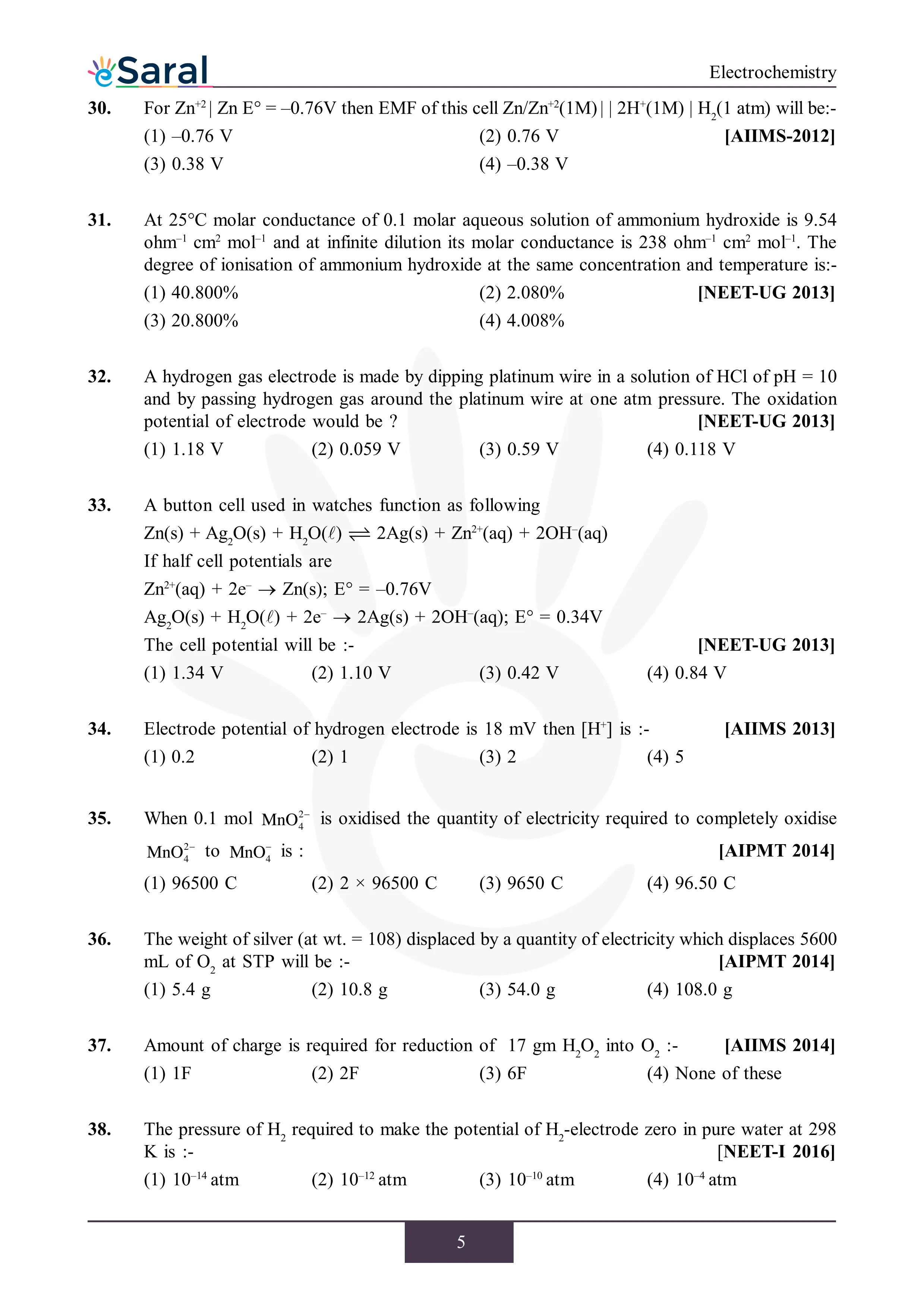
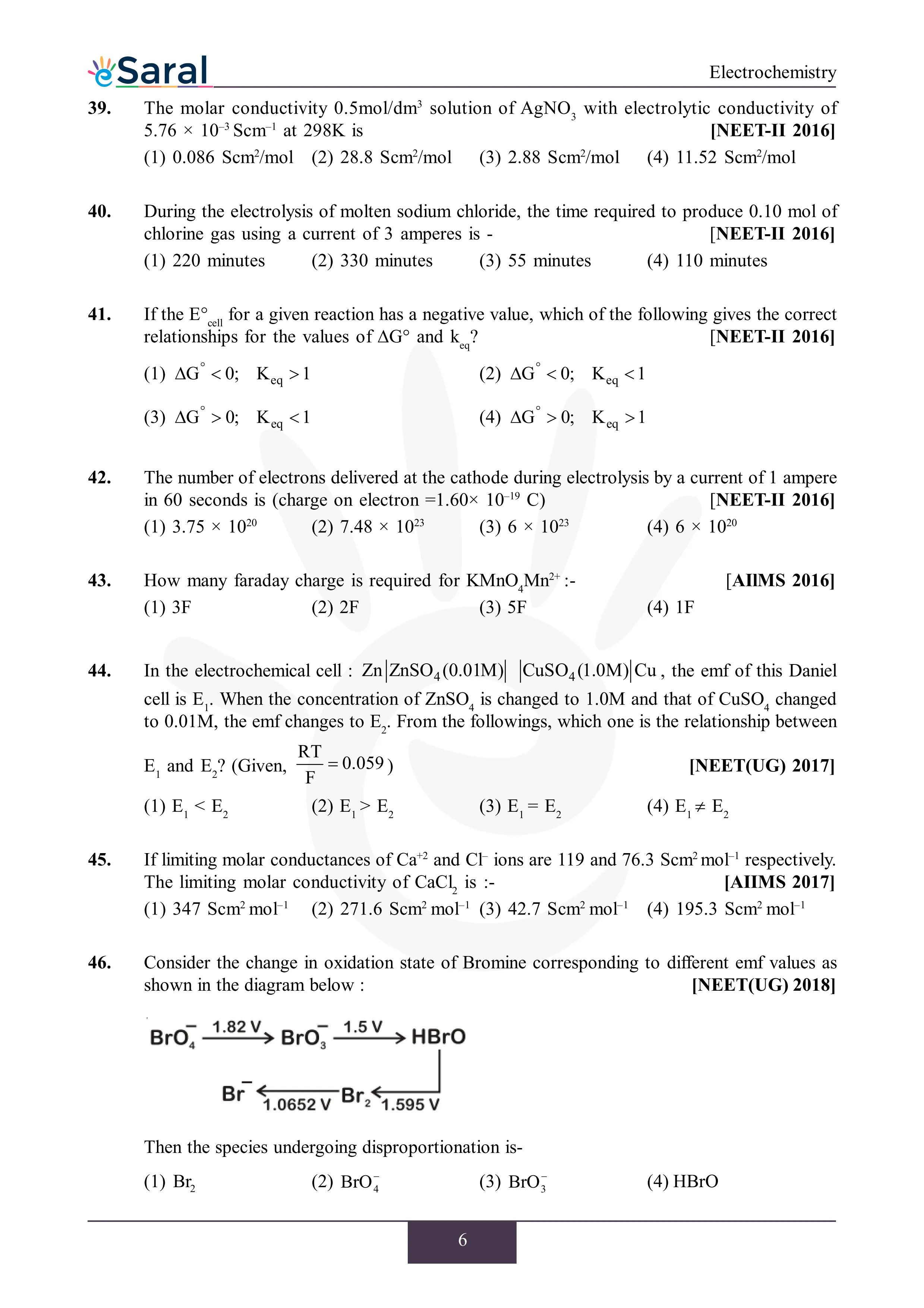
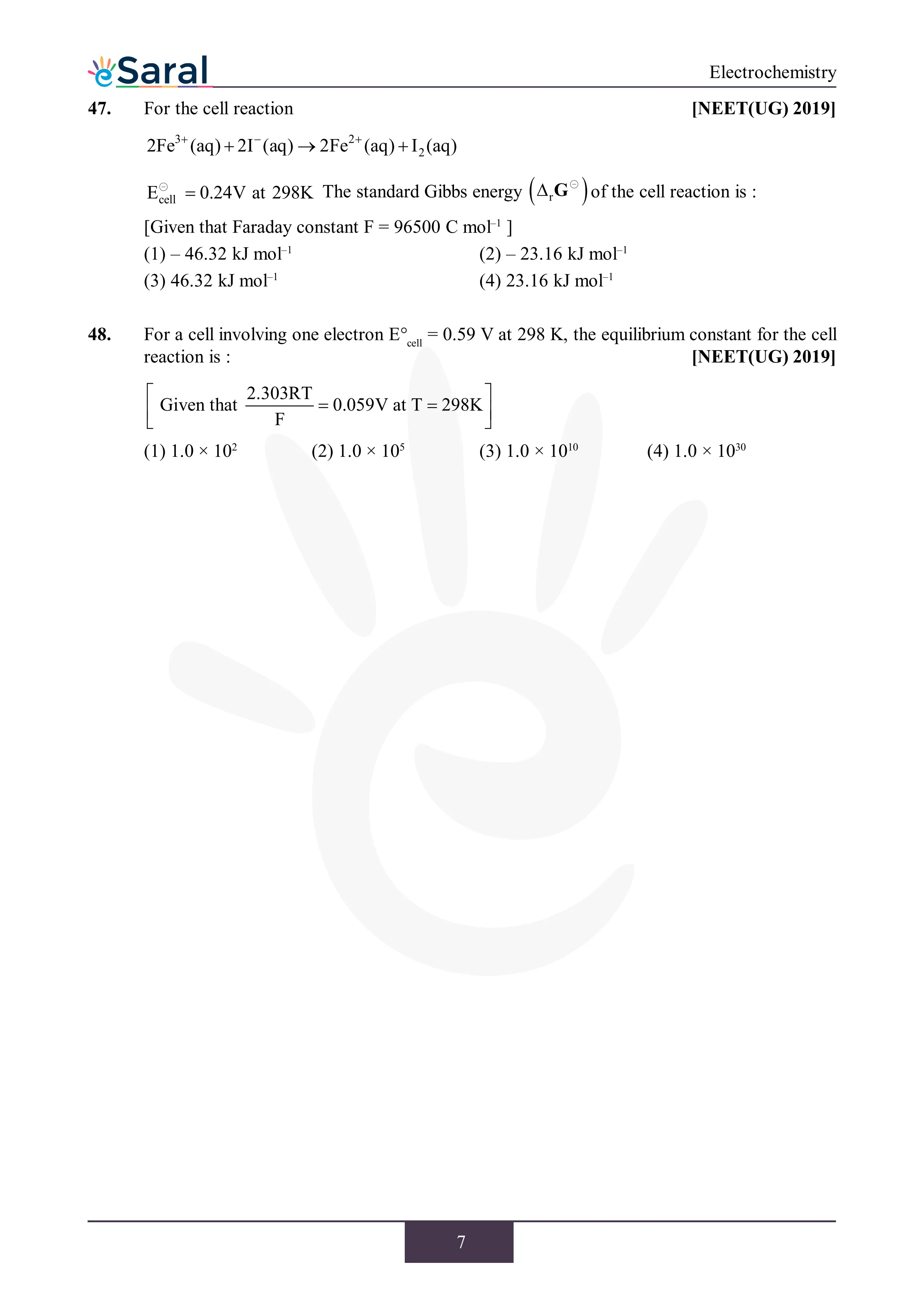
NEET PYQs: Electrochemical Cells and EMF

Common Mistakes in Electrochemistry NEET Questions
Mistake 1 — Swapping Anode and Cathode in EMF Calculation
The most common error: students subtract E°cathode from E°anode instead of the reverse.
Correct formula: E°cell = E°cathode – E°anode
Remember: RED CAT — Reduction at Cathode. The cathode always has the higher reduction potential in a spontaneous cell.
Mistake 2 — Wrong Q in the Nernst Equation
Q is always products over reactants — but pure solids (Zn, Cu) are not included. For Zn | Zn²⁺ || Cu²⁺ | Cu, Q = [Zn²⁺]/[Cu²⁺]. Students who include solid concentrations get the wrong answer.
Mistake 3 — Using Wrong n in Faraday's Law
n is the number of electrons transferred per ion — not the charge of the ion. For Cu²⁺ → Cu, n = 2. For Al³⁺ → Al, n = 3. Always write the half-reaction first to determine n before substituting.
Mistake 4 — Forgetting to Convert Units
F = 96500 C/mol. If current is in mA, convert to A first. If time is in minutes, convert to seconds. ΔG° comes out in joules from ΔG° = –nFE° — remember to divide by 1000 for kJ.
| Mistake | How to Avoid |
|---|---|
| E°cell = E°anode – E°cathode | Always: E°cell = E°cathode – E°anode |
| Including pure solids in Q | Only include dissolved species in Q |
| Using wrong n in Faraday's law | Write the half-reaction first, count electrons |
| Not converting units | Check: current in A, time in s, before substituting |
| Confusing Λm and Λm° | Λm° is at infinite dilution; Λm is at given concentration |
Frequently Asked Questions
Find answers to common questions.
How many questions come from Electrochemistry in NEET every year?
Electrochemistry contributes 2–3 questions in NEET Chemistry almost every year, making it one of the highest-scoring chapters in the section. Topics tested consistently include the Nernst equation, Faraday's laws of electrolysis, Kohlrausch's law, and the relationship between ΔG°, E°cell, and equilibrium constant K.
What is the weightage of Electrochemistry in NEET Chemistry?
Electrochemistry carries approximately 5–8% weightage in NEET Chemistry, contributing 2–3 questions worth 8–12 marks. It is part of the Class 12 Chemistry syllabus and consistently appears in every NEET paper. Along with Chemical Kinetics and Coordination Compounds, it is one of the three highest-weightage chapters in NEET Class 12 Chemistry.
What is the Nernst equation and how is it used in NEET?
The Nernst equation relates cell EMF to standard EMF and ion concentrations: E_cell = E°cell – (0.0592/n) log Q at 298 K. In NEET, it is used to calculate actual cell potential when concentrations are not 1 M. Q is the reaction quotient — products over reactants, excluding pure solids and liquids.
How do I calculate mass deposited using Faraday's first law?
Use the formula m = (M × I × t) / (n × F), where m is mass deposited in grams, M is molar mass, I is current in amperes, t is time in seconds, n is electrons transferred per ion, and F = 96500 C/mol. Always write the half-reaction first to determine n before substituting values.
Is NCERT enough for Electrochemistry NEET questions?
Yes — NCERT Class 12 Chemistry Chapter 3 is sufficient for all Electrochemistry questions in NEET. Every formula, concept, and example tested in NEET traces back to the NCERT text. Students should solve all in-text examples and exercise questions thoroughly. Explore NCERT Solutions for Class 12 Chemistry for step-by-step solutions to every NCERT Electrochemistry question.