Enzymes - NEET Previous Year Questions with Complete Solutions
Enzymes are high-yield NEET Biology topics from the Biomolecules chapter, frequently contributing 2–4 marks through questions on enzyme action, inhibition, cofactors, and NCERT-based concepts, making PYQ practice essential for exam success.
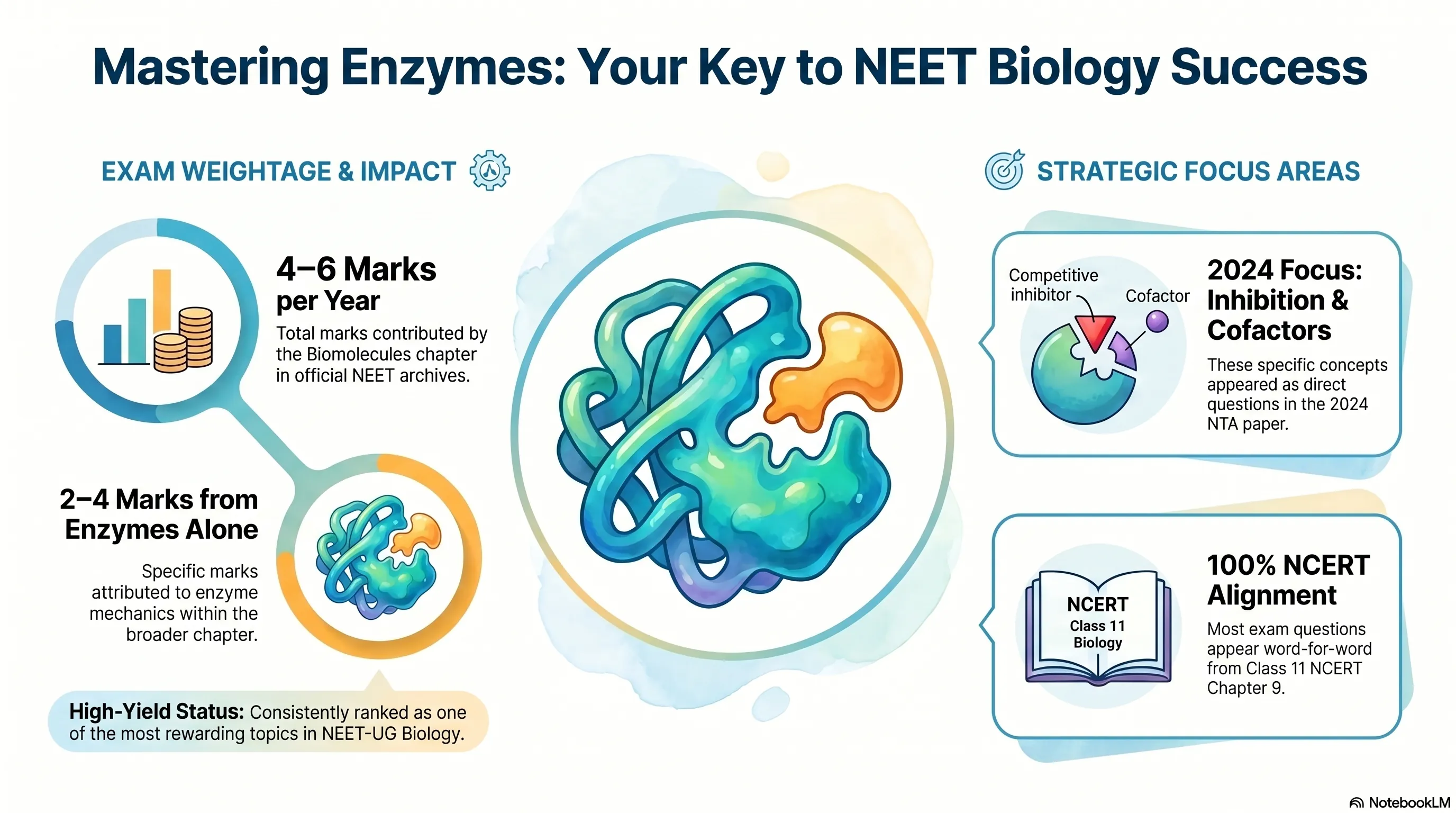
Table of Contents


Why Enzymes Matter in NEET Biology
Enzymes sit inside the Biomolecules chapter of Class 11 NCERT Biology (Chapter 9), which is one of the highest-yielding chapters in NEET-UG. According to NTA's official NEET question paper archives, Biomolecules contributes 4–6 marks almost every year, and enzymes alone account for 2–4 of those marks.
For NEET 2024, NTA asked direct questions on enzyme inhibition and the role of cofactors — both concepts that appear word-for-word in Class 11 NCERT. This means students who read NCERT carefully and practice previous year questions on enzymes are directly rewarded on exam day.
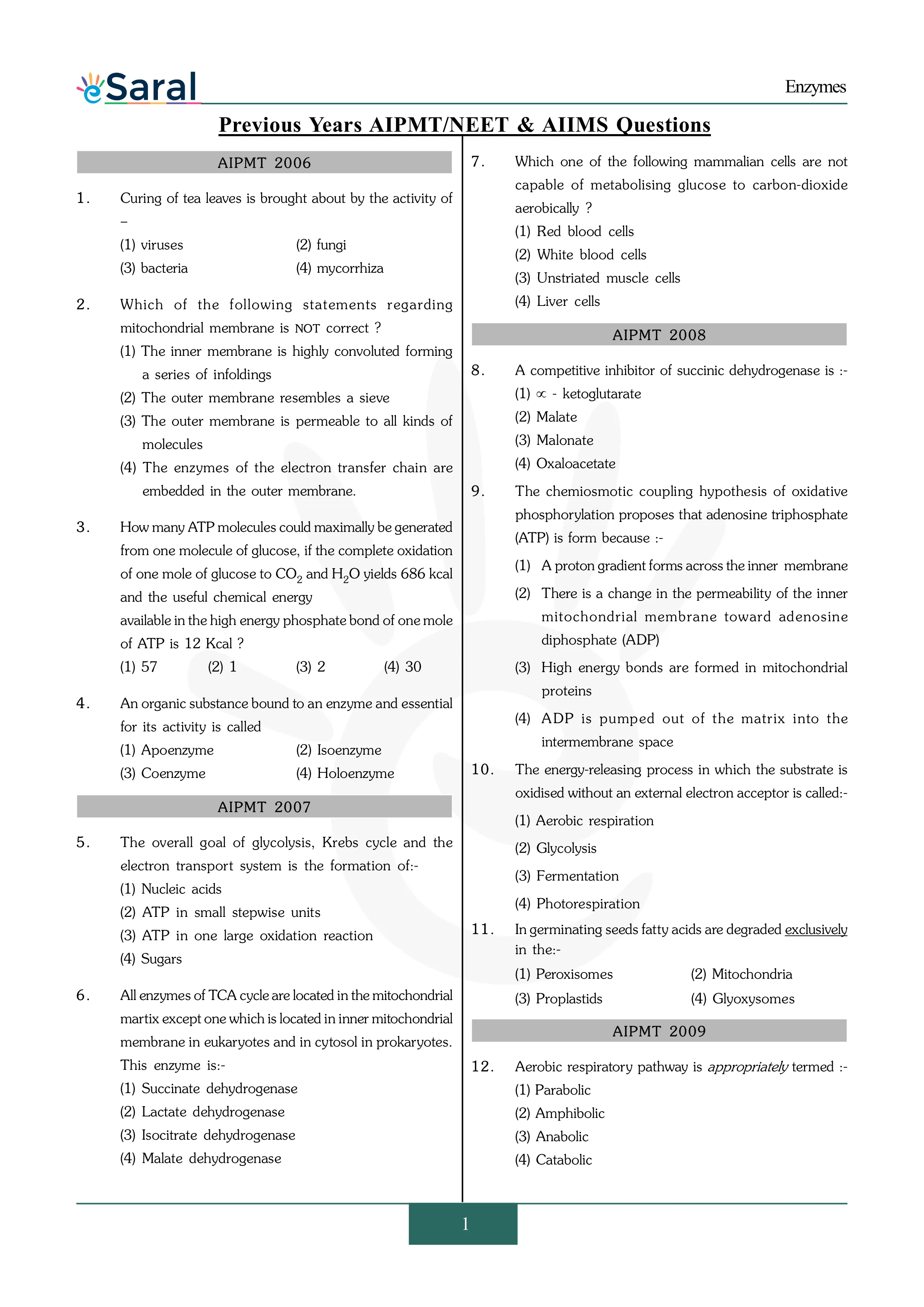
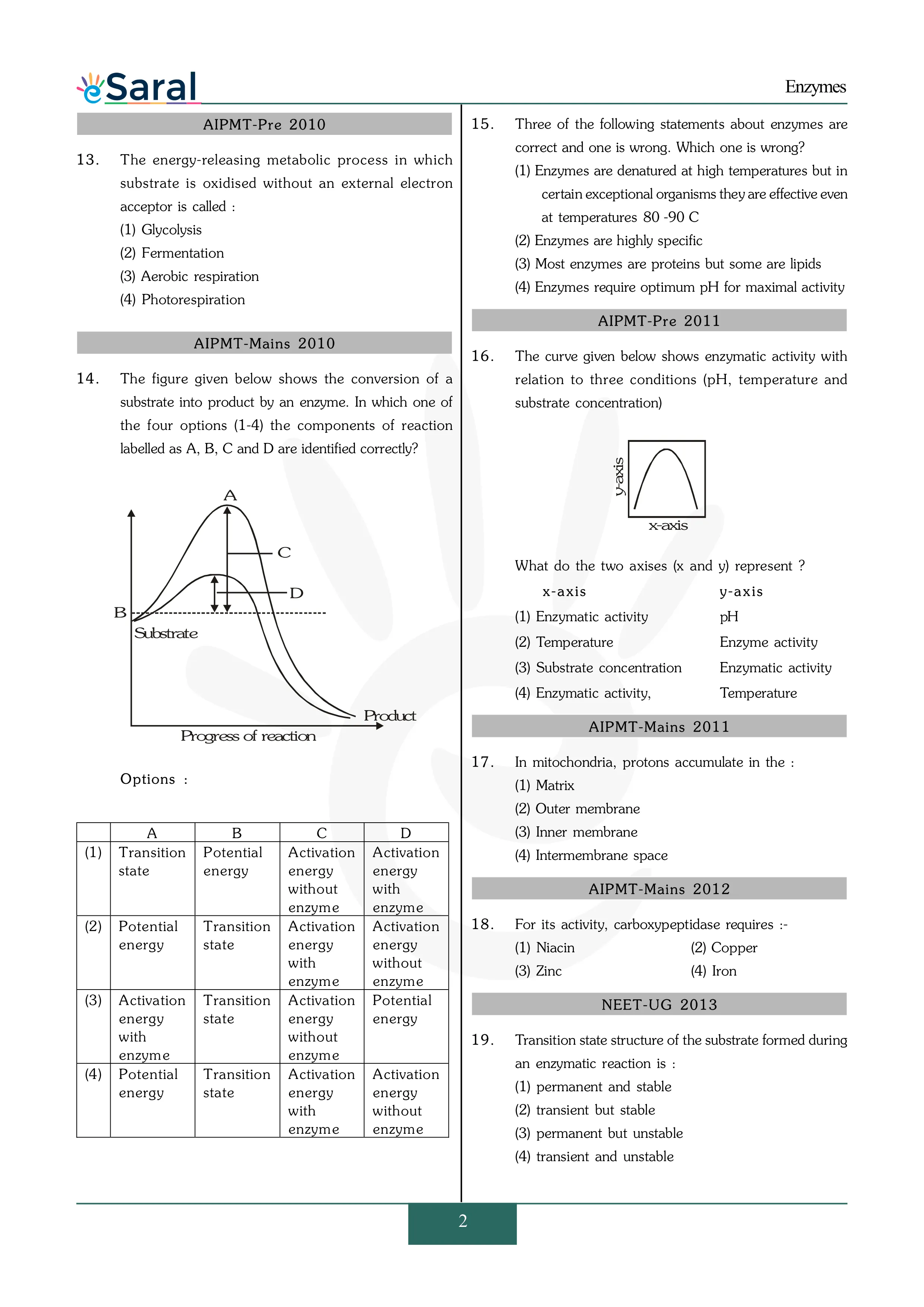
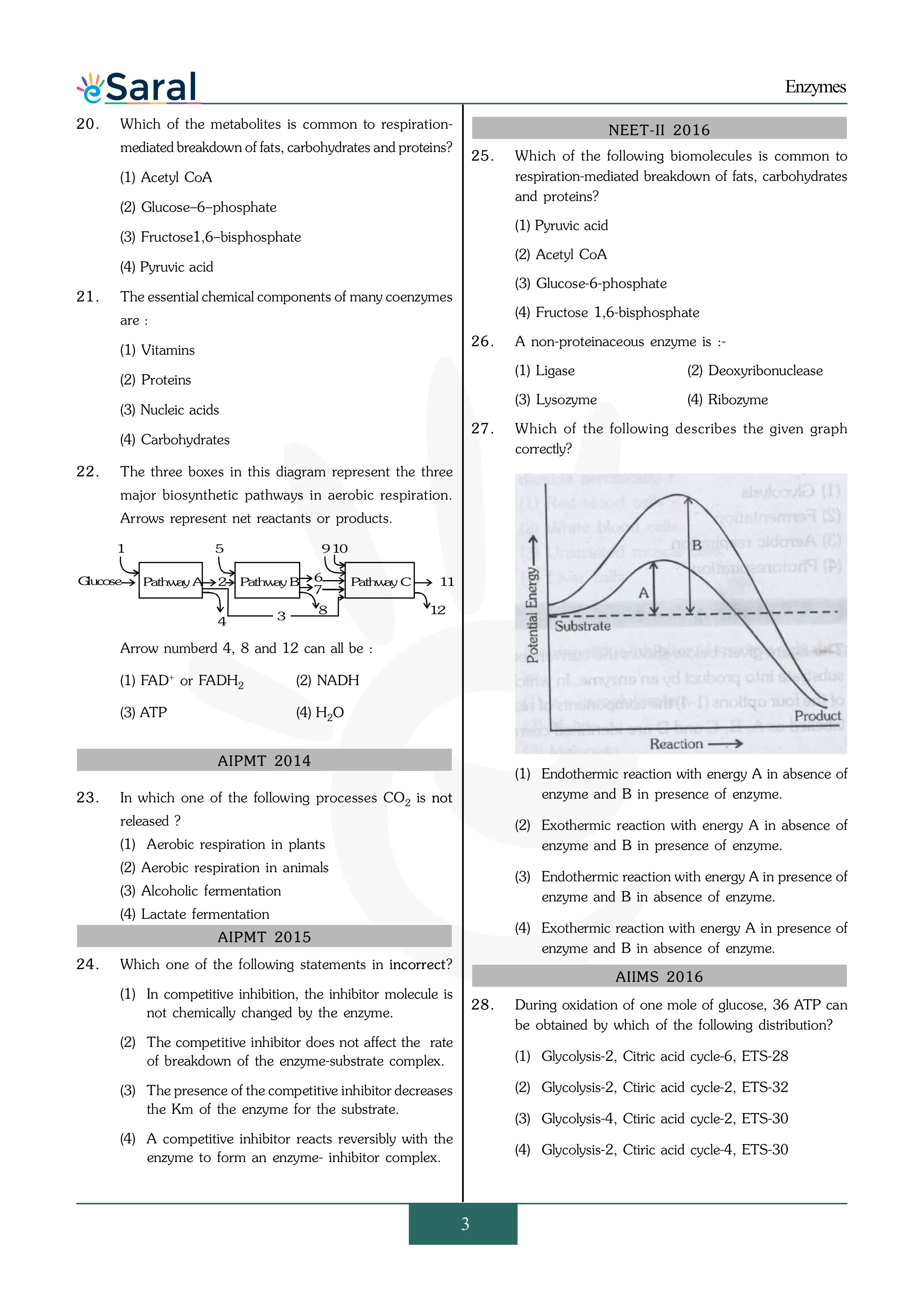
Enzymes NEET Previous Year Questions & Solutions
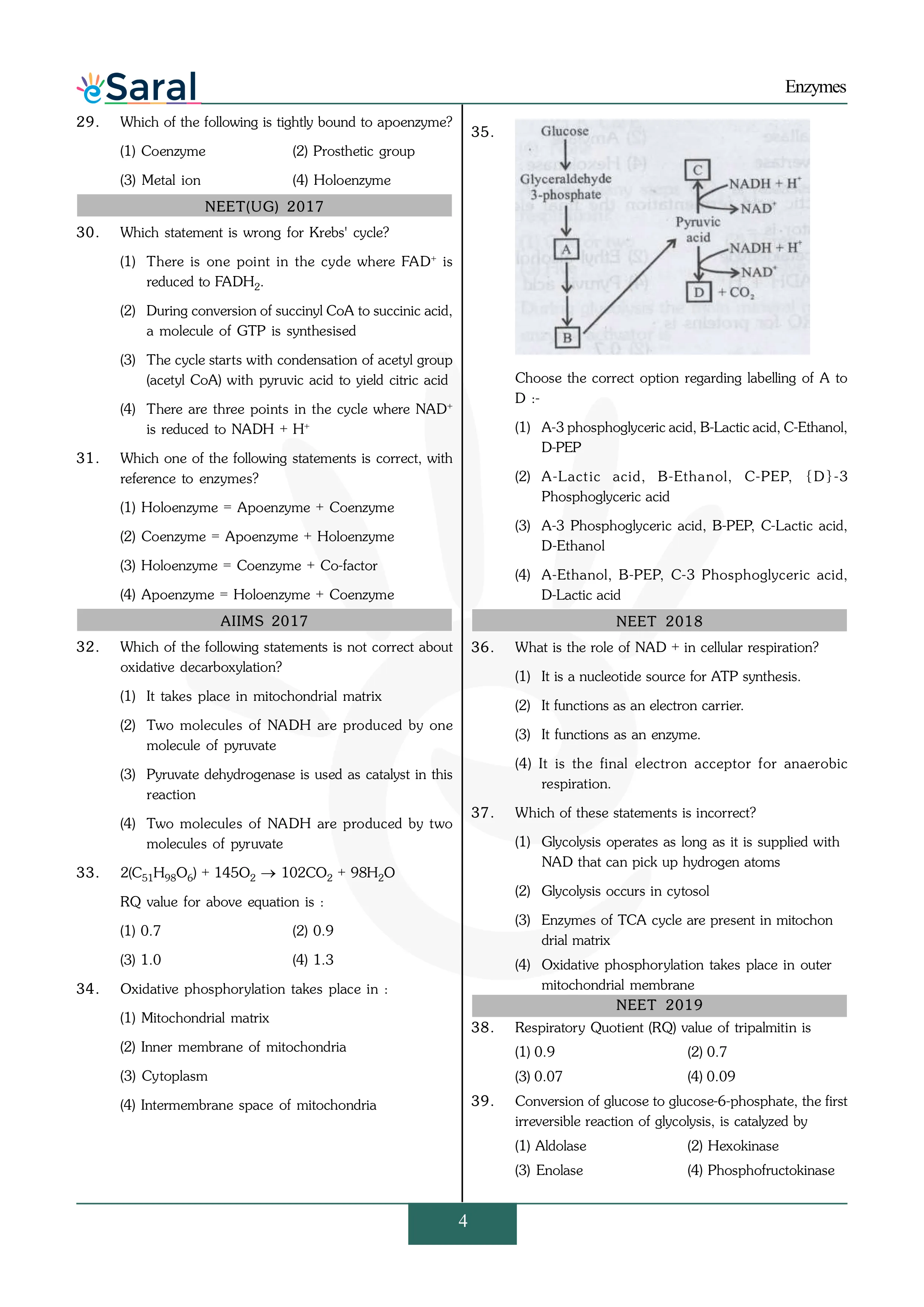

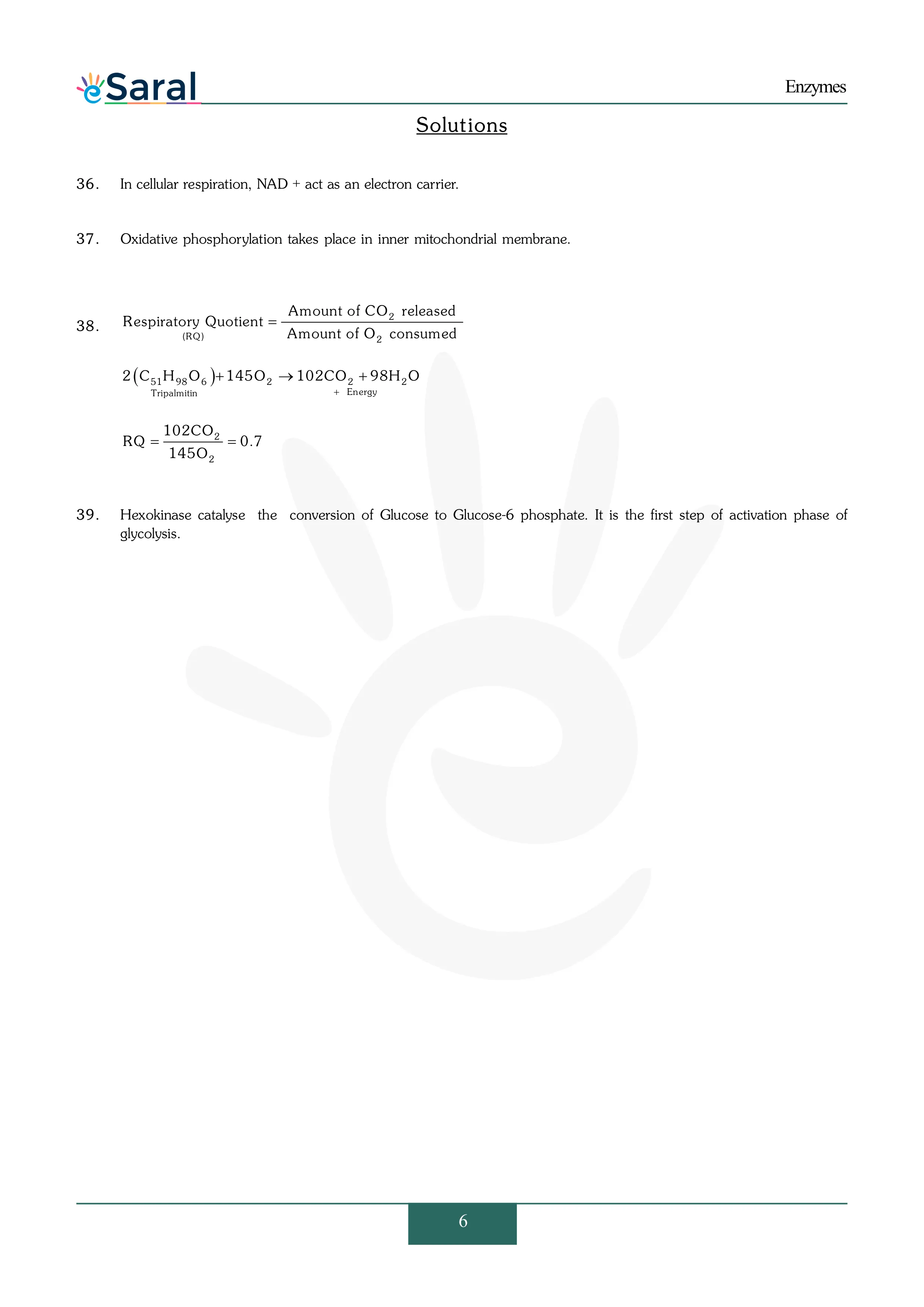
Frequently Asked Questions
Find answers to common questions.
How many questions come from Enzymes in NEET every year?
NTA typically asks 2 to 4 questions directly from the Enzymes sub-topic within Biomolecules. Some years, an additional question on enzyme-related metabolism (like the role of NAD⁺ in respiration) appears under other chapters. Over the last 10 years, enzymes have contributed 6–12 marks in total across all NEET papers.
Which enzyme topic is most important for NEET 2025 and 2026?
Competitive inhibition and the active site are the most frequently tested topics — they have appeared in 9 and 8 questions respectively across 15 years of NEET papers. Cofactors (coenzymes, prosthetic groups, metal ion activators) are the third-highest priority. Prepare these three before anything else.
Is the induced fit model or lock and key model more important for NEET?
Both models appear in NEET, but the induced fit model (Koshland, 1958) is more frequently tested in recent years (2019 onwards). NEET questions often ask students to distinguish which model explains flexibility in the active site. The induced fit model is the correct, modern explanation — the lock and key model is the historical one.
What is the difference between a coenzyme and a prosthetic group?
A coenzyme is an organic, non-protein molecule that is loosely attached to the enzyme and can be removed, such as NAD⁺ or FAD. A prosthetic group is also organic and non-protein but is tightly or covalently bound to the enzyme — for example, haem in catalase. Both are types of cofactors, and NEET distinguishes them by their binding strength.
How does competitive inhibition differ from non-competitive inhibition?
In competitive inhibition, the inhibitor molecule resembles the substrate and competes for the same active site. Adding more substrate reverses this inhibition. Km increases but Vmax remains unchanged. In non-competitive inhibition, the inhibitor binds at a different (allosteric) site, permanently reducing Vmax without changing Km. NEET most frequently tests competitive inhibition.