How Do IIT Toppers Revise?
Successful IIT toppers revise consistently with same-day, weekly, and monthly revision cycles, analyze mock test mistakes, prioritize NCERT and PYQs, and avoid new topics in the final weeks while maintaining proper sleep and routine.
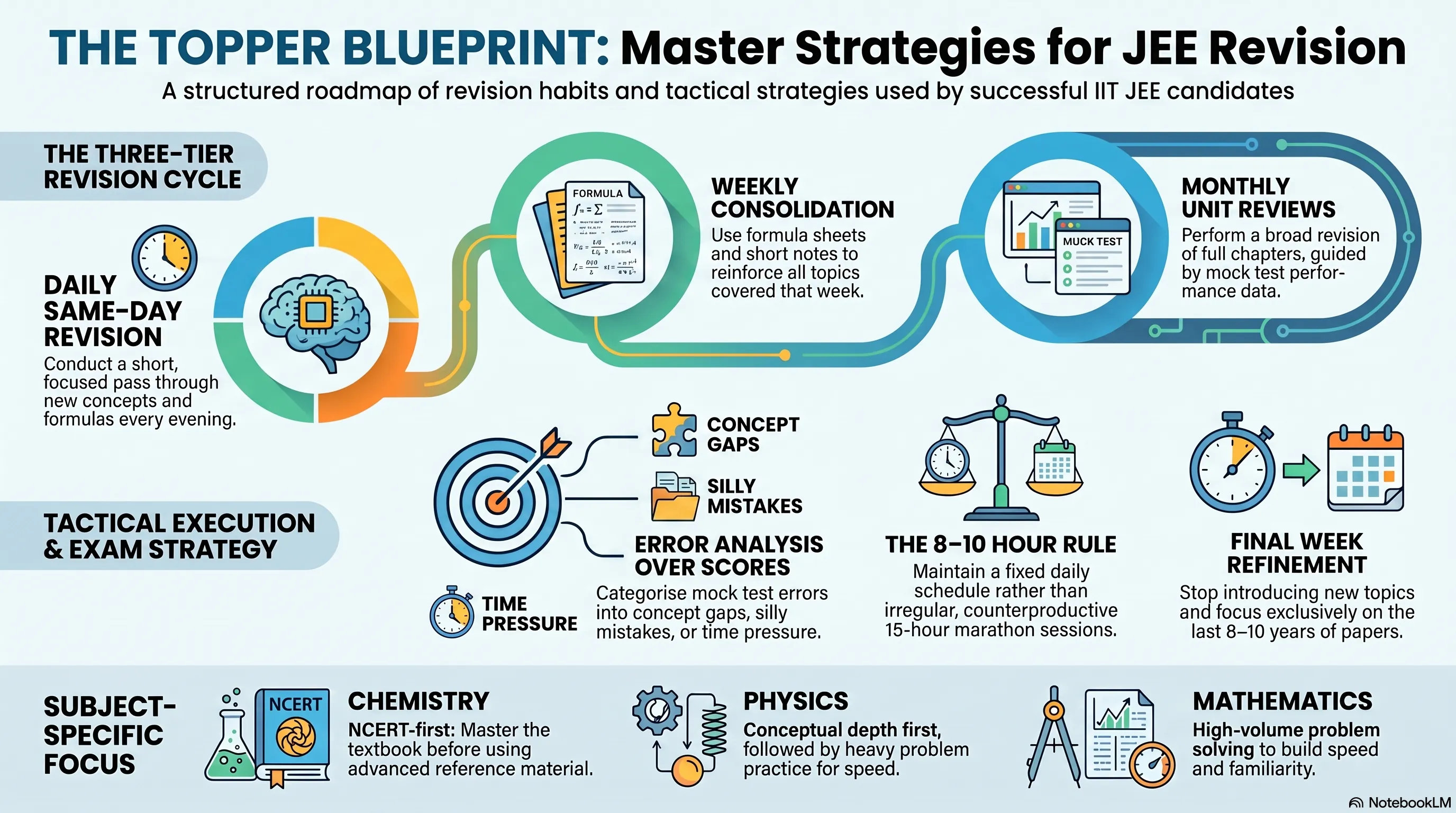
Table of Contents

eSaral › JEE › JEE Main ›How Do IIT Toppers Revise?

🚀 Checkout eSaral Courses
The Core Pattern Behind Topper Revision
Across recent topper interviews, one theme repeats: a fixed daily study schedule of 8–10 hours, maintained without exception, rather than irregular marathon sessions. Studying beyond 15 hours in a single day is consistently flagged by toppers as counterproductive — it leads to burnout and lower efficiency in the days that follow.
The other repeated theme is structure over intensity. Toppers describe having a clear plan for what to study and revise on a given day, rather than deciding day by day. This removes decision fatigue and keeps revision consistent even when motivation dips.
💡 Expert Tip from eSaral's JEE Faculty Panel: If your revision plan changes every week based on how you feel, that inconsistency is usually a bigger problem than any single weak topic. Toppers succeed with an ordinary plan followed reliably, not an extraordinary plan followed occasionally.
You can see how this fits into overall exam preparation on the JEE Advanced page and the JEE Main page.
Same-Day Revision: The Habit Almost Every Topper Mentions
One specific habit shows up repeatedly in topper interviews: revising classroom topics on the same day they're taught, rather than letting revision pile up. This keeps concepts fresh and prevents the common trap of accumulating a backlog that becomes overwhelming closer to the exam.
Same-day revision doesn't mean re-reading the whole topic in detail — it means a short, focused pass through the day's concepts, formulas, and problem types before moving on. This small daily habit compounds significantly over a two-year preparation window.
Why Does Same-Day Revision Matter More Than Occasional Deep Revision?
Spaced, frequent revision strengthens long-term memory far more effectively than infrequent, longer revision sessions. Toppers who revise daily are essentially doing what spaced repetition research supports — reinforcing memory before it fades, rather than trying to relearn forgotten material weeks later.
Weekly and Monthly Revision Cycles
On top of same-day revision, toppers layer in weekly revision of everything covered that week, ensuring topics get reinforced at least twice before they're likely to fade. This weekly cycle is where formula sheets, short notes, and quick-reference summaries typically come in.
- Daily: Quick pass through the day's new concepts and formulas.
- Weekly: Consolidated revision of everything covered that week, often using self-made short notes.
- Monthly: A broader revision pass across full chapters or units, checked against mock test performance.
This layered cycle means no topic goes untouched for more than a few weeks at a time, which is very different from the common pattern of revising a chapter once after finishing it and not returning until right before the exam.
How Toppers Use Mock Tests in Revision
Mock tests aren't just practice for toppers — they're a core revision tool. Interviews consistently describe using mock test results to identify weak areas and direct revision time specifically at those gaps, rather than revising everything equally.
💡 Expert Tip from eSaral's JEE Faculty Panel: A mock test score by itself tells you very little. What matters is the error analysis afterward — which questions were lost to concept gaps versus silly mistakes versus time pressure, since each of those needs a different fix.
In the final weeks before the exam, several recent toppers describe narrowing their practice specifically to the last 8–10 years of JEE Advanced papers, since solving genuine past papers builds a more accurate sense of the exam's actual difficulty and question style than generic mock series alone. You can check your own progress against past performance using the JEE Advanced marks vs rank page.
Subject-Wise Revision Approach
Revision habits differ slightly by subject, based on what toppers repeatedly emphasize:
| Subject | Topper-Reported Approach |
|---|---|
| Chemistry | NCERT-first — mastering the NCERT textbook before moving to advanced reference material |
| Physics | Conceptual depth first (often through a standard reference book alongside coaching material), then heavy problem practice for speed |
| Maths | High-volume problem solving to build speed, since Maths performance is closely tied to practice volume |
The common thread across all three subjects is prioritizing question types that carry the most marks per question — multi-correct and integer-type questions in JEE Advanced specifically — since these offer the highest potential for score differentiation and are where partial marking is most underused by average aspirants.
What Toppers Do Differently in the Final Weeks
The final-weeks approach described by recent toppers is less about learning new material and more about tightening what's already known:
- Stop introducing new topics and shift entirely to revision and practice of covered material.
- Solve only genuine past-year papers, not fresh mock series, to calibrate exactly to the real exam's difficulty and pacing.
- Protect sleep and physical routine — 7–8 hours of sleep and at least 30 minutes of daily physical activity are both repeatedly cited as critical for memory consolidation and focus, not optional extras.
- Maintain regular connection with mentors or family for emotional stability, since sustained preparation over 1–2 years takes a toll that pure study hours don't account for.
💡 Expert Tip from eSaral's JEE Faculty Panel: The urge to add new study material in the last month is common but usually counterproductive. Toppers consistently narrow their focus in the final stretch, not widen it.
For a sense of how your final-weeks preparation maps to the actual syllabus, see the JEE Main syllabus page.
🚀 Checkout eSaral Courses
Frequently Asked Questions
Find answers to common questions.
How do IIT toppers revise for JEE Advanced?
IIT toppers revise through daily same-day revision of classroom topics, weekly consolidation cycles, and structured mock test analysis focused on specific weak areas. This consistent, layered approach matters more than occasional long study sessions.
How many hours do JEE Advanced toppers study each day?
Most recent toppers report studying 8–10 hours daily on a fixed schedule maintained consistently over 1–2 years. Studying beyond 15 hours in a single day is generally described as counterproductive due to burnout.
Do toppers revise the same day they learn a topic?
Yes, same-day revision of classroom topics is one of the most consistently mentioned habits across topper interviews. This prevents backlog and reinforces memory before it starts to fade.
What do toppers do in the last month before JEE Advanced?
In the final weeks, toppers typically stop learning new material and focus on revising covered topics and solving genuine past-year JEE Advanced papers. Protecting sleep and physical activity is also consistently emphasized during this period.
How do toppers use mock test results for revision?
Toppers use mock test results to identify specific weak areas and direct revision time toward those gaps rather than revising everything equally. Detailed error analysis after each mock, not just the score, is what drives their revision priorities.