Hydrocarbons - NEET Previous Year Questions with Complete Solutions
Hydrocarbons is a core NEET Organic Chemistry chapter covering alkanes, alkenes, alkynes, aromatic compounds, reaction mechanisms, and named reactions, with 1–2 questions appearing regularly and forming the foundation for advanced organic chemistry topics.
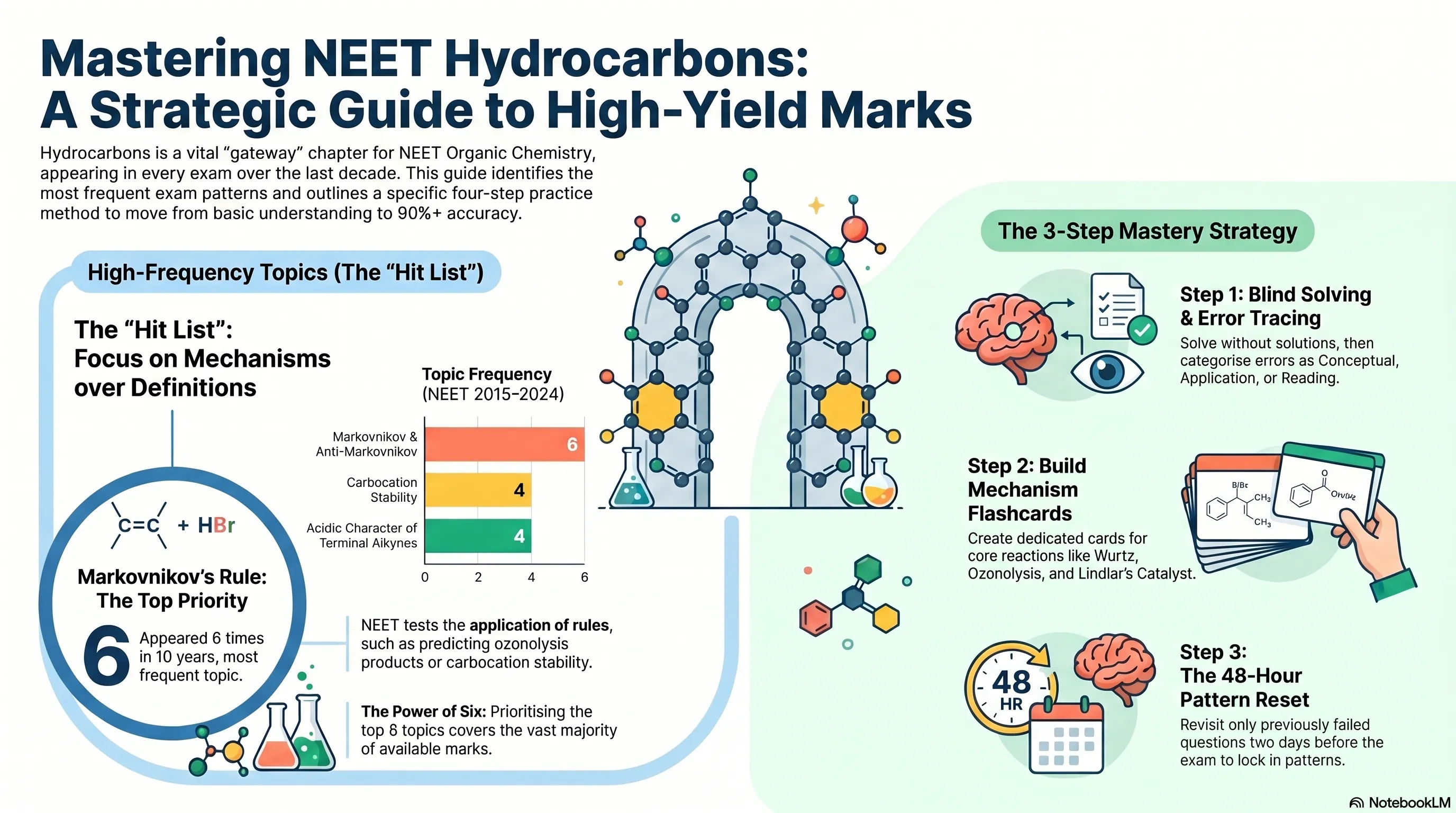
Table of Contents

eSaral › NEET ›Hydrocarbons - NEET Previous Year Questions with Complete Solutions

🩺 Explore NEET Courses
Hydrocarbons in NEET: Chapter Weightage and Exam Pattern
Hydrocarbons contributes 1–2 questions per NEET UG paper, placing it in the moderate-weightage category for Class 11 Organic Chemistry. Over the past 10 years, the chapter has never been skipped entirely — making it a reliable source of marks if prepared thoroughly.
Why this chapter matters beyond its direct weightage:
Hydrocarbons is the gateway to all of organic chemistry. The reaction mechanisms — carbocation stability, Markovnikov's rule, electrophilic addition, electrophilic aromatic substitution — appear repeatedly in Class 12 chapters including Haloalkanes, Alcohols, Aldehydes and Ketones, and Carboxylic Acids. A strong foundation in Hydrocarbons multiplies your score across the entire Organic Chemistry section.
| Exam Year | No. of Questions from Hydrocarbons | Sub-topics Covered |
|---|---|---|
| 2024 | 1 | Aromaticity, Hückel's rule |
| 2023 | 2 | Alkene reactions, Markovnikov addition |
| 2022 | 1 | IUPAC nomenclature |
| 2021 | 2 | Alkyne reactions, acidic character of alkynes |
| 2020 | 1 | Benzene reactions, EAS mechanism |
| 2019 | 2 | Carbocation stability, alkene isomerism |
| 2018 | 1 | Ozonolysis products |
| 2017 | 2 | Baeyer's reagent, alkene identification |
| 2016 | 1 | Arenes, directive influence of substituents |
| 2015 | 1 | Wurtz reaction, alkane synthesis |
💡 Expert Tip by Prateek Gupta, IIT Bombay: "Students underestimate Hydrocarbons because it feels like a 'theory chapter.' It is not. NEET questions from this chapter are almost always reaction-based or mechanism-based — they test whether you can apply Markovnikov's rule or predict the product of ozonolysis, not just define it."
Hydrocarbons NEET Previous Year Questions: Alkanes

What Are the Most Repeated Topics in Hydrocarbons for NEET?
Based on analysis of NEET UG papers from 2015 to 2024, these are the highest-frequency topics — ranked by number of appearances:
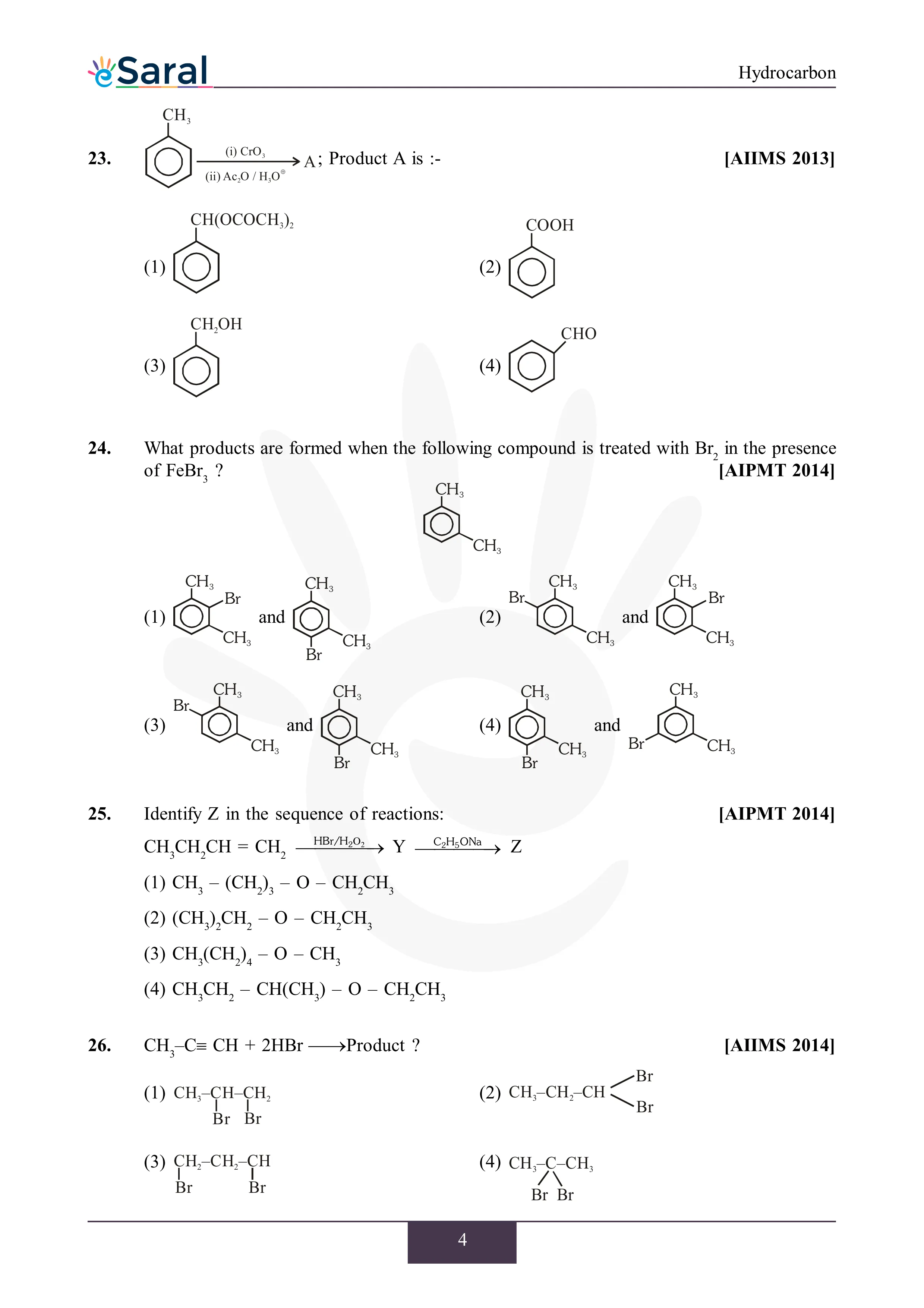
- Markovnikov's rule and anti-Markovnikov addition (peroxide effect of HBr) — appeared 6 times in 10 years
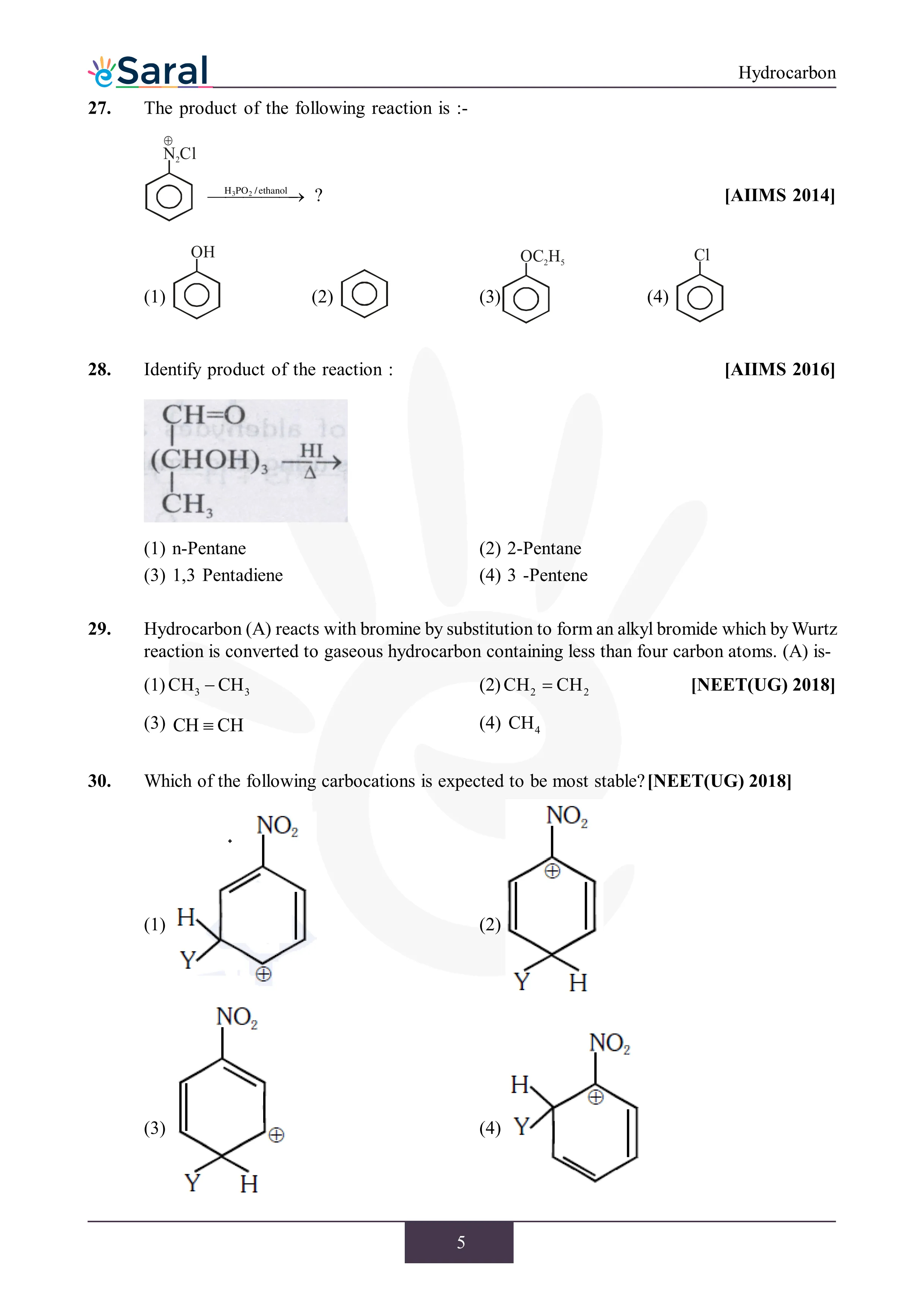
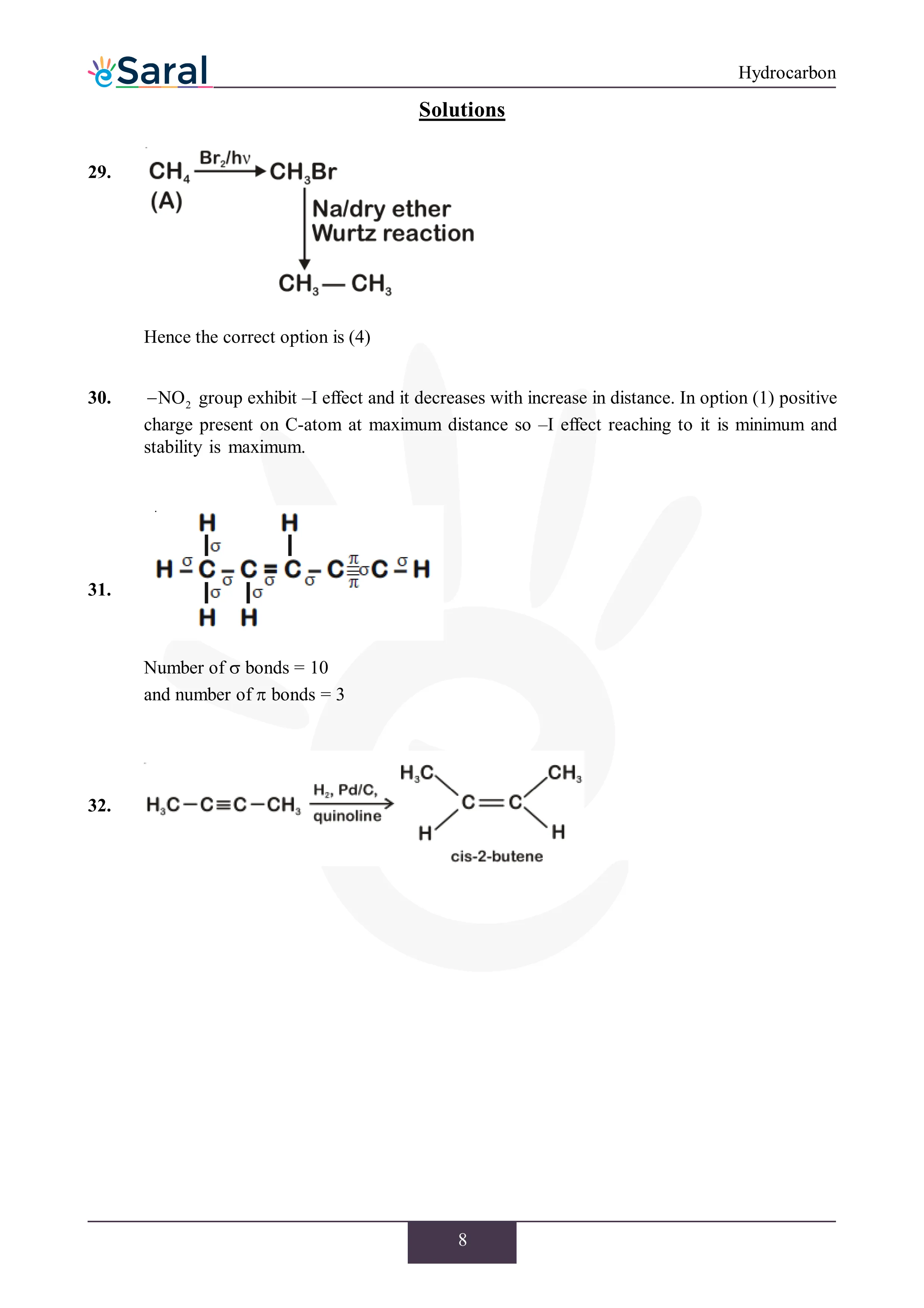
- Carbocation stability order — appeared 4 times
- Acidic character of terminal alkynes (sp hybridisation, s-character) — appeared 4 times
- Ozonolysis products — appeared 3 times
- Hückel's rule and aromaticity — appeared 3 times
- Directive influence of substituents in EAS — appeared 3 times
- Wurtz reaction — appeared 2 times
- IUPAC nomenclature of alkenes/alkynes — appeared 2 times
- Baeyer's reagent (cold dilute KMnO₄) — appeared 2 times
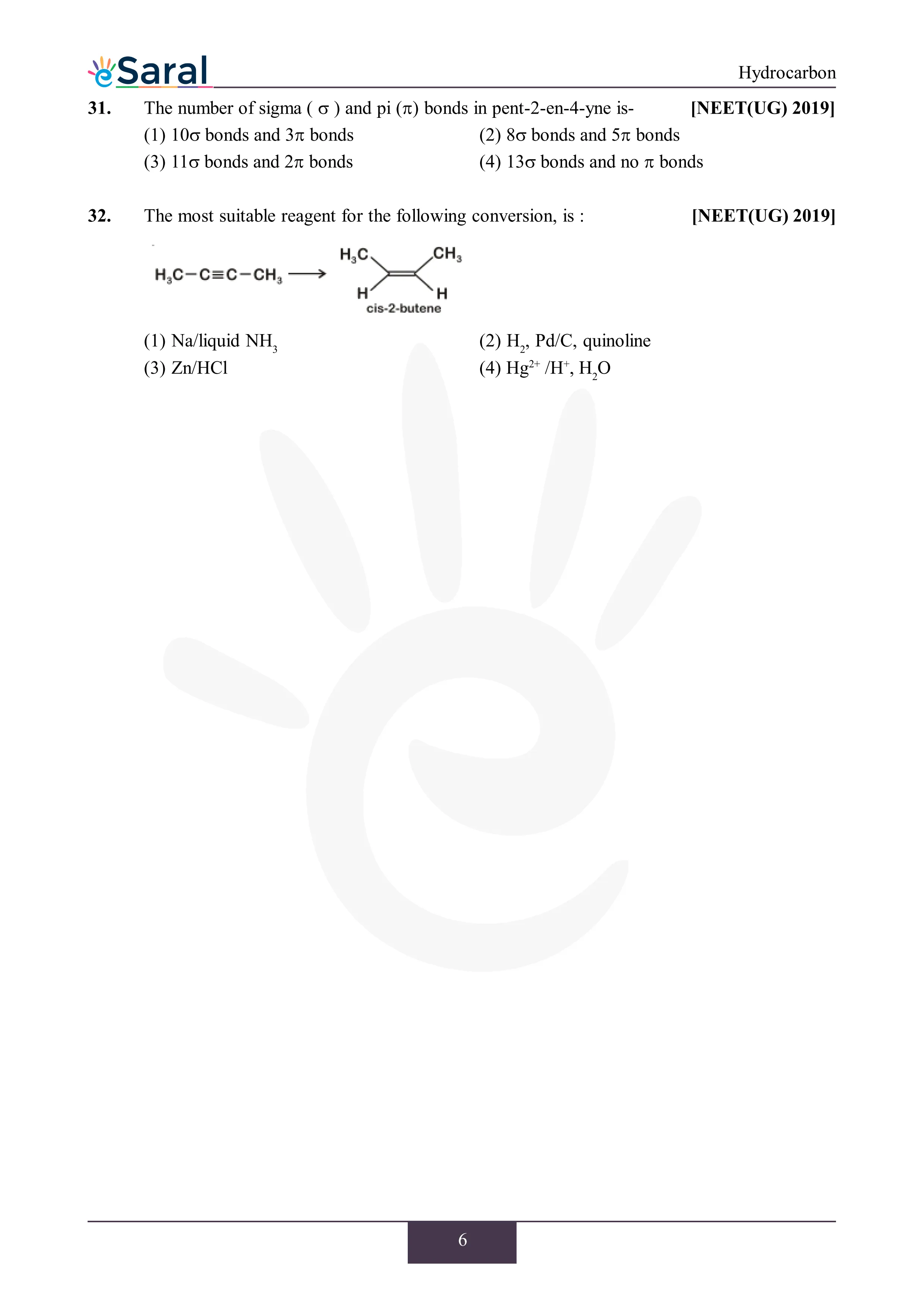
- Lindlar's catalyst vs Na/liquid NH₃ (cis vs trans alkenes from alkynes) — appeared 2 times
If you have limited time before NEET, prioritise topics 1–6 from this list. These 6 topics alone cover the vast majority of Hydrocarbons marks available in the exam.
How to Use NEET PYQs to Maximise Your Score in Hydrocarbons
Solving previous year questions without a method produces average results. Here is the approach eSaral recommends — and that has helped students move from 50% to 90%+ accuracy in Organic Chemistry:
Step 1: Solve the PYQ Without Looking at the Solution
Treat each question as a mini-exam. Attempt it first. Write down your reasoning, not just the answer choice. If you guessed, mark it.
Step 2: Check the Solution — Then Trace Your Error Type
Every wrong answer falls into one of three categories:
- Conceptual gap — you did not know the concept (Markovnikov's rule, Hückel's rule)
- Application error — you knew the concept but applied it incorrectly
- Reading error — you misread "with peroxide" or "without peroxide"
Each error type needs a different fix. Conceptual gaps require going back to notes. Application errors require more practice questions. Reading errors require slowing down.
Step 3: Build a Reaction Flashcard for Every Mechanism Tested
For Hydrocarbons, you need reaction flashcards for:
- Wurtz reaction
- Markovnikov addition (with and without peroxide)
- Ozonolysis (reductive and oxidative)
- Baeyer's test
- Lindlar's catalyst vs Na/NH₃ reduction
- EAS reactions of benzene (nitration, halogenation, Friedel-Crafts)
Step 4: Revisit This Chapter's PYQs 48 Hours Before NEET
Do not attempt new questions in the final 48 hours. Revisit only PYQs you got wrong previously. This pattern recognition is what converts 1 mark into 2 in this chapter.
Frequently Asked Questions
Find answers to common questions.
How many questions come from Hydrocarbons in NEET every year?
Hydrocarbons typically contributes 1–2 questions per NEET UG paper. The chapter has appeared in every NEET paper from 2015 to 2024 without exception. Questions focus primarily on reaction mechanisms — Markovnikov's rule, ozonolysis, acidic character of alkynes, and electrophilic aromatic substitution — rather than factual recall.
What are the most important topics in Hydrocarbons for NEET?
The most repeated topics in NEET Hydrocarbons are: Markovnikov's rule and the peroxide effect of HBr, carbocation stability, acidic character of terminal alkynes (sp hybridisation), ozonolysis products, Hückel's rule for aromaticity, and directive influence of substituents. These six topics account for over 60% of all Hydrocarbons marks in the past decade.
Is NCERT enough for Hydrocarbons in NEET?
NCERT is the foundation and must be read thoroughly — especially the reaction mechanisms, named reactions, and in-text examples. However, NEET questions often present reactions in applied or product-prediction format that requires practising PYQs and module-level questions beyond NCERT. Reading NCERT without solving questions is not sufficient.
What is Markovnikov's rule and why does it appear so often in NEET?
Markovnikov's rule states that in the addition of HX to an unsymmetrical alkene, the hydrogen adds to the carbon bearing more hydrogen atoms (the less substituted carbon), producing the more stable carbocation intermediate. It appears frequently in NEET because it is the central mechanism of alkene reactivity and connects directly to carbocation stability — both of which are high-yield NEET topics.
How is Lindlar's catalyst different from Na in liquid NH₃ for alkynes?
Both reagents reduce alkynes to alkenes, but they give opposite stereochemistry. Lindlar's catalyst (Pd/CaCO₃ with quinoline) gives cis (Z) alkene via syn addition of H₂. Sodium in liquid ammonia (Birch-type reduction) gives trans (E) alkene via anti addition. This distinction is tested in NEET as a product-identification question.