Is Class 11 More Difficult Than Class 12 for JEE?
Class 11 is generally considered conceptually harder for JEE. The jump from school-level thinking to analytical, multi-step problem-solving happens mostly in Class 11 — especially in Mechanics and Trigonometry. Class 12 carries slightly more exam weightage, but most students find it more manageable once the Class 11 foundation is actually solid.
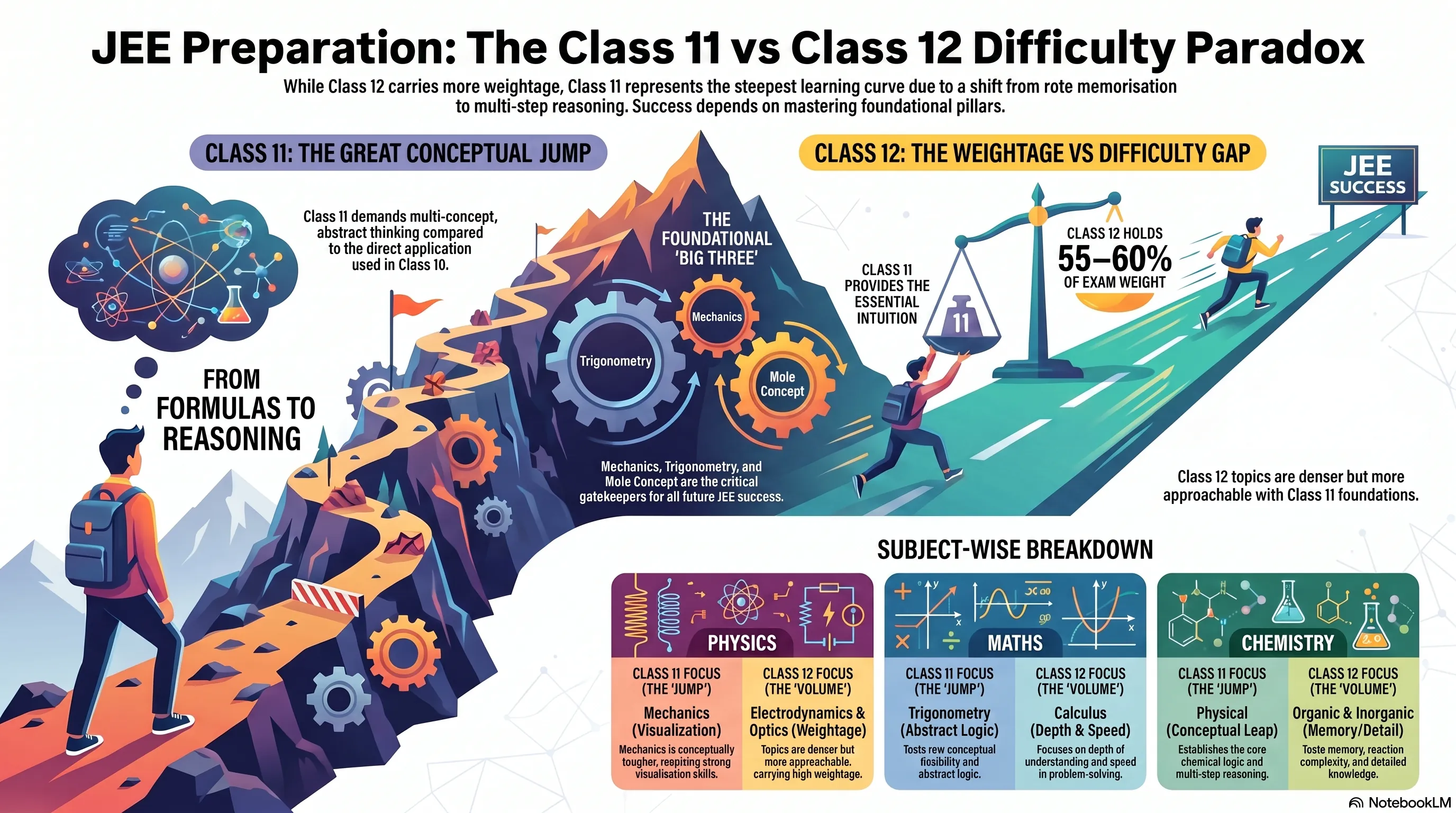
Table of Contents

eSaral › JEE › JEE Main ›Is Class 11 More Difficult Than Class 12 for JEE?

🚀 Checkout eSaral Courses
Why Class 11 Feels Harder Than Class 12
The difficulty in Class 11 isn't really about volume — it's about the type of thinking required. Class 10 rewards direct formula application and memorization. Class 11 suddenly asks for multi-concept, multi-step reasoning, often without telling you which formula to use.
This shift shows up hardest in three places: Mechanics in Physics, Trigonometry and coordinate geometry in Maths, and the Mole Concept in Chemistry. All three demand a kind of abstract, layered thinking that school exams never really tested before.
💡 Expert Tip from eSaral's JEE Faculty Panel: If Class 11 feels unusually hard, that's not a sign you're behind — it's the expected reaction to the biggest single jump in problem-solving style in the entire JEE syllabus. Class 12 builds on this jump; it doesn't repeat it.
You can see how this maps to the exam structure on the JEE Main syllabus page and the JEE Main page.
Physics: Which Year Is Actually Tougher?
Class 11 Physics is widely considered the conceptually harder half of JEE Physics, largely because of Mechanics — Kinematics, Laws of Motion, Work-Energy-Power, and Rotational Motion. These chapters demand visualization and multi-step reasoning that most students haven't practiced before.
Class 12 Physics — Electrostatics, Current Electricity, Magnetism, Optics, Modern Physics — is dense and has more overall weightage, but many students find it more approachable once Class 11's problem-solving style is already familiar. The exception is Rotational Motion (technically Class 11 in NCERT, but often taught late), which many students and faculty independently rank as the single hardest chapter in either year.
Is Class 11 Mechanics Really the Hardest JEE Physics Topic?
Yes, for most students. Mechanics questions frequently combine multiple concepts — forces, energy, and motion — in one problem, and unlike later Class 12 chapters, there's no earlier chapter to lean on for intuition. This is why faculty consistently flag Mechanics as the topic that decides whether a student's Physics foundation holds up for the rest of JEE.
Chemistry: Which Year Is Actually Tougher?
Chemistry splits difficulty differently across its three branches:
| Branch | Harder Year | Why |
|---|---|---|
| Physical Chemistry | Class 11 | Mole Concept, Equilibrium, and Thermodynamics are numerically dense and conceptually new |
| Organic Chemistry | Class 12 | Reaction mechanisms and named reactions build directly on Class 11 basics but add real complexity |
| Inorganic Chemistry | Class 12 | Coordination Compounds and d/f-Block Elements are memory-heavy and detail-dense |
Class 11 Chemistry sets up the logic — mole concept and bonding — while Class 12 tests how well that logic scales to more complex molecules and reactions. Most students find Class 11 Physical Chemistry the harder conceptual leap, and Class 12 Organic and Inorganic the harder volume to manage.
💡 Expert Tip from eSaral's JEE Faculty Panel: If Mole Concept in Class 11 feels shaky, don't move on hoping Class 12 will clarify it — it won't. Every numerical chapter in Class 12 Chemistry assumes Mole Concept is already second nature.
Maths: Which Year Is Actually Tougher?
Class 11 Maths introduces a lot of genuinely new abstract thinking — Trigonometry, Sequences and Series, Permutations and Combinations, Straight Lines, and Conic Sections — often for the first time at this depth. Trigonometry in particular is frequently cited as the topic that separates strong JEE Maths students early on.
Class 12 Maths is Calculus-heavy — Limits, Continuity, Differentiation, Integration, and Differential Equations — plus Vectors, 3D Geometry, and Probability. Calculus has a steep initial learning curve but tends to become more mechanical with practice, whereas Trigonometry-based problems keep demanding fresh insight even at an advanced level.
- Class 11 Maths tests raw conceptual flexibility across many small, distinct topics.
- Class 12 Maths tests depth and speed within a smaller number of heavily weighted topics (mainly Calculus).
Most faculty consider this close to a tie, with a slight edge to Class 11 for "hardest to first understand" and a slight edge to Class 12 for "hardest to master under time pressure."
Does Difficulty Match Exam Weightage?
Not exactly — and this is where a lot of students misjudge their preparation. Class 12 typically carries around 55–60% of JEE Main weightage against Class 11's 40–45%, but weightage measures how often a topic is tested, not how hard it is to learn.
Class 11's Mechanics, Trigonometry, and Mole Concept are lower-weightage individually but disproportionately difficult, since they're new conceptual territory. Class 12's Electrodynamics and Calculus carry more weightage but often feel more learnable once Class 11 groundwork is in place.
💡 Expert Tip from eSaral's JEE Faculty Panel: Don't allocate revision time purely by weightage percentage. A hard, lower-weightage Class 11 chapter that keeps costing you marks deserves more attention than a high-weightage Class 12 chapter you've already mastered.
How to Handle the Class 11 Difficulty Spike
- Expect the difficulty jump and don't read it as a personal weakness — it's the same jump every JEE aspirant goes through.
- Slow down specifically on Mechanics, Trigonometry, and Mole Concept, since rushing through these chapters compounds into Class 12 struggles.
- Solve fewer, harder problems rather than many easy ones once basics are clear — this is what actually builds the analytical thinking JEE rewards.
- Revisit these three chapters periodically through Class 12, since they remain the base for the highest-weightage Class 12 topics.
- Check your eligibility and exam timeline early so your preparation schedule accounts for this adjustment period — see the JEE Main eligibility criteria page and the JEE Advanced page.
-
🚀 Checkout eSaral Courses
Frequently Asked Questions
Find answers to common questions.
Is Class 11 more difficult than Class 12 for JEE?
Class 11 is generally considered conceptually harder because it introduces the analytical, multi-step problem-solving style JEE requires, especially in Mechanics and Trigonometry. Class 12 carries more exam weightage but tends to feel more manageable once the Class 11 foundation is solid.
Which is the hardest chapter in JEE Physics, Class 11 or Class 12?
Mechanics, taught in Class 11, is widely considered the hardest Physics topic in JEE due to its multi-concept, visualization-heavy problems. Rotational Motion, also part of the Class 11 syllabus in NCERT, is frequently ranked as the single toughest chapter.
Is Class 11 Maths harder than Class 12 Maths for JEE?
Class 11 Maths, especially Trigonometry, is often considered harder to first understand since it introduces new abstract concepts. Class 12 Maths, dominated by Calculus, has a steep initial curve too but becomes more mechanical with practice.
Does Class 12 have more weightage than Class 11 in JEE Main?
Yes, Class 12 typically carries around 55-60% of JEE Main weightage compared to Class 11's 40-45%. However, weightage reflects how often topics are tested, not how difficult they are to learn.
Why does Class 12 feel easier than Class 11 for many JEE students?
Class 12 often feels easier because the hardest adjustment, shifting from school-style thinking to JEE-style analytical problem-solving, already happens in Class 11. Once that shift is made, Class 12 topics build on familiar reasoning patterns.