Is It Too Late to Start JEE Preparation? Honest Answer + Catch-Up Roadmap

Table of Contents

eSaral › JEE › Is It Too Late to Start JEE Preparation

Yaar, take a breath. If you're reading this at 11 PM, heart racing because you feel like everyone else is months ahead of you—you're not alone, and you're not finished. Thousands of students who cracked JEE were sitting exactly where you are right now, Googling this same question.
This article is written by eSaral's faculty team—educators who have personally coached students from "I haven't opened my textbook yet" to JEE Main selections. The goal here is simple: give you an honest, practical answer with no false comfort and no scare tactics.
Let's get straight into it.
Why So Many Students Ask This Question
The anxiety around starting late is one of the most common experiences in JEE preparation. Understanding why it happens is actually the first step to moving past it.
The Comparison Trap
Coaching culture in India starts early. By the time many students reach Class 11, they're hearing stories of batchmates who "started in Class 9." Social media amplifies this. A single Instagram reel of someone's 10-hour study schedule can make a student who just opened their Physics book feel hopelessly behind.
Here's the truth: most students who "started early" also wasted large chunks of that time. Beginning early and studying effectively are two very different things.
The Information Overload Problem
The JEE preparation space is flooded with conflicting advice—15-hour study days, impossible schedules, and lists of "100 must-solve books." A student who starts late reads all of this and immediately feels overwhelmed before even attempting a single problem.
Expert Tip by eSaral Academic Team: "The students who succeed after a late start are seldom the ones who tried to do everything. They're the ones who identified the highest-weightage topics, committed to those first, and built momentum chapter by chapter."
A late start creates panic. Panic leads to poor decisions—jumping between books, studying 15 hours one day and zero the next, skipping mock tests because "I'm not ready." The worry itself becomes the obstacle.
What Actually Decides Your JEE Result?
Before you make a plan, it helps to understand what JEE Main is actually testing. This shapes everything.
The Real JEE Syllabus Is Smaller Than You Think
The JEE Main syllabus covers Physics, Chemistry, and Mathematics from Classes 11 and 12. But NTA data from recent years shows that roughly 60–70% of questions consistently come from a core set of high-weightage chapters — not the entire syllabus equally.
| Subject | High-Weightage Chapters (Approx.) | Typical Question Share |
|---|---|---|
| Physics | Mechanics, Electrostatics, Modern Physics, Waves | ~55–60% of Physics questions |
| Chemistry | Organic Reactions, Coordination Compounds, Thermodynamics, Electrochemistry | ~60% of Chemistry questions |
| Mathematics | Calculus, Coordinate Geometry, Algebra, Vectors | ~65% of Mathematics questions |
A student who masters these high-priority areas is already competitive. You do not need to cover every single corner of every chapter to score well in JEE Main.
Consistency Over Duration
Research from eSaral's own student cohorts shows that students who studied 6–7 focused hours daily for 8–10 months outperformed many who studied 12 unfocused hours over 2 years. Duration matters far less than the quality and consistency of your daily effort.
Is One Year Enough to Crack JEE Main?
Yes — one year is genuinely sufficient for JEE Main if you use it intelligently. This is not motivational fluff; it is backed by actual results.
In eSaral's 2027 batch, several dropper students who enrolled with significant syllabus gaps achieved 90+ percentile in JEE Main within 10–11 months of structured preparation. The pattern was consistent: high-priority chapters first, daily problem-solving, fortnightly mock tests from Month 4 onward.
Even Class 12 students who begin serious preparation in July or August of their exam year have enough time — roughly 8–9 months to the January JEE Main session — to cover the critical syllabus and solve sufficient previous year papers.
💡 Expert Tip by eSaral Academic Team: "Don't try to simulate two years of preparation in one. Instead, ask: 'What is the minimum I need to master to cross the cut-off?' Build outward from that core. JEE Main is a percentile-based exam — you don't need a perfect score; you need a better score than most."
Check the JEE Main exam dates so you can map your available months precisely and build a realistic schedule around actual deadlines.
A Realistic JEE Catch-Up Roadmap
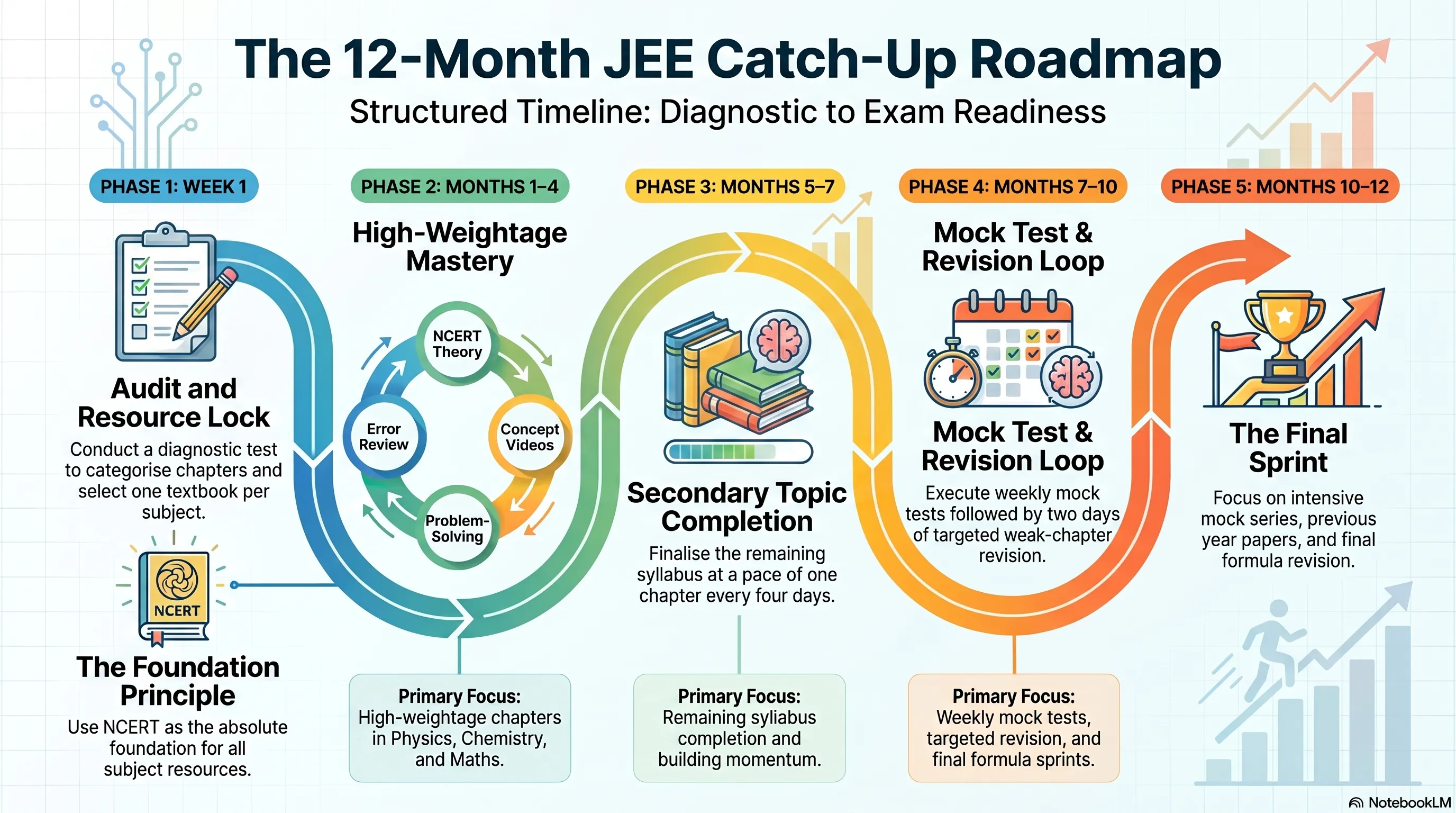
| Month | Focus |
|---|---|
| 1–4 | Complete high-weightage chapters in Physics, Chemistry, and Mathematics |
| 5–7 | Finish the remaining syllabus and strengthen weaker topics |
| 7–10 | Attempt weekly mock tests alongside targeted revision and error analysis |
| 10–12 | Focus on intensive mock series, previous year papers, and formula revision |
Common Mistakes Students Make When They Panic
Panic is the real enemy — not the calendar. Here are the five most damaging patterns we see in students who feel they're starting late.
Mistake 1: Trying to Study Everything at Once
Late starters often try to open four chapters simultaneously, switching between them every hour. Nothing gets completed. Stick to one chapter at a time, finish it, then move on.
Mistake 2: Ignoring Previous Year Papers Until "After Preparation"
JEE Main previous year question papers are your most valuable resource — not something you save for the end. Start using them from Month 3 onward for the chapters you have already covered.
Mistake 3: Measuring Progress by Hours, Not by Problems Solved
Ten hours of passive reading is worth less than three hours of active problem-solving with review. Track problems attempted and concepts revised not just time spent at your desk.
Mistake 4: Skipping NCERT
NCERT is the foundation of JEE Main Chemistry in particular. Every year, questions appear that are directly traceable to NCERT paragraphs. Students who skip NCERT because it "feels too basic" almost always leave marks on the table.
Mistake 5: Waiting Until You Feel "Ready" for Mock Tests
There is no ready. Start mock tests when you have covered roughly 40% of the syllabus. Mock tests reveal gaps you cannot find any other way.
For students targeting JEE Advanced eventually, this disciplined foundation built during catch-up preparation is exactly what they'll need to build on.
Frequently Asked Questions
Find answers to common questions.
Is one year enough to crack JEE Main for the first time?
One year is genuinely sufficient for JEE Main if used well. Students in eSaral's 2025 dropper batch who began with significant syllabus gaps achieved 90+ percentile within 10–11 months through focused, chapter-prioritised preparation. The key is daily consistency, early mock test practice, and a strict hierarchy of which topics to master first.
How to prepare for JEE in 6 months from scratch?
Focus only on high-weightage chapters for the first three months — Mechanics, Electrostatics, Organic Chemistry, Calculus, and Coordinate Geometry cover the bulk of marks. Months 4–5 fill secondary topics. Month 6 is exclusively mock tests and revision. Do not attempt the entire syllabus; prioritise ruthlessly and solve every previous year paper from the past five years.
Can I crack JEE Main if I start preparing in Class 12?
Yes, absolutely. Class 12 students who begin structured preparation between June and August have roughly 8–9 months before the January JEE Main session. That is enough time to cover high-priority chapters thoroughly, solve past papers, and attempt multiple mock tests — provided you study consistently for 6–8 hours daily without major breaks.
Should I take a drop year if I feel I started JEE preparation too late?
A drop year is worth it only if you have a genuine, honest commitment to a structured daily schedule and a clear strategy — not just the hope that "more time" will fix things. If your Class 12 preparation was seriously disrupted, a disciplined dropper batch with guided mentorship gives you the reset you need. If you're simply anxious about having started late in Class 12, stay the course and build momentum now.
What is the best JEE Main preparation strategy for a late starter?
The best JEE Main preparation strategy for a late start has three pillars: prioritise high-frequency chapters first, use previous year papers from Month 3 onward, and take weekly mock tests from Month 7 onward. Avoid switching between multiple books. One reliable resource per subject, finished completely, is far more effective than half-reading five different books.
How many hours a day should I study for JEE if I'm starting late?
Aim for 6–8 hours of focused study daily — not more. Quality beats quantity. Split your time: 3 hours new concept/problems, 2 hours revision of recently completed chapters, 1–2 hours problem-solving under timed conditions. Avoid marathon sessions that leave you too tired to retain anything the following day.
Which chapters should I skip if I have less time for JEE Main?
Never skip chapters entirely; reduce depth instead. Topics like Statistics, Mathematical Reasoning, and some low-frequency Physics chapters (e.g., Communication Systems) typically contribute 1–2 questions each. Cover these lightly — one reading pass and 10 practice questions — rather than skipping them and missing easy marks. Focus your deep effort on high-weightage chapters only.