Is Self-Study Enough for JEE The Honest Answer (2026)
Find out whether self-study is enough for JEE, how many hours you should study, a practical 8-week preparation roadmap, common mistakes to avoid, and when structured guidance can improve your results.
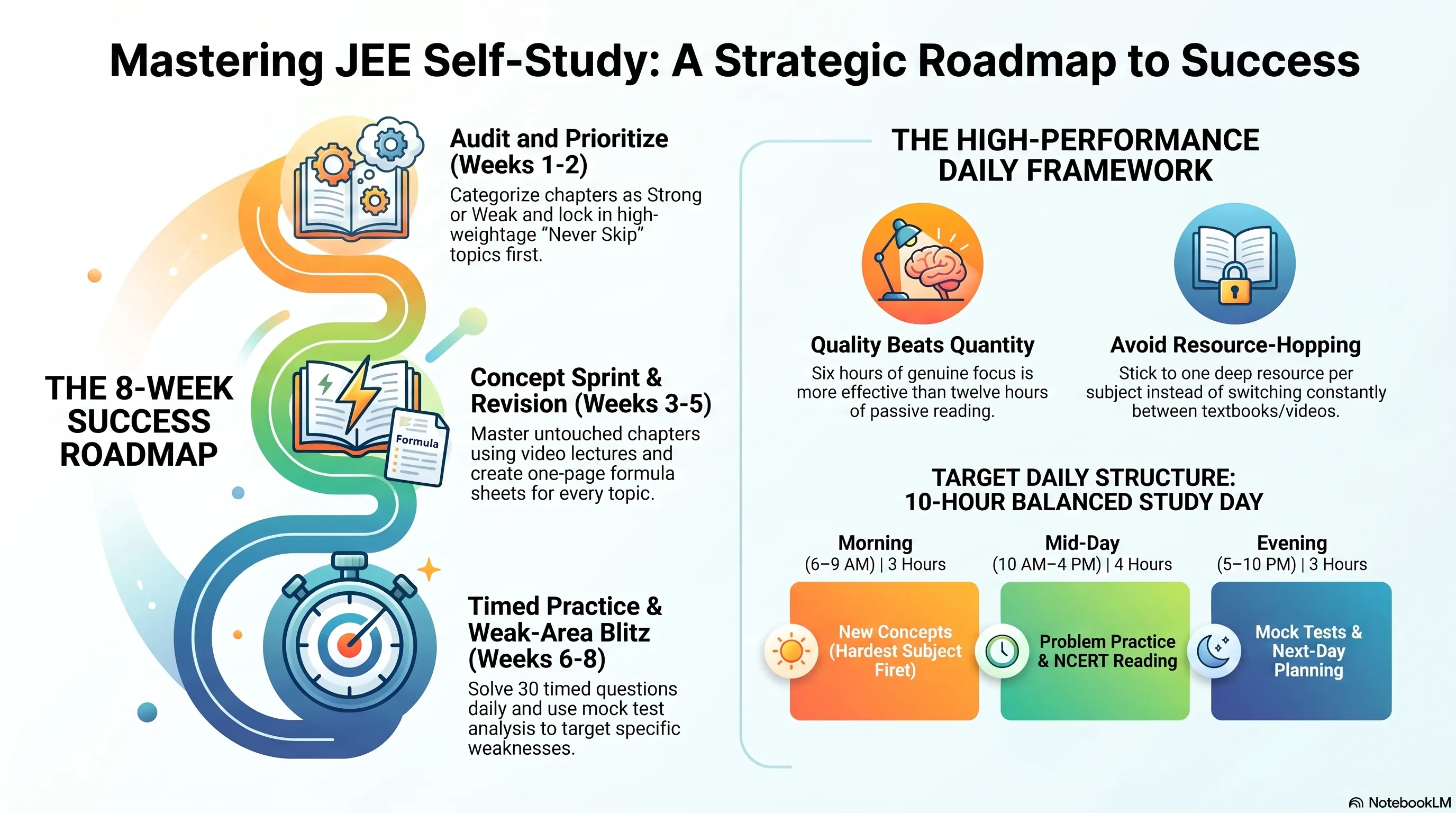
Table of Contents
- Why So Many Students Ask This Question
- What the Exam Actually Tests — and What Self-Study Can Cover
- How Many Hours of self-study are required for JEE ?
- A Realistic 8-Week Self-Study Catch-Up Roadmap
- Common Mistakes Students Make When Panicking About Self-Study
- When Should You Add Structured Support to Your Self-Study?

eSaral › JEE › JEE Main ›Is Self-Study Enough for JEE The Honest Answer (2026)

Why So Many Students Ask This Question
This worry spikes for a very specific reason. JEE are high-stakes exams where the margin between selection and rejection can be a single question. That pressure makes every student second-guess their method.
The Coaching Culture Creates Comparison Anxiety
India's competitive exam ecosystem is built around coaching institutes. When most students around you are in classroom batches, self-study can feel like a risk. But the numbers tell a different story. According to NTA data, over 13 lakh students appear for JEE Main every year. A significant portion of top scorers across all years have used a mix of self-study and online resources — not exclusive classroom coaching.
Social Media Distorts the Picture
You see highlights, not reality. Someone posting their "10-hour study vlog" is not representative of every successful aspirant. The student who quietly studied five focused hours a day, revised consistently, and cleared JEE Main with 99+ percentile does not always make a reel about it.
💡 Expert Tip by eSaral Academic Team: "Comparison is the thief of preparation time. Every hour spent worrying about someone else's method is one hour taken away from your own syllabus. Focus on your output, not their optics."
The real question is never "coaching or self-study?" The real question is always "structured or unstructured?"
What the Exam Actually Tests — and What Self-Study Can Cover
Before you decide whether your current approach is enough, understand what JEE actually reward.
JEE Main and Advanced: Core Demand Areas
JEE Main tests conceptual clarity, speed, and accuracy across Physics, Chemistry, and Mathematics. JEE Advanced adds multi-concept problems that require deep, connected understanding.
|
Subject |
Key Skill Needed |
Can Self-Study Deliver? |
|
Physics |
Concept application + numericals |
Yes, with good video/notes resources |
|
Chemistry |
NCERT mastery + organic mechanisms |
Yes, especially for Physical & Inorganic |
|
Mathematics |
Problem-solving speed + pattern recognition |
Yes, through consistent practice |
How Many Hours of self-study are required for JEE ?
This is one of the most searched questions — and the honest answer is: it depends less on hours and more on what happens inside those hours.
The Minimum Effective Study Window
Most JEE toppers report 6–8 hours of focused, distraction-free study per day during the main preparation phase. This does not mean 8 hours of sitting at a desk with a phone nearby. It means 8 hours where real learning, practice, and revision happen.
💡 Expert Tip by eSaral Academic Team: "Six hours of genuine focus beats twelve hours of passive reading every single time. If you are re-reading the same paragraph without absorbing it, close the book and take a 20-minute break. Quality of attention is the real metric."
A Realistic Daily Split (Self-Study Model)
|
Time Block |
Activity |
Duration |
|
Morning (6–9 AM) |
New concept study (hardest subject first) |
3 hours |
|
Late morning (10 AM–12 PM) |
Problem practice on yesterday's topic |
2 hours |
|
Afternoon (2–4 PM) |
NCERT reading / revision |
2 hours |
|
Evening (5–7 PM) |
Test or past paper questions |
2 hours |
|
Night (9–10 PM) |
Short revision + next day planning |
1 hour |
Total: ~10 hours. Not every day will match this. But use it as a target structure, not a rule to break yourself against.
A Realistic 8-Week Self-Study Catch-Up Roadmap
If you feel behind, this roadmap is designed to help you stabilise and accelerate — without burning out. JEE ki taiyari takes consistency, not chaos.
-
Week 1 — Audit and Prioritise (Days 1–7): List every chapter in your exam syllabus. Mark each as Strong, Weak, or Untouched. This single act removes blind panic and replaces it with a real picture.
-
Week 2 — Lock Your "Never Skip" Chapters (Days 8–14): Identify the 5–7 highest-weightage chapters per subject using past papers. These are your non-negotiables. Study nothing new until these are revision-ready.
-
Week 3–4 — Concept Sprint (Days 15–28): Cover all "Untouched" high-priority chapters, one chapter per day per subject. Use the best available video lectures. Take notes in your own words — not copy-paste.
-
Week 5 — First Full Revision Pass (Days 29–35): Revisit every chapter you studied in Weeks 3–4. Create a one-page formula/fact sheet per chapter. This is your revision backbone.
-
Week 6 — Timed Practice Begins (Days 36–42): Solve at least 30 questions per subject per day, timed. Include questions from JEE Main question papers from previous years. Track your accuracy, not just your speed.
-
Week 7 — Mock Test Week (Days 43–49): Take one full-length mock test every two days. After each test, spend equal time on analysis — what went wrong and exactly why.
-
Week 8 — Targeted Weak-Area Blitz (Days 50–56): Your mock tests have now shown you your real weak spots. Spend this week almost entirely on those areas. Do not touch new topics.
-
Final Days — Light Revision Only: No new chapters. Only revise your formula sheets, key concepts, and your personal error log.
In eSaral's 2025 preparation batches, students who followed a structured weekly roadmap like this improved their mock test scores by an average of 12–18 percentile points over eight weeks — without adding more hours, just more structure.
Common Mistakes Students Make When Panicking About Self-Study
When anxiety kicks in, students often make the same set of errors. Recognising them is the first step to avoiding them.
Mistake 1: Switching Resources Constantly
One textbook, then a YouTube channel, then a different app, then another teacher's notes. This "resource-hopping" feels productive but creates surface-level knowledge across many sources rather than deep knowledge from a few good ones. Pick one strong resource per subject and go deep.
Mistake 2: Studying Without Testing
Reading feels safe. Testing feels scary. But JEE are tests — not reading exercises. If you are not solving past papers and mocks regularly, you are training for the wrong event. Start testing yourself from Week 1, not Week 10.
Mistake 3: Ignoring Revision
New topics feel urgent. Revision feels boring. But memory research consistently shows that spaced repetition — revisiting material at increasing intervals — is how information becomes permanent. Schedule revision blocks as seriously as you schedule new learning.
Mistake 4: Studying in Isolation With No Feedback Loop
Self-study does not mean studying alone forever. It means you drive your own preparation. But you still need feedback — from mock tests, from answer key analysis, from solved examples. Without feedback, you reinforce mistakes instead of correcting them.
Mistake 5: Treating Every Chapter as Equal Priority
Not every chapter carries equal marks. Spending three days on a low-weightage topic while a high-weightage chapter remains untouched is a preparation error, not a commitment one. Always study by impact, not alphabetical order.
When Should You Add Structured Support to Your Self-Study?
Self-study works — but there are specific signals that tell you it is time to add structured guidance. Agar confusion barh rahi hai aur progress ruk gayi hai, that is a clear sign.
Signs You Need More Structure
-
Your mock test scores have plateaued for more than three weeks despite consistent practice.
-
You are unable to identify *why* you are getting questions wrong — only *that* you are.
-
You have significant gaps in Class 11 fundamentals that are blocking Class 12 topics.
-
You feel motivationally depleted and cannot self-correct your study schedule.
If two or more of these apply to you, adding a structured programme — whether for specific subjects or full preparation — is not a sign of failure. It is strategic. Explore the JEE courses at eSaral or contact the eSaral team to understand which support level matches where you are right now.
Frequently Asked Questions
Find answers to common questions.
Can I crack JEE Main without coaching through self-study alone?
Yes. Self-study is enough for JEE Main if it is structured and consistent. Many students clear JEE Main every year using only online resources, NCERT, and previous year question papers. What matters is daily accountability, timed practice, and honest revision — not the presence of a physical classroom.
Is self-study enough for NEET UG preparation?
Self-study is particularly well-suited for NEET UG because the exam is heavily NCERT-based. Biology (360 marks) can be mastered through deep NCERT reading alone. Physics and Chemistry require problem practice, but both are manageable with a disciplined self-study plan and good reference materials.
How many hours of self-study are required for JEE Advanced?
JEE Advanced demands deeper problem-solving ability than JEE Main. Most successful self-study aspirants report 8–10 focused hours per day during the final six months. Crucially, at least 3–4 of those hours must be active problem-solving — not passive reading.
What are the best resources for self-study for JEE?
NCERT textbooks form the non-negotiable base. Beyond that, use H.C. Verma for Physics, M.S. Chauhan for Organic Chemistry, and Cengage or Arihant for Mathematics. Supplement with structured video lectures and solve JEE Main past papers from at least the last five years.
Is self-study enough for dropper students preparing for JEE or NEET?
Dropper students often struggle not because self-study fails them but because they repeat the same mistakes from the previous year without a feedback mechanism. Self-study works for droppers who build a new, honest plan from scratch — identifying what went wrong before and correcting it systematically rather than just studying more hours.