JEE 2028 Preparation After Class 10: How to Get Top 100 Rank in 2 Years
JEE 2028 preparation after Class 10 should begin immediately after board exams. Students who start in Class 11 and follow a structured 2-year plan covering Physics, Chemistry, and Maths with 6–8 hours of daily focused study consistently achieve top 100 ranks in JEE Advanced. Over 65% of top-10 AIR holders in the last 20 years prepared for exactly 2 years. A top-100 rank in JEE 2028 is achievable with consistency, structured revision cycles, and the right mentorship.

Table of Contents
- What Is JEE and Why Is It So Tough?
- Can You Really Get a Top 100 Rank Starting from Class 10?
- How Many Hours Should You Study Daily for JEE Top 100?
- The 2-Year JEE Preparation Roadmap: Month-by-Month Breakdown
- Best Books and Study Material for JEE 2028
- What Do JEE Toppers Do Differently?
- How to Balance School and JEE Preparation Simultaneously

eSaral › JEE › JEE Main ›JEE 2028 Preparation After Class 10

What Is JEE and Why Is It So Tough?
JEE — the Joint Entrance Examination — is the gateway to India's IITs and NITs. It has two stages.
JEE Main is held twice a year, in January and April. Your best percentile out of the two attempts is counted. The top 2.5 lakh scorers from JEE Main qualify to appear for JEE Advanced, which is the actual IIT entrance exam. Clearing JEE Advanced is what makes you an IITian.
Why Is JEE Called One of the Toughest Exams in the World?
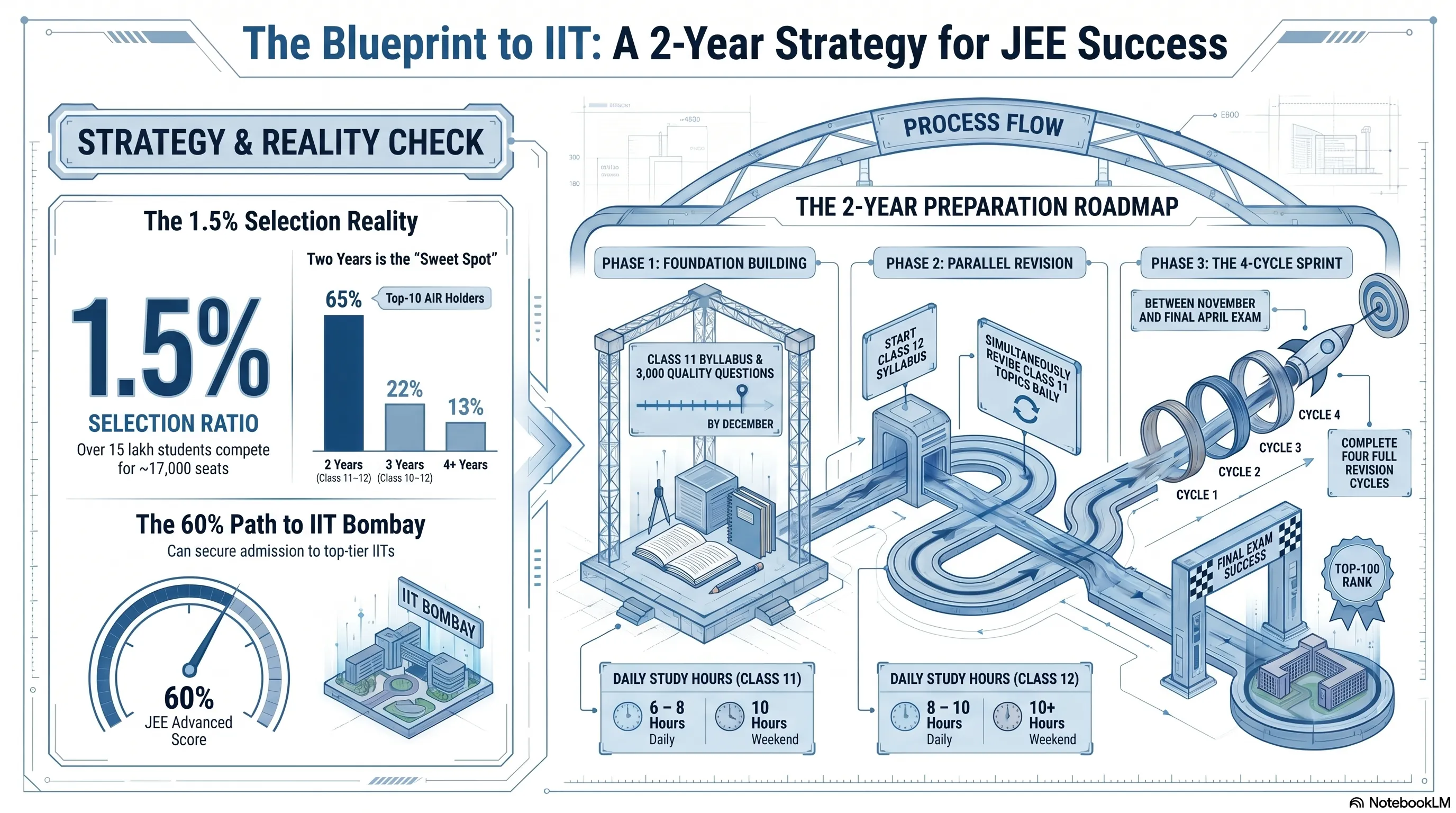
JEE Advanced tests deep conceptual understanding, not memory. Scoring just 60% in JEE Advanced can get you into IIT Bombay, which tells you exactly how hard the paper is. The difficulty is not in the volume of topics. It is in the depth at which those topics are tested.
Between 15 and 18 lakh students compete for roughly 17,000 IIT seats. That is a selection ratio of under 1.5%. According to NTA official data, the number of registered candidates has grown every year since 2020.
💡 Expert Tip by Saransh Gupta, IIT Bombay AIR-41: "JEE does not reward students who study the most — it rewards students who understand the most. Every hour you spend understanding a concept deeply is worth more than three hours spent memorising formulas."
Can You Really Get a Top 100 Rank Starting from Class 10?
Yes — and the data backs this up completely.
Over the last 20 years, the majority of AIR-1 holders in JEE Advanced have prepared for 2 years, starting from Class 11. Students who begin in Class 6 or Class 8 do not automatically have an advantage. In fact, early starters often face burnout by the time they reach Class 12.
What the Numbers Actually Say
| Preparation Duration | % of Top-10 AIR Holders (Last 20 Years) |
|---|---|
| 2 years (Class 11–12) | ~65% |
| 3 years (Class 10–12) | ~22% |
| 4+ years | ~13% |
The narrative that "you need to start in Class 6 to crack JEE" is simply not supported by results data. What matters far more is the quality and structure of those 2 years — not the quantity of years spent preparing.
At eSaral, in 2025, 1,550 students became IITians, including many who prepared entirely online from home. 1,200 students scored in the 99+ percentile in JEE Main. This is the fifth consecutive year eSaral has achieved India's highest selection ratio in JEE.
💡 Expert Tip by N.K. Gupta, 37 years of JEE teaching experience: "Every average student has the ability to become a topper. The question is never 'am I capable?' The question is always 'am I consistent?' Consistency over 2 years beats talent without structure every single time."
How Many Hours Should You Study Daily for JEE Top 100?
For a top-100 rank in JEE Advanced 2028, you need 6 to 8 hours of focused daily study in Class 11, scaling to 8 to 10 hours in Class 12 as the exam approaches.
Recommended Daily Study Schedule
| Time Slot | Activity |
|---|---|
| 6:00 AM – 7:30 AM | Morning revision / previous day notes |
| School Hours | Stay attentive, especially in PCM classes |
| 4:00 PM – 5:00 PM | Break + physical activity |
| 5:00 PM – 7:00 PM | Live coaching class (Physics / Chemistry / Maths) |
| 7:30 PM – 9:30 PM | Homework + question solving from the module |
| 9:30 PM – 10:30 PM | Daily revision of formulas + doubt clearing |
This schedule gives you approximately 6.5 to 7 hours of quality JEE study daily alongside school. On weekends, extend this to 10 hours.
The 2-Year JEE Preparation Roadmap: Month-by-Month Breakdown
Phase 1: Class 11 — Foundation Building (April 2026 – November 2026)
Complete the entire Class 11 syllabus in Physics, Chemistry, and Maths by mid-December. This is non-negotiable. Most students who fail JEE do so because they treat Class 11 casually and enter Class 12 with a weak foundation.
Key milestones:
- Complete all Class 11 chapters chapter-by-chapter with proper homework
- Give chapter-wise JEE Main tests after every chapter
- Follow up with chapter-wise JEE Advanced tests
- Solve a minimum of 3,000 quality questions across all subjects in Class 11
Phase 2: Class 12 + Parallel Revision (January 2027 – October 2027)
Start the Class 12 syllabus in January 2027 while simultaneously revising Class 11 topics. This parallel revision is what separates toppers from average students.
By October 2027, you should have completed the full 2-year syllabus.
Phase 3: Revision Cycles (November 2027 – April 2028)
| Revision Cycle | Timeline | Focus |
|---|---|---|
| 2nd Revision | November – December 2027 | Full 2-year syllabus |
| 3rd Revision + Board Prep | January 2028 | JEE Main January attempt + Boards |
| 4th Revision | February – March 2028 | JEE Advanced focused |
| Final Sprint | April 2028 | JEE Main April + Pre-Advanced tests |
Students who complete 4 full revision cycles before JEE Advanced have a dramatically higher probability of a top-100 rank. Most students complete only 1 revision. That gap is where rank differences are created.
Best Books and Study Material for JEE 2028
The most common mistake students make is trying to solve too many problems. JEE toppers use fewer books, but go deeper into each one.
Subject-Wise Book Recommendations
| Subject | Books to Use |
|---|---|
| Physics | HC Verma (Vol 1 & 2), DC Pandey (selected chapters), Irodov (for JEE Advanced practice) |
| Chemistry | NCERT (mandatory for all three sections), JD Lee (Inorganic), MS Chauhan (Organic), Narendra Awasthi (Physical) |
| Maths | RD Sharma (Class 11-12 foundation), Arihant (coordinate geometry, calculus) |
Important: If you are studying with eSaral's Brahmos batch, you do not need to separately purchase additional books. The eSaral module covers all 3,000 best-quality questions per year — which is sufficient for AIR-1. The only addition is Irodov for Physics, which your faculty will guide you on.
What Do JEE Toppers Do Differently?
After coaching thousands of JEE students at eSaral, including multiple AIR-1, AIR-2, and AIR-5 holders, here is what consistently separates toppers from the rest:
1. They Never Let Doubts Accumulate
A doubt that is not cleared within 24 hours becomes a concept gap. Concept gaps compound. By Class 12, you end up with a backlog that feels impossible to clear. Toppers clear every doubt on the same day — either in class, in doubt sessions, or through video solutions.
2. They Treat Tests as Learning Tools, Not Exams
Average students give tests to "see how they do." Toppers give tests to find weaknesses. After every test, a topper spends more time on analysis than on the test itself. They ask: What did I get wrong? Why? What is the pattern in my mistakes?
3. They Maintain Balance Across All Three Subjects
A student who is excellent in Maths but weak in Chemistry will not get a top-100 rank. JEE tests all three subjects equally. Toppers actively track their weakest subject and spend extra hours there, not on their strengths.
4. They Show Up Every Day
Consistency beats intensity. A student who studies 6 focused hours every day for 700 days will always outperform a student who studies 12 hours for 300 days and takes breaks in between.
How to Balance School and JEE Preparation Simultaneously
School and JEE preparation are not enemies — they overlap significantly, especially in Class 11 and 12, where the PCM syllabus is directly relevant to JEE.
3 Practical Rules to Manage Both
Rule 1 — Use school classes as your first pass. Pay full attention in school Physics, Chemistry, and Maths. School teachers often explain concepts differently, and that alternate explanation sometimes makes a difficult topic click.
Rule 2 — Treat Class 12 boards as a bonus, not a burden. JEE 2028 students need a minimum 75% in Class 12 boards to be eligible for IITs. Since your JEE preparation covers the entire Class 12 syllabus at a much deeper level, boards become easy if you stay on track with your JEE prep.
Rule 3 — Don't let school holidays go to waste. Diwali break, summer vacation, and winter break are when toppers accelerate. Every vacation is an opportunity to complete an extra revision cycle or strengthen a weak chapter.
Frequently Asked Questions
Find answers to common questions.
Can I crack JEE 2028 if I start preparing after Class 10?
Yes. Starting JEE 2028 preparation after Class 10 gives you the full 2-year window of Class 11 and 12 — which is the most common preparation period among top-100 AIR holders historically. Over 65% of top-10 AIR holders in the last 20 years prepared for 2 years starting from Class 11. Starting immediately after your Class 10 boards is ideal.
How many hours a day should I study for JEE to get top 100 rank?
For a top-100 rank in JEE 2028, aim for 6–8 hours of focused daily study in Class 11, increasing to 8–10 hours in Class 12. Quality matters more than quantity — 6 focused hours with zero distraction outperforms 10 hours of scattered study every time.
What is the difference between JEE Main and JEE Advanced?
JEE Main is held twice a year (January and April) by NTA and is the qualifying exam for JEE Advanced. The top 2.5 lakh scorers from JEE Main are eligible to sit for JEE Advanced, which is the actual IIT entrance exam. JEE Advanced is significantly harder and tests deeper conceptual understanding.
Is online JEE preparation good enough to crack JEE Advanced with top rank?
Yes — provided the online platform offers live, two-way interactive classes (not just recorded lectures), regular doubt-solving sessions, personalised mentorship, and a structured test series. Students in eSaral's 2025 batch who studied fully online achieved top-100 ranks in JEE Advanced, confirming that mode of study matters less than quality of teaching and mentorship.
Is eSaral good for JEE preparation?
eSaral is taught by IIT Bombay faculty including AIR-2 and AIR-41 rankers, with live two-way interactive classes and a 5-layer mentorship system. In 2025, 1,550 eSaral students became IITians and 1,200 scored 99+ percentile in JEE Main. eSaral has delivered India's highest JEE selection ratio for 5 consecutive years, making it one of India's most trusted JEE preparation platforms.
Does starting JEE prep from Class 9 or Class 8 give a real advantage?
Data from the last 20 years shows no significant advantage. The majority of top-10 AIR holders prepared for 2 years starting in Class 11. Early starters often face burnout. What matters is starting Class 11 with full seriousness, maintaining consistency, and completing multiple revision cycles before the exam.