JEE Advanced 2025: 3 Toughest Physics Questions Solved by IIT Faculty
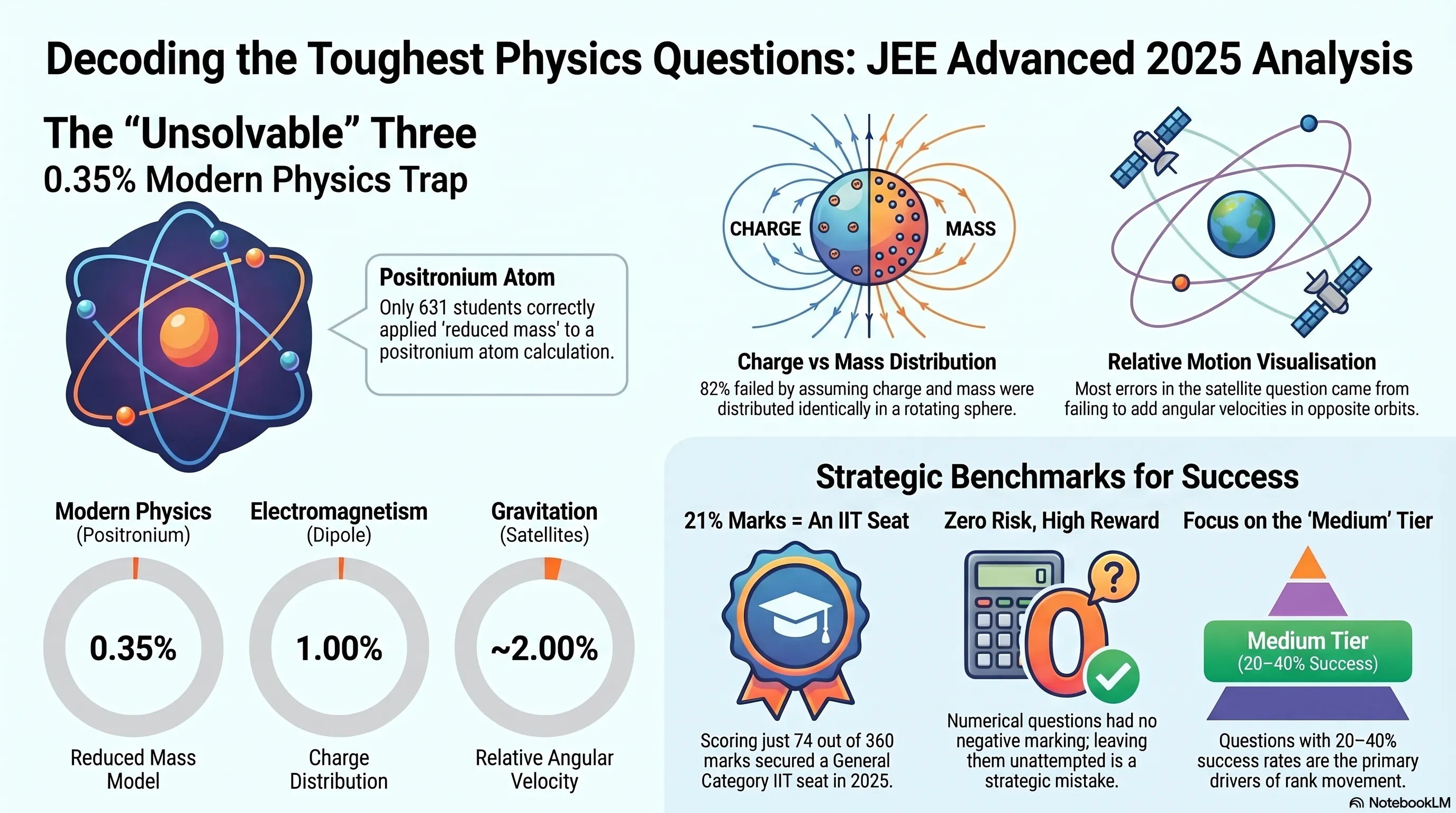
In JEE Advanced 2025 Physics Paper 2, the three toughest questions were solved correctly by only 0.35%, 1%, and 2% of approximately 2.5 lakh students, respectively. The hardest question — on positronium and reduced mass — was solved by just 631 students, and all three tested deep but learnable concepts that serious aspirants can master with the right preparation.


Table of Contents
- The JEE Advanced Data Nobody Talks About
- How Many Marks Do You Actually Need to Crack JEE Advanced?
- Question 1: Positronium and Reduced Mass — Solved by Only 631 Students
- Question 2: Conducting Sphere Magnetic Dipole Moment — The Trap Question
- Question 3: Geostationary Satellite Relative Time Period — Visualisation Problem
- What These 3 Questions Tell Every JEE Aspirant
- How to Prepare for JEE Advanced Physics at This Level

eSaral › JEE › JEE Main ›Explore the 3 toughest Physics questions from JEE Advanced 2025

A structured plan is essential, so follow a proper JEE dropper strategy
The JEE Advanced Data Nobody Talks About
JEE Advanced releases a detailed performance report after every exam. It runs to 1,281 pages. Almost no student reads it — but buried inside is some of the most useful data an aspirant can find: exactly what percentage of students got each question right, wrong, or left it unattempted.
This data changes how you should think about JEE Advanced preparation.
Here is what that data showed for the three toughest questions in JEE Advanced 2025 Physics Paper 2:
| Question | Topic | % Correct | % Wrong | % Unattempted |
|---|---|---|---|---|
| Q1 (Hardest) | Modern Physics — Positronium / Reduced Mass | 0.35% (631 students) | 73% | ~26% |
| Q2 (Second Hardest) | Electromagnetism — Conducting Sphere Dipole Moment | 1% (~1800 students) | 82% | ~17% |
| Q3 (Third Hardest) | Gravitation — Satellite Relative Time Period | ~2% (~3575 students) | High | Moderate |
One important note: Paper 2 also had one bonus question — a rare event in JEE Advanced. When a question is declared a bonus, all students receive full marks for it regardless of their answer.
The marking scheme for these numerical questions was +4 for correct, 0 for incorrect (no negative marking). This is a critical detail — and we will come back to it.
💡 Expert Tip by Saransh Gupta, IIT Bombay AIR-41: "Read the JEE Advanced question-by-question performance data every year. It tells you which concepts are actually tested, which ones trap students, and where the real marks are. Most students never look at this data — that alone is a preparation edge."
How Many Marks Do You Actually Need to Crack JEE Advanced?
Before solving the hard questions, understand what the numbers actually mean for your target rank.
Most students believe JEE Advanced requires scoring very high. The reality is very different.
Based on JEE Advanced 2025 data:
| Target | Marks Required (out of 360) | Percentage |
|---|---|---|
| Last IIT seat (General Category) | 74 marks | ~20–21% |
| AIR 500 (General Category) | ~234 marks | ~63% |
| AIR 1000 | ~200 marks | ~56% |
You read that correctly. A student scoring 74 out of 360 — roughly 1 in 5 questions correct — can get an IIT seat in the General Category. That is how difficult this paper is.
This means two things for your strategy:
- Every question you solve correctly matters enormously. The competition is not about getting everything right — it is about getting more right than the next student.
- The toughest questions are not the ones that decide most ranks. The questions that decide rank are the medium-difficulty ones that 20–40% of students get right. The three questions below are the ones that separate the top 500 from the rest.
Now, let us look at all three.
Question 1: Positronium and Reduced Mass — Solved by Only 631 Students
What Did the Question Ask?
This was a Modern Physics question — and it introduced a concept that had rarely, if ever, appeared in JEE Advanced in the last 20 years: the reduced mass model for positronium.
Here is the problem setup:
A hydrogen atom at rest in the ground state absorbs a photon of frequency μ₁ and ejects an electron with kinetic energy 10 eV. That electron then combines with a positron at rest to form a positronium atom in its ground state — emitting a photon of frequency μ₂ simultaneously. The positronium atom's centre of mass moves with kinetic energy 5 eV. The positron has the same mass as the electron. Find the difference in energies of the two photons: hμ₁ − hμ₂.
Why Did 73% of Students Get It Wrong?
The concept that broke this question open: in positronium, both particles (electron and positron) orbit the centre of mass. This is unlike a normal hydrogen atom,m where the nucleus is effectively stationary.
When two particles of equal mass orbit each other, the standard Bohr model energy formula must be modified using the reduced mass (μ).
Reduced mass: μ = m₁m₂ / (m₁ + m₂)
Since both particles have mass m: μ = m/2
The total energy in the ground state of positronium becomes:
E = −13.6 × (μ/m) = −13.6 × (1/2) = −6.8 eV
Students who used the standard −13.6 eV got the wrong answer. That was the trap.
Step-by-Step Solution
Step 1 — Find hμ₁ (energy of the first photon):
- Ionisation energy of hydrogen from ground state = 13.6 eV
- Kinetic energy of the ejected electron = 10 eV
- Therefore: hμ₁ = 13.6 + 10 = 23.6 eV
Step 2 — Apply energy conservation for the electron–positron system:
Energy in (from the 10 eV electron) = KE of positronium centre of mass + internal energy of positronium atom + energy of emitted photon hμ₂
- KE of centre of mass = 5 eV (given)
- Internal energy (positronium ground state with reduced mass) = −6.8 eV
- Therefore: 10 = 5 + (−6.8) + hμ₂
- hμ₂ = 10 − 5 + 6.8 = 11.8 eV
Step 3 — Find the difference: hμ₁ − hμ₂ = 23.6 − 11.8 = 11.8 eV
JEE Advanced accepted any answer between 11.7 and 11.9.
💡 Expert Tip by Saransh Gupta, IIT Bombay AIR-41: "Reduced mass is not a standard chapter in most coaching syllabi. But it appears at the intersection of Bohr's model and two-body mechanics. Students who had covered this in their rank booster material or advanced modules solved it. The concept is learnable — it just requires going one level deeper than NCERT."

To master real exam patterns, students should practice JEE Advanced previous year questions:
Question 2: Conducting Sphere Magnetic Dipole Moment — The Trap Question
What Did the Question Ask?
This was an Electromagnetism question that looked straightforward — and that is exactly why it trapped the most students.
A conducting solid sphere of radius r, mass m, and charge q rotates about an axis through its centre with uniform angular speed ω. The ratio of magnetic dipole moment to angular momentum on the same axis is given as α/2m. Find α.
Why Did 82% of Students Get It Wrong?
Most students immediately applied the standard formula:
μ/L = q/2m → α = 1
This formula is valid — but only under a specific condition: charge and mass must be distributed in the same region.
For a conducting sphere, all charge moves to the surface. The mass, however, is distributed throughout the volume. So the formula μ/L = q/2m does not hold here directly.
What this question actually asked, without saying it explicitly, was: μ of a hollow sphere / L of a solid sphere.
This is the minute point that eSaral faculty explicitly warned students about when teaching this chapter.
Step-by-Step Solution
Step 1 — Angular momentum of the solid sphere:
L = Iω = (2/5)mr²ω
Step 2 — Magnetic dipole moment of the surface charge (hollow sphere equivalent):
For a hollow sphere with all charge on the surface, μ/L = q/2m. So:
μ_hollow = (q/2m) × L_hollow = (q/2m) × (2/3)mr²ω = qr²ω/3
Step 3 — Calculate the ratio:
μ/L = (qr²ω/3) / (2mr²ω/5) = (q/3) × (5/2m) = 5q/6m = (5/3) × (q/2m)
Step 4 — Find α:
Comparing with α/2m: α = 5/3 ≈ 1.667
JEE Advanced accepted answers between 1.65 and 1.67.
The student who wrote α = 1 because they applied the standard formula without checking the charge distribution condition lost 4 marks on what looked like a simple question.
Question 3: Geostationary Satellite Relative Time Period — Visualisation Problem
What Did the Question Ask?
This Gravitation question was solved by approximately 3,575 students — the "easiest" of the three tough questions. Most errors came from calculation mistakes and failure to visualise the geometry correctly.
A geostationary satellite orbits at radius R₁ with time period T₁ = 24 hours. A second satellite orbits in the opposite direction in the equatorial plane at radius R₂, where R₁ = 1.21 × R₂. Find the time period T that the geostationary satellite observes for the second satellite (given as 24/p hours — find p).
Why Did Students Struggle?
Two failure modes:
- Failing to visualise that opposite-direction orbits mean relative angular velocities add (not subtract)
- Calculation errors with the 1.21 factor
Step-by-Step Solution
Step 1 — Find T₂ using Kepler's Third Law:
T₁²/T₂² = R₁³/R₂³
T₁/T₂ = (R₁/R₂)^(3/2) = (1.21)^(3/2)
Note: 1.21 = (1.1)² → (1.21)^(3/2) = (1.1)³ = 1.331
So T₂ = T₁/1.331 → ω₂ = 1.331 × ω₁
Step 2 — Calculate relative angular velocity:
Since the satellites move in opposite directions, relative angular velocity = ω₁ + ω₂
ω_relative = ω₁ + 1.331ω₁ = 2.331ω₁
Step 3 — Find relative time period:
T_relative = 2π / ω_relative = 2π / (2.331ω₁) = T₁/2.331 = 24/2.331 hours
So p = 2.331, rounded to p = 2.33
JEE Advanced accepted answers between 2.3 and 2.4.
What These 3 Questions Tell Every JEE Aspirant
Three patterns stand out across all three questions:
1. Rare Concepts Are Tested — And They Are Learnable
The positronium question used reduced mass, a concept rarely seen in JEE Advanced in recent years. The conducting sphere question exploited a "minute point" in the μ/L formula. Neither is beyond a well-prepared student. Both are taught in depth in advanced JEE modules. The lesson: go one level deeper than NCERT on every chapter.
2. Numerical Questions With Zero Negative Marking Must Always Be Attempted
The marking scheme was +4 for correct, 0 for wrong, with no negative marks. Yet 26% of students left the hardest question unattempted. Even a rough attempt based on partial understanding costs you nothing and could earn you 4 marks. In a paper where the AIR 500 cutoff was ~234 marks, one extra question correct can move your rank by hundreds of positions.
3. Visualisation Is a Scoring Skill
The satellite question was not harder conceptually than many standard problems. It required students to draw and visualise two satellites orbiting in opposite directions and correctly add their angular velocities. Students who had practised visualisation — building a mental picture before writing equations — solved it. Those who jumped straight to formulas made errors.
| Lesson | Action Point |
|---|---|
| Rare concepts appear | Cover reduced mass, advanced Bohr model, hollow vs solid body moments |
| No negative marking in numerical = always attempt | Write your best estimate, even if unsure |
| Visualisation separates ranks | Draw every problem before solving it |
How to Prepare for JEE Advanced Physics at This Level
What Type of Questions Should You Practice?
The three questions above are representative of JEE Advanced's top difficulty tier. According to the JEE Advanced exam pattern, numerical answer-type questions have appeared consistently with zero negative marking, making attempted-but-wrong answers costless.
To reach this level, your practice must include:
- Chapter-wise JEE Advanced previous year papers — analysed question by question, not just solved
- Rank Booster level problems — these go harder than the exam itself, so the exam feels manageable
- Topic-wise mock tests — to identify which sub-topics are genuinely weak before the final exam
- Visualisation exercises — for every Mechanics, Gravitation, and Electromagnetism problem, draw the physical setup before writing a single equation.
You can access JEE Advanced previous year question papers with solutions to start this analysis yourself.
Which Chapters Produce These Hard Questions Most Often?
Based on multi-year analysis of JEE Advanced Physics paper patterns:
| High-Difficulty Chapter | Rare Concepts to Cover |
|---|---|
| Modern Physics | Reduced mass, positronium, de Broglie at relativistic speeds |
| Electromagnetism | Charge distribution in conductors vs insulators, non-uniform field energy |
| Gravitation | Relative orbital motion, binary systems, tidal effects |
| Mechanics | Non-inertial frames, constraint motion in 3D |
| Optics | Wave optics at boundary conditions, thin film with phase shifts |
💡 Expert Tip by Saransh Gupta, IIT Bombay AIR-41"In JEE Advanced, Paper 2 Physics is consistently harder than Paper 1. The data shows the easiest question in Paper 2 Physics 2025 was only solved by 30% of students. Plan your attempt strategy accordingly — do not spend 15 minutes on a Paper 2 Physics question that may be unsolvable when there are marks available elsewhere."
The JEE Advanced Paper Attempt Strategy Nobody Teaches
Most coaching tells you what to study. Few teach you how to decide what to attempt during the exam.
Here is the decision framework based on score data:
- If a question takes under 3 minutes to read and the approach is clear → attempt immediately
- If the approach is not clear after 2 minutes of reading → mark it, move on, and return later
- For numerical questions with no negative marking → always write your best answer before time is called
- Target the 20–40% difficulty range questions first — these determine most rank movements
This is a skill built through full-length mock tests, not through solving individual problems in a notebook.
Focusing on important Physics chapters can improve scoring efficiency.
Join JEE Dropper Batch Now – Online & Offline Available
Start your focused drop year with structured mentorship, expert faculty, and a proven study system. Choose flexible online learning or classroom coaching, follow a disciplined plan, and maximize your chances of securing a top rank in JEE.
Frequently Asked Questions
Find answers to common questions.
How many students solved the toughest JEE Advanced 2025 Physics questions correctly?
The data from JEE Advanced's official report shows: 631 students (0.35%) solved the hardest question, approximately 1,800 students (1%) solved the second hardest, and approximately 3,575 students (2%) solved the third hardest. These three were the lowest-scoring questions in JEE Advanced 2025 Physics Paper 2.
What is the reduced mass concept tested in JEE Advanced 2025?
Reduced mass applies when two particles of comparable mass orbit each other, like in a positronium atom,m where an electron and positron have equal mass. The reduced mass is μ = m₁m₂/(m₁+m₂). For positronium, this equals m/2, which changes the ground state energy from −13.6 eV (hydrogen) to −6.8 eV. Students who had studied this concept cracked the question; others could not.
How many marks are needed to crack JEE Advanced and get into an IIT?
Based on JEE Advanced 2025 data, the last General Category student to receive an IIT seat scored approximately 74 marks out of 360 — just 20–21%. A rank of AIR 500 required approximately 234 marks (~63%). This shows JEE Advanced is low-scoring by design, and every correctly solved question has a significant impact on rank
Why did 82% of students get the conducting sphere question wrong in JEE Advanced 2025?
Most students applied the standard formula μ/L = q/2m directly, arriving at α = 1. The correct answer was 5/3 ≈ 1.67. The formula μ/L = q/2m only holds when charge and mass are distributed in the same region. In a conducting sphere, all charge moves to the surface while mass remains throughout the volume — making this a hollow sphere dipole moment divided by solid sphere angular momentum problem.
How do I prepare for the toughest JEE Advanced Physics questions?
A: Four steps work best: (1) Study rank-booster level problems for every chapter — these are harder than the actual exam, making JEE Advanced feel manageable. (2) Analyse JEE Advanced previous year papers question by question using official data on what percentage of students got each question right. (3) Practise visualisation — draw every Physics problem before solving it. (4) Cover rare but examinable concepts like reduced mass, non-standard Bohr model applications, and charge distribution in conductors.
What is the JEE Advanced 2025 Physics Paper 2 difficulty level?
JEE Advanced 2025 Physics Paper 2 was significantly harder than Paper 1. The easiest question in Paper 2 was solved by only 30% of students — compared to some Paper 1 questions where 50% of students got full marks. The three toughest questions were solved by fewer than 2% of aspirants each. Overall, the paper tested deep conceptual understanding far beyond standard textbook problems.