JEE Advanced 2026 Electric Dipole Question: Full Solution & Correct Answers
In the JEE Advanced 2026 electric dipole question, a dipole of charge +q and −q (mass m each, separated by distance d) is initially at rest along the x-axis. A uniform electric field E in the j-direction is switched on at t = 0 and switched off at t = t_f, by which time the dipole has rotated to angle θ_f with the x-axis. The correct answers are B and D, derived using energy conservation, rotational mechanics, and the centre-of-mass theorem.

Table of Contents
- What Is the JEE Advanced 2026 Electric Dipole Question?
- Key Concepts Involved in This Question
- How to Read a JEE Advanced Question the Right Way
- Step-by-Step Solution: Option A — Centre of Mass Displacement
- Step-by-Step Solution: Option B — Finding Angular Velocity ω
- Step-by-Step Solution: Option C — Kinetic Energy at θ_f = π/3
- Step-by-Step Solution: Option D — Motion After Electric Field Is Switched Off
- Final Answer and Concept Map

eSaral › JEE › JEE Main ›JEE Advanced 2026 Electric Dipole Question

🚀 Checkout eSaral Courses
What Is the JEE Advanced 2026 Electric Dipole Question?
This multiple-choice question from JEE Advanced 2026 is based on the behaviour of an electric dipole placed in a uniform electric field. It tests four chapters simultaneously — a hallmark of JEE Advanced's design philosophy.
Here is the exact setup:
| Parameter | Value |
|---|---|
| Charges on dipole | +q and −q |
| Mass of each charge | m |
| Separation between charges | d |
| Initial position | Origin (x = 0), at rest |
| Initial orientation | Along î (x-axis) |
| Electric field applied | E ĵ (y-direction), switched on at t = 0 |
| Electric field switched off | At t = t_f |
| Angle made at t = t_f | θ_f with the x-axis |
The question asks which of the four options (A, B, C, D) is correct.
Key Concepts Involved in This Question
This single question requires mastery of four major chapters:
1. Electrostatics — Electric Dipole in a Field
When an electric dipole of moment p is placed in a uniform electric field E, it experiences:
- Torque: τ = p × E (magnitude = pE sinθ)
- Potential Energy: U = −p · E = −pE cosθ
- Net Force = 0 (in a uniform field)
2. Work, Power & Energy — Energy Conservation
To find the angular velocity ω at any angle, we apply conservation of mechanical energy:
Initial KE + Initial PE = Final KE + Final PE
3. Rotational Mechanics — Moment of Inertia
The dipole rotates about its centre of mass. Since both charges have equal mass m and each is at a distance d/2 from the centre:
I = 2 × m(d/2)² = md²/2
4. Centre of Mass — System Motion
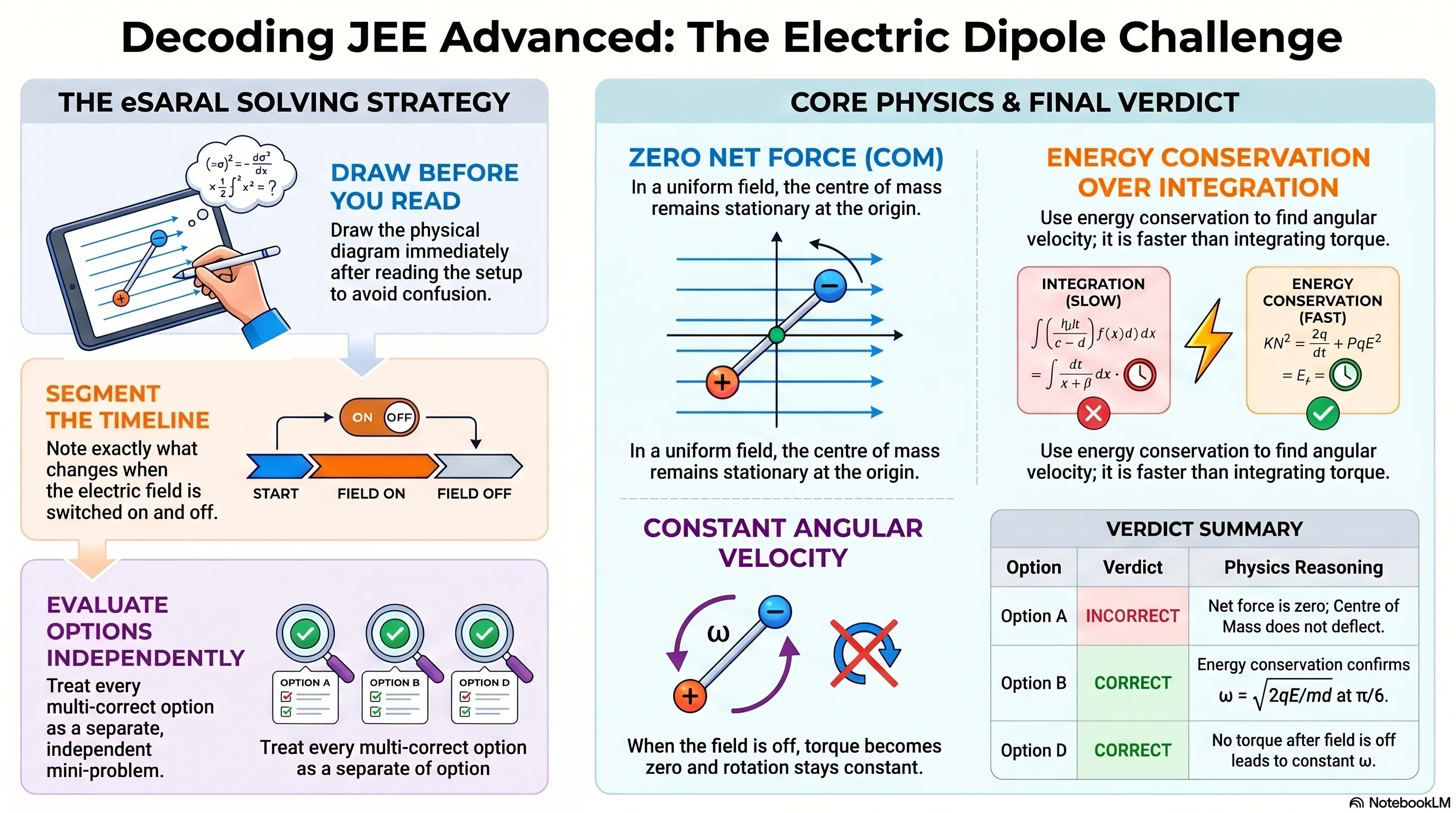
In a uniform electric field, the net force on the dipole system is zero (+qE and −qE cancel). Therefore, the centre of mass does not move — it only rotates about its own position.
How to Read a JEE Advanced Question the Right Way
Reading a JEE Advanced question is itself a skill. Here is a structured approach used in eSaral's live sessions:
Step 1 — Read up to the physical setup, then stop. After reading "dipole of +q, −q, mass m, separation d, initially at rest, along î direction", stop. Draw the figure. The dipole moment p = qd î.
Step 2 — Note what changes with time. At t = 0: field E ĵ is switched on. Between t = 0 and t = t_f: torque acts, dipole rotates. At t = t_f: field is switched off. After t_f: no torque.
Step 3 — Evaluate each option as a mini-problem. Never read all four options together. Each option is a separate sub-question. Treat it that way.
This is how eSaral trains students to approach every JEE Advanced paragraph-based or multi-correct question in every class — not just for this problem.
Step-by-Step Solution: Option A — Centre of Mass Displacement
Option A states: The centre of mass of the dipole is deflected towards ĵ (y-direction) in the presence of the electric field.
Is This Correct?
Ask one simple question: What is the net force on the dipole system?
- Force on +q: F₁ = +qEĵ (upward)
- Force on −q: F₂ = −qEĵ (downward)
- Net force = F₁ + F₂ = 0
By Newton's second law for the centre of mass: F_net = Ma_cm
Since F_net = 0, acceleration of centre of mass = 0. The centre of mass does not move — it stays at the origin.
Option A is INCORRECT. ✗
Step-by-Step Solution: Option B — Finding Angular Velocity ω
Option B states: If the magnitude of the final angular velocity is a specific expression, then θ_f = π/6.
Setting Up Energy Conservation
At t = t_f, the dipole has rotated from θ = 0 (along x-axis) to θ = θ_f. Apply energy conservation:
Initial State (t = 0):
- KE_initial = 0 (dipole at rest)
- PE_initial = −pE cos(angle between p and E)
Here, p is along î and E is along ĵ. The angle between them = 90°.
PE_initial = −pE cos 90° = 0
Final State (t = t_f):
The angle between p and E at time t_f is (90° − θ_f), not θ_f. This is a common error students make.
🚨 Critical mistake to avoid: Students often write cos θ_f for the final PE. The correct angle between the dipole vector and E-field vector is (90° − θ_f). So cos(90° − θ_f) = sin θ_f.
- PE_final = −pE sin θ_f = −qd · E · sin θ_f
- KE_final = ½Iω² = ½ · (md²/2) · ω²
Energy Conservation Equation
0 + 0 = −qEdsinθ_f + ½ · (md²/2) · ω²

½ · (md²/2) · ω² = qEd sinθ_f

ω² = 4qE sinθ_f / (md)

ω = √(4qE sinθ_f / md)
Checking Option B
Option B gives a specific value of ω and says θ_f = π/6.
Substituting θ_f = π/6: sin(π/6) = 1/2
ω = √(4qE · (1/2) / md) = √(2qE / md)This exactly matches the expression given in Option B.
Option B is CORRECT. ✓
Step-by-Step Solution: Option C — Kinetic Energy at θ_f = π/3
Option C states: When θ_f = π/3, the kinetic energy equals a specific value (given in the options).
Calculating KE at θ_f = π/3
From the energy conservation derived above:
KE = qEd sinθ_fAt θ_f = π/3: sin(π/3) = √3/2
KE = qEd · (√3/2) = (√3/2) · qEdNow check whether Option C gives this value. The value given in Option C does not equal (√3/2)qEd.
Option C is INCORRECT. ✗
Step-by-Step Solution: Option D — Motion After Electric Field Is Switched Off
Option D states: If θ_f = π/4, the dipole rotates about its centre of mass with constant angular velocity after t > t_f.
What Happens When E is Switched Off?
At t = t_f:
- The electric field is set to zero: E = 0
- Torque = pE sinθ = p · 0 = 0
- Angular acceleration α = τ/I = 0
Since α = 0, the angular velocity ω that existed at t = t_f remains constant for all t > t_f.
The dipole continues to rotate about its centre of mass with the same ω it had at the moment the field was switched off.
This is exactly what Option D describes.
Option D is CORRECT. ✓
Final Answer and Concept Map
✅ Correct Options: B and D
| Option | Statement | Verdict | Reasoning |
|---|---|---|---|
| A | Centre of mass deflects towards ĵ | ✗ Incorrect | Net force on dipole = 0 in uniform field; COM does not move |
| B | ω = √(2qE/md) when θ_f = π/6 | ✓ Correct | Energy conservation gives ω = √(4qE sinθ_f / md); verified |
| C | KE = [given value] when θ_f = π/3 | ✗ Incorrect | Actual KE = (√3/2)qEd, doesn't match option |
| D | Constant ω after field is off (θ_f = π/4) | ✓ Correct | τ = 0 after E = 0, so α = 0, ω = constant |
Chapters Used in This Question
- Electrostatics — dipole moment, torque, PE in electric field
- Work, Power & Energy — energy conservation for rotation
- Rotational Mechanics — moment of inertia, angular velocity, angular acceleration
- Centre of Mass — COM motion requires a net external force
This question is a masterclass in multi-concept integration — the defining trait of JEE Advanced. If you have been preparing with eSaral, every one of these concepts has been covered at this exact level in class.
🚀 Checkout eSaral Courses
Frequently Asked Questions
Find answers to common questions.
What is the net force on an electric dipole in a uniform electric field?
The net force on an electric dipole in a uniform electric field is zero. The forces on the +q and −q charges are equal in magnitude but opposite in direction, so they cancel. This means the centre of mass of the dipole does not translate — it can only rotate about its own position under the action of a torque.
How do you find the angular velocity of a dipole rotating in an electric field?
Use energy conservation. Set initial KE + initial PE equal to final KE + final PE. For a dipole starting at rest with p perpendicular to E, initial energy is zero. At angle θ_f, the PE is −pE sin θ_f and KE = ½Iω². Solving gives ω = √(4qE sinθ_f / md) for a two-charge dipole with total moment of inertia I = md²/2.
What happens to an electric dipole after the electric field is switched off?
When the electric field is switched off, the torque on the dipole immediately becomes zero. With zero torque, angular acceleration becomes zero. The dipole continues rotating at whatever constant angular velocity it had at the instant the field was removed, rotating uniformly about its centre of mass indefinitely (assuming no friction or resistance).
What is the moment of inertia of an electric dipole about its centre of mass?
For a dipole with two equal masses m separated by distance d, each mass is at d/2 from the centre. Moment of inertia I = 2 × m(d/2)² = md²/2. This value is used in kinetic energy calculations: KE = ½Iω² = md²ω²/4.
Why is the angle between dipole and electric field (90° − θ_f) and not θ_f in this JEE Advanced 2026 question?
The dipole is initially along the x-axis (î direction) and the electric field is along the y-axis (ĵ direction). When the dipole rotates by θ_f from the x-axis, the angle between the dipole vector and the E-field vector becomes (90° − θ_f), not θ_f. This is the most common error in this question — writing PE = −pE cosθ_f instead of −pE cos(90° − θ_f) = −pE sinθ_f.